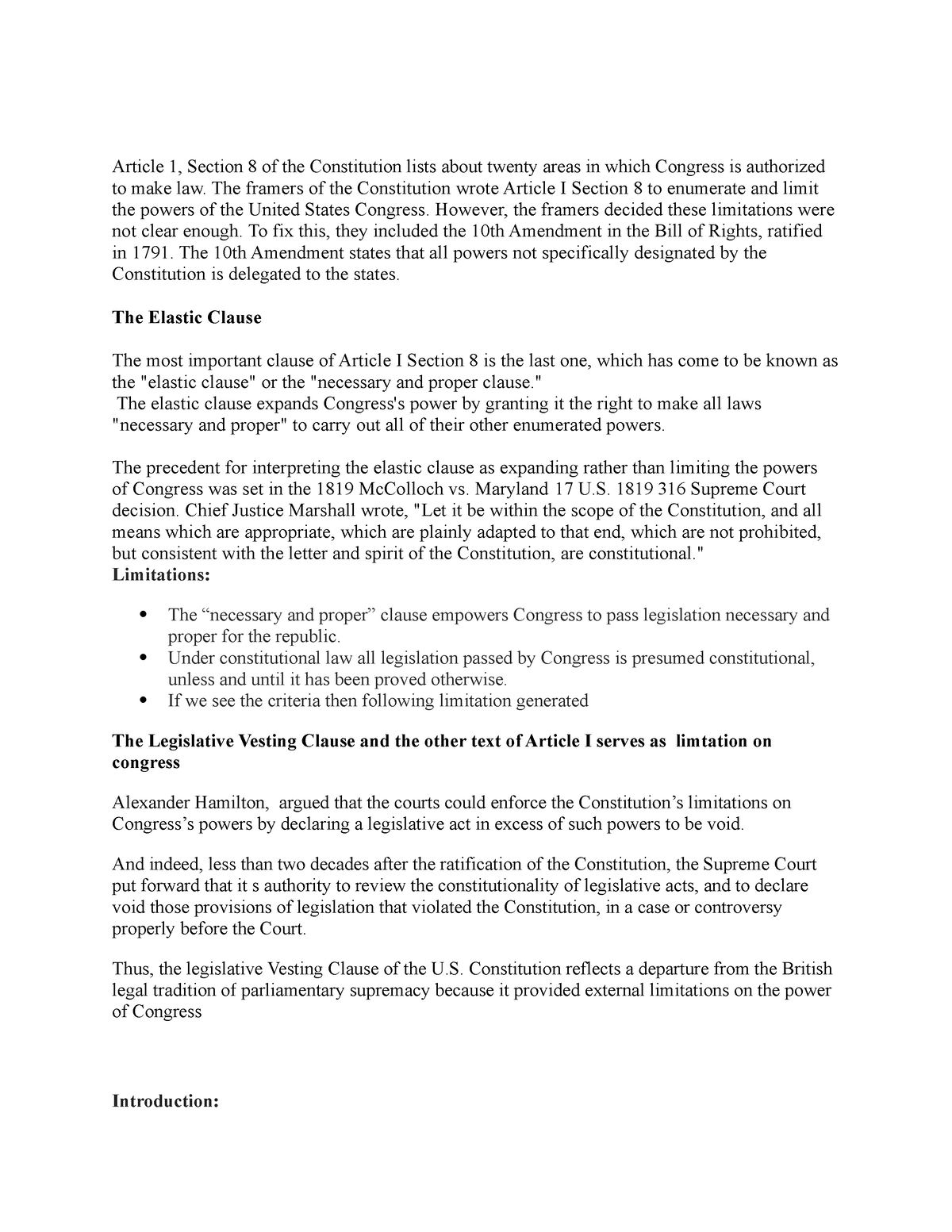
Article 1 Section 8 Clause 11 of the U.S. Constitution—commonly known as the Declare War Clause—does not provide explicit authority for federal arts funding; rather, federal support for arts and culture relies primarily on the General Welfare Clause in Clause 1 of the same article. Understanding how the federal government finances creative and cultural initiatives requires examining the boundaries of constitutional enumerated powers, the mechanics of congressional appropriations, and the complex legal history of public arts support.
Constitutional Architecture: Enumerated Powers and the Spending Power
To understand federal involvement in the arts, one must first examine the framework established by Article I, Section 8 of the United States Constitution. This section outlines the specific, enumerated powers granted to Congress. Among these are the power to regulate commerce, coin money, establish post offices, and—crucially for national security and foreign policy—the power addressed in Clause 11:
"To declare War, grant Letters of Marque and Reprisal, and make Rules concerning Captures on Land and Water."
Clause 11 focuses strictly on military powers and the orchestration of armed conflict. It contains no language concerning cultural preservation, aesthetic development, theatrical performance, or public education. Consequently, scholars and legal historians agree that Article 1 Section 8 Clause 11 provides no direct constitutional basis for funding the arts.
Instead, when Congress appropriates funds for cultural agencies such as the National Endowment for the Arts (NEA) or the National Endowment for the Humanities (NEH), it operates under the authority granted by Article 1, Section 8, Clause 1—frequently referred to as the Taxing and Spending Clause. This clause empowers Congress:
"To lay and collect Taxes, Duties, Imposts and Excises, to pay the Debts and provide for the common Defence and general Welfare of the United States..."
The Supreme Court has long interpreted the General Welfare Clause as granting Congress broad discretion in deciding how to spend tax revenues, provided the spending serves a national public purpose and does not violate other constitutional provisions, such as the First Amendment.
The Distinction Between Military Powers (Clause 11) and Cultural Spending
While Clause 11 is entirely unrelated to civilian arts funding, it is helpful to understand how military powers and cultural expression occasionally intersect within federal law. Governments throughout history have utilized creative works, architecture, and public monuments to bolster national morale during wartime, document military campaigns, or memorialize fallen service members.
Even during periods governed by the war powers of Clause 11, federal funding directed toward creative expression—such as wartime propaganda posters produced by the Division of Pictorial Publicity during World War I or the Office of War Information during World War II—was justified under emergency executive powers and general wartime appropriations rather than any direct interpretation of the Declare War Clause itself.
The following table contrasts the specific domains of Article 1, Section 8, Clause 1 and Clause 11 to clarify their distinct constitutional functions:
| Constitutional Provision | Primary Subject | Scope of Authority | Relevance to Arts Funding |
|---|---|---|---|
| Article 1, Section 8, Clause 1 (Taxing & Spending) | Taxation, national debt, and the "general welfare" | Broad discretionary authority to allocate federal tax revenues for national public purposes. | Directly relevant. Serves as the primary constitutional vehicle for funding the NEA, NEH, and public broadcasting. |
| Article 1, Section 8, Clause 11 (War Powers) | Declaring war, letters of marque, and military captures | Exclusive congressional authority to initiate formal warfare and govern wartime rules of capture. | Not relevant. Contains no provisions for cultural, artistic, or civic subsidy outside of incidental wartime documentation. |
Historical Evolution of Federal Arts Support
Federal involvement in the arts did not begin with a permanent agency. For much of American history, public funding for culture was ad hoc, typically taking the form of commissions for Capitol artwork, monuments, or funding for international expositions.
The New Deal and the Federal Project Number One
The most expansive early effort to fund arts and culture occurred during the Great Depression. Under the Works Progress Administration (WPA), the federal government established Federal Project Number One (Federal One). This program directly employed artists, musicians, actors, and writers. While the primary immediate goal was economic relief for struggling professionals, the resulting murals, theatrical productions, and historical guides fundamentally shaped the American cultural landscape.
Legally, WPA programs relied on emergency relief appropriations enacted pursuant to the spending power, bypassing any need to stretch military clauses or other non-relevant provisions of Article I.
Establishment of the National Endowment for the Arts (1965)
Public debate persisted for decades over whether the federal government should permanently patronize the arts. Proponents argued that a great nation must support its cultural infrastructure, while critics raised concerns about government overreach, federal censorship, and the use of taxpayer funds for controversial works.
In 1965, Congress resolved this debate by passing the National Foundation on the Arts and the Humanities Act, signed into law by President Lyndon B. Johnson. This legislation established the National Endowment for the Arts (NEA) and the National Endowment for the Humanities (NEH) as independent federal agencies.
- Statutory Purpose: To promote public access to excellence in the arts, support individual creators and nonprofit organizations, and foster cultural education across all states and territories.
- Funding Mechanism: Annual congressional appropriations distributed through grants, which require matching funds from non-federal sources to leverage private support.
Legal and Policy Challenges to Federal Arts Funding
Because federal arts funding rests on the flexible framework of the Spending Clause rather than explicit textual commands like Clause 11, it has frequently faced legal scrutiny and political debate.
First Amendment and Content Neutrality
When the government distributes funds to artists and cultural institutions, questions inevitably arise regarding free speech. In the late 20th century, controversies surrounding NEA grants awarded to works by artists like Robert Mapplethorpe and Andres Serrano led to congressional battles over decency standards.
In the landmark case National Endowment for the Arts v. Finley (1998), the U.S. Supreme Court upheld the constitutionality of a statute requiring the NEA to consider "general standards of decency and respect for the diverse beliefs and values of the American public" when evaluating grant applications. The Court ruled that while the government cannot censor private speech, it has wide latitude in setting criteria when it acts as a patron and subsidizer of the arts, provided the restrictions do not constitute invidious viewpoint discrimination.
Tenth Amendment and Federalism
Critics of federal arts funding occasionally invoke the Tenth Amendment—which reserves powers not delegated to the United States by the Constitution to the states or to the people—arguing that culture and education are traditionally local matters. However, under established modern jurisprudence regarding the Spending Clause, Congress may incentivize states and private entities to pursue national policy goals through conditional funding, provided the conditions are not coercive. Consequently, federal arts grants distributed to state arts agencies remain constitutionally secure.
Frequently Asked Questions
Does Article 1 Section 8 Clause 11 mention the arts?
No. Clause 11 is strictly dedicated to the power of Congress to declare war, grant letters of marque and reprisal, and make rules concerning captures on land and water. It contains no language regarding artistic, cultural, or educational funding.
Which part of the Constitution authorizes federal funding for agencies like the NEA?
Federal funding for cultural agencies relies on Article 1, Section 8, Clause 1, known as the Taxing and Spending Clause. This clause allows Congress to collect taxes and spend revenue to provide for the "general welfare" of the United States.
Can Congress defund the National Endowment for the Arts?
Yes. Funding for the NEA and NEH is not permanently mandated by constitutional text; it is subject to annual congressional appropriations. Congress has the constitutional authority to increase, decrease, or eliminate funding for these agencies during the yearly federal budget cycle.
Do state governments have their own constitutional provisions for the arts?
Many state constitutions or statutes establish state arts councils and provide dedicated revenue streams for cultural preservation. These state-level initiatives operate independently of federal authority under the police powers reserved to the states.
Conclusion and Next Actions
Federal arts funding is a creature of statutory law and broad fiscal discretion rooted in the Spending Clause, entirely separate from the military and wartime provisions of Article 1 Section 8 Clause 11. For researchers, legal analysts, and advocates examining the intersection of government and culture, verifying the correct constitutional mechanism prevents common misallocations of legal arguments. To explore current funding mechanisms, statutory guidelines, and grant opportunities, consult the official legislative texts hosted on Congress.gov or review administrative guidelines directly through the National Endowment for the Arts.