In Arizona, workers’ compensation rates for the construction industry are determined by the National Council on Compensation Insurance (NCCI) classification codes, which reflect the specific risk profile of various trades. Premiums are calculated based on these codes, an employer’s payroll, and an experience modification factor, ensuring that businesses in high-risk sectors contribute appropriately to the statewide insurance pool.
Understanding the Regulatory Framework in Arizona
The Industrial Commission of Arizona (ICA) oversees the administration of the state’s workers’ compensation system. Unlike states that utilize a government-run monopolistic fund, Arizona operates as a competitive insurance market. This means that private insurance carriers provide coverage, competing based on service, financial stability, and pricing, albeit within a framework of regulated rates.
Construction is classified by the NCCI as one of the most high-risk sectors, largely due to the physical nature of the work, the use of heavy machinery, and the hazards associated with heights, excavation, and electrical systems. Consequently, employers in this sector generally face higher premium rates compared to industries such as retail or professional services. It is essential for business owners to understand that their "base rate" is not a static number; it is a dynamic figure that adjusts based on the collective loss experience of all employers within a specific classification code.
The Role of NCCI Classification Codes
The NCCI system uses specific numerical identifiers to categorize workers based on the primary job functions performed. In the construction industry, these codes are granular to account for the varying levels of danger associated with different crafts. For instance, a roofing contractor faces a significantly different risk profile than a cabinet installer or a general foreman.
Employers must accurately categorize their employees under the correct code. Misclassification is a frequent source of premium audits and legal friction. If an employer incorrectly lists high-risk employees under a lower-risk classification code to save on premiums, they are effectively engaging in premium fraud. Conversely, over-classifying can lead to excessive costs that hinder a firm's competitiveness in bidding for contracts.
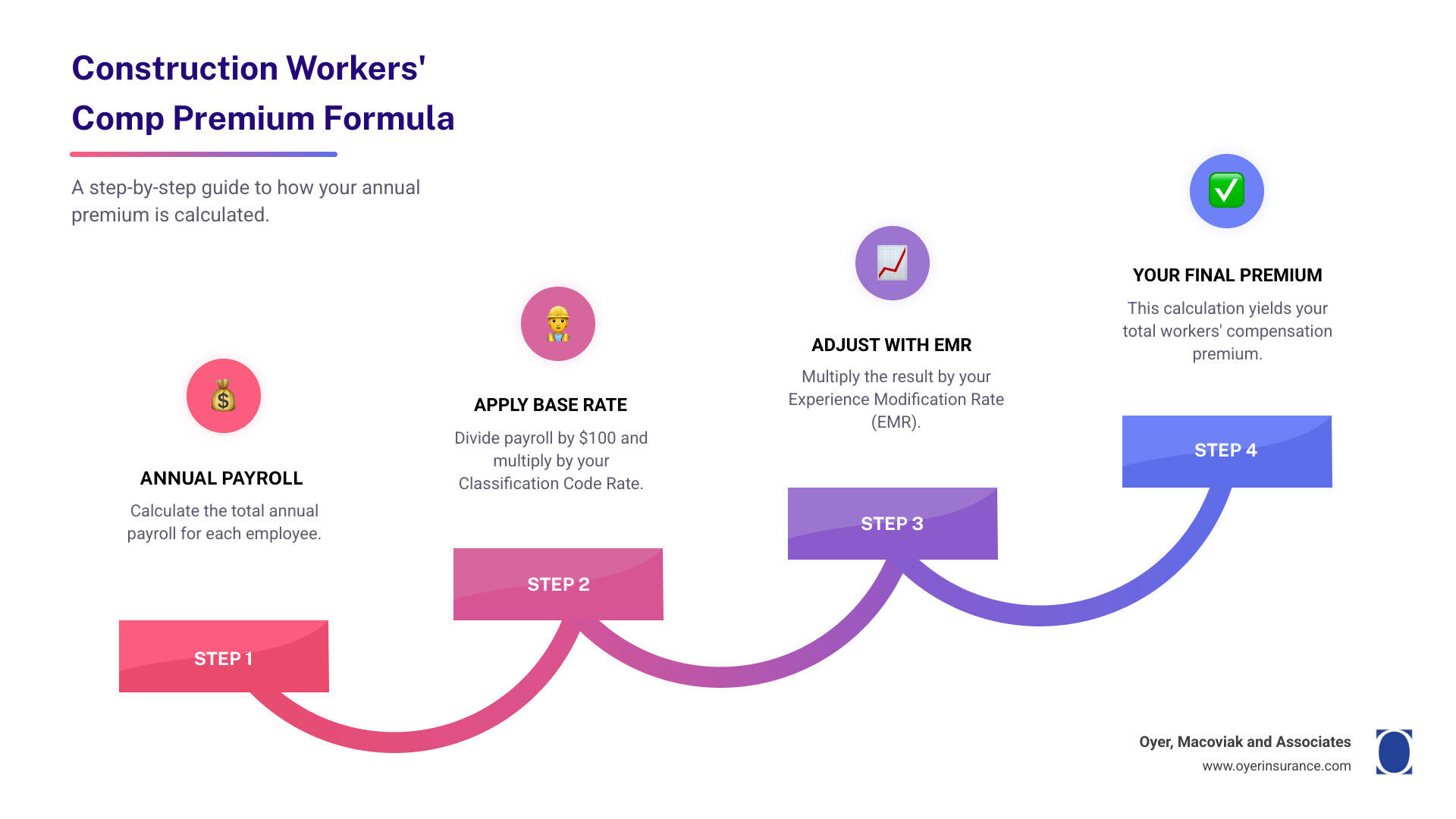
The premium calculation formula is generally structured as follows: (Payroll per $100 units) × (Classification Base Rate) × (Experience Modification Factor) = Annual Premium.
The Experience Modification Factor (Ex-Mod)
Perhaps the most significant tool an Arizona construction employer has to control their workers’ compensation rates is the Experience Modification Factor, commonly referred to as the "Ex-Mod." This factor acts as a multiplier, either increasing or decreasing the base premium based on the company’s individual safety history compared to the industry average.
- Neutral (1.0): An Ex-Mod of 1.0 indicates that your company’s safety record is exactly on par with the industry average.
- Credit (Below 1.0): If your firm has fewer or less severe accidents than expected, you receive a "credit mod," which reduces your annual premium costs.
- Debit (Above 1.0): If your firm has an above-average frequency or severity of injury claims, you are assigned a "debit mod," which significantly increases your annual premium.
In the construction industry, where base rates are already high, a debit modification can represent an enormous financial burden, potentially pricing a contractor out of the market. Therefore, investing in a robust safety program is not merely a legal or ethical obligation; it is a critical fiscal strategy.
Factors Influencing Rate Variability
Beyond the NCCI codes and the Ex-Mod, several external and internal factors influence the final cost of coverage in Arizona. Insurance carriers in the private market may apply "schedule credits" or "debits" to a policyholder’s premium based on their perception of the company’s management quality.
- Safety Culture: Carriers evaluate whether a company has a written safety program, conducts regular "toolbox talks," and provides adequate personal protective equipment (PPE). A company with a demonstrable commitment to safety is a preferred risk.
- Return-to-Work Programs: A well-structured return-to-work program that offers light-duty assignments to injured employees can substantially reduce the cost of claims. By getting employees back to work in a modified capacity, companies lower the indemnity payments insurers must make, which in turn preserves a better Ex-Mod.
- Employee Turnover: High turnover in construction often leads to an influx of inexperienced workers. Statistically, new or inexperienced workers are more prone to injury. Carriers often view stable workforces as lower risks.
Comparing Risks by Trade Segment
To illustrate the disparity in risk, the following table highlights how different construction roles are generally perceived within the insurance market. Note that actual rates change annually based on NCCI filings and carrier-specific adjustments.
| Construction Trade | Relative Risk Profile | Common Coverage Challenges |
|---|---|---|
| Roofing (Commercial) | Very High | Frequent falls and high-altitude hazards. |
| Masonry | Moderate to High | Back injuries and repetitive strain. |
| Carpentry (Structural) | High | Sharp tool usage and structural collapse risks. |
| Electrical Work | Moderate | Arc flash hazards and high-voltage exposure. |
| Plumbing (Interior) | Low to Moderate | Minor cuts and slips, fewer catastrophic events. |
| Concrete Paving | Moderate | Heavy machinery operation and silica exposure. |
The Impact of Payroll Audits
Because workers' compensation premiums are based on payroll, carriers conduct mandatory audits at the end of every policy term. These audits verify that the reported payroll matches the actual amount paid to employees. In the construction industry, where subcontractors are common, auditors pay special attention to certificates of insurance (COI).
If a general contractor hires a subcontractor who does not carry their own workers’ compensation insurance, the general contractor may be held responsible for the subcontractor's employees' injuries. In such cases, the insurer will add the subcontractor’s payroll to the general contractor's audit, resulting in a retroactive increase in premiums. Maintaining a strict "No COI, No Work" policy is the standard professional approach to avoiding these unexpected liabilities.
Legal Requirements and Compliance
Under Arizona law, virtually every employer who hires one or more employees is required to carry workers’ compensation insurance. For the construction industry, this requirement is strictly enforced. The Industrial Commission of Arizona maintains that failure to provide coverage can lead to severe civil and criminal penalties, including "stop-work" orders that halt all operations on a project site.
Beyond legal compliance, providing coverage is the primary mechanism that shields the employer from civil lawsuits regarding workplace injuries. This is known as the "exclusive remedy" doctrine. By providing workers' compensation, the employer generally avoids being sued by the employee for negligence, provided the injury occurred within the scope of employment.
Troubleshooting High Premiums
If a business is facing prohibitive workers’ compensation rates, the immediate response should be a "gap analysis." First, review the NCCI class codes assigned to your operations. Ensure they are the most accurate descriptions of your work. If your business has diversified—for example, a masonry company that has moved into general contracting—ensure the payroll is split correctly between the codes.
Second, engage with a professional insurance broker who specializes in the construction industry. They can perform an "experience mod audit" to check for clerical errors in the history of claims reported by your insurer. It is not uncommon for old, closed, or miscalculated claims to persist on a record, artificially inflating the modification factor.
Third, verify your safety documentation. Many insurance carriers offer safety credits if the employer can demonstrate specific loss-control measures, such as mandatory site-specific safety training or the use of automated machinery that removes workers from the line of fire.
Next Steps for Arizona Contractors
Business owners should start by conducting a comprehensive review of their current insurance policy declarations page. Identify the specific classification codes being used and compare them against the work actually being performed on current project sites. If you have concerns about your current rate, contact your insurance agent to request a "loss control visit." Most major carriers will send a safety specialist to your site to identify potential hazards and provide recommendations on how to lower your risk profile. Finally, ensure that your administrative team is tracking and verifying all subcontractor certificates of insurance before any new project begins to mitigate the risk of "audit surprise" costs.