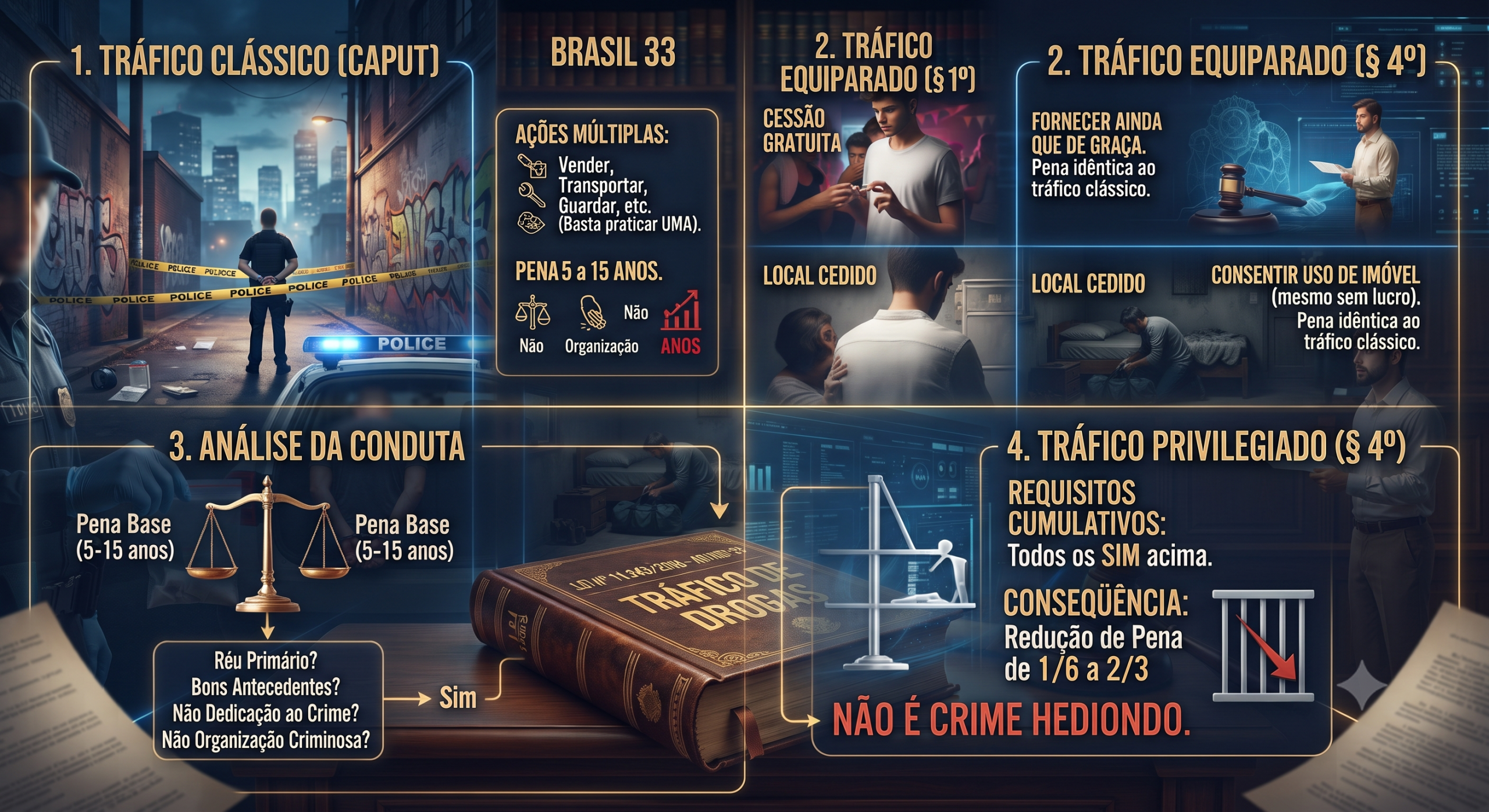
Artigo 33 of Law 11.343/2006 is the primary statute in Brazil defining drug trafficking. It prohibits 18 distinct actions, such as selling, transporting, or storing illicit substances. Conviction carries a penalty of 5 to 15 years in prison, alongside substantial fines, though sentences may be reduced for first-time offenders under specific "privileged" conditions.
In the Brazilian legal system, Artigo 33 (Article 33) serves as the cornerstone of the "Lei de Drogas" (Drug Law). While it is often associated simply with "selling drugs," the legal reality is far more complex. The law is designed as a "multiple type" or "alternative mixed" crime, meaning that performing any one of the eighteen listed actions—or multiple actions in a single context—constitutes the same crime. As of 2026, legal interpretation of this article has been significantly refined by Supreme Court (STF) precedents, particularly regarding the distinction between traffickers and users.
The 18 Conducts: What Constitutes Trafficking?
The legal definition of trafficking under Artigo 33 is remarkably broad. It does not require a commercial transaction (money changing hands) for a crime to occur. The law lists 18 specific verbs (conducts) that trigger the application of the statute. Understanding these is vital for anyone analyzing a police report or legal indictment.
Core Conducts of Distribution and Sale
The most common applications of Artigo 33 involve the direct movement and sale of substances. These include:
- Importing and Exporting: Bringing substances into Brazil or sending them abroad.
- Selling and Offering: Even if the "offer" is not accepted, the crime is technically consummated.
- Exposing for Sale: Having drugs visible in a retail-like environment.
- Delivering and Supplying: Providing drugs to another person, even for free (gratuitously).
Storage and Logistics
Many arrests under Artigo 33 occur without the suspect ever being caught "selling." These logistical conducts are equally punishable:
- Having in Deposit (Ter em depósito): Keeping drugs in a warehouse, home, or locker.
- Transporting and Carrying (Trazer consigo): Moving drugs from one location to another or having them on one's person.
- Storing: Specifically keeping drugs for future use or distribution.
- Prescribing or Dispensing: This applies to professionals (like pharmacists or doctors) who deviate from legal requirements to provide controlled substances.
Production and Preparation
Artigo 33 also covers the "upstream" portion of the drug trade:
- Producing and Manufacturing: Creating the final product.
- Preparing: Cutting, mixing, or packaging substances for consumption.
- Extracting and Transforming: Converting raw materials (like coca leaves) into refined products.
Because Artigo 33 is an alternative mixed type crime, if a person "prepares," "stores," and then "sells" the same batch of drugs, they are charged with a single count of trafficking, not three separate crimes. However, the intensity and variety of the conducts will influence the judge’s final sentencing.
Penalties and Financial Consequences in 2026
The statutory penalty for Artigo 33 is severe, reflecting its classification as a "heinous-equivalent" crime (equiparado a hediondo) under the Brazilian Constitution.
Imprisonment (Reclusão)
The base sentence ranges from 5 to 15 years. In the Brazilian penal system, a 5-year sentence often starts in a semi-open regime (where the inmate may work during the day), but aggravating factors or a total sentence exceeding 8 years typically mandate an initial closed regime (maximum security).
The "Dias-Multa" (Fine Days) System
In addition to prison time, Artigo 33 imposes heavy financial penalties. The law stipulates a fine of 500 to 1,500 "fine-days."
- The judge first determines the number of days (e.g., 500 for a minor role, 1,500 for a major leader).
- The judge then determines the value of each "day," which can range from 1/30th of the current minimum wage to 5 times the minimum wage, depending on the defendant's documented wealth.
In 2026, these fines often reach hundreds of thousands of Reais, making the financial burden of a trafficking conviction nearly as significant as the loss of liberty.
The "Privileged" Trafficking Clause (Art. 33, § 4º)
One of the most litigated aspects of the Drug Law is the Tráfico Privilegiado (Privileged Trafficking). This is not a separate crime but a sentence reduction clause designed to distinguish "small-time" or "one-off" offenders from professional criminals.
To qualify for a reduction of one-sixth to two-thirds of the sentence, the defendant must satisfy four cumulative requirements:
- Primary Offender Status: The individual must not have any prior criminal convictions (reincidência).
- Good Criminal Record: Beyond just being a first-timer, the defendant must not have a history of criminal behavior.
- No Connection to Criminal Organizations: The defendant cannot be a member of groups like the PCC or CV.
- No Dedication to Criminal Activities: The court must be convinced that the defendant does not make a living through crime.
If these criteria are met, a 5-year sentence can be reduced to 1 year and 8 months. In many cases, this allows the judge to substitute the prison sentence with community service or "restrictive rights" punishments, provided the final sentence is under 4 years.
Distinguishing Between Artigo 33 (Trafficker) and Artigo 28 (User)
The most critical legal battleground in Brazil is the distinction between Artigo 33 (Trafficking) and Artigo 28 (Possession for Personal Use). Artigo 28 carries no prison time, focusing instead on educational measures and community service.
Following a landmark Supreme Court (STF) decision in 2024, which remains the standard in 2026, there are objective criteria for this distinction, particularly regarding cannabis.
The 40-Gram Standard
For Cannabis sativa, the STF established a "relative presumption" that individuals carrying up to 40 grams or cultivating up to 6 female plants are users (Artigo 28). However, this is not an absolute "pass." Police and prosecutors can still argue for Artigo 33 if there is evidence of trafficking, such as:
- The presence of precision scales.
- Drugs divided into many small, individual packages.
- The presence of large amounts of cash in small denominations.
- Logbooks or cell phone messages indicating sales.
For other substances like cocaine or synthetic drugs, there is no fixed grammage established by the STF, and judges rely on the "circumstances of the arrest" (nature of the substance, location, and the suspect's behavior) as dictated by § 2º of Article 28 of Law 11.343/2006.
Equated Conducts and Specific Increases
Artigo 33 also includes paragraphs that expand its reach to secondary actors and specific scenarios.
Article 33, § 1º: Equated Conducts
This section punishes actions that facilitate trafficking with the same 5-to-15-year penalty. This includes:
- Providing raw materials or chemicals used for drug production.
- Utilizing or permitting the use of property (a house, farm, or boat) for drug trafficking.
- Selling "legal" substances (like ether or acetone) when the seller knows they are destined for drug manufacturing.
Sentences Increases (Artigo 40)
Sentences for Artigo 33 can be increased by one-sixth to two-thirds if specific aggravating factors are present:
- Transnationality: If the drug crossed international borders.
- Interstate Trafficking: If the drug moved between Brazilian states.
- Public Places: If the crime occurred near schools, hospitals, or prisons.
- Involving Children: If the defendant used minors to assist in the crime.
- Violence or Threat: If the trafficking involved the use of firearms or intimidation.
| Category | Legal Statute | Typical Penalty | Regime Potential |
|---|---|---|---|
| Standard Trafficking | Artigo 33, caput | 5 to 15 Years | Closed / Semi-open |
| Privileged Trafficking | Artigo 33, § 4º | 1y 8m to 5 Years | Semi-open / Open / Service |
| Possession for Use | Artigo 28 | None (Educational) | Community Service / Warning |
| Drug Association | Artigo 35 | 3 to 10 Years | Often added to Art. 33 |
| Equipment/Machinery | Artigo 34 | 3 to 10 Years | Possession of lab equipment |
Common Defense Strategies and Procedural Rights
In the Brazilian legal system, the defense against an Artigo 33 charge often focuses on the nullity of evidence or the reclassification of the crime.
Search and Seizure Issues
A significant portion of trafficking cases in 2026 are dismissed due to "home invasion" issues. According to the STJ (Superior Court of Justice), police cannot enter a home without a warrant unless there is "founded suspicion" or an active crime occurring inside. Simply "looking suspicious" or running away from a patrol is often insufficient to justify a warrantless home search. If the entry is deemed illegal, all evidence (the drugs found) is discarded.
Reclassification to Artigo 28
If the quantity of drugs is small and there is no evidence of sales (no scales, no messages, no witnesses of a transaction), the defense will argue for the reclassification to Artigo 28. This effectively eliminates the threat of prison time and clears the way for a simplified judicial process.
The Role of the Custody Hearing (Audiência de Custódia)
Within 24 hours of an arrest under Artigo 33, the suspect must be brought before a judge for a custody hearing. The judge does not decide guilt or innocence here but determines if the person should remain in preventive detention (prison while awaiting trial) or be released on bail/monitored with an electronic ankle tag. For "privileged" traffickers (Art. 33, § 4º), defense attorneys frequently secure release at this stage.
FAQs about Artigo 33
Is Artigo 33 a "bailable" crime?
Technically, trafficking is "unbailable" (inafiançável) according to the Constitution. However, this does not mean the person must stay in jail. Judges can grant provisional liberty without bail if the legal requirements for preventive detention are not met (e.g., if the person has a fixed address and no criminal record).
What is the difference between Artigo 33 and Artigo 35?
Artigo 33 is the act of trafficking itself. Artigo 35 refers to "Association for Trafficking," which occurs when two or more people unite with a sense of stability and permanence to commit trafficking. If two people are caught selling together once, it is Artigo 33 with a penalty increase. If they are part of a structured "gang," they are charged with both Artigo 33 and Artigo 35.
Can I be convicted of Artigo 33 if no drugs were found with me?
It is difficult but possible. If there is wiretapping evidence, witness testimony, and proof of a "connection" to a drug stash found elsewhere, a conviction can stand. However, the "materiality" of the crime (physical evidence of the substance) is generally required for a valid conviction in Brazil.
Does the "Privileged Trafficking" reduction apply to repeat offenders?
No. One of the absolute requirements for § 4º of Artigo 33 is that the defendant must be a primary offender (primário). If you have a prior finalized conviction for any crime within the last five years, you are considered a "reincidente" and cannot receive this specific reduction.
How does the 2024 marijuana decriminalization affect Artigo 33?
The STF decriminalized the possession for personal use (Artigo 28) but did not legalize the sale (Artigo 33). Selling even one gram of marijuana is still a crime under Artigo 33. The 40-gram limit serves only as a tool to help the police and the courts decide if someone is a user or a dealer.
Summary of Next Actions
If you are researching Artigo 33 for legal reasons, your first step should be to examine the Auto de Prisão em Flagrante (Arrest Report). Check for the specific "verb" used to justify the arrest and cross-reference the quantity of substances with current STF thresholds. For those facing these charges, securing a specialist criminal defense lawyer is essential, as the nuances between standard trafficking and "privileged" trafficking can mean the difference between years in a closed-regime prison and community service.