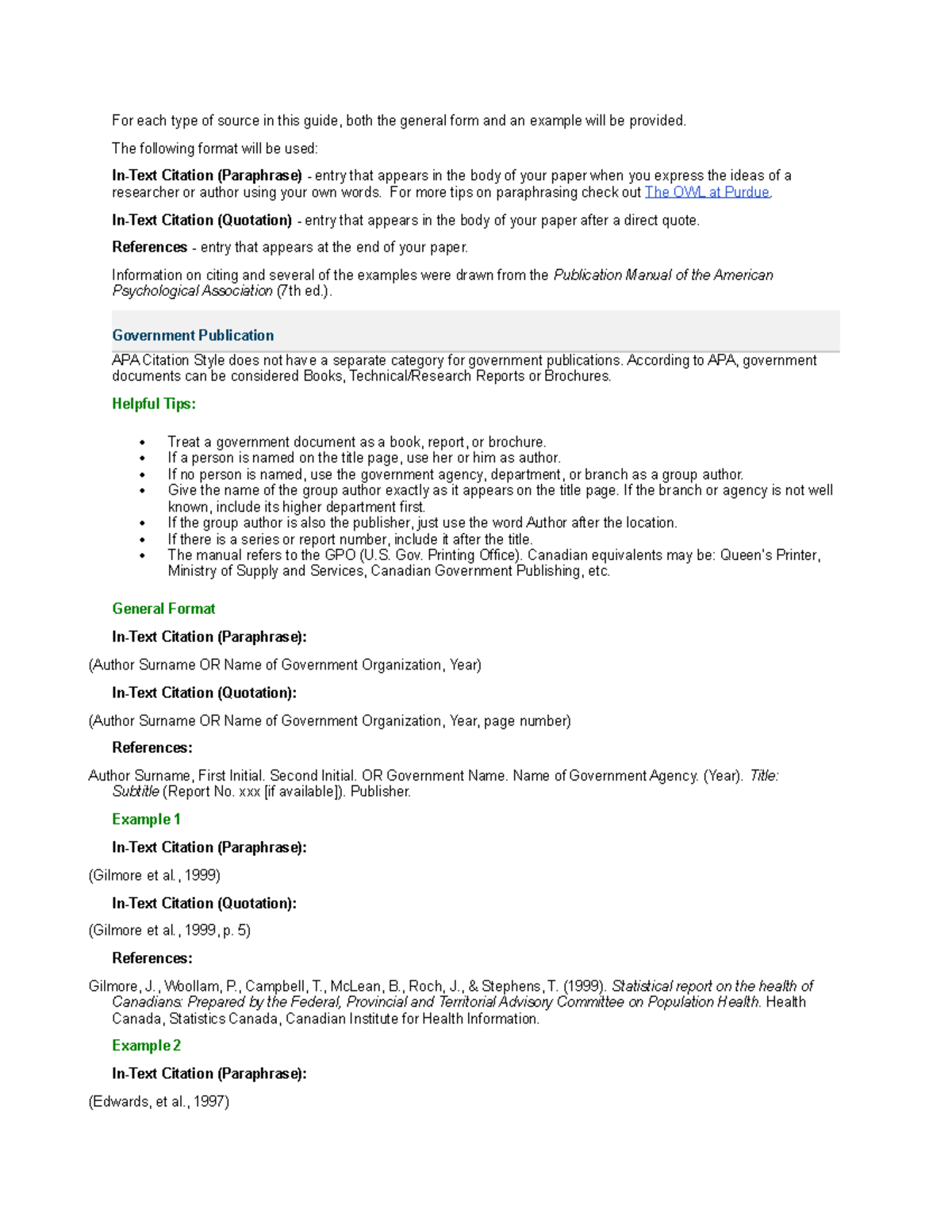
To cite a government document in APA Style (7th Edition), use the following general format: Authoring Agency. (Year). Title of document (Report No. xxx). Publisher. URL. If the agency is also the publisher, omit the publisher name to avoid repetition. For in-text citations, use the agency name and the year of publication.
Government documents represent a vast category of information, ranging from census data and legislative transcripts to technical reports and executive orders. Because these documents are often published by bureaucratic entities rather than individual people, citing them requires a specific understanding of organizational hierarchies and APA-specific "gray literature" rules. In 2026, as more government data becomes centralized in digital repositories, the precision of your citations ensures that readers can navigate directly to the primary source of evidence.
The Hierarchy of Government Authorship
One of the most common challenges in APA citations for government documents is determining who the "author" is. In most cases, the author is a government agency, department, or office. APA style refers to these as group authors.
Identifying the Correct Agency
When a document is produced by a specific office within a larger department, you should generally list the most specific agency that has primary responsibility for the work as the author. For example, if you are citing a report from the National Institute of Mental Health (NIMH), which is part of the National Institutes of Health (NIH) under the U.S. Department of Health and Human Services (HHS), you would typically list the "National Institute of Mental Health" as the author.
However, if the report is highly general or if the specific sub-agency is not clearly defined as the primary creator, you may list the parent agency first. The goal is to provide a clear path for the reader. If you choose to list a hierarchy in the author element, start with the most senior agency and work down to the specific office: U.S. Department of Justice, Office of Justice Programs.
Individual Authors within Agencies
Sometimes, a government report will list specific individuals as the authors. If a person’s name is on the cover or title page (e.g., "Prepared by Jane Doe"), you should list that individual as the author in the reference list. The government agency that commissioned or published the work then moves to the publisher position in the reference.
General Template for Government Reports
Most government documents are classified as reports in APA style. This includes white papers, policy briefs, and technical manuals.
Reference List Components
- Author: Name of the government agency.
- Year: The year the document was published. Use (n.d.) if no date is available.
- Title: The title of the document in sentence case and italics.
- Report Number: If the document has a specific number (e.g., Publication No. 12-345), include it in parentheses immediately after the title, but before the period.
- Publisher: The name of the government department or agency. If the author and publisher are the same, omit this element.
- URL: The direct link to the document or the landing page where the document is hosted.
Example Reference: National Cancer Institute. (2023). Taking time: Support for people with cancer (NIH Publication No. 23-2056). U.S. Department of Health and Human Services, National Institutes of Health. https://www.cancer.gov/publications/patient-education/taking-time.pdf
Citing Legislative and Legal Documents
Citing legal materials like statutes, court cases, and constitutions in APA is unique because APA defers to The Bluebook: A Uniform System of Citation. This means legal citations often look different from standard APA references.
Court Decisions
For a court case, the reference includes the name of the case, the volume and page of the reporter, and the court and year.
- Format: Name v. Name, Volume Source Page (Court Year).
- Example: Brown v. Board of Education, 347 U.S. 483 (1954).
Statutes and Laws
Statutes are usually cited by their official name and the section of the United States Code (U.S.C.) where they are recorded.
- Format: Official Name of Act, Volume U.S.C. § Section Number (Year).
- Example: Americans with Disabilities Act of 1990, 42 U.S.C. § 12101 et seq. (1990).
The U.S. Constitution
The U.S. Constitution does not require a reference list entry if you are citing it as a whole. You only cite it in the text. However, if you are citing a specific amendment or article, use the following format for the reference list:
- Format: U.S. Const. art. [Article Number], § [Section Number].
- Format: U.S. Const. amend. [Amendment Number].
Executive Orders and Administrative Resources
Presidential executive orders are primary government documents that require specific formatting. These are typically found in the Federal Register or the Code of Federal Regulations (CFR).
Executive Orders
To cite an executive order, include the number of the order, its title (if available), the volume and page of the Federal Register, and the date it was signed.
- Format: Exec. Order No. 13,673, 3 C.F.R. 511 (2014).
The Federal Register
The Federal Register is the official daily publication for rules, proposed rules, and notices of Federal agencies.
- Format: Agency Name. (Year, Month Day). Title of notice. Federal Register, Volume(Issue), Page–Page.
- Example: Environmental Protection Agency. (2025, November 12). Proposed air quality standards. Federal Register, 90(218), 74502–74510.
In-Text Citations and Abbreviations
Government agencies often have long, cumbersome names. APA allows for the use of abbreviations in in-text citations to improve readability, provided the first mention is clear.
The First Mention
The first time you cite a government document, you must write out the full name of the agency. If you intend to use an abbreviation later, introduce it in brackets within the parenthetical citation.
- First Citation: (Federal Bureau of Investigation [FBI], 2024).
- Subsequent Citations: (FBI, 2024).
Narrative Citations
In a narrative citation, where the author's name is part of the sentence, the abbreviation is introduced in parentheses next to the full name.
- First Mention: The Federal Bureau of Investigation (FBI, 2024) reported that...
- Subsequent Mentions: According to the FBI (2024)...
Comparison of Government Document Types
The table below summarizes the citation requirements for the most common types of government documents found in academic and professional research.
| Document Type | Author Component | Title Style | Key Detail to Include |
|---|---|---|---|
| Agency Report | Specific Bureau/Office | Italicized | Report/Publication Number |
| Statute/Law | Title of the Act | Not Italicized | U.S. Code (U.S.C.) Section |
| Court Case | Case Name (v.) | Italicized | Volume and Reporter Page |
| Executive Order | President's Name (if ind.) | Not Italicized | Order Number and C.F.R. Vol |
| Press Release | Issuing Agency | Italicized | [Press release] description |
| Testimony | Speaker or Agency | Italicized | Congressional Hearing Title |
Handling Electronic and Digital Government Data
By 2026, almost all government documents are accessed via digital portals such as GovInfo or specific agency websites. When citing these, the digital provenance is essential.
PDF vs. HTML
If you are citing a PDF version of a government report that is an exact replica of a print document, you do not need to indicate "PDF" in the citation. Simply provide the URL. If the document is only available as an HTML webpage, follow the standard APA webpage format, using the agency as the author.
Retrieval Dates
APA 7th Edition generally does not require a retrieval date for most government documents because they are considered stable, archived records. However, if you are citing a government website that is designed to change frequently (such as a live data dashboard or a "Current News" page), include a retrieval date before the URL.
- Example with Retrieval Date: U.S. Census Bureau. (n.d.). U.S. and World Population Clock. Retrieved January 15, 2026, from https://www.census.gov/popclock/
Common Mistakes to Avoid
- Over-Abbreviation: Do not use abbreviations like "U.S. Dept of Labor" in the reference list. The reference list must contain the full, formal name of the agency. Save abbreviations for in-text citations.
- Duplicating the Publisher: If the author is "U.S. Department of Education" and the publisher is also the "U.S. Department of Education," do not list it twice. Move directly from the title to the URL.
- Italicizing Legal Titles: Unlike books or reports, the names of laws (statutes) are generally not italicized in the reference list or the text. Only court case names are italicized.
- Omitting Report Numbers: Many government documents are part of a series. Omitting the report number makes it significantly harder for librarians or researchers to find the exact version of the document you used.
International and Intergovernmental Documents
Documents from the United Nations (UN), World Health Organization (WHO), or the European Union follow similar rules to U.S. government documents. Treat the organization as the group author.
- UN Example: United Nations General Assembly. (2025). Resolution adopted by the General Assembly on the rights of the child (A/RES/80/12). https://undocs.org/A/RES/80/12
For these entities, ensure you are using the official English-language name of the organization if your paper is written in English.
Frequently Asked Questions
How do I cite a document from a local or city government?
Follow the same format as federal documents, but start with the name of the city or county followed by the specific department. For example: City of Chicago, Department of Public Health. (2024). Annual report on community wellness. URL.
What if a government report has no author?
It is extremely rare for a government document to have no author. Usually, the agency that published it is the author. If no agency is listed on the cover, look at the "About Us" page or the footer of the document to identify the responsible body. If truly no author can be identified, move the title of the document to the author position.
How do I cite a transcript of a congressional hearing?
The author is usually the specific committee that held the hearing. Include the name of the hearing in italics, the number of the Congress, and the session.
- Example: House Committee on Energy and Commerce. (2025). Hearing on renewable energy infrastructure (Serial No. 119-12). https://www.govinfo.gov/link/cpd/119/house/hearing
Should I include the "U.S." before agency names?
According to APA, you should use the name as it appears on the document. If the document says "U.S. Department of Agriculture," use the "U.S." If it simply says "Department of Agriculture," you may omit it in the reference list for brevity, though including it is rarely considered an error.
How do I cite the Federal Register?
The Federal Register acts as a periodical. The author is the agency that issued the notice or rule. The year and date are specific, the title is the name of the rule/notice, and the "Journal Name" is Federal Register.
Do I need to cite the Government Publishing Office (GPO)?
In APA 7, you do not need to list the GPO as the publisher if the specific agency that wrote the report is already known. The GPO is the printer/distributor, not the intellectual creator.
Next Steps for Researchers
When citing government documents, your first step should always be to identify whether the document is legislative/legal or a standard report. This distinction determines whether you follow the standard APA author-date format or the specialized Bluebook style. Always download a PDF version of the document when available, as it usually contains the report numbers and official agency hierarchies that might be missing from a simplified HTML webpage. For complex legal citations, consult the official APA Style Blog or the latest edition of the Publication Manual of the American Psychological Association to ensure compliance with the most recent 2026 standards.