AP World History: Modern exam scores reflect a student’s proficiency in analyzing historical events from 1200 CE to the present. Results are reported on a 1 to 5 scale, where a 3 or higher is typically considered passing. These scores determine eligibility for college credit and advanced course placement at thousands of universities.
The Composition of an AP World History Exam Score
An AP World History score is not a simple percentage of correct answers. Instead, it is a weighted composite score derived from two distinct sections: the multiple-choice section and the free-response section. Understanding how these components are weighted is essential for students aiming to optimize their performance and predict their final results.
The College Board uses a rigorous process to ensure that a score of 4 in 2026 represents the same level of achievement as a 4 in previous years. This involves "equating," where the difficulty of the specific year's questions is factored into the final scaled score.
Section I: Objective Assessment (60% of Total Score)
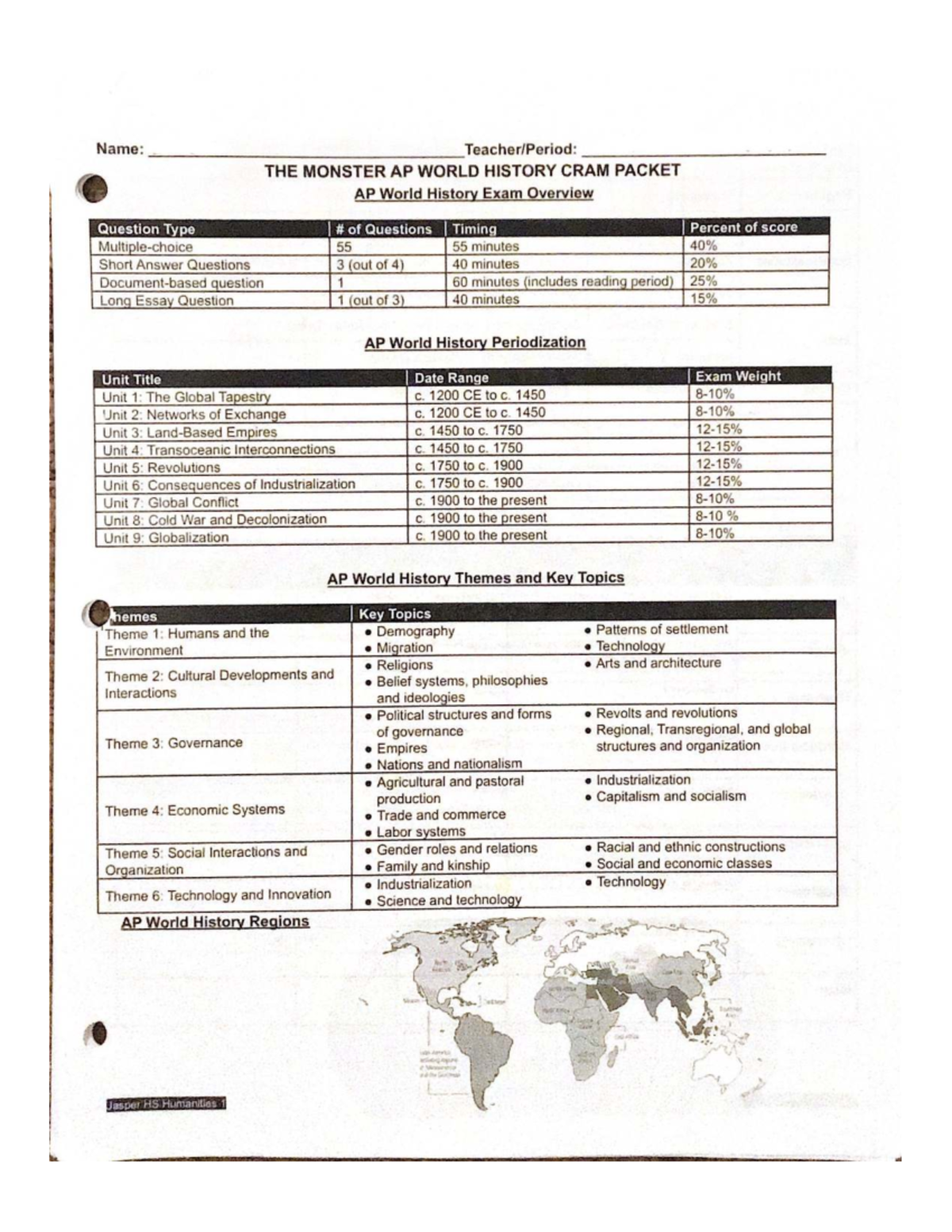
The first half of the exam consists of two parts. Part A is the Multiple-Choice Question (MCQ) section, which accounts for 40% of the total score. It contains 55 stimulus-based questions that must be answered in 55 minutes. These are not rote memorization questions; they require students to analyze primary and secondary sources, maps, and data.
Part B is the Short-Answer Question (SAQ) section, contributing 20% to the total score. Students answer three questions in 40 minutes. The first two questions are required, while students choose between two options for the third, usually focusing on different time periods.
Section II: Free-Response Narrative (40% of Total Score)
The second half of the exam requires extensive writing and is often the most challenging for students. This section is divided into the Document-Based Question (DBQ) and the Long Essay Question (LEQ).
The DBQ is the "heavy hitter" of the exam, worth 25% of the total score. Students are given seven documents and must craft an essay that incorporates at least six of them to support a thesis. The LEQ is worth 15% and provides students with a choice of three prompts, allowing them to demonstrate their knowledge of a specific historical theme across different eras without the aid of provided documents.
Interpreting the 1–5 Scoring Scale
The final score reported to students and colleges is a scaled integer from 1 to 5. Each number corresponds to a specific level of "qualification" for college-level work.
| AP Score | Qualification Recommendation | Typical College Credit Equivalent |
|---|---|---|
| 5 | Extremely Well Qualified | Introductory World History (6 credits/2 semesters) |
| 4 | Well Qualified | Introductory World History (3-6 credits) |
| 3 | Qualified | Introductory World History (3 credits/1 semester) |
| 2 | Possibly Qualified | No credit; placement in standard intro courses |
| 1 | No Recommendation | No credit |
The "Passing" Threshold
While a score of 3 is technically the "passing" mark, the utility of this score varies by institution. Public university systems, such as the University of California or the State University of New York (SUNY), are often mandated by state law to grant credit for scores of 3 or higher. In contrast, highly selective private institutions may only grant credit or "advanced standing" for a 4 or a 5.
Percentile Ranks and Score Distributions
Historically, AP World History: Modern has a middle-of-the-road pass rate compared to other AP subjects. In recent years, approximately 60% to 65% of students have earned a 3 or higher. The "5" is relatively elusive, typically awarded to only 12% to 15% of test-takers. These distributions remain stable because the College Board adjusts the raw-to-scaled score conversion (the "curve") to account for slight variations in exam difficulty each year.
Accessing Your 2026 AP World History Scores
Scores are typically released in early July. For the 2026 testing cycle, students can expect their results to become available on the College Board’s online portal starting the first week of July.
How to Retrieve Results
- Account Access: Ensure you have your College Board username and password ready. If you have forgotten them, use the "Forgot Password" tool well before July to avoid the rush.
- Verify Information: Confirm that your school code and email address are correct in your profile.
- The Portal: Log in to the official AP Score website.
- Score Send: If you designated a college to receive your scores during the exam registration, the College Board will send your entire score report to that institution automatically in late June or early July.
Dealing with Missing Scores
If your score is not appearing by mid-July, it may be due to a clerical delay, a mismatch in student identification information, or a late-testing exception. In such cases, contact AP Services for Students. It is rare for scores to be permanently lost, but administrative holds can occur if there were testing irregularities at your specific location.
How the 2026 Digital Exam Affects Scoring
By 2026, the transition to digital testing for AP World History is fully integrated. While the content and the rubric remain identical to the paper-based version, the digital format has implications for how scores are processed.
Digital exams allow for more efficient grading of the multiple-choice section. However, the free-response questions (DBQ, LEQ, and SAQs) are still evaluated by human "Readers"—high school AP teachers and college professors who gather every June for the "AP Reading." The digital format means Readers can access student essays more easily, potentially speeding up the verification process, but the rigorous human element of scoring remains the standard.
Scoring the Free-Response Questions: The Rubric
To achieve a 4 or 5, students must master the specific "point-based" rubrics used by the College Board. Unlike a standard English essay, AP World History essays are scored based on the presence of specific elements rather than general writing quality.
The DBQ Rubric Breakdown (7 Points Total)
- Thesis/Claim (1 pt): Must be a defensible claim that responds to the prompt and sets up a roadmap for the essay.
- Contextualization (1 pt): Describes the broader historical events or trends relevant to the prompt (the "background").
- Evidence from Documents (2 pts): One point for using three documents; two points for using six documents to support an argument.
- Evidence Beyond the Documents (1 pt): Providing a specific historical example not mentioned in the provided sources.
- Sourcing (1 pt): For at least three documents, explaining why the author’s point of view, purpose, or audience is relevant.
- Complexity (1 pt): Demonstrating a nuanced understanding, such as explaining multiple perspectives or connections across different time periods.
The Complexity Point is the most difficult to earn and is often the deciding factor between a 4 and a 5. In 2026, the criteria for this point remain high, requiring a cohesive argument throughout the entire essay rather than a single "complex" sentence.
College Credit and Course Placement
The primary motivation for many students taking the AP World History exam is to save money on college tuition. By earning a score that grants credit, students can skip introductory-level history courses.
Credit vs. Placement
It is important to distinguish between "credit" and "placement."
- Credit: You receive actual semester hours toward graduation (e.g., 3 units of History 101).
- Placement: You are allowed to skip the introductory course and move straight into an upper-level seminar, but you do not receive "free" credits toward your degree.
Most state universities offer both, while elite private colleges often only offer placement. Before the July score release, students should use the College Board’s AP Credit Policy Search tool to see how specific universities treat AP World History scores.
Common Obstacles to High Scores
Even high-achieving students can struggle with the AP World History exam due to its unique structure. Understanding these common pitfalls can help in interpreting a lower-than-expected score or preparing for a retake.
- Chronological Errors: AP World History: Modern starts at 1200 CE. Students who spend too much time discussing the Roman Empire or Ancient Greece often fail to address the specific time period required by the prompt.
- Descriptive vs. Analytical Writing: Many students "tell a story" rather than "make an argument." The rubrics require analysis—explaining the why and how of historical change and continuity.
- Time Management: The MCQ section requires answering one question per minute. Students who get stuck on difficult questions often fail to finish the section, significantly lowering their raw score.
- Misunderstanding the Prompt: AP prompts often use specific "task verbs" like Compare, Contrast, or Analyze the extent to which. Failing to follow the specific instruction of the verb results in a loss of thesis and argument points.
Comparing World History Scores to Other AP Exams
Students often wonder how their AP World History score "ranks" against other subjects. Generally, AP World History is considered a "foundational" AP. It is often one of the first AP exams students take (usually in 10th grade).
Because it is taken by younger students, the pass rate can be slightly lower than more specialized exams like AP Comparative Government or AP Art History, which are typically taken by seniors. However, the skills learned in AP World History—specifically DBQ writing—transfer directly to AP U.S. History (APUSH) and AP European History. Students who earn a 4 or 5 in World History are statistically much more likely to repeat that success in subsequent history APs.
FAQ
When will 2026 AP World History scores be released?
Scores are scheduled for release in early July 2026. The exact date is typically announced by the College Board in June, and scores are released simultaneously to students worldwide via the online portal.
Can I retake the AP World History exam if I get a 1 or 2?
Yes, you can retake the exam the following May. However, most students choose not to, as the time and effort required to relearn a year's worth of content is significant. A better strategy for most is to focus on succeeding in a different AP subject the following year.
Is a score of 3 good enough for Ivy League schools?
Generally, no. While a 3 is a "pass," Ivy League and other Tier-1 institutions (like Stanford or MIT) usually require a 4 or 5 to grant credit or recognize the score for placement. However, a 3 still demonstrates that you challenged yourself with a rigorous curriculum, which has value in the admissions process even if it doesn't result in credit.
How do I send my scores to colleges?
You can send one free score report to a college of your choice each year you take AP exams. This must be done through your College Board account by June 20, 2026. After that date, or for sending scores to additional colleges, there is a fee (approximately $15–$25 per report).
What is the "raw score" needed for a 5?
While it varies slightly each year, a student typically needs a composite raw score of approximately 75-80% to earn a 5. To earn a 3, a student often only needs to secure about 45-50% of the total available points, depending on the year's difficulty scaling.
Practical Recommendation for 2026 Test-Takers
Once you receive your score in July 2026, the first action you should take is to download your unofficial score report as a PDF. Many students lose access to their high school emails or forget their College Board credentials after graduation. Having a saved copy of your report is essential for future transfer applications or proving your credentials to internship coordinators.
If your score is a 3 or higher, immediately check the credit transfer portal of the college you plan to attend. Ensure that your "Score Send" was successful so that your academic advisor has the results ready for your first-semester course registration. If you are a sophomore or junior, use your score report to identify strengths and weaknesses—high marks in the MCQ but low marks in the DBQ suggest you should focus on writing skills in your next AP course.