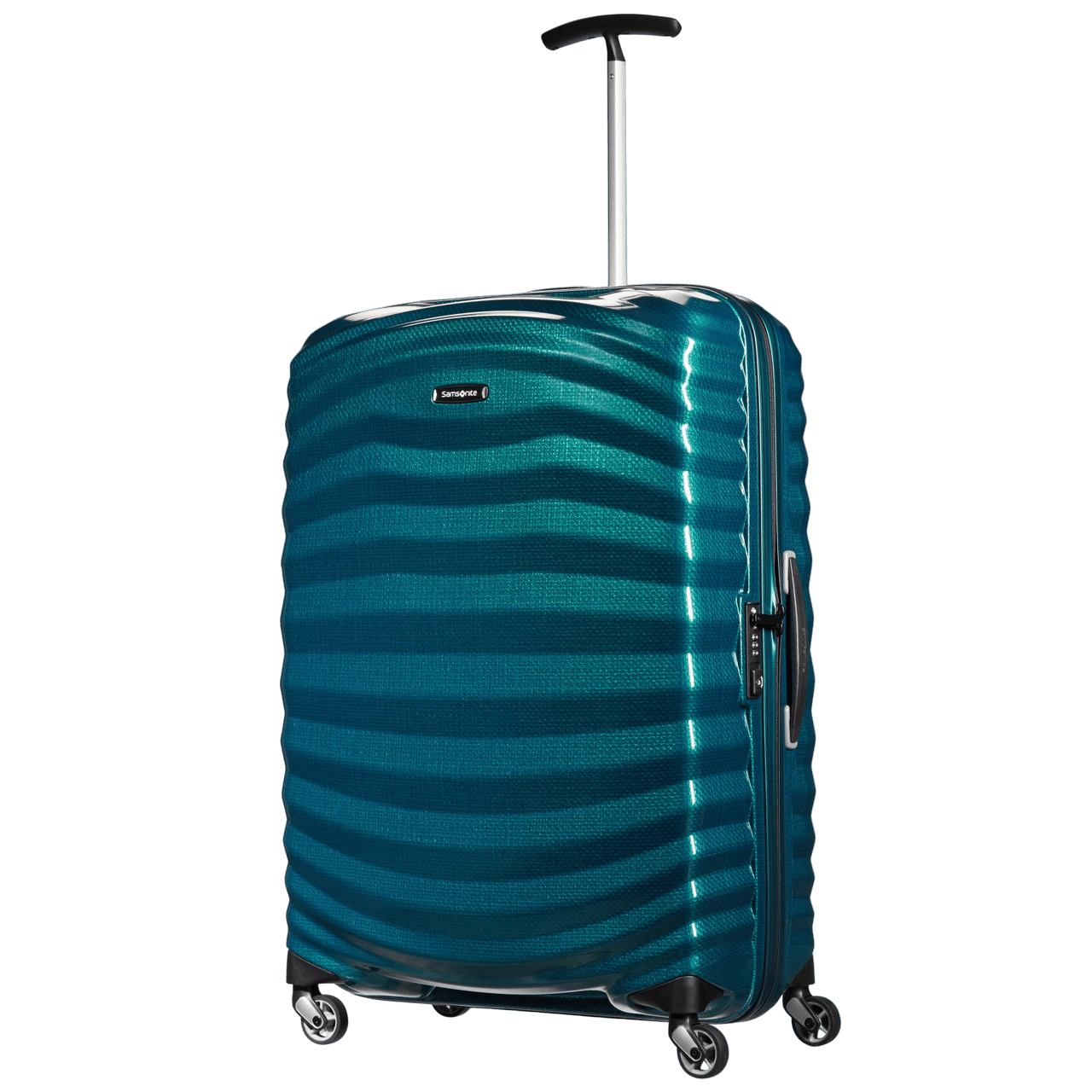
A 4-wheel lightweight suitcase combines multi-directional 360-degree spinner wheels with ultra-light materials like polycarbonate, polypropylene, or high-denier nylon. This design minimizes physical strain by letting you glide luggage upright beside you, saves critical weight to meet strict airline baggage allowances, and significantly improves maneuverability through crowded transit hubs and narrow airplane aisles.
Anatomy of the Modern 4-Wheel Lightweight Suitcase
The evolution of modern luggage design transitioned from two-wheeled rolling bags (rollaboards) to four-wheeled "spinner" cases. Traditional two-wheel suitcases require the traveler to tilt the bag at a 45-degree angle, transferring approximately 30% of the suitcase's total weight directly onto the user’s hand, wrist, and arm. In contrast, a 4-wheel suitcase relies on independent 360-degree rotating caster wheels mounted at each corner of the base, allowing the bag to roll vertically alongside the traveler.
When combined with modern lightweight manufacturing techniques, these suitcases solve two of the most persistent problems in travel: physical fatigue and restrictive airline weight thresholds. Lightweight engineering relies on high-strength-to-weight ratio polymers, structural framing techniques, and optimized internal hardware. Understanding the interplay between wheel physics, frame composition, and ergonomics reveals why the 4-wheel lightweight suitcase has become the benchmark standard for business travelers, vacationers, and digital nomads alike.
1. Effortless 360-Degree Maneuverability
The defining structural feature of a 4-wheel suitcase is its multi-directional movement. Because each wheel assembly rotates independently on a 360-degree axis, the suitcase can move in any vector without requiring the user to change their grip or body orientation.
- Traditional 2-Wheel Pull (Tilted):
- User Hand transfers ~30% Weight to Luggage
- Base supported by Wheel and Grounded Base
- 4-Wheel Spinner Roll (Upright):
- User Hand steers only, 0% Vertical Load to Luggage
- Base supported by four Wheels
Zero-Torque Steering
When pulling a traditional two-wheeled bag, altering your direction requires applying rotational torque through your forearm and shoulder. A 4-wheel spinner eliminates this force. The traveler simply pushes or guides the bag in the desired direction, and the caster wheels automatically align with the vector of travel. This enables effortless navigation around sharp corners, through crowded airport security lines, and past sudden obstacles.
Dual-Wheel vs. Single-Wheel Spinners
High-performance lightweight suitcases feature double-wheel casters (eight total wheels arranged in four paired sets). Dual-wheel designs double the ground contact area, dispersing the weight over eight points rather than four. This structural redundancy reduces rolling resistance, stabilizes movement across minor ground imperfections like tile grout lines, and prevents the wheels from catching on small debris.
2. Maximized Airline Weight Allowance and Reduced Excess Fees
Global airlines enforce strict weight limitations for both carry-on and checked luggage. Budget carriers routinely enforce carry-on weight limits ranging from 7 kg to 10 kg (15 to 22 lbs), while checked baggage limits typically cap at 23 kg (50 lbs) before heavy excess baggage fees apply.
The Physics of "Tare Weight" Savings
The unladen mass of a suitcase is known as its tare weight. A traditional heavy-frame carry-on bag made from heavy ABS plastic or thick canvas can weigh between 3.8 kg and 4.8 kg (8.4 to 10.5 lbs) empty. If an airline enforces a strict 7 kg carry-on limit, a heavy bag consumes over 60% of your total allowance before a single piece of clothing is packed.
Modern lightweight 4-wheel carry-on suitcases utilize advanced materials to reduce empty weight to between 1.8 kg and 2.5 kg (3.9 to 5.5 lbs).
| Suitcase Type | Average Empty Weight | Available Payload (at 7 kg Limit) | Packable Capacity Gain |
|---|---|---|---|
| Traditional Heavy Carry-On | 4.2 kg (9.2 lbs) | 2.8 kg (6.2 lbs) | Baseline |
| Standard Spinner Carry-On | 3.2 kg (7.0 lbs) | 3.8 kg (8.4 lbs) | +35% Payload Capacity |
| Ultra-Lightweight 4-Wheel | 2.0 kg (4.4 lbs) | 5.0 kg (11.0 lbs) | +78% Payload Capacity |
By reducing the tare weight of your suitcase, you reallocate valuable kilograms to clothing, electronics, or travel gear while staying compliant with strict airline check-in scales.
3. Ergonomic Health and Reduction of Physical Strain
Carrying or dragging heavy loads across long airport concourses causes acute biomechanical stress. The upright posture facilitated by a 4-wheel lightweight suitcase offers significant physical benefits across key body zones.
- Biomechanical Strain Comparison:
- 2-Wheel Suitcase (Pulling Behind):
- Shoulder: Hyperextension & Rotational Torque
- Lower Back: Asymmetric Lateral Bending
- Wrist: Continuous Flexion & Pronation
- 4-Wheel Suitcase (Rolling Beside):
- Shoulder: Neutral Axial Alignment
- Lower Back: Symmetrical Spinal Posture
- Wrist: Micro-Guidance (Minimal Force)
- 2-Wheel Suitcase (Pulling Behind):
Shoulder and Wrist Protection
Dragging a two-wheel bag forces the arm into back-extension and internal rotation. Over long distances, this unnatural posture strains the rotator cuff muscles, biceps tendons, and wrist flexors. A 4-wheel suitcase rolls parallel to your body, keeping your shoulder in a neutral, relaxed position and eliminating wrist torque.
Spinal Alignment and Balance
Pulling a heavy bag behind you forces your torso to lean forward and twist slightly to compensate for the trailing load. This asymmetric lateral bending creates uneven pressure on intervertebral discs and lower back muscles. Walking with a lightweight spinner upright at your side keeps your spine aligned correctly, allowing for a natural gait and reducing the risk of lumbar fatigue or spasms.
Accessibility for Travelers with Physical Limitations
For travelers managing arthritis, joint replacement, back pain, or reduced physical strength, pushing an upright, ultra-light 4-wheel suitcase requires only minimal effort. The floor bears 100% of the bag's weight, making travel accessible to individuals who cannot drag heavy gear.
4. Enhanced Upright Stability and Versatile Handling
Traditional suitcases are prone to tipping forward or sideways when brought to a stop, especially when front exterior pockets are loaded with heavy items. A 4-wheel suitcase is engineered around a stable four-point baseline.
Hands-Free Waiting and Vertical Balance
When standing in passport queues, waiting at gate lounges, or using public transportation, a 4-wheel suitcase remains completely self-supporting. The central center of gravity sits squarely within the footprint of the four caster wheels. You can let go of the handle entirely without worrying that the bag will fall over, leaving your hands free to handle travel documents, phones, or coffee.
Dual-Mode Operation (Push vs. Pull)
While 4-wheel suitcases are designed primarily to be pushed upright, high-quality spinner wheels are fully adaptable to different surfaces. When moving over smooth indoor surfaces (tile, polished concrete, carpet), pushing the bag upright is ideal. When encountering challenging outdoor terrain like rough asphalt or cobblestones, the suitcase can easily be tilted onto two wheels and pulled behind like a classic rollaboard without structural damage to the wheel housing.
5. Seamless Navigation in Confined Spaces
Transit environments—such as airplane aisles, crowded train corridors, elevators, and bus turnstiles—are narrow and difficult to navigate with wide loads.
Narrow Profile Alignment
Commercial aircraft cabin aisles typically measure between 15 and 20 inches (38 to 50 cm) in width. A traditional carry-on pulled behind a traveler is oriented wide-side-forward, wider than most aisles, forcing the traveler to carry the bag awkwardly in front of them or turn sideways while dragging it.
A 4-wheel suitcase can be instantly rotated 90 degrees so its narrow side faces forward. In this slim profile, the suitcase glides smoothly down airplane aisles alongside or directly in front of the traveler, eliminating the need to lift heavy bags over seats or knock into seated passengers.
Precision Steering in Crowds
Navigating high-density hubs during peak hours requires quick stops, immediate lateral shifts, and tight turns. Because 4-wheel suitcases require no turning radius, you can execute lateral sidesteps and micro-adjustments in packed lines without tripping pedestrians or creating bottlenecks.
Material & Construction Comparison Matrix
The weight and durability of a 4-wheel suitcase depend heavily on the materials used for its shell, frame, and hardware. The table below outlines how common lightweight materials compare across key performance dimensions:
| Shell Material | Category | Avg. Empty Carry-On Weight | Durability & Impact Resistance | Flex & Shape Memory | Water Resistance |
|---|---|---|---|---|---|
| Polycarbonate (PC) | Hard Shell | 2.1 – 2.6 kg (4.6 – 5.7 lbs) | High: Absorbs severe impacts by flexing and springing back. | High flex without cracking. | Excellent (Sealed shell). |
| Polypropylene (PP) | Hard Shell | 1.9 – 2.3 kg (4.2 – 5.1 lbs) | Very High: Lightest hardshell polymer with superior fatigue resistance. | Moderate flex; highly resilient. | Excellent (Sealed shell). |
| ABS Plastic | Hard Shell | 2.5 – 3.2 kg (5.5 – 7.0 lbs) | Moderate: Rigid surface; can crack under heavy cold-weather impacts. | Rigid; limited flex. | Excellent (Sealed shell). |
| Ripstop Nylon (Soft) | Soft Shell | 1.7 – 2.2 kg (3.7 – 4.8 lbs) | High: Excellent tear/abrasion resistance; lightweight. | High fabric flexibility; expandable. | High (with DWR coating). |
| Polyester (Soft) | Soft Shell | 2.2 – 2.8 kg (4.8 – 6.2 lbs) | Moderate: Good for casual use; lower scuff resistance than nylon. | Moderate fabric flexibility. | Moderate to low. |
Engineering Trade-Offs and Hardware Considerations
While 4-wheel lightweight suitcases offer clear advantages, understanding potential limitations ensures realistic expectations and proper selection.
External Wheel Exposure and Rough Terrain
Unlike 2-wheel rollaboards, whose wheels are partially recessed into the protective frame of the suitcase, 4-wheel spinners feature fully external caster modules.
- Impact Risk: External wheel assemblies are more exposed to hard side impacts during automated luggage handling. Opting for reinforced, bolted wheel housing (rather than glued or basic riveted setups) mitigates this risk.
- Surface Resistance: Extremely lightweight micro-wheels can struggle on irregular outdoor surfaces like cobbles, loose gravel, or thick carpet. Selecting high-grade thermoplastic polyurethane (TPU) wheels with sealed steel ball bearings ensures smooth operation across varied ground types.
Structural Frame vs. Weight Reduction
Achieving an ultra-lightweight profile requires manufacturers to optimize frame wall thickness, zipper profiles, and handle tubes.
- Telescoping Handles: Look for handles made from high-grade aircraft aluminum with minimal play or wobble. Multi-stage locking handles allow height adjustments suitable for upright pushing or tilted pulling.
- Soft vs. Hard Shell Weight Balance: Softside lightweight bags often include external organizational pockets, adding slight weight from zippers and fabric layers. Hardside lightweight bags prioritize a clean, uncluttered main compartment to minimize tare weight.
Selection Guide: How to Pick the Ideal 4-Wheel Lightweight Suitcase
To select the best bag for your specific travel needs, evaluate these key criteria before purchasing:
- Selection Flowchart:
- Hardshell Preference:
- PC: Max Impact Resistance
- PP: Lightest Hardshell
- Softshell Preference:
- Nylon: Max Tear R.
- Polyester: Budget-Friendly Lightweight
- Hardshell Preference:
- Verify Exterior Dimensions (Including Wheels): Airlines measure total exterior volume, including wheels and handles. Ensure your carry-on meets standard international dimensions (typically 55 x 40 x 20 cm or 22 x 14 x 9 inches).
- Inspect the Wheel Hardware: Choose dual spinner wheels (8 total wheels) made of sound-dampening TPU rubber rather than hard PVC plastic. Spin each wheel manually to ensure smooth rotation along its vertical axle.
- Check Handle Extension Height: Ensure the telescoping handle locks securely at a height comfortable for your stature. When standing upright, the handle top should rest at wrist height so your arm remains relaxed while pushing.
- Evaluate Internal Packing Architecture: Ultra-lightweight suitcases often drop heavy internal dividers to save weight. Ensure the interior includes at least cross-straps and a basic mesh divider to keep contents secure during transit.
- Confirm Security & Closure Hardware: Look for puncture-resistant double-coil zippers or latching aluminum frame systems, alongside an integrated, TSA-accepted combination lock for international transit security.
Frequently Asked Questions
Are 4-wheel suitcases durable enough to be checked as luggage?
Yes, provided the suitcase uses high-grade shell materials like pure polycarbonate or polypropylene paired with reinforced wheel housings. While spinner wheels extend further from the bag than recessed 2-wheel setups, modern high-end and mid-range lightweight bags feature impact-absorbent housing plates that protect the wheel assemblies from rough handling.
Can you pull a 4-wheel suitcase behind you like a 2-wheel bag?
Yes. 4-wheel spinner suitcases operate on 360-degree casters, allowing them to tilt and roll on two wheels whenever necessary. This is especially helpful when transitioning from smooth airport floors to rough outdoor pavement, high-pile carpet, or steep inclines.
What is considered a true "lightweight" weight for a carry-on suitcase?
For an international carry-on (20–22 inches in height), an empty weight between 1.8 kg and 2.4 kg (4.0 to 5.3 lbs) is considered ultra-lightweight. Standard suitcases usually weigh between 3.2 kg and 4.5 kg (7.0 to 10.0 lbs).
Why do some budget 4-wheel suitcases feel difficult to roll?
Budget suitcases often use cheap, single-wheel plastic casters without internal ball bearings. These wheels can bind under load, flatten over time, or create high rolling friction. Quality 4-wheel suitcases use rubberized TPU dual-wheels with precision bearings that roll effortlessly even when loaded to capacity.
Are softshell lightweight suitcases better than hardshell options?
Neither is universally better; they serve different travel priorities. Softshell suitcases (made from ripstop nylon) offer exterior pockets for quick document access and flexible fabric that compresses easily. Hardshell suitcases (polycarbonate or polypropylene) offer superior rain resistance, protect fragile items better, and are easier to wipe clean after transit.
Summary and Practical Recommendation
Investing in a 4-wheel lightweight suitcase transforms the physical experience of travel. By shifting the entire payload off your arms and onto high-efficiency 360-degree wheels, you eliminate back, wrist, and shoulder strain while maintaining total control in tight, crowded spaces. Concurrently, reducing your suitcase’s unladen weight allows you to pack more gear without risking heavy excess baggage fees.
For most modern travelers, a 21-to-22-inch dual-wheel spinner constructed from 100% Polycarbonate or Polypropylene provides the optimal balance of strength, maneuverability, and minimal weight. Verify your preferred airline’s dimension limits, choose high-performance wheel hardware, and enjoy a faster, more comfortable journey.