The 2014 NCAA Division I Men's Basketball Tournament Final Four featured the University of Florida Gators, the University of Kentucky Wildcats, the University of Wisconsin Badgers, and the University of Connecticut Huskies. Held at AT&T Stadium in Arlington, Texas, this historic weekend culminated in the UConn Huskies capturing the national championship under head coach Kevin Ollie, cementing an improbable run as a seventh seed.
Introduction to the 2014 NCAA Men's Basketball Tournament
The 2014 NCAA Division I Men's Basketball Tournament stands out in college basketball history as one of the most unpredictable and thrilling postseasons ever played. Known colloquially as March Madness, the tournament brought together 68 of the best college basketball teams in the United States, all vying for the ultimate prize: a spot in the Final Four and a chance to cut down the nets as national champions.
The road to the 2014 Final Four in Arlington, Texas, was paved with dramatic upsets, buzzer-beaters, and elite-level performances. Analyzing the four teams that reached the national semifinals—Florida, Kentucky, Wisconsin, and Connecticut—requires examining not just their play during those magical three weeks in March, but the tactical identities, player rosters, and seasonal trajectories that allowed them to outlast 64 other programs.
By understanding how these four distinct programs navigated their respective regions, basketball fans and sports historians can appreciate the unique convergence of veteran leadership, freshman phenoms, and tournament resilience that defined the 2014 college basketball landscape.
The Florida Gators: The South Region Dominators
The University of Florida Gators entered the 2014 NCAA Tournament as the overall number one seed, carrying the weight of massive expectations throughout the regular season and the Southeastern Conference (SEC). Head coach Billy Donovan, already a proven master of March success with his back-to-back national titles in 2006 and 2007, molded a veteran-laden squad that balanced suffocating defensive intensity with disciplined half-court offense.
Roster Construction and Tactical Identity
Florida’s success in the 2014 season was built upon a foundation of experienced upperclassmen who had tasted postseason heartbreak in previous years and returned determined to finish the job. The starting lineup featured senior guard Scottie Wilbekin, junior guard Michael Frazier II, senior guard Casey Prather, senior forward Patric Young, and junior forward Will Yeguete.
Offensively, the Gators did not rely on blistering pace or overwhelming three-point volume. Instead, Billy Donovan utilized a sophisticated motion offense that prioritized ball movement, high basketball IQ, and relentless offensive rebounding. Defensively, Florida played a hyper-aggressive, physical man-to-man defense that disrupted opponent passing lanes and forced turnovers, ranking among the stingiest defensive units in the country.
Path to the Final Four
As the top seed in the South Regional, Florida handled its early-round business with relative authority, defeating the 16th-seeded University of Albany in the opening round. However, the tournament quickly tested the Gators' mettle:
- Round of 32: Defeated the ninth-seeded University of Pittsburgh 61–45 in a hard-fought defensive battle.
- Sweet 16: Overcame a stubborn fifth-seeded UCLA Bruins team 79–68, utilizing second-half adjustments to pull away.
- Elite Eight: Survived a tense, tactical battle against the eleventh-seeded University of Dayton Flyers, winning 62–52 to punch their ticket to Arlington.
This victory over Dayton extended Florida's winning streak to 30 consecutive games, showcasing a level of consistency rarely seen in modern college basketball. Yet, their journey would hit a brick wall in the national semifinals against a familiar conference foe.
The Kentucky Wildcats: The Freshman Phenoms' Late Surge
While Florida entered the tournament as a dominant, experienced juggernaut, the University of Kentucky Wildcats arrived at the 2014 Big Dance as an enigmatic collection of five-star talent that had struggled to find consistency during the regular season. Head coach John Calipari assembled a roster dominated by freshman phenoms, leading to immense media scrutiny and wild fluctuations in performance before everything clicked in March.
Roster Construction and Tactical Identity
Kentucky's 2014 roster featured a historic influx of elite freshman talent, anchored by forward Julius Randle, guard Aaron Harrison, guard Andrew Harrison, and guard James Young, complemented by experienced sophomore center Willie Cauley-Stein. Julius Randle served as the undisputed anchor, bullying opponents in the paint with relentless rebounding and physical scoring.
The tactical evolution of the 2014 Wildcats centered on individual isolation scoring, transition opportunities, and offensive rebounding. While they struggled with outside shooting and defensive rotations during the SEC regular season, John Calipari simplified their defensive schemes and empowered his guards to make plays in crunch time, turning raw physical talent into a cohesive tournament-time machine.
Path to the Final Four
Seeded eighth in the Midwest Region, Kentucky was widely picked by pundits to suffer an early exit. Instead, the Wildcats embarked on one of the most thrilling tournament runs in modern history:
- Round of 32: Outlasted the top-seeded Wichita State Shockers 78–76 in a classic game widely considered one of the greatest second-round matchups in tournament history.
- Sweet 16: Defeated the fourth-seeded Louisville Cardinals 74–69 in an intense intrastate rivalry game.
- Elite Eight: Edged out the second-seeded Michigan Wolverines 75–72, courtesy of a dramatic, deep game-winning three-pointer by Aaron Harrison in the final seconds.
Kentucky’s improbable run from an 8-seed to the Final Four proved that March rewards peak momentum and clutch shot-making over regular-season seeding.
The Wisconsin Badgers: Bo Ryan’s Efficient Offense
Representing the Big Ten Conference, the University of Wisconsin Badgers brought a vastly different style of basketball to the 2014 Final Four. Under the legendary guidance of head coach Bo Ryan, the Badgers were synonymous with discipline, execution, low-turnover basketball, and a famously deliberate offensive pace known colloquially as the "Swing" offense.
Roster Construction and Tactical Identity
Wisconsin's roster was built on the quintessential Bo Ryan model: versatile, high-IQ players who stayed in school, mastered fundamentals, and executed offensive sets with surgical precision. The team was led by junior forward Frank Kaminsky, senior guard Ben Brust, junior guard Traevon Jackson, sophomore forward Sam Dekker, and senior guard Josh Gasser.
The Badgers rarely beat themselves. They ranked near the top of the nation in fewest turnovers committed, defensive rebounding, and free-throw shooting efficiency. Frank Kaminsky’s emergence as a stretch-big—capable of scoring in the post, driving past slower centers, and shooting from beyond the arc—transformed Wisconsin from a standard grit-and-grind Big Ten squad into an offensive powerhouse.
Path to the Final Four
Earned a 2-seed in the West Region, Wisconsin navigated a challenging bracket with trademark poise:
- Round of 32: Overcame the seventh-seeded University of Oregon Ducks 85–77 in a surprisingly high-scoring affair.
- Sweet 16: Defeated the sixth-seeded Baylor Bears 69–52, neutralizing Baylor's physical length with crisp perimeter passing and disciplined defense.
- Elite Eight: Survived a brutal, overtime thriller against the top-seeded University of Arizona Wildcats, winning 64–63 to secure their first Final Four appearance since 2000.
Wisconsin’s methodical approach proved that patience and execution could dismantle hyper-athletic opponents on the game's biggest stages.
The UConn Huskies: The Improbable Seventh-Seed Champions
Perhaps no team in the 2014 Final Four captured the imagination of college basketball fans quite like the University of Connecticut Huskies. Coming off a postseason ban the previous year and adjusting to life under new head coach Kevin Ollie, the Huskies entered the East Region as a seventh seed with few predicting a deep national title run.
Roster Construction and Tactical Identity
UConn’s championship aspirations rested heavily on the shoulders of one of the greatest backcourts in college basketball history: senior guard Shabazz Napier and junior guard Ryan Boatright. Napier, a clutch scorer and floor general, provided leadership and veteran poise, while Boatright supplied defensive harassment and rapid transition scoring.
Supported by center Amida Brimah and forward DeAndre Daniels, the Huskies operated out of a guard-centric, pick-and-roll-heavy offensive system. Defensively, Kevin Ollie instilled a gritty, switching perimeter defense that forced opponents into contested jump shots while minimizing paint penetration.
Path to the Final Four
UConn’s path through the East Region required surviving several nail-biters and defeating formidable opposition:
- Round of 32: Survived a double-overtime thriller against the second-seeded Villanova Wildcats, winning 77–65.
- Sweet 16: Defeated the third-seeded Iowa State Cyclones 81–76, neutralizing Iowa State’s high-powered offensive attack.
- Elite Eight: Edged out the fourth-seeded Michigan State Spartans 60–54 in a physical defensive struggle at Madison Square Garden.
By securing the East Regional crown, UConn proved that guard play and tournament resilience could overcome seeding disadvantages.
| Team | Seed | Region | Head Coach | Star Players | Conference |
|---|---|---|---|---|---|
| Florida Gators | 1 | South | Billy Donovan | Scottie Wilbekin, Patric Young | SEC |
| Kentucky Wildcats | 8 | Midwest | John Calipari | Julius Randle, Aaron Harrison | SEC |
| Wisconsin Badgers | 2 | West | Bo Ryan | Frank Kaminsky, Sam Dekker | Big Ten |
| UConn Huskies | 7 | East | Kevin Ollie | Shabazz Napier, Ryan Boatright | American |
The Final Four Matchups in Arlington
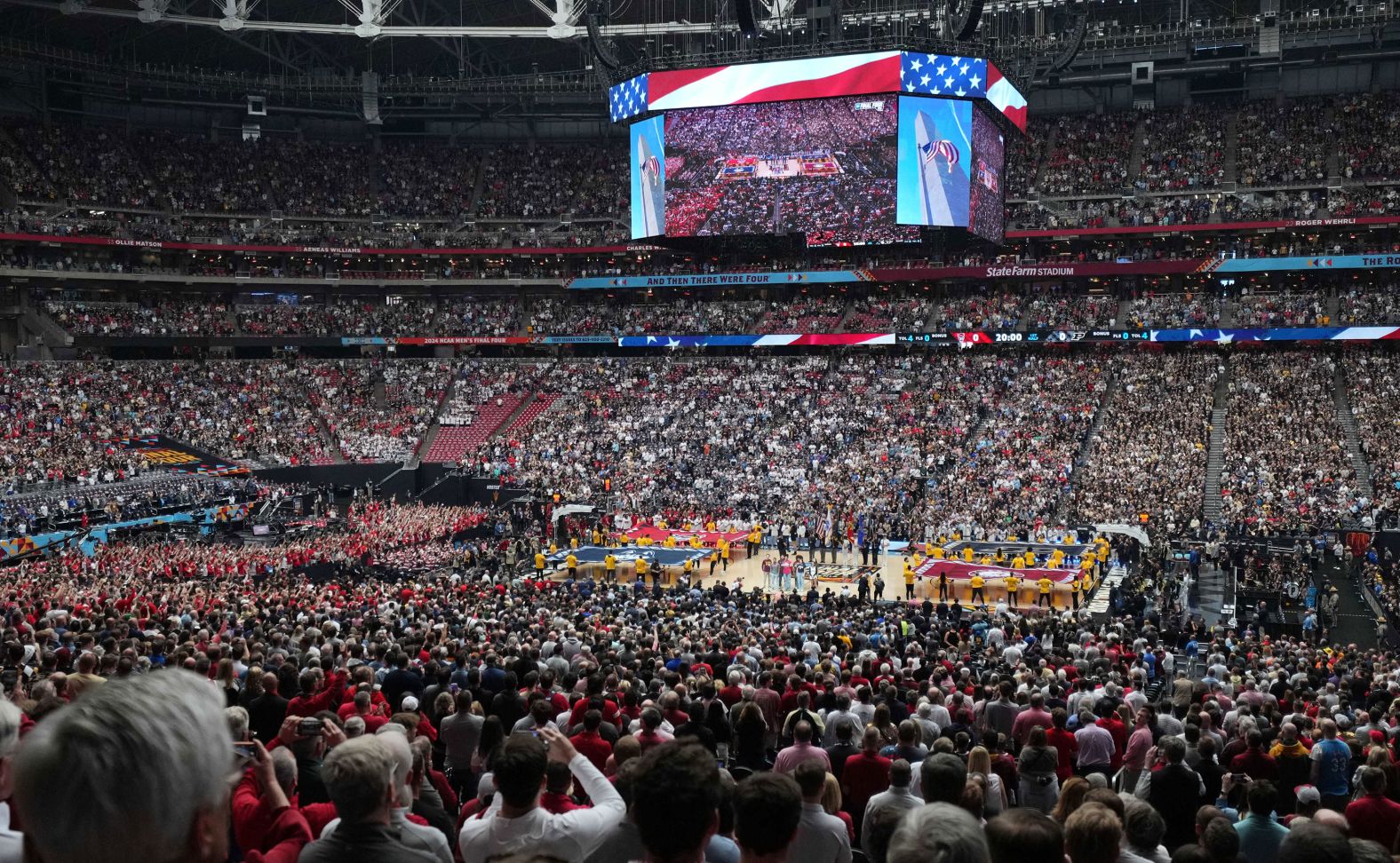
The 2014 Final Four at AT&T Stadium in Arlington, Texas, marked a historic weekend for college basketball, drawing massive crowds to a cavernous NFL venue. The semifinal matchups pitted conference rivals against one another in two contrasting battles of strategy and talent.
Florida vs. UConn: The Rematch of the Titans
The first national semifinal featured a clash between the overall top-seeded Florida Gators and the seventh-seeded UConn Huskies. Earlier in the regular season, Florida had defeated UConn in a close game, giving the Gators a psychological edge entering Arlington.
However, March Madness is a different arena. Shabazz Napier put on a masterclass in point-guard play, scoring 18 points, grabbing 5 rebounds, and distributing 6 assists. Despite a valiant effort from Scottie Wilbekin and the Florida defense, UConn’s perimeter shooting and defensive pressure flustered the Gators. The Huskies secured a 63–53 victory, ending Florida’s 30-game winning streak and advancing to the national championship game.
Wisconsin vs. Kentucky: The Ultimate Clutch Battle
The second semifinal game between Wisconsin and Kentucky delivered one of the most exciting finishes in Final Four history. The contest was a stylistic war: Wisconsin’s deliberate, disciplined execution against Kentucky’s relentless athleticism and isolation scoring.
The game remained tight throughout the second half, with Frank Kaminsky dominating the paint for Wisconsin while Julius Randle and the Harrison twins kept Kentucky within striking distance. In the game's dying seconds, with the score tied, sophomore guard Aaron Harrison once again delivered tournament heroics, sinking a deep, contested three-pointer with 5.7 seconds remaining to give Kentucky a 74–73 victory and send the Wildcats to the title game.
The National Championship Game: UConn vs. Kentucky
The 2014 NCAA National Championship game on April 7, 2014, pitted two unexpected opponents against each other: the 7-seed UConn Huskies and the 8-seed Kentucky Wildcats. It was the first time in tournament history that neither a 1, 2, 3, nor 4 seed reached the title game, highlighting the sheer unpredictability of the 2014 postseason.
Shabazz Napier continued his legendary tournament run, scoring 22 points and orchestrating UConn’s offense with poise. While Julius Randle and James Young fought hard to keep Kentucky competitive, the Wildcats struggled mightily from the free-throw line and committed costly turnovers against UConn's active defense.
UConn maintained control for the majority of the contest, ultimately securing a 60–54 victory to claim the fourth national championship in program history. Shabazz Napier was named the tournament's Most Outstanding Player (MOP), cementing his legacy alongside past UConn greats like Kemba Walker and Richard Hamilton.
Legacy and Impact of the 2014 Final Four
The 2014 March Madness Final Four teams left a permanent mark on college basketball history. The tournament challenged conventional wisdom regarding regular-season dominance and tournament seeding. Florida demonstrated the power of senior leadership and defensive discipline, Kentucky proved the immense upside of elite freshman talent when it catches fire in March, Wisconsin showcased the enduring value of foundational execution, and UConn illustrated how elite guard play can carry an entire program to glory.
For college basketball enthusiasts, the 2014 tournament remains a benchmark for drama, competitive balance, and unforgettable athletic achievement.
Frequently Asked Questions
Who won the 2014 NCAA Men's Basketball Tournament?
The UConn Huskies won the 2014 NCAA Men's Basketball Tournament by defeating the Kentucky Wildcats 60–54 in the national championship game held in Arlington, Texas. It was the program's fourth national title, led by head coach Kevin Ollie and tournament Most Outstanding Player Shabazz Napier.
Why were Kentucky and UConn seeded so low in the 2014 tournament?
Kentucky entered the tournament as an 8-seed due to extreme inconsistency during the regular season, as a roster dominated by freshmen struggled to find defensive cohesion early on. UConn was a 7-seed primarily due to a competitive American Athletic Conference schedule and fluctuating quality-win metrics, though both teams peaked at precisely the right time in March.
Who was named the Most Outstanding Player (MOP) of the 2014 Final Four?
Shabazz Napier, the senior star guard for the UConn Huskies, was named the Most Outstanding Player of the 2014 Final Four. Napier averaged stellar numbers throughout the tournament and led his team through tight victories against Villanova, Iowa State, Michigan State, Florida, and Kentucky.
Where was the 2014 Final Four played?
The 2014 Final Four was played at AT&T Stadium in Arlington, Texas. Hosting the event in a massive NFL football stadium marked a continuation of the NCAA's tradition of staging the national semifinals and championship game in large-capacity multi-use venues.
What was notable about the seeds of the 2014 Final Four teams?
The 2014 Final Four was historically unique because it featured no number-one or number-two seeds making it to the final weekend from the West and Midwest regions in conventional distributions. Florida was a 1-seed, Wisconsin was a 2-seed, but Kentucky was an 8-seed and UConn was a 7-seed, marking one of the lowest-seeded combined Final Fours in tournament history.
Conclusion and Final Takeaways
The journey of the 2014 March Madness Final Four teams—Florida, Kentucky, Wisconsin, and Connecticut—remains a masterclass in tournament resilience, tactical diversity, and competitive drive. Whether evaluating Billy Donovan’s defensive schemes, John Calipari’s freshman development, Bo Ryan’s efficiency metrics, or Kevin Ollie’s guard-led championship run, the 2014 postseason offers enduring lessons in basketball strategy. Fans looking to relive the magic of this era should study the full-game film archives of the regional finals and national semifinals to witness collegiate execution at its finest.