Asset based business loans allow companies to leverage their balance sheet assets—such as accounts receivable, inventory, equipment, and real estate—to secure crucial working capital or growth financing. This type of commercial lending focuses primarily on the liquidation value of the collateral rather than relying solely on traditional metrics like historical profitability or high credit scores.
Understanding Asset Based Lending
Asset based lending (ABL) represents a flexible financial strategy utilized by companies experiencing rapid growth, turnaround situations, or seasonal cash flow fluctuations. Unlike conventional bank loans that evaluate a borrower primarily through cash flow projections and historical earnings, asset based business loans view collateral as the primary source of repayment. If the business defaults, the lender has a direct legal claim against the pledged assets, which they can liquidate to recover their capital.
This financing mechanism operates through a revolving line of credit or a term loan. A revolving credit facility is especially popular because the borrowing limit fluctuates dynamically alongside the value of the underlying collateral. As a business generates more accounts receivable or acquires more inventory, its available borrowing capacity increases proportionately. This relationship provides a continuous stream of liquidity that matches the operational rhythms of manufacturing, distribution, wholesale, and service companies.
Core Collateral Types Accepted by Lenders
Evaluating collateral requires a comprehensive appraisal process. Lenders do not lend against the full book value of an asset; instead, they apply a discount known as an "advance rate" to account for potential depreciation, market volatility, and liquidation costs.
Accounts Receivable
Accounts receivable (AR) typically serve as the highest-quality collateral for asset based business loans. Lenders analyze the aging report of unpaid invoices to determine which accounts are eligible. Typically, invoices over 90 days past due, foreign accounts, or disputed invoices are excluded. Advance rates for accounts receivable generally range from 70% to 85% of the eligible invoice value.
Inventory
Inventory is considered secondary collateral because it is less liquid than cash or receivables. Lenders evaluate raw materials, work-in-progress (WIP), and finished goods. Finished goods command higher advance rates—often between 40% and 50%—while raw materials receive lower rates, and work-in-progress is frequently excluded entirely due to the difficulty of valuation.
Equipment and Machinery
Heavy machinery, manufacturing equipment, delivery vehicles, and office technology can be leveraged through term loans or equipment-backed credit lines. An independent machinery and equipment appraiser determines the Forced Liquidation Value (FLV) or Orderly Liquidation Value (OLV). Advance rates for equipment generally hover between 50% and 80% of the FLV.
Real Estate
Commercial real estate owned by the business can be integrated into an asset based lending facility. Commercial mortgage appraisals establish the market value, and lenders typically offer advance rates between 65% and 75% of the appraised property value.
Comparing Financing Options
Choosing the right financing vehicle requires balancing flexibility, cost, and qualification requirements. The following comparison outlines how asset based loans stack up against traditional commercial loans and invoice factoring.
| Feature | Asset Based Lending (ABL) | Traditional Bank Loan | Invoice Factoring |
|---|---|---|---|
| Primary Focus | Collateral liquidation value | Cash flow and credit score | Quality of individual invoices |
| Structure | Revolving line of credit / Term loan | Term loan / Standard line of credit | Purchase of invoices at a discount |
| Advance Rates | 50% to 85% of blended asset value | N/A (Based on debt-service coverage) | 80% to 90% of face invoice value |
| Control of Collections | Borrower collects payments (usually) | Borrower collects payments | Factor takes over customer collections |
| Cost / Fees | Interest rate plus monitoring fees | Interest rate and origination fees | Factoring fees per week or month |
| Ideal Borrower | Mid-market companies with heavy assets | Established firms with strong cash flow | Small businesses with unpaid B2B invoices |
Qualifications and Application Requirements
Securing an asset based business loan involves rigorous underwriting. Because lenders rely on the integrity of the collateral, they enforce stringent monitoring and reporting protocols.
- Collateral Quality and Volume: The business must possess sufficient qualifying assets to support the minimum loan amount, which often starts at $500,000 or higher for dedicated ABL facilities.
- Financial Reporting Infrastructure: Borrowers must demonstrate the capability to produce accurate, timely financial statements, aging reports, and inventory logs. Many lenders require integration with enterprise resource planning (ERP) or accounting software.
- Borrowing Base Certificate: Borrowers must submit a periodic Borrowing Base Certificate (BBC)—often on a weekly or monthly basis—calculating the exact value of eligible collateral minus reserves to determine available credit.
- Business Viability: While cash flow is secondary to collateral, lenders still evaluate the business plan to ensure the company can service the interest and operational expenses without continuously eroding its asset base.
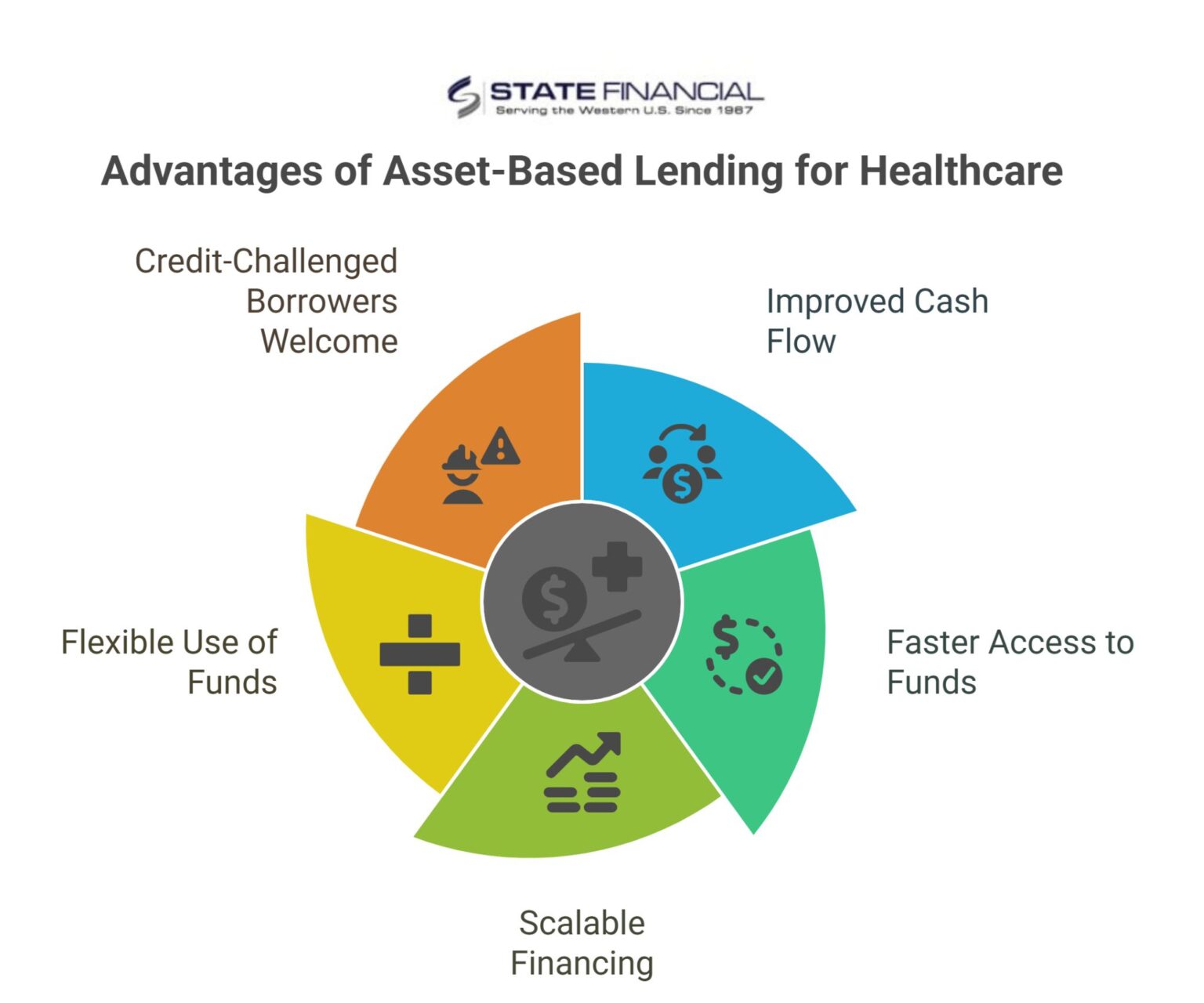
Advantages of Asset Based Business Loans
Asset based lending provides strategic benefits that standard commercial lending cannot match, particularly for operational scalability and liquidity management.
- High Liquidity Scaling: As sales grow, accounts receivable and inventory expand automatically, which immediately increases the available borrowing capacity without requiring renegotiation of the credit limit.
- Accessibility for Turnarounds: Companies experiencing temporary financial distress, seasonal slumps, or rapid growth phases that strain cash flow can qualify based on their hard assets rather than historical profitability.
- Working Capital Freedom: Capital secured through ABL can be used for general corporate purposes, including payroll, supply chain purchases, debt consolidation, or strategic acquisitions.
- Preservation of Equity: Unlike equity financing, taking on an asset based loan does not dilute ownership or require giving up board seats to outside investors.
Potential Risks and Disadvantages
Despite the flexibility, ABL facilities carry distinct operational challenges and cost structures that business owners must carefully evaluate.
- Intensive Monitoring and Audits: Lenders conduct regular field audits, inventory inspections, and financial reviews. This oversight requires dedicated administrative time and resources.
- Higher Total Cost of Capital: Interest rates, monthly monitoring fees, appraisal costs, and legal closing fees can make ABL more expensive than traditional prime-rate bank loans.
- Collateral Risk: If business performance declines and the value of receivables or inventory drops, the lender may issue a "margin call" requiring the borrower to pay down the loan immediately or post additional collateral.
- Personal Guarantees: Depending on the structure and corporate entity, lenders may still require personal guarantees from major stakeholders, putting personal assets at risk.
Frequently Asked Questions
What is the difference between asset based lending and invoice factoring?
While both options leverage accounts receivable, they operate fundamentally differently. In invoice factoring, the business sells its invoices outright to a third party (the factor), who then assumes responsibility for collections and customer communication. In asset based lending, the business retains ownership of the receivables, collects payments directly from customers, and uses the receivables as collateral for a revolving line of credit.
How do lenders calculate the borrowing base?
Lenders calculate the borrowing base by taking the total value of eligible assets, applying specific advance rates to each category (e.g., 80% for accounts receivable and 50% for inventory), and subtracting any designated reserves or dilution factors. Dilution accounts for customer returns, discounts, and allowances that reduce the actual cash collected from invoices.
What types of businesses benefit most from asset based loans?
Asset-intensive industries benefit the most from ABL facilities. This includes manufacturers, distributors, wholesalers, staffing agencies, transportation companies, and B2B service providers that maintain substantial accounts receivable or inventory balances.
Are personal credit scores important for asset based lending?
Personal credit scores matter less in asset based lending than in unsecured or traditional small business loans because the underwriting decision centers on the collateral. However, lenders still review the personal credit history and background of principal owners to assess overall business integrity and reliability.
How long does it take to secure an asset based loan?
Due to the complex nature of collateral appraisals, legal documentation, and field audits, the underwriting and closing process for an asset based business loan typically takes between 30 and 60 days.
Next Actions for Prospective Borrowers
Before approaching an asset based lender, conduct an internal audit of your balance sheet. Review your accounts receivable aging report to identify uncollectible or sluggish invoices, verify that your inventory management systems are accurate, and ensure your financial statements are up to date. Engage with commercial finance brokers or specialized ABL lenders to compare advance rates, monitoring fees, and reporting requirements to find a facility that aligns with your operational growth goals.