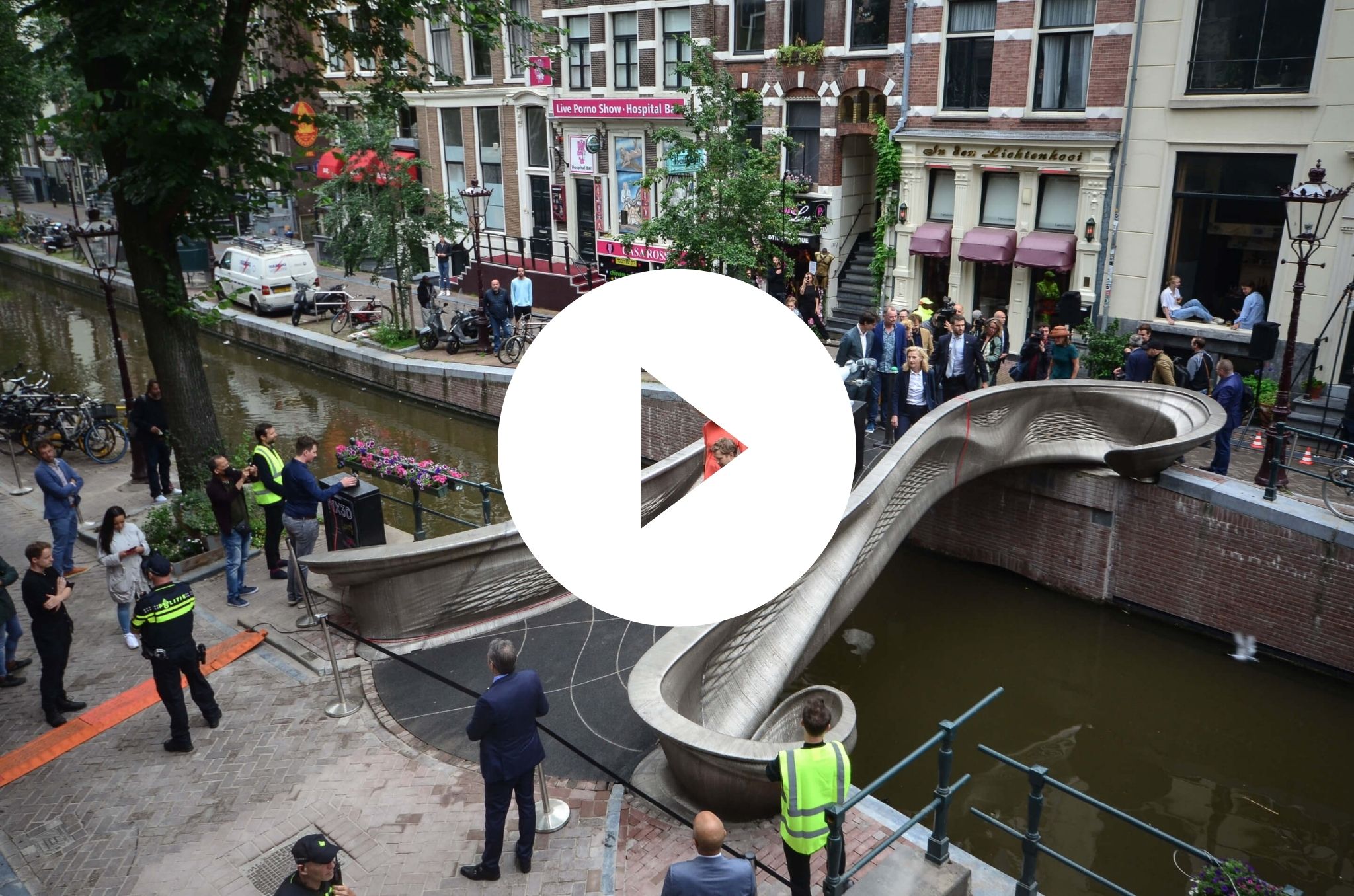
The 3D printed stainless steel bridge in Amsterdam, spanning the Oudezijds Achterburgwal canal, is the world's first fully functional, pedestrian-accessible bridge manufactured using robotic additive manufacturing techniques. Developed by MX3D and designed by Joris Laarman Lab, the structure serves as both a public thoroughfare in the historic Red Light District and a living laboratory for structural health monitoring, structural engineering, and advanced material science in architecture.
Introduction to the 3D Printed Bridge in Amsterdam
The intersection of historical preservation and cutting-edge manufacturing reached a milestone in Amsterdam when a futuristic, organically shaped stainless steel structure was installed across one of the city's oldest canals. Known widely as the MX3D bridge, this pedestrian crossing challenges traditional fabrication methods by utilizing multi-axis robotic welding arms to print metal layers in mid-air without the need for traditional support structures.
For engineers, municipal planners, and architects, the bridge represents a paradigm shift in how urban infrastructure can be conceived, tested, and deployed. Rather than relying on standard pre-cast concrete or heavy steel beams shaped off-site, this project demonstrated that complex geometries could be fabricated locally, optimized for material efficiency, and embedded with digital sensor networks from the ground up. This article explores the engineering mechanics, design philosophy, regulatory hurdles, material science, and long-term implications of Amsterdam’s iconic 3D printed bridge.
Project Background and Conception
The genesis of the 3D printed bridge dates back to 2015, when the Amsterdam-based technology startup MX3D, led by Gijs van der Velden, partnered with designer Joris Laarman. The initial vision was ambitious: to demonstrate the potential of large-scale wire arc additive manufacturing (WAAM) by printing a functional bridge directly over an Amsterdam canal.
The Vision of MX3D and Joris Laarman Lab
MX3D specialized in developing software and hardware that transformed standard industrial welding robots into 3D printers capable of extruding molten metal in mid-air. Joris Laarman Lab brought a distinct bio-mimetic design philosophy to the table, arguing that computer algorithms could mimic natural growth patterns to optimize structural strength while minimizing material waste.
Instead of a uniform, industrial profile, the bridge's form was generated using generative design software. This approach calculated stress concentrations and allocated metal precisely where structural loads demanded it, resulting in a skeletal, web-like aesthetic that contrasts sharply with the rigid brick facades of the surrounding medieval canal houses.
Selecting the Location: Oudezijds Achterburgwal
Choosing the exact site required extensive coordination with the City of Amsterdam. The Oudezijds Achterburgwal, located in the heart of the De Wallen district, presented significant historical, spatial, and logistical constraints.
- Historical Context: The canal is lined with centuries-old buildings, requiring any new intervention to respect the visual heritage of the area while offering a bold contemporary contrast.
- Pedestrian Traffic: As a high-traffic tourist and local corridor, the bridge had to withstand heavy, continuous daily loads despite its lightweight appearance.
- Permitting and Heritage Oversight: Local heritage boards (
Monumenten en Archeologie Amsterdam) rigorously evaluated the proposal to ensure the structure would not compromise the structural integrity of the canal walls or clash irreconcilably with municipal zoning laws.
Manufacturing Process: Wire Arc Additive Manufacturing (WAAM)
The core innovation of the Amsterdam bridge lies in its manufacturing technique. Traditional metal structures are typically milled, cast, or welded from standardized sheets and profiles, generating substantial scrap waste. In contrast, WAAM builds objects layer by layer using an electric arc welding process combined with industrial robotic arms.
How WAAM Works
The production sequence for the bridge components involved several precise steps:
- Digital Modeling: The bridge design was translated into a multi-axis toolpath using specialized computational software.
- Robotic Extrusion: Industrial robots equipped with welding torches deposited molten high-grade stainless steel wire drop by drop, solidifying instantly as the torch moved along spatial trajectories.
- Multi-Axis Freedom: Because the robots operated with six degrees of freedom, they could print overhangs and curved nodes without the traditional scaffolding or support beds required by powder-bed fusion 3D printers.
- Assembly and Welding: Due to the physical reach limitations of the robotic arms, the bridge was printed in multiple segments at an MX3D facility in the Port of Amsterdam, and subsequently welded together into a single 12-meter span.
Material Selection: High-Grade Stainless Steel
Selecting the right alloy was critical for ensuring longevity in an outdoor urban environment subject to weather fluctuations and heavy pedestrian wear. The project utilized a specialized duplex stainless steel alloy supplied by the multinational steel manufacturer Aperam.
This specific grade offers exceptional tensile strength, ductility, and corrosion resistance, reducing the need for intensive ongoing maintenance or chemical anti-corrosion treatments that are typically required for traditional carbon steel bridges exposed to canal humidity.
Structural Engineering and Load Testing
Before the bridge could welcome the public, it had to undergo rigorous structural verification to satisfy European safety codes and Dutch municipal building regulations (Bouwbesluit). Because a 3D printed metal structure lacks historical precedent in civil engineering standards, safety factors and load capacities had to be proven through extensive physical testing and finite element analysis (FEA).
Finite Element Analysis and Computational Modeling
Engineers simulated millions of loading scenarios—ranging from dense crowds of pedestrians to emergency maintenance vehicles—using advanced computational models. Because the generative design produced an irregular lattice rather than uniform beams, stress distribution was highly non-linear. The models helped identify potential weak points in the welded nodes, allowing engineers to reinforce critical zones before final assembly.
Physical Load Testing and Certification
In 2018, prior to its canal installation, the bridge was subjected to a comprehensive load test at the workshop.
- Initial Tests: The structure was loaded with two tons of sandbags to simulate baseline pedestrian traffic, monitoring deflection rates and micro-strain across the joints.
- Destructive Testing of Test Pieces: Separate printed test coupons were pulled to failure in laboratory settings to verify the tensile strength of the multi-directional weld beads.
- Municipal Approval: The test results were reviewed by independent engineering firms and municipal inspectors, eventually securing the necessary permits for public installation.
Sensor Network and Digital Twin Integration
One of the most defining technological features of the Amsterdam 3D printed bridge is its role as a "smart" bridge. Embedded beneath its deck and woven into its metal framework is a comprehensive network of sensors designed to monitor the health and behavior of the structure in real time.
| Sensor Type | Primary Function | Data Collected |
|---|---|---|
| Strain Gauges | Measure structural deformation | Stress levels, load distribution under heavy foot traffic |
| Tilt Sensors | Detect foundational shifts | Settlement of canal walls, rotational movement |
| Environmental Sensors | Track ambient conditions | Temperature gradients, humidity, surface moisture |
| Acoustic Emission | Monitor micro-cracking | Material fatigue, weld integrity over time |
The Concept of a Digital Twin
The data gathered by these physical sensors feeds directly into a "digital twin"—a dynamic, real-time virtual model of the bridge hosted in the cloud. Researchers from the Alan Turing Institute and the Amsterdam Institute for Advanced Metropolitan Solutions (AMS Institute) use this digital replica to:
- Predict maintenance schedules before visible wear occurs.
- Study how large crowds alter the vibrational frequency of organic metal lattices.
- Inform future civil engineering projects regarding the long-term fatigue behavior of WAAM structures.
Installation and Public Unveiling
The physical installation of the bridge in July 2021 marked the culmination of over six years of design, printing, engineering, and regulatory navigation. Transported by barge through Amsterdam’s historic canals, the 4.5-tonne structure was carefully hoisted into position by a floating crane across the Oudezijds Achterburgwal.
Balancing Innovation with Historical Preservation
Installing a futuristic robot-printed bridge directly adjacent to the 14th-century Oude Kerk (Old Church) generated significant public discourse. Preservationists debated whether the organic, silver-gray metal structure clashed with the brick vernacular of the canal belt.
Ultimately, municipal leaders embraced the project as a testament to Amsterdam's historical identity as a center of trade, technological innovation, and engineering experimentation. The bridge successfully bridged the gap between heritage tourism and advanced industry, drawing architects, designers, and curious travelers from around the world.
Comparative Analysis: 3D Printed Bridges vs. Traditional Construction
To understand the broader implications of the Amsterdam project, it is valuable to compare WAAM metal bridge construction with traditional civil engineering methods in terms of cost, time, material efficiency, and design flexibility.
- Design Freedom:
- 3D Printed (WAAM): Unlimited geometric complexity; optimized material distribution; organic forms.
- Traditional Steel/Concrete: Constrained by standard formwork, rolling mills, and modular pre-casting.
- Material Waste:
- 3D Printed (WAAM): Minimal waste; metal is deposited precisely where needed.
- Traditional Steel/Concrete: High waste rates from cutting, milling, and discarded formwork.
- Production Speed (Component Level):
- 3D Printed (WAAM): Slow printing speeds per kilogram, requiring specialized robotic hardware.
- Traditional Steel/Concrete: Rapid fabrication using standardized industrial assembly lines.
- Initial Capital Costs:
- 3D Printed (WAAM): High R&D, specialized software, and robotics investment.
- Traditional Steel/Concrete: Lower unit costs due to mature, highly optimized supply chains.
Maintenance, Durability, and Regulatory Challenges
While the MX3D bridge stands as a triumph of modern engineering, operating a novel structure in a public municipal environment presents unique ongoing challenges.
Corrosion Protection in Urban Canals
Although high-grade duplex stainless steel offers exceptional resistance to environmental degradation, urban canals accumulate air pollution, organic debris, and chemical runoff. The bridge requires periodic washing and inspection to prevent grime buildup in its intricate hollow nodes, where moisture could theoretically accumulate over extended periods.
Public Safety and Vandalism
As a high-profile public landmark located in a heavily visited district, the bridge is vulnerable to graffiti, sticker placement, and physical impact from erratic water traffic or bicycles. Maintaining the exposed metal finish requires specialized cleaning protocols that do not damage the underlying weld beads or interfere with the embedded sensor wiring.
Frequently Asked Questions
Who designed and built the 3D printed bridge in Amsterdam?
The bridge was designed by Joris Laarman Lab and manufactured by MX3D, an Amsterdam-based robotics and additive manufacturing startup, in collaboration with a multidisciplinary team of structural engineers, material scientists, and academic institutions.
What material is the bridge made of, and why was it chosen?
The structure is printed from a high-grade duplex stainless steel supplied by Aperam. This material was selected for its exceptional tensile strength, ductility, and superior resistance to corrosion in humid, urban canal environments.
Is the bridge safe for daily pedestrian use?
Yes. Before receiving municipal authorization from the City of Amsterdam, the bridge underwent rigorous finite element analysis, workshop load testing with multi-tonne weights, and independent structural safety audits to comply with European and Dutch building standards.
How do engineers monitor the structural health of the bridge?
The bridge is equipped with an integrated network of IoT sensors—including strain gauges, tilt meters, and acoustic emission monitors—which feed data into a digital twin model to track real-time stress, vibration, and environmental wear.
Can visitors walk across the bridge today?
Yes, the bridge is fully integrated into the public pedestrian network crossing the Oudezijds Achterburgwal canal in Amsterdam’s historic Red Light District, accessible to everyday foot traffic and tourists alike.
Practical Guidance and Next Actions for Industry Professionals
For civil engineers, municipal planners, and architects looking to adopt additive manufacturing principles inspired by the Amsterdam project, several strategic actions are recommended:
- Engage Regulatory Authorities Early: Novel materials and construction methods require close collaboration with local building departments and heritage boards from the concept phase onward to establish customized testing protocols.
- Prioritize Digital Integration: Combine physical additive manufacturing with embedded sensor arrays and digital twin platforms to satisfy long-term safety monitoring requirements.
- Evaluate Lifecycle Economics: While initial capital expenditures for robotic metal printing remain high, assess projects on long-term material savings, reduced waste disposal costs, and unique architectural value.