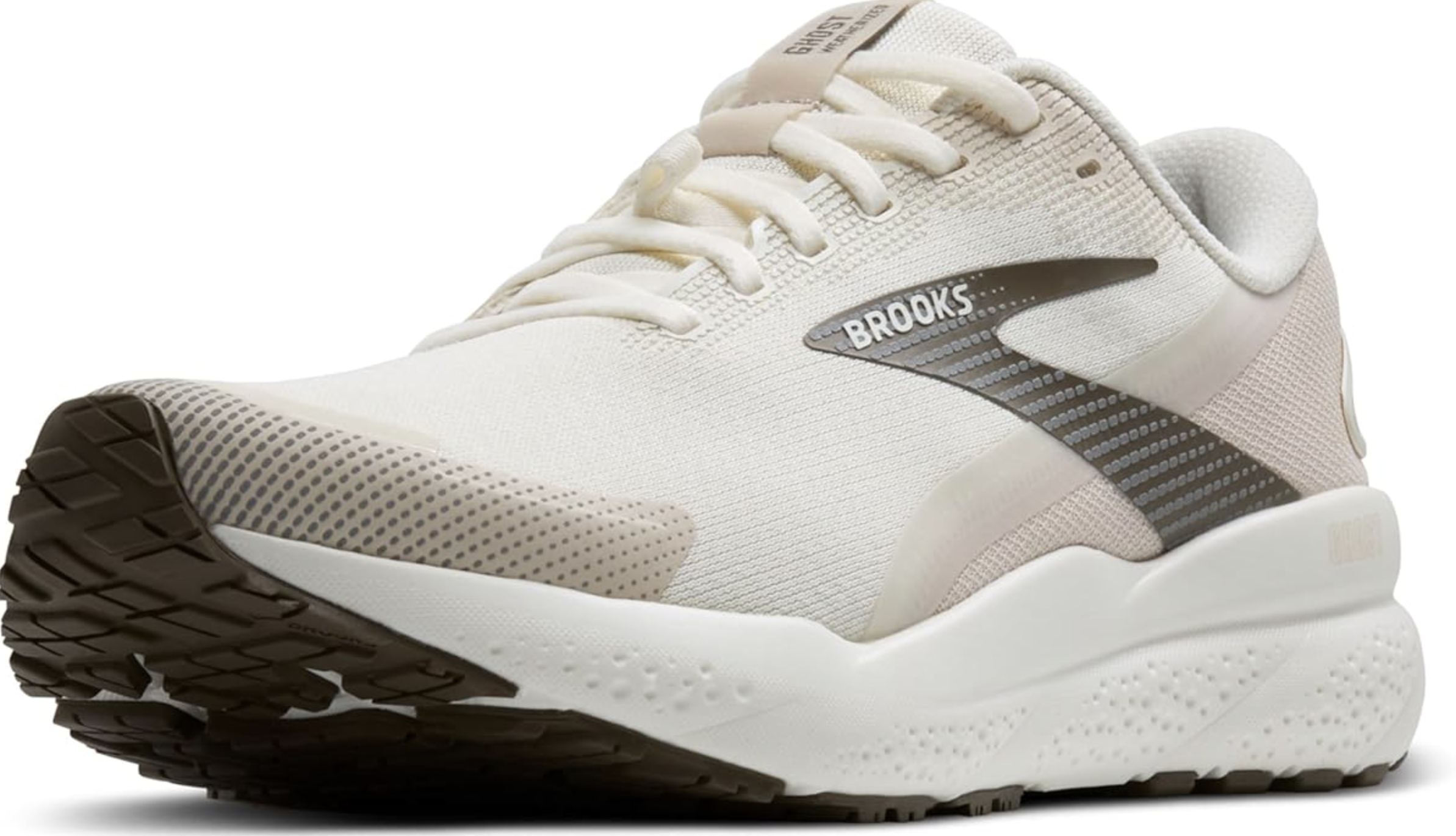
The Brooks Ghost 17 is highly suitable for individuals managing plantar fasciitis, particularly runners and walkers with neutral mechanics or mild supination. Its traditional 12 mm heel-to-toe drop significantly unloads tension from the Achilles tendon and plantar fascia, while the nitrogen-infused DNA LOFT v3 midsole delivers protective shock absorption without unstable softness.
Understanding Plantar Fasciitis and Footwear Mechanics
Plantar fasciitis is a degenerative condition characterized by micro-tears, collagen breakdown, and inflammation at the calcaneal origin of the plantar fascia—the thick band of connective tissue running along the bottom of the human foot. Managing this condition requires a clear understanding of foot mechanics during weight-bearing movement. Every step places tensile load on this aponeurosis through the windlass mechanism, a mechanical process where the toes dorsiflex, tightening the plantar fascia and elevating the longitudinal arch.
- Heel Strike (Impact Shock)
- Midstance (Arch Elongation & Tensile Load)
- Propulsion (Windlass Engagement)
Footwear directly influences how forces transfer across the foot during the gait cycle. When a shoe lacks adequate structure or features an inappropriate geometry, the plantar fascia absorbs excessive strain during three critical phases:
- Heel Strike: The initial collision generates ground reaction forces up to two to three times body weight. Without adequate rearfoot attenuation, shock reverberates directly into the calcaneus (heel bone), aggravating inflamed tissue.
- Midstance: The arch naturally flattens to absorb impact. If a shoe is excessively flexible through the midfoot shank, the arch collapses unchecked, causing repeated stretching and micro-trauma to the fascia.
- Toe-Off: As the heel lifts, the plantar fascia is pulled taut. Shoes with a flat heel-to-toe offset force the calf muscles and Achilles tendon to stretch further, increasing downstream traction on the heel spur region.
An effective shoe for plantar fasciitis must balance shock attenuation with structural integrity. It requires a firm heel counter to stabilize the calcaneus, torsional rigidity to prevent unnatural twisting through the midfoot, and an elevated heel drop to reduce tension across the posterior kinetic chain.
Brooks Ghost 17 Technical Specifications and Biomechanics
The Brooks Ghost series has long served as a benchmark in the neutral daily trainer category. In the Ghost 17, Brooks integrates its nitrogen-infused DNA LOFT v3 cushioning across the entire midsole, replacing earlier EVA-blend iterations. Evaluating how these engineering updates interact with foot pathology is critical for assessing plantar fasciitis suitability.
| Specification | Brooks Ghost 17 Measurement / Detail | Biomechanical Implication for Plantar Fasciitis |
|---|---|---|
| Midsole Foam | DNA LOFT v3 (supercritical nitrogen-infused EVA) | High shock absorption with resilience; prevents bottoming out under the heel. |
| Heel-to-Toe Drop | 12 mm (Heel: 36 mm / Forefoot: 24 mm) | Significantly reduces tensile load on the Achilles tendon and plantar aponeurosis. |
| Weight | ~10.1 oz (Men's 9) / ~8.8 oz (Women's 8) | Balanced daily trainer weight; stable platform without inducing early muscle fatigue. |
| Support Category | Neutral | Linear support profile; does not force arch redirection, allowing natural or orthotic movement. |
| Torsional Rigidity | Moderate to High | Resists midfoot twisting, preventing overstretching of the longitudinal arch. |
| Heel Counter | Internal rigid thermoplastic cup | Stabilizes the rearfoot, centralizing the fat pad beneath the calcaneus. |
| Outsole Material | RoadTack blown rubber with flex grooves | Segmented crash pad optimizes smooth transitions, mitigating abrupt loading shocks. |
The Role of the 12 mm Heel-to-Toe Drop
The hallmark of the Brooks Ghost lineage remains its 12 mm heel-to-toe drop. In an era where modern running shoes frequently trend toward lower offsets (0 mm to 6 mm) or extreme rocker geometries, this 12 mm gradient provides therapeutic benefits for plantar heel pain:
- Kinetic Chain Relief: By placing the calcaneus slightly higher relative to the metatarsal heads, the shoe shortens the functional distance between the origin and insertion of the calf musculature (gastrocnemius and soleus).
- Decreased Fascial Tension: Because the Achilles tendon inserts directly onto the calcaneus and connects anatomically to the superficial fibers of the plantar fascia, reducing Achilles strain directly lowers tension on the plantar fascia itself.
- Heel-Strike Dampening: The elevated stack height in the rearfoot provides a deep reservoir of cushioning precisely where heel strikers with plantar fasciitis experience the sharpest focal pain.
DNA LOFT v3 Nitrogen-Infused Midsole Dynamics
A common pitfall in therapeutic shoe selection is choosing a shoe that is too soft. Pillowy midsoles often cause the foot to sink deeply upon impact, destabilizing the rearfoot and forcing the intrinsic foot muscles to overwork to maintain balance. This phenomenon, known as "bottoming out," can stretch the plantar fascia beyond its physiological limit.
The DNA LOFT v3 foam in the Ghost 17 uses a supercritical fluid foaming process that injects nitrogen into the material. This creates closed, consistent cell structures that produce a distinct performance profile:
- Initial Step-in Comfort: Soft enough to cushion a sensitive, inflamed calcaneal tuberosity upon first contact.
- Compressive Resistance: Under dynamic loads, the nitrogen cells compress progressively, offering firm rebound rather than uncontrolled collapse. This protects the midfoot arch during the transition from midstance to toe-off.
Rearfoot Stability and the Internal Heel Counter
The Ghost 17 incorporates a reinforced, rigid internal heel counter wrapped in memory foam padding. For plantar fasciitis, this component serves two vital functions:
- Fat Pad Preservation: The human heel fat pad acts as a natural shock absorber. When the heel strikes a hard or unstable surface, this fat pad splays laterally, losing thickness. A rigid, cupping heel counter holds the fat pad directly beneath the heel bone, preserving natural shock-absorption mechanics.
- Motion Control at Impact: While the Ghost is a neutral shoe rather than a motion-control shoe, its heel counter prevents excessive lateral heel tilt (calcaneal eversion), reducing asymmetric shearing forces at the plantar fascia insertion site.
Detailed Evaluation: Strengths and Limitations
Evaluating footwear suitability for a medical condition requires analyzing both positive traits and functional constraints.
- Strengths
- 12 mm drop unloads fascia
- Resilient DNA LOFT v3
- Deep, rigid heel counter
- Accommodates orthotics
- Limitations
- Lacks medial arch posting
- Not built for flat feet
- High drop alters forefoot loading for midfoot strikers
Advantages for Plantar Fasciitis
- Immediate Mechanical Unloading: The 12 mm drop works immediately to relieve early-morning tightness and post-rest stiffness during initial steps.
- Segmented Crash Pad System: Brooks integrates a Caterpillar-style flex groove pattern along the lateral edge of the outsole. This design creates smooth heel-to-midfoot transitions, preventing jarring impacts that trigger heel inflammation.
- Accommodates Medical Orthotics: The factory insole of the Ghost 17 is fully removable, revealing a flat, stable strobel board beneath. The shoe features sufficient interior volume (available in Narrow, Medium, Wide, and Extra-Wide widths) to seat custom carbon-fiber or semi-rigid orthotics without shifting or heel slippage.
- Durable RoadTack Outsole: Outsole degradation unevenly tilts the foot, altering gait mechanics and stressing the fascia. The RoadTack rubber compound on the Ghost 17 maintains structural balance over hundreds of miles of use.
Potential Drawbacks and Considerations
- Absence of Dynamic Pronation Control: The Ghost 17 is a neutral trainer. It does not feature medial posts, dual-density wedges, or Brooks' proprietary GuideRails system. If a runner’s plantar fasciitis stems primarily from severe overpronation or dynamic arch collapse, the Ghost 17 may allow too much inward foot roll unless paired with a supportive orthotic insert.
- Forefoot Loading Dynamics: While the 12 mm drop helps heel strikers and relieves the posterior kinetic chain, it naturally shifts a minor percentage of weight forward onto the metatarsal heads. Runners who also experience forefoot issues (such as metatarsalgia or Morton’s neuroma) should monitor this shift carefully.
- Break-in Transition: For individuals accustomed to ultra-plush, maximalist shoes (e.g., standard EVA foams with high stack heights), the slightly firmer rebound of the nitrogen-infused DNA LOFT v3 may require a gradual break-in period of 7 to 14 days.
Comparative Analysis: Brooks Ghost 17 vs. Competing Footwear
Selecting the right shoe for plantar fasciitis often involves balancing drop, stability, and rocker geometries. The following comparison highlights how the Brooks Ghost 17 compares to alternative footwear options commonly evaluated for plantar heel pain.
| Feature / Model | Brooks Ghost 17 | Brooks Adrenaline GTS 24 | Hoka Bondi 8 | Asics Gel-Nimbus 26 |
|---|---|---|---|---|
| Category | Neutral Daily Cushion | Structured Stability | Maximalist Neutral | Plush Neutral Daily |
| Heel-to-Toe Drop | 12 mm | 12 mm | 4 mm | 8 mm |
| Cushioning Type | Nitrogen-Infused DNA LOFT v3 | DNA LOFT v3 | Compression-Molded EVA | PureGEL & FF BLAST+ ECO |
| Midsole Density | Medium-Soft / Resilient | Medium-Soft / Structured | Ultra-Plush / High Stack | Plush / Soft Underfoot |
| Stability System | None (Neutral platform) | GuideRails Holistic Support | Wide base + Active Foot Frame | Broad outsole / Internal heel cup |
| Rocker Geometry | Mild / Traditional bevel | Mild / Traditional bevel | Aggressive Early-Stage Meta-Rocker | Moderate forefoot rocker |
| Best For (PF Gait) | Neutral/Supinated, Heel Strikers | Overpronators, Collapsing Arches | Severe Heel Impact, Forefoot Offloading | High-impact walkers needing extreme softness |
Ghost 17 vs. Brooks Adrenaline GTS
The primary distinction between these sibling models lies in stability architecture. The Adrenaline GTS utilizes GuideRails technology, which acts like bumpers on a bowling lane to limit excessive calcaneal eversion and tibial rotation.
- Choose the Ghost 17 if your arches remain relatively stable during single-leg balance and you want unencumbered, natural movement.
- Choose the Adrenaline GTS if your ankles roll inward noticeably at midstance, as unchecked inward rolling torques the plantar fascia insertion point.
Ghost 17 vs. Hoka Bondi 8 (Drop vs. Rocker)
The Hoka Bondi 8 represents a fundamentally different biomechanical approach to plantar fasciitis. With an aggressive early-stage Meta-Rocker and a low 4 mm drop, the Bondi relies on rolling the foot forward quickly like a wheel, reducing the degree of metatarsal dorsiflexion required at toe-off.
- However, the Ghost 17's 12 mm drop provides superior mechanical unloading of the calf and Achilles complex.
- Patients with tight, shortened gastrocnemius muscles often find low-drop shoes like the Bondi place excessive strain on the calf, paradoxically aggravating the plantar fascia. In these cases, the Ghost 17 is generally the safer initial choice.
Patient Selection: Who Is the Ghost 17 Best For?\n\nFootwear interventions must align with individual anatomical variations and functional gait patterns.
- Patient Foot Profile Suitability
- High Suitability:
- ✔ Rigid High Arches (Pes Cavus)
- ✔ Neutral Arches (Pes Rectus)
- ✔ Severe Morning Calcaneal Pain
- ✔ Significant Gastrocnemius / Soleus Tightness
- ✔ Predominant Heel-Strike Landing Pattern
- Requires Modification or Alternative:
- ✖ Severe Overpronation (Needs Adrenaline or Insole)
- ✖ Midfoot / Forefoot Strikers (12mm drop excess)
- ✖ Completely Flat Feet (Pes Planus) with Valgus
- High Suitability:
Ideal Profiles
- Neutral Arches with Calcaneal Bruising: Runners whose feet track centrally through midstance benefit from the Ghost's balanced platform and deep heel dampening.
- High Arches (Pes Cavus): High, rigid arches are poor natural shock absorbers. Impact forces travel straight to the heel and ball of the foot. The Ghost 17's DNA LOFT v3 dispersion helps shield these pressure points.
- Individuals with Concomitant Achilles Tendinopathy: If plantar fasciitis is accompanied by soreness or stiffness along the back of the ankle, the 12 mm drop provides therapeutic elevation that simultaneously unloads both structures.
- Occupational Standers: Professionals standing on concrete surfaces for extended shifts will appreciate the Ghost 17's balance of comfort and compression-resistant stability.
Sub-Optimal Profiles (When to Look Elsewhere)
- Severe Flexible Flatfoot (Pes Planus): In individuals whose arches flatten completely upon weight-bearing, causing inward ankle collapse, the neutral construction of the Ghost 17 provides insufficient arch support out of the box. A stability shoe (such as the Brooks Adrenaline GTS or Saucony Guide) is recommended.
- Low-Drop Devotees: Runners adapted to minimalist or zero-drop shoes should not switch abruptly to the Ghost 17, as the steep 12 mm gradient alters knee and hip mechanics if the body is not accustomed to it.
Practical Setup: Maximizing Relief with the Ghost 17
Purchasing the correct shoe is the foundational step; optimizing its fit and integrating it into a comprehensive recovery protocol determines long-term success.
1. Insole Integration and Sizing Considerations
If your treatment plan requires an over-the-counter orthotic (e.g., firm-arched inserts like Powerstep Protech or Superfeet) or a custom podiatric orthotic, remember that these devices consume vertical volume within the shoe.
- Remove the factory Brooks liner before placing the orthotic flat against the base.
- Ensure the orthotic does not lift the heel collar too high, which can cause heel slippage.
- If you wear rigid orthotics or prefer thicker therapeutic socks, consider sizing up a half-size or choosing a wider width (Wide 2E for men, Wide D for women).
2. Heel-Lock (Runner’s Knot) Lacing Technique
Micro-movements inside the shoe produce frictional shear stress directly across the heel. To eliminate heel slippage, use the extra eyelet located at the top of the Ghost 17's eye-stay:
- Step 1: Thread the lace through the final eyelet to create an exterior loop on each side.
- Step 2: Cross each lace end over the tongue and thread it through the opposite loop.
- Step 3: Pull the laces downward and forward to cinch the collar firmly around the ankle.
- Step 4: Tie your standard bow knot securely across the central instep.
This lacing method secures the foot firmly back against the internal heel counter, keeping the calcaneal fat pad centered over the shoe's shock-absorbing foam.
3. Gradual Adaptation Protocol
Do not immediately log long runs or 10-hour work shifts in a brand-new pair of Ghost 17s. Follow a staged integration:
- Days 1–3: Wear the shoes indoors for 1–2 hours during routine household tasks to verify heel hold and arch alignment.
- Days 4–7: Increase wear to short outdoor walks or brief recovery runs (under 3 miles).
- Week 2 and Beyond: Gradually phase the shoe into your primary rotation as the midsole foam conforms to your movement patterns and your plantar fascia adapts.
Disclaimer: Footwear selection is an important component of conservative plantar fasciitis management, but it is not a standalone cure. Consult a qualified podiatrist, physical therapist, or orthopedic physician for a tailored treatment plan, which may include targeted calf stretching, night splints, shockwave therapy, or formal gait retraining.
Frequently Asked Questions
Can the Brooks Ghost 17 cure plantar fasciitis?
No running shoe cures plantar fasciitis on its own. The Brooks Ghost 17 is a mechanical management tool designed to reduce continuous tissue stress. Its 12 mm drop unloads tension from the plantar fascia and Achilles tendon, and its nitrogen-infused midsole dampens the impact forces that aggravate inflamed tissue. For lasting recovery, footwear must be combined with targeted gastrocnemius-soleus stretching, plantar-fascia-specific strengthening, and activity management.
How does the Ghost 17 compare to the older Ghost 15 and 16 for foot pain?
The Ghost 17 features a full-length application of supercritical nitrogen-infused DNA LOFT v3 foam, whereas the Ghost 15 utilized standard DNA LOFT v2 (an EVA-rubber blend). The Ghost 17 offers a more energetic, resilient underfoot feel that resists long-term compression fatigue better than older models. This means the foam provides consistent shock absorption over longer durations, preventing the gradual bottoming-out effect that can trigger plantar fasciitis flare-ups during extended walks or runs.
Should I choose the Ghost 17 or the Brooks Glycerin 21 if I have heel spurs?
The Brooks Glycerin 21 features a slightly lower drop (10 mm) and a softer, thicker stack of DNA LOFT v3 cushioning compared to the Ghost 17. If you require maximum plushness due to severe calcaneal bone spurs or deep fat pad atrophy, the Glycerin provides greater impact isolation. However, if your plantar fasciitis is aggravated by tight Achilles tendons and requires maximum mechanical unloading, the higher 12 mm drop of the Ghost 17 makes it biomechanically preferable.
Is the Brooks Ghost 17 stiff enough to support collapsing arches?
On its own, the Ghost 17 is a neutral shoe with moderate torsional stiffness. It allows the foot to move naturally through the gait cycle without medial posting. While it resists bending through the midfoot shank better than lightweight racing flats or flexible minimalist shoes, it will not actively stop severe arch collapse. Runners with low, hypermobile arches should either pair the Ghost 17 with a rigid, supportive orthotic or consider the Brooks Adrenaline GTS, which incorporates GuideRails to control inward pronation.
What is the expected lifespan of the Ghost 17 before it loses its therapeutic cushioning?
For an individual managing plantar fasciitis, the protective benefits of the Ghost 17 typically last between 300 and 450 miles of running, or roughly 6 to 9 months of daily walking. While the durable RoadTack outsole rubber may show little wear beyond this timeframe, the microscopic cellular structure of the midsole foam gradually loses its elasticity and rebound capacity. As shock absorption diminishes, impact forces transfer back into the heel, potentially causing a recurrence of plantar symptoms.
Recommendation and Next Steps
The Brooks Ghost 17 is a mechanically sound, reliable, and protective shoe for neutral runners and walkers coping with plantar fasciitis. Its 12 mm heel-to-toe drop provides tangible relief for the posterior kinetic chain, while the nitrogen-infused DNA LOFT v3 foam shields inflamed heel tissue without creating an unstable, overly soft platform.
Next Actions to Take:
- Assess Your Arch Mechanics: Perform a simple wet-foot test or visit an independent running specialty store to verify that your foot strike is neutral or supinated. If severe overpronation is present, cross-shop the Brooks Adrenaline GTS instead.
- Verify Sizing with Orthotics: If using corrective insoles, take them with you to try on the Ghost 17. Ensure you have a thumb's width of space between your longest toe and the end of the shoe box, and confirm your heel remains securely locked during stride simulation.
- Incorporate Kinetic Chain Stretching: Pair your footwear transition with daily eccentric calf exercises (such as heel drops on a step) and plantar fascia self-massage to address the underlying muscular tightness driving the condition.