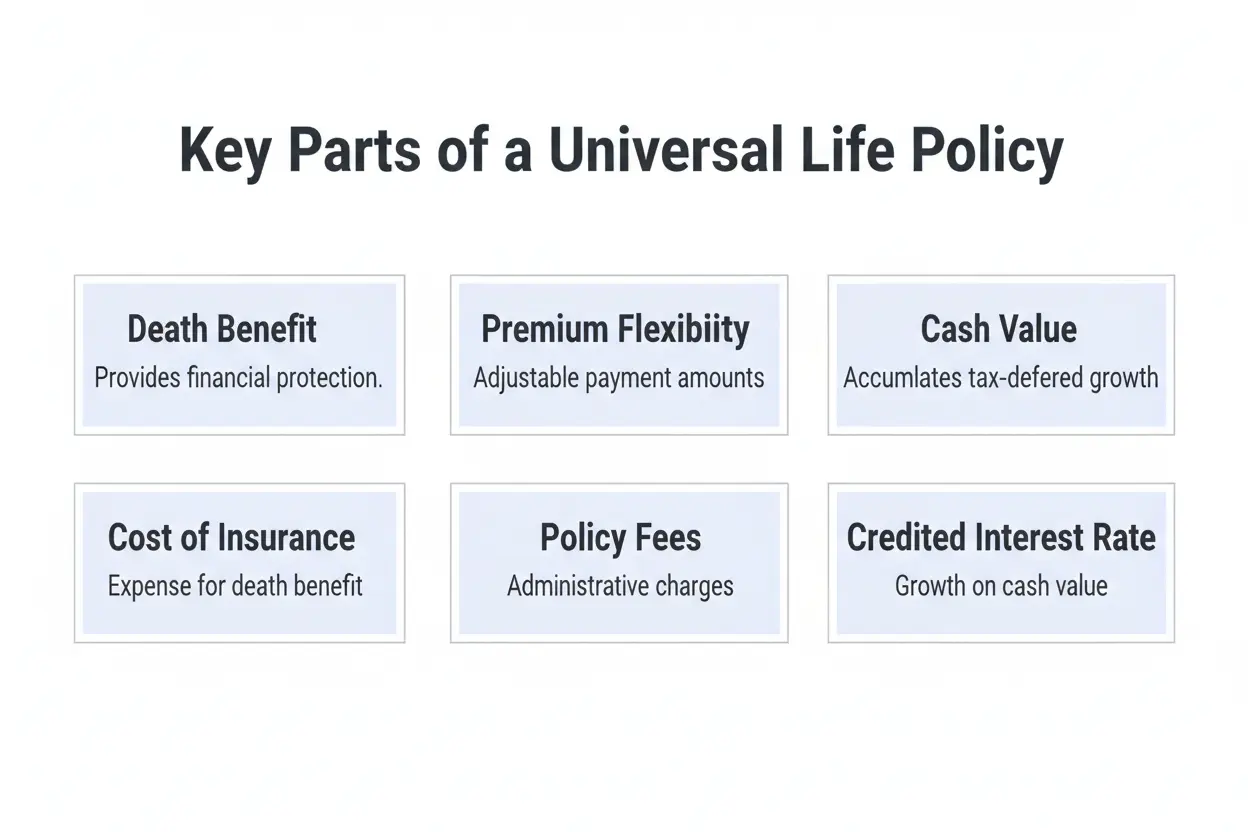
Universal Life (UL) insurance typically begins to make financial sense when an individual's net worth exceeds $1 million, particularly for high-income earners seeking tax-deferred growth. However, its most critical application occurs at the federal estate tax threshold—projected at approximately $7 million per individual in 2026—where it provides essential liquidity to cover tax liabilities.
Determining whether Universal Life insurance is a sophisticated financial tool or an unnecessarily expensive product depends heavily on your balance sheet, your tax bracket, and your long-term estate goals. As we navigate the financial landscape of 2026, the sunsetting of prior tax exemptions has shifted the "break-even" point for many families. To decide if UL fits your portfolio, you must look past the marketing myths and analyze the underlying mechanics of cash value accumulation, the cost of insurance (COI), and the legal framework of the Internal Revenue Code.
The Net Worth Thresholds: A Tiered Analysis
There is no single "magic number" that applies to everyone, but net worth categories provide a framework for when the internal costs of a Universal Life policy are outweighed by its tax and estate benefits.
The $0 to $500,000 Range: The "Term is King" Zone
For individuals in this bracket, Universal Life insurance rarely makes sense. At this level of wealth, the primary goal is income replacement for survivors. Term insurance provides the highest death benefit for the lowest premium, allowing the individual to invest the difference in low-fee index funds or employer-sponsored 401(k) plans. The administrative fees and commissions associated with UL policies would likely erode the relatively small amounts of capital available for investment.
The $500,000 to $2 Million Range: The Tax Diversification Tier
This is the "Mass Affluent" category where Universal Life—specifically Indexed Universal Life (IUL)—begins to appear in financial plans. For high-earning professionals who have already maximized their 401(k) and IRA contributions, a UL policy can act as a "Roth alternative." Because the cash value grows tax-deferred and can be accessed tax-free via policy loans, it provides a bucket of money that is immune to future income tax hikes. At this net worth, the decision usually hinges on whether the individual has the cash flow to "overfund" the policy to minimize the impact of the cost of insurance.
The $2 Million to $7 Million Range: The Business and Legacy Tier
In 2026, individuals in this range are often business owners or highly successful professionals. Here, Universal Life makes sense for specific structural reasons. Business owners use these policies for Buy-Sell agreements or Key Person insurance. Additionally, for those concerned about the "Stretch IRA" rules (which now require most non-spouse beneficiaries to deplete inherited IRAs within ten years), a UL policy can serve as a more tax-efficient vehicle for passing wealth to the next generation.
The $7 Million+ Range: The Estate Liquidity Tier
As of 2026, the significantly higher estate tax exemptions of the early 2020s have "sunset," returning to levels near $7 million for individuals (adjusted for inflation). For anyone with a net worth exceeding this amount, Universal Life insurance is no longer just an "option"—it is a strategic necessity for liquidity. When an estate is composed of illiquid assets like real estate or a private business, the IRS still demands estate taxes in cash within nine months of death. A UL policy held within an Irrevocable Life Insurance Trust (ILIT) provides the cash to pay the government without forcing a fire sale of family assets.
The "Cost of Insurance" Trap: Understanding the Mechanics
One of the most dangerous myths about Universal Life is that it is a "permanent" version of term insurance with a savings account attached. While technically true, the "Cost of Insurance" (COI) inside a UL policy is not level; it increases every year as the insured person gets older.
In the early years of a policy, the premiums paid are much higher than the actual cost of insuring your life. This excess goes into the cash value account and earns interest. In the later years (ages 75+), the COI often exceeds the annual premium. If the cash value account hasn't grown sufficiently, the policy will begin to eat itself, eventually lapsing just when the death benefit is needed most.
For a UL policy to "make sense," the policyholder must be committed to "Maximum Funding." This means paying in as much as the IRS allows without turning the policy into a Modified Endowment Contract (MEC). If you only pay the "target premium" suggested by an agent, there is a high statistical probability that the policy will fail in your 80s.
Myth vs. Fact: Debunking Common Misconceptions
The life insurance industry is rife with half-truths. To make an informed decision in 2026, you must distinguish between marketing "illustrations" and the economic reality of the contract.
| Feature | Myth | Fact |
|---|---|---|
| Returns | IUL policies can earn 10-12% annually like the S&P 500. | Returns are limited by "caps" and "participation rates." Net returns after fees are often 4-6%. |
| Flexibility | You can skip premiums whenever you want without consequence. | Skipping premiums reduces cash value, which can lead to policy lapse as the Cost of Insurance rises. |
| Safety | Universal Life is as safe as a savings account. | It is a long-term contract with surrender charges that can last 10-15 years. It is not liquid "emergency" money. |
| Costs | The fees are comparable to a mutual fund. | Fees include premium loads, expense charges, and mortality costs, which are often significantly higher than low-cost ETFs. |
| Taxes | Death benefits are always tax-free. | While death benefits are generally income tax-free, they are included in your taxable estate unless the policy is owned by an ILIT. |
Why 2026 is a Pivotal Year for Universal Life
The year 2026 marks a significant shift in the financial utility of permanent life insurance. The Tax Cuts and Jobs Act (TCJA) of 2017 doubled the federal estate tax exemption, making estate tax a non-issue for all but the ultra-wealthy. However, those provisions have now expired.
For a married couple in 2026, the combined exemption has dropped from approximately $27 million down to roughly $14 million. This "exemption cliff" has pushed millions of American families back into the territory where they owe 40% of their estate to the federal government. Universal Life insurance, specifically Guaranteed Universal Life (GUL), has become the primary tool for these families to "hedge" against this tax bill. Unlike Indexed or Variable UL, a GUL policy focuses strictly on the death benefit with a secondary emphasis on cash accumulation, guaranteeing the policy stays in force until age 121 as long as the premiums are paid.
The Importance of Product Selection
"Universal Life" is a broad category. Choosing the wrong type for your net worth can be a multi-million dollar mistake.
- Guaranteed Universal Life (GUL): Best for estate tax liquidity. It has little to no cash value but offers a guaranteed death benefit at a lower cost than Whole Life.
- Indexed Universal Life (IUL): Best for the "Mass Affluent" ($1M–$5M) looking for tax-deferred growth. Returns are tied to a market index (like the S&P 500) but usually have a "floor" of 0%, protecting against market losses.
- Variable Universal Life (VUL): Best for sophisticated investors with very high risk tolerance. The cash value is invested directly in sub-accounts (mutual funds). This carries the highest risk but the highest potential for growth.
When Universal Life is a Bad Idea
Despite the benefits for the wealthy, Universal Life is frequently sold to people who do not need it. If you fall into any of the following categories, a UL policy likely does not "make sense" regardless of the sales pitch:
- You have high-interest debt: No insurance policy's internal growth will outperform the cost of a 20% credit card or a 10% private student loan.
- You haven't maxed out your 401(k) or HSA: These vehicles have lower fees and more transparent tax benefits for those in middle-income brackets.
- You need the money in less than 15 years: The surrender charges on UL policies are draconian. If you cancel the policy in the first decade, you will likely walk away with less money than you put in.
- You are looking for "Investment Performance" only: If your only goal is the highest possible ROI, a taxable brokerage account with low-turnover ETFs will almost always outperform a life insurance policy over 30 years due to the lack of "mortality costs."
Comparing Wealth Strategies by Net Worth
The following table outlines how life insurance should generally fit into a broader financial plan based on your 2026 net worth.
| Net Worth | Primary Goal | Recommended Product | Strategic Role |
|---|---|---|---|
| <$500k | Protection | 20 or 30-Year Term | Debt payoff and family lifestyle protection. |
| $500k - $2M | Accumulation | Term + Max-Funded IUL | Supplemental tax-free retirement income. |
| $2M - $7M | Optimization | IUL or VUL | Alternative to "Stretch IRA" and business succession. |
| $7M - $15M | Conservation | GUL (Individual) | Liquidity for the 2026 Estate Tax "Exemption Cliff." |
| $15M+ | Transfer | Survivorship GUL | Paying estate taxes for the next generation via an ILIT. |
Technical Considerations: The "Internal Rate of Return" (IRR)
When evaluating a Universal Life policy, ignore the "Non-Guaranteed" columns in the illustration that show 7% or 8% growth. Instead, ask your advisor for the IRR on Death Benefit.
The IRR on Death Benefit calculates what your effective annual return would be if you died at a specific age. For high-net-worth individuals, a UL policy often shows an IRR of 5% to 7% at age 85. When you consider that this is a tax-free death benefit, the "tax-equivalent" yield might be 9% or 10% depending on your state of residence. This is the true metric of whether the policy makes sense: Can you find another investment that provides a guaranteed, tax-free 6% return upon your death? For the wealthy, the answer is often no, which justifies the use of UL.
Common Pitfalls and How to Avoid Them
The most frequent reason Universal Life insurance fails is underfunding. Many agents show a "minimum premium" to make the policy look affordable. In 2026, with higher administrative costs and volatile interest rates, minimum-funded policies are highly susceptible to lapsing.
Another pitfall is the failure to monitor the "Shadow Account" or the "Secondary Guarantee." In many GUL policies, if you are late on a single payment by even a few days, you might lose the lifetime guarantee, effectively turning your permanent policy into an expensive term policy.
Professional Advice Limitation: This article provides general financial information and is not intended as legal, tax, or financial advice. Life insurance regulations and tax laws are subject to change. Always consult with a qualified estate attorney or a Certified Financial Planner (CFP) before purchasing a complex permanent life insurance product.
Frequently Asked Questions
Is Universal Life insurance a good investment for a net worth of $1 million?
For a net worth of $1 million, Universal Life insurance is generally better viewed as a tax-management tool rather than a pure investment. If you have already maxed out other tax-advantaged accounts and are in a high tax bracket, the tax-free growth and loan provisions of an IUL can be beneficial. However, for most millionaires, the high fees and long-term commitment make it less efficient than a simple brokerage account unless there is a specific need for permanent death benefit protection.
How does the 2026 tax law change affect my insurance needs?
In 2026, the federal estate tax exemption levels have significantly decreased. This means that estates valued above approximately $7 million (individual) or $14 million (married couple) are now subject to a 40% federal tax. Universal Life insurance makes sense for people in this bracket because it provides the liquid cash needed to pay the IRS, preventing the need to sell off property or business interests.
Can I lose money in a Universal Life insurance policy?
Yes. In a Variable Universal Life (VUL) policy, you can lose money if the underlying market investments perform poorly. In an Indexed Universal Life (IUL) policy, you generally won't lose money due to market drops (because of the 0% floor), but you can lose cash value if the annual fees and cost of insurance exceed the interest credited to the account. If the cash value hits zero, the policy will lapse and you will lose the coverage.
What is the difference between Whole Life and Universal Life for high net worth?
Whole Life has fixed premiums and guaranteed growth, making it very stable but less flexible. Universal Life allows you to adjust your premiums and death benefit as your financial situation changes. For high-net-worth individuals, Universal Life is often preferred because it allows for "maximum overfunding," which can lead to higher tax-free growth potential than the more rigid Whole Life structure.
Is it true that I can use my UL policy to "be my own bank"?
This is a popular marketing concept often called "Infinite Banking." While you can take loans against your policy's cash value, it is not "free money." You are charged interest by the insurance company, and the loan amount reduces the death benefit if not repaid. This strategy only makes sense for those with high net worth who can afford to "overfund" the policy significantly in the first ten years.
Final Recommendation: The "Stress Test" Approach
Before committing to a Universal Life policy, request a "Stress Test" illustration. Ask the insurance carrier to show you how the policy performs if the interest rate is 2% lower than the current projection, or if the internal costs of insurance are increased to the "contractual maximum."
If your net worth is under $1 million, focus on term insurance and low-cost index funds. If your net worth is between $1 million and $7 million, consider an IUL only if you have the discipline to overfund it. If your net worth is over $7 million, consult with an estate attorney about using a Guaranteed Universal Life policy inside an ILIT to protect your heirs from the 2026 estate tax reality.