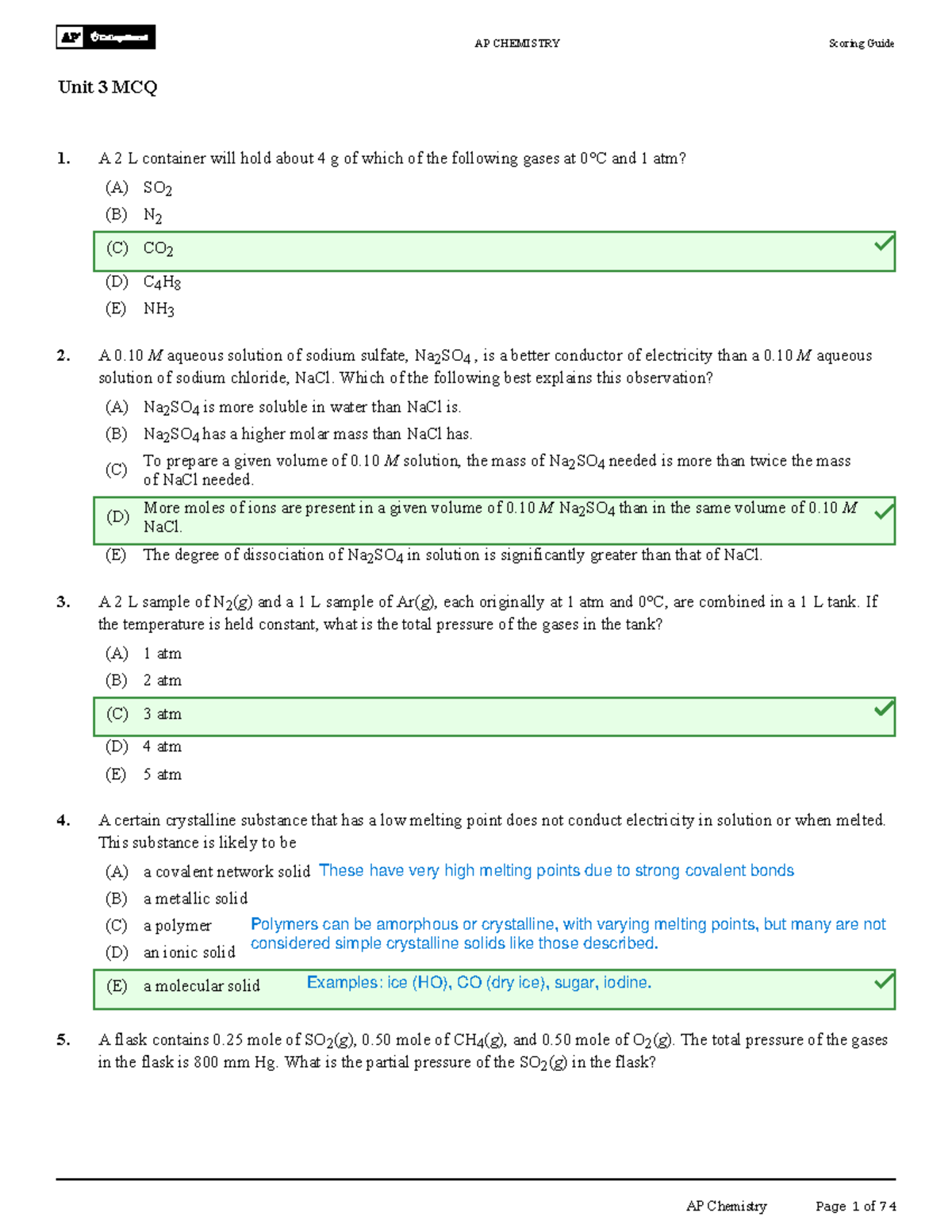
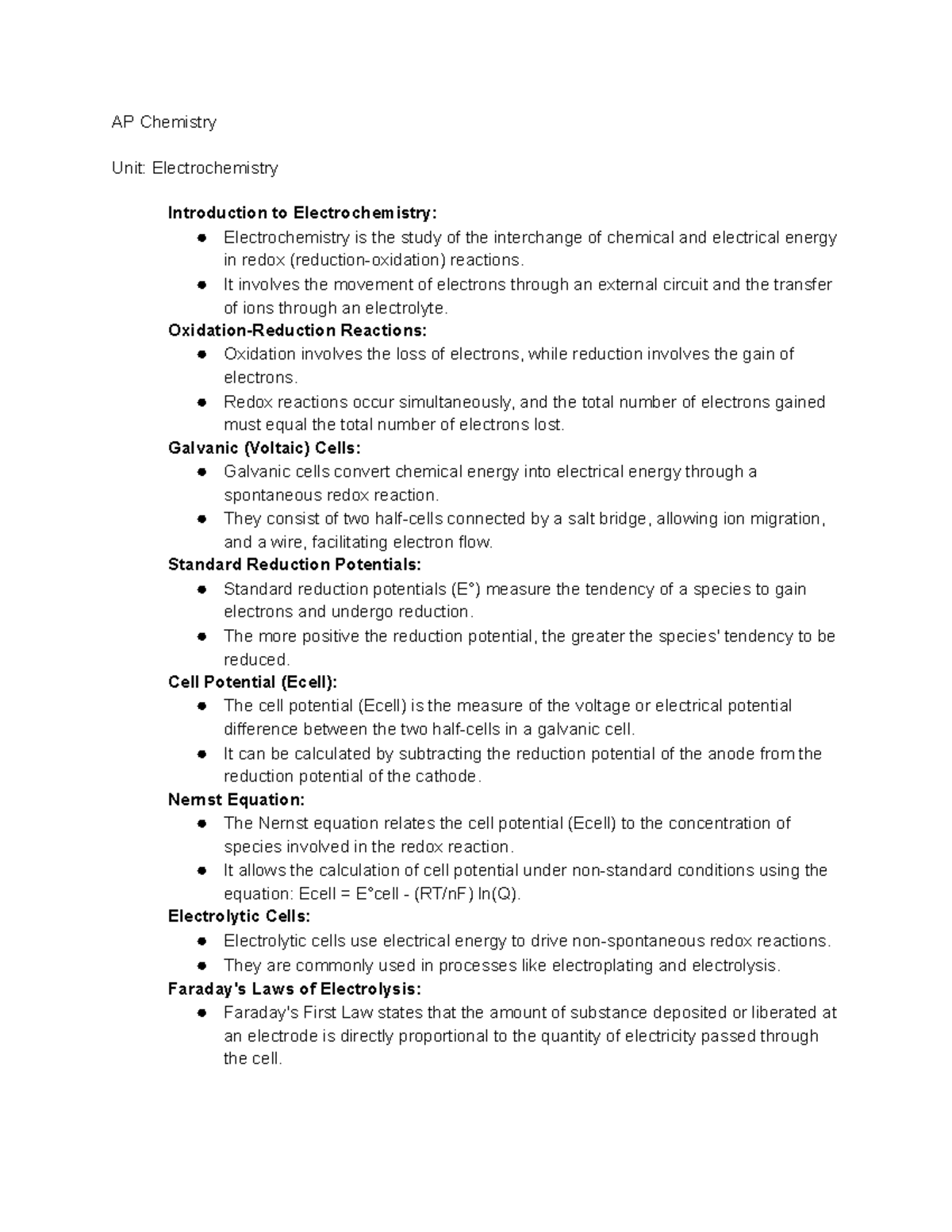
This comprehensive AP Chemistry Unit 3 study guide provides an in-depth analysis of intermolecular forces, the behavior of gases, the structure of solids and liquids, and the principles of spectroscopy. Mastering these concepts is essential for success on the 2026 AP Exam, as Unit 3 typically accounts for 18–22% of the total score.
Understanding the Foundations of Unit 3
Unit 3 of the AP Chemistry curriculum, titled Intermolecular Forces and Properties, shifts the focus from the internal structure of atoms and individual molecules to how those molecules interact with one another. While previous units cover the "intra-molecular" forces (the covalent and ionic bonds holding a single unit together), Unit 3 explores the "inter-molecular" forces (the attractions between separate units).
The strength and nature of these forces dictate the physical state of matter—solid, liquid, or gas—at a given temperature. Furthermore, these interactions explain why some substances have high boiling points while others evaporate instantly, why certain liquids mix and others separate, and how light interacts with matter to reveal its concentration or identity.
3.1 Intermolecular Forces (IMFs)
Intermolecular forces are the attractive forces that exist between molecules. It is vital to distinguish these from chemical bonds. Breaking an IMF is a physical change (like melting ice), while breaking a chemical bond is a chemical change.
London Dispersion Forces (LDFs)
London Dispersion Forces are the weakest type of IMF and are present in all molecules, whether polar or nonpolar. They arise from the constant motion of electrons, which can create a temporary, instantaneous dipole. This temporary dipole can then induce a dipole in a neighboring molecule.
- Polarizability: This is the ease with which the electron cloud of an atom or molecule can be distorted. As the number of electrons increases (usually associated with a larger molar mass), the polarizability increases, leading to stronger LDFs.
- Application: Larger molecules like $I_2$ are solids at room temperature due to high polarizability, while smaller molecules like $F_2$ are gases.
Dipole-Dipole Interactions
These forces occur between the permanent dipoles of polar molecules. The partial positive end of one polar molecule is attracted to the partial negative end of another.
- Strength: These are generally stronger than LDFs for molecules of similar size.
- Dipole Moment: The greater the electronegativity difference between atoms in the molecule, the larger the dipole moment and the stronger the dipole-dipole interaction.
Hydrogen Bonding
Hydrogen bonding is a specific, particularly strong type of dipole-dipole interaction. It occurs when hydrogen is covalently bonded to a highly electronegative atom—specifically Nitrogen (N), Oxygen (O), or Fluorine (F)—and is attracted to the lone pair on a nearby N, O, or F atom.
- Significance: Hydrogen bonding explains the unexpectedly high boiling point of water ($H_2O$) compared to other group 16 hydrides like $H_2S$.
Ion-Dipole Forces
These forces occur between an ion (like $Na^+$) and a polar molecule (like $H_2O$). This is the primary force responsible for the solubility of ionic compounds in water. The negative ends of water molecules surround the cations, and the positive ends surround the anions, a process known as hydration.
3.2 Properties of Solids
The arrangement of particles and the types of forces holding them together determine the macroscopic properties of solids. The AP Chemistry exam frequently asks students to categorize solids based on their characteristics.
| Solid Type | Particle Units | Primary Attractions | Properties | Examples |
|---|---|---|---|---|
| Ionic | Ions ($+$ and $-$) | Coulombic (Ionic Bonds) | High MP, brittle, conducts only when liquid/aqueous | $NaCl, MgO$ |
| Molecular | Molecules | IMFs (LDF, Dipole, H-bond) | Low MP, non-conducting | $H_2O, CO_2, C_{12}H_{22}O_{11}$ |
| Metallic | Metal Cations | Metallic Bonding (Delocalized $e^-$) | Malleable, ductile, high conductivity | $Fe, Cu, Au$ |
| Network Covalent | Atoms | Covalent Bonds | Extremely high MP, very hard, non-conducting | Diamond, $SiO_2, SiC$ |
Distinguishing Solids
One of the most common mistakes is confusing molecular solids with network covalent solids. Molecular solids (like sugar) are held together by weak IMFs, meaning they melt easily. Network covalent solids (like quartz) are held together by a continuous "network" of strong covalent bonds, making them incredibly difficult to melt or break.
3.3 Solids, Liquids, and Gases: Particulate Models
Visualizing matter at the particulate level is a core skill for Unit 3.
- Gases: Particles are in constant, random motion. They are far apart, meaning the volume of the particles themselves is negligible compared to the container's volume.
- Liquids: Particles are close together and in contact but can slide past one another. This allows liquids to take the shape of their container while maintaining a definite volume.
- Solids: Particles are packed tightly in a regular, repeating pattern (crystalline) or a disordered arrangement (amorphous). They vibrate in fixed positions.
When drawing particulate diagrams, ensure that the density of the particles reflects the state of matter and that any attractions (like H-bonds) are represented by dashed lines between molecules, not solid lines within them.
3.4 The Ideal Gas Law
The behavior of gases is described by the Ideal Gas Law: $PV = nRT$.
- P: Pressure (atm, torr, or kPa)
- V: Volume (Liters)
- n: Moles
- R: Ideal Gas Constant (0.08206 $L \cdot atm / mol \cdot K$)
- T: Temperature (Must be in Kelvin)
Combined Gas Law and Partial Pressures
If a gas undergoes a change in conditions, we use $\frac{P_1V_1}{T_1} = \frac{P_2V_2}{T_2}$. Furthermore, Dalton’s Law of Partial Pressures states that the total pressure of a mixture of gases is the sum of the pressures each gas would exert if it were alone: $P_{total} = P_A + P_B + ...$. The partial pressure of a gas is also proportional to its mole fraction ($X$): $P_A = X_A \cdot P_{total}$.
3.5 Kinetic Molecular Theory (KMT)
KMT provides a theoretical model to explain gas behavior. Its core postulates include:
- Gas particles are in continuous, random motion.
- The volume of gas particles is negligible compared to the container.
- Attractions and repulsions between particles are negligible.
- Collisions are perfectly elastic (no energy is lost).
- The average kinetic energy ($KE$) of the particles is proportional to the Absolute Temperature (Kelvin).
Maxwell-Boltzmann Distribution
This graph shows the distribution of particle speeds in a gas sample. At higher temperatures, the curve flattens and shifts to the right, indicating a higher average speed and a wider range of speeds. Heavier gases at the same temperature will have a distribution shifted to the left (slower average speed) because $KE = \frac{1}{2}mv^2$. If $KE$ is constant, a larger mass ($m$) must result in a smaller velocity ($v$).
3.6 Deviation from the Ideal Gas Law
In the real world, no gas is truly "ideal." Gases deviate from $PV = nRT$ under two specific conditions: High Pressure and Low Temperature.
- Low Temperature: Particles move slowly enough that the attractive forces (IMFs) between them become significant. This causes particles to "clump" slightly, leading to a measured pressure that is lower than predicted by the Ideal Gas Law.
- High Pressure: The particles are forced so close together that the volume of the particles themselves becomes a significant fraction of the total container volume. This leads to an actual volume that is higher than predicted for the "empty space" available.
The most "ideal" gases are small, nonpolar atoms like Helium ($He$), which have the weakest IMFs and the smallest volume.
3.7 Solutions and Mixtures
A solution is a homogeneous mixture composed of a solute (substance being dissolved) and a solvent (the dissolving medium).
- Molarity ($M$): The standard measure of concentration, defined as $moles \text{ of solute} / liters \text{ of solution}$.
- Particulate Representations: When drawing ionic solutions, ensure the water molecules are oriented correctly. The oxygen atom (partial negative) should face the cation, and the hydrogen atoms (partial positive) should face the anion.
3.8 Chromatography and Distillation
Separating mixtures is a practical application of Unit 3 concepts.
- Chromatography: This technique separates components based on their differential affinity for a stationary phase (like paper) and a mobile phase (the solvent). If the paper is polar and the solvent is nonpolar, a polar solute will stay near the bottom, while a nonpolar solute will travel further up the paper.
- Distillation: This separates liquids based on differences in boiling points. The substance with the weaker IMFs will have a lower boiling point and will vaporize first, allowing it to be condensed and collected separately.
3.9 Solubility and "Like Dissolves Like"
The phrase "like dissolves like" refers to the fact that substances with similar IMFs tend to be soluble in one another.
- Polar/Ionic Solutes: Dissolve well in polar solvents (like water) because the dipole-dipole or ion-dipole forces are strong enough to overcome the solute-solute attractions.
- Nonpolar Solutes: Dissolve well in nonpolar solvents (like hexane) because the LDFs are compatible.
- Immiscibility: Oil and water do not mix because the strong hydrogen bonds between water molecules effectively "squeeze out" the nonpolar oil molecules, which can only offer weak LDFs in return.
3.10 The Electromagnetic Spectrum and Spectroscopy
Spectroscopy is the study of the interaction between matter and electromagnetic radiation. Different regions of the spectrum affect matter in different ways:
- Microwave Radiation: Associated with transitions in molecular rotational levels.
- Infrared (IR) Radiation: Associated with transitions in molecular vibrational levels (bond stretching and bending).
- Ultraviolet/Visible (UV-Vis) Radiation: Associated with transitions in electronic energy levels (moving electrons between shells).
3.11 Beer-Lambert Law
The Beer-Lambert Law relates the absorption of light to the properties of the material through which the light is traveling. It is expressed as: $$A = \epsilon bc$$
- A: Absorbance (no units).
- $\epsilon$: Molar absorptivity (a constant specific to the solute).
- b: Path length (the width of the cuvette, usually 1 cm).
- c: Concentration (Molarity).
Practical Application
In a lab setting, you can create a standard curve by measuring the absorbance of several solutions with known concentrations. By plotting Absorbance vs. Concentration, you can use the linear relationship to determine the concentration of an unknown sample. If the absorbance is too high, the solution must be diluted to bring it into the linear range of the spectrophotometer.
Common Mistakes to Avoid
- Confusing Bonds and IMFs: Never say that "water boils because the $O-H$ bonds break." Water boils because the hydrogen bonds between molecules are overcome.
- Molarity Units: Always ensure the volume is in Liters, not milliliters, when calculating molarity.
- STP Conditions: Standard Temperature and Pressure (STP) is 0°C (273 K) and 1 atm. At STP, one mole of any ideal gas occupies 22.4 Liters. Do not use this value unless the gas is at STP.
- LDFs in Polar Molecules: Remember that polar molecules also have LDFs. Sometimes the LDFs in a large polar molecule are actually stronger than its dipole-dipole forces.
Frequently Asked Questions
What is the strongest intermolecular force?
The strongest intermolecular force is generally the ion-dipole force, followed by hydrogen bonding. However, it is important to remember that LDFs can become stronger than both in very large, highly polarizable molecules. For the AP exam, always compare the specific molecules provided rather than relying on a rigid hierarchy.
Why does boiling point increase with molar mass for nonpolar molecules?
As molar mass increases, the number of electrons increases. This makes the electron cloud more polarizable, which leads to stronger and more frequent temporary dipoles (London Dispersion Forces). Stronger IMFs require more thermal energy to overcome, resulting in a higher boiling point.
How do I identify which substance will deviate most from ideal gas behavior?
The substance that deviates the most will be the one with the strongest intermolecular forces or the largest molecular volume. For example, $H_2O$ gas will deviate more than $He$ gas because $H_2O$ can form hydrogen bonds and has a larger radius.
What is the difference between a photon and a vibration in spectroscopy?
A photon is a particle of light that carries energy. When a molecule absorbs a photon in the infrared range, that energy is converted into a molecular vibration (the bonds stretch or bend). In the UV-Vis range, the photon's energy is used to "kick" an electron to a higher energy level.
Can I use $PV=nRT$ for liquids?
No. The Ideal Gas Law and all related gas laws (Boyle's, Charles's, etc.) apply only to gases. For liquids and solids, properties are governed by density, IMFs, and structures, not the gas constant.
Final Recommendations for Study
To master Unit 3, you should focus heavily on the relationship between molecular structure and macroscopic properties. Practice drawing particulate diagrams frequently, as these are common on the Free Response Section (FRQ). Ensure you can explain why a property changes (e.g., "The boiling point is higher because the IMFs are stronger due to increased polarizability") rather than just stating that it does. Finally, review the Beer-Lambert Law lab procedures, as 2026 exam trends suggest a continued emphasis on laboratory-based data analysis.
For further practice, consult the official College Board AP Chemistry resources and past exam questions to familiarize yourself with the phrasing of Unit 3 prompts.