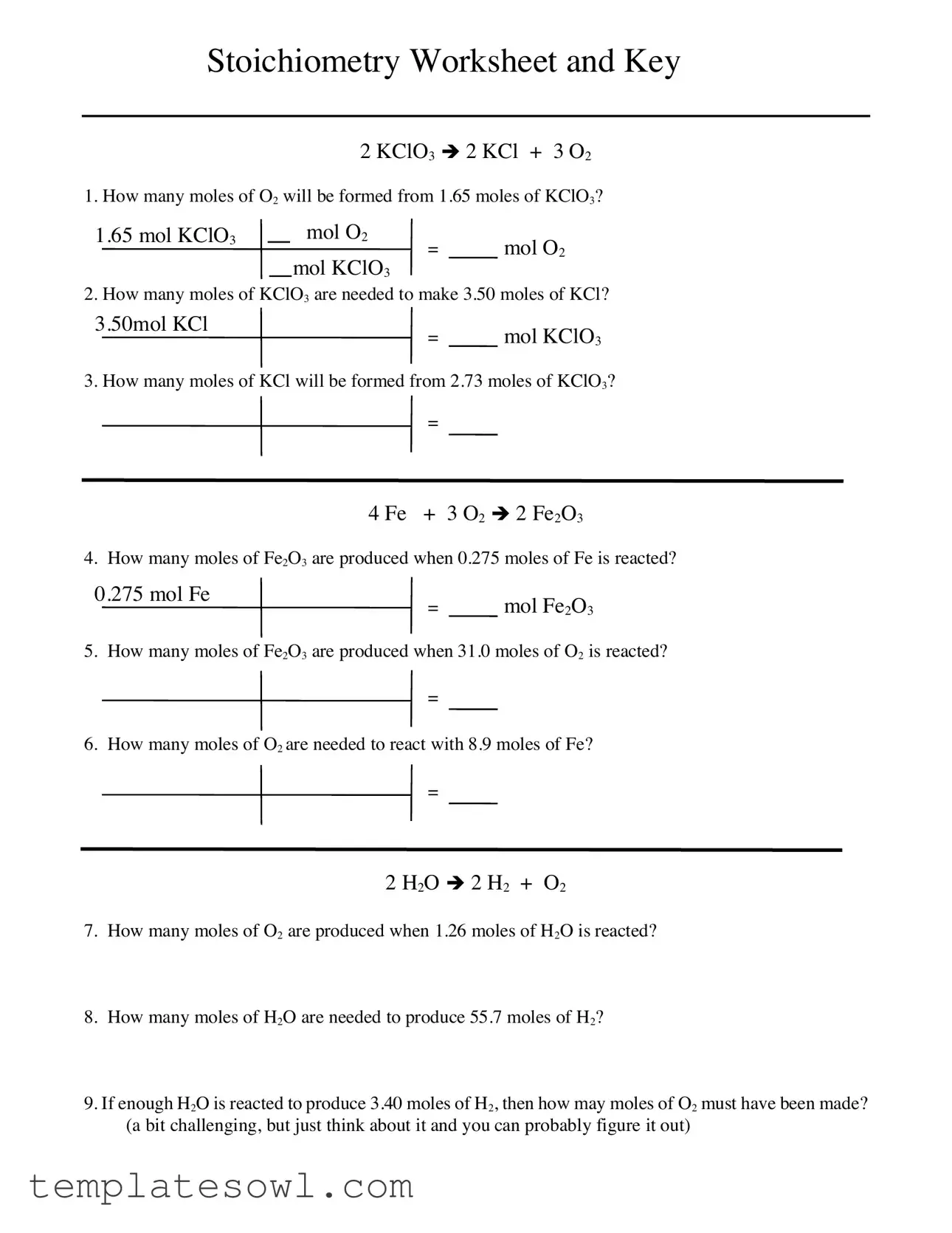
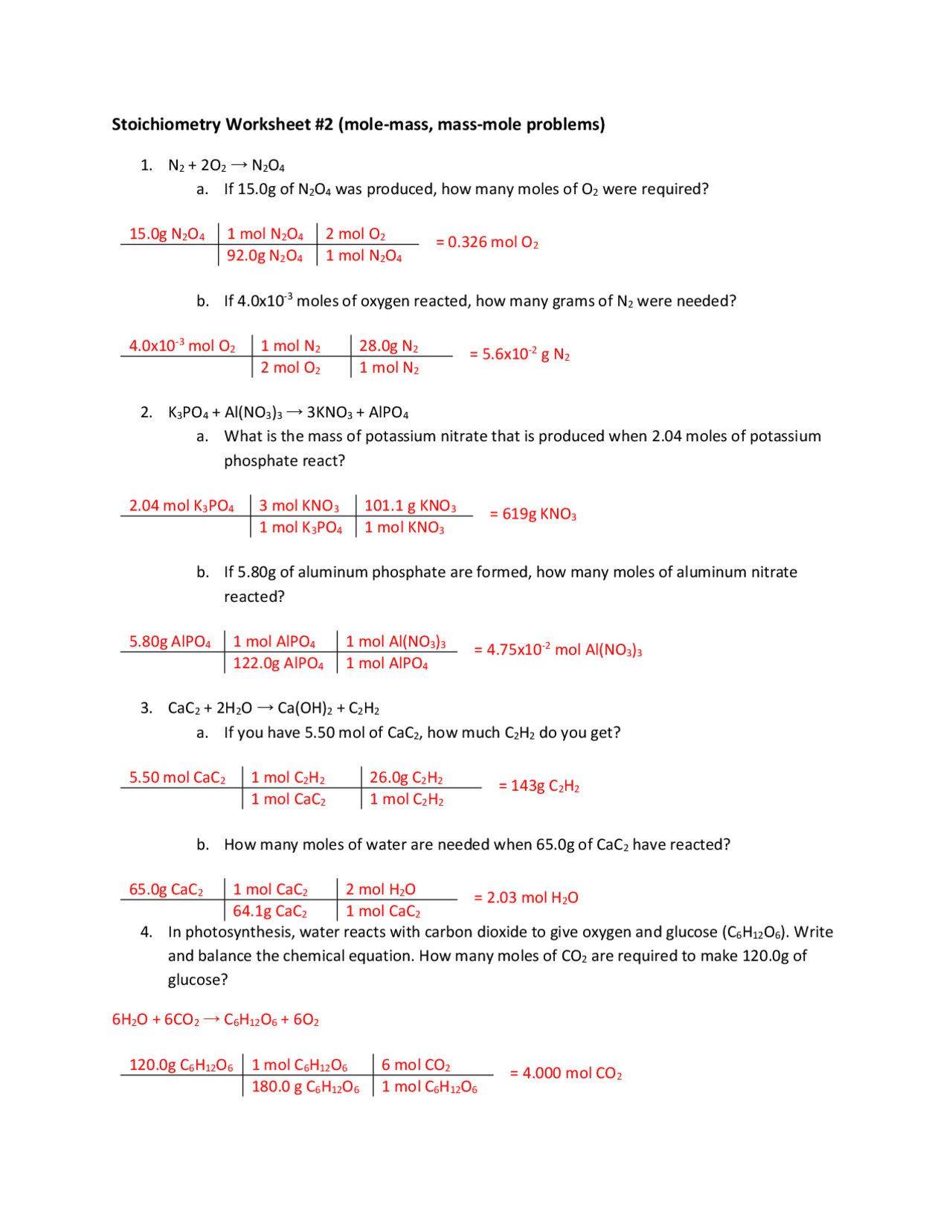
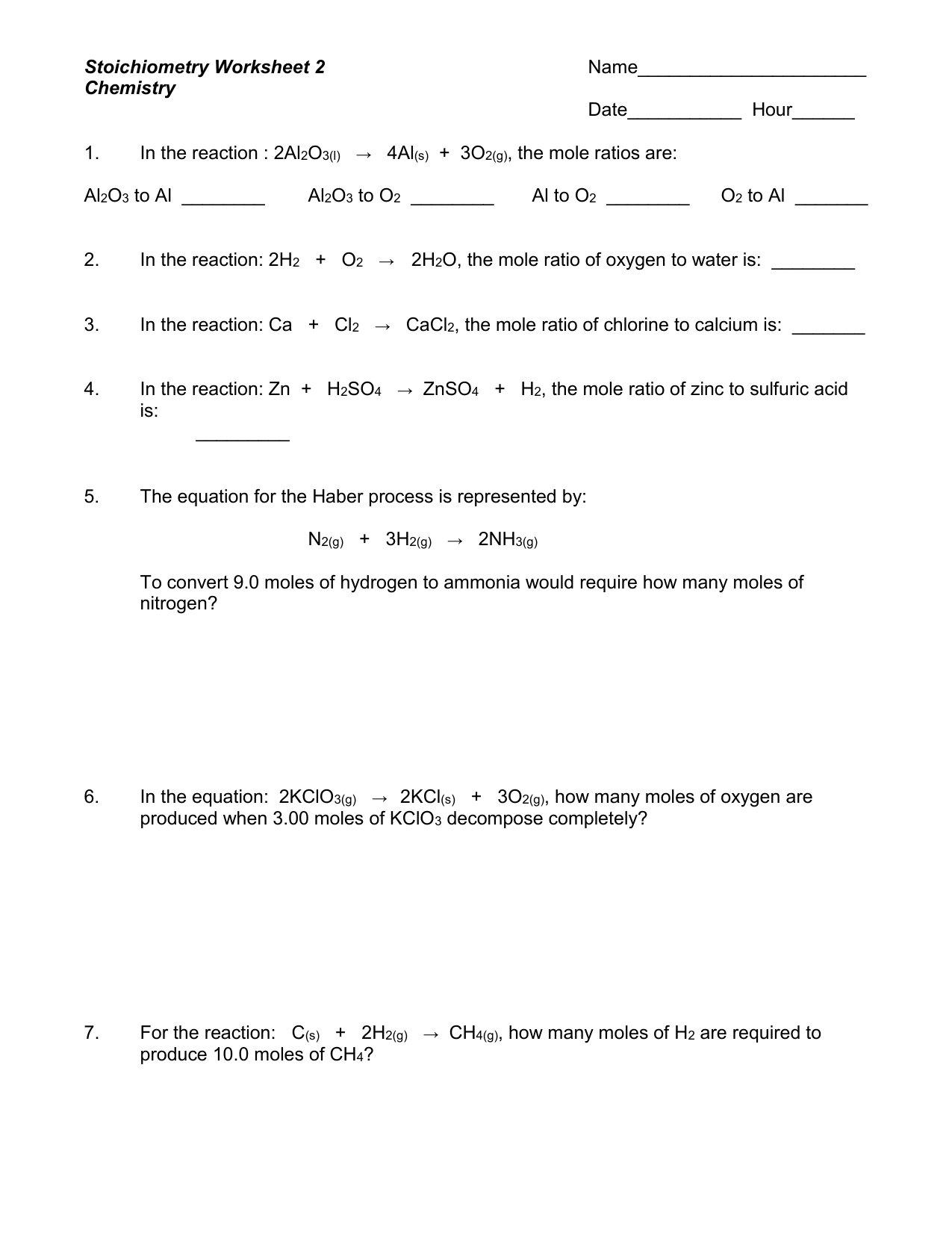
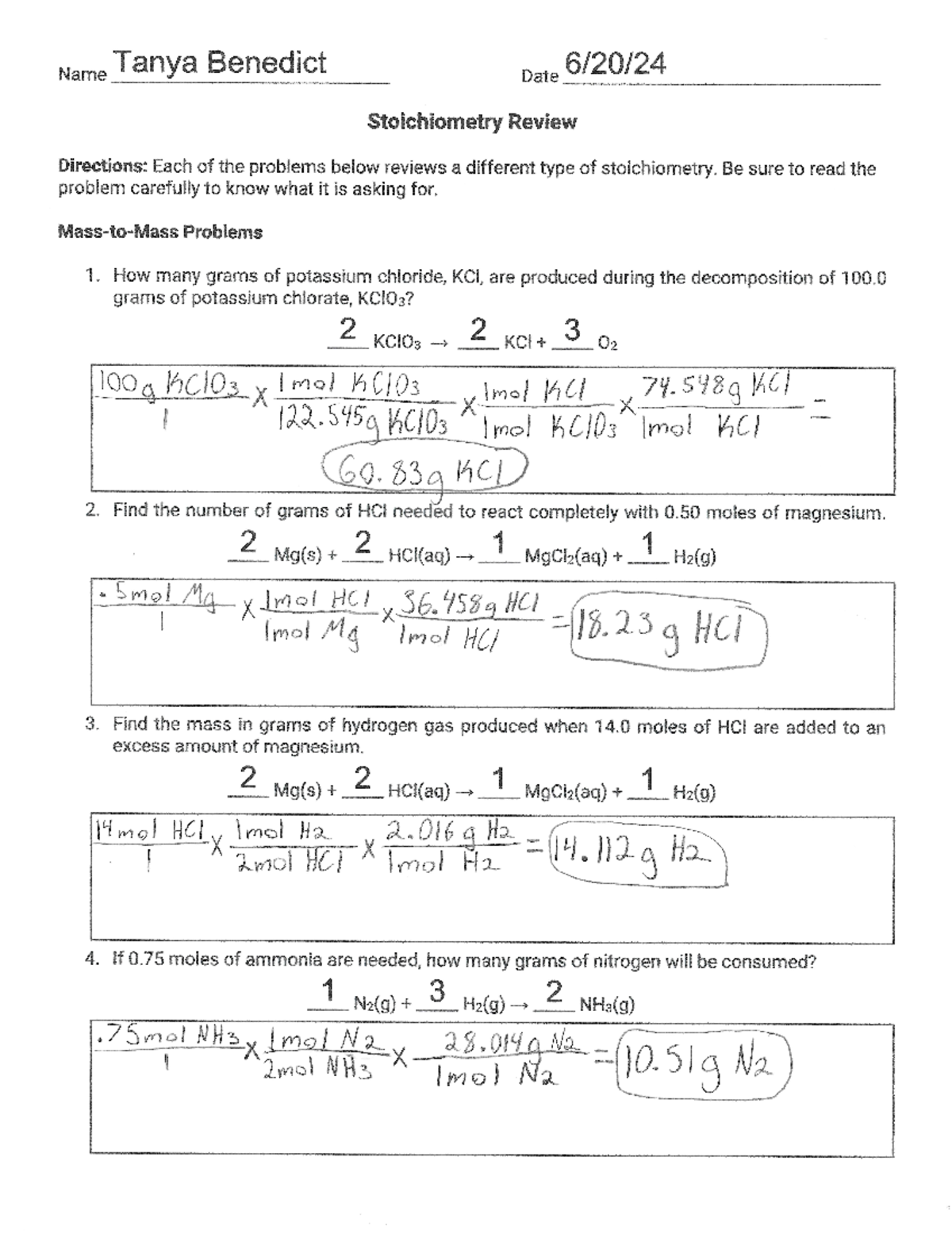
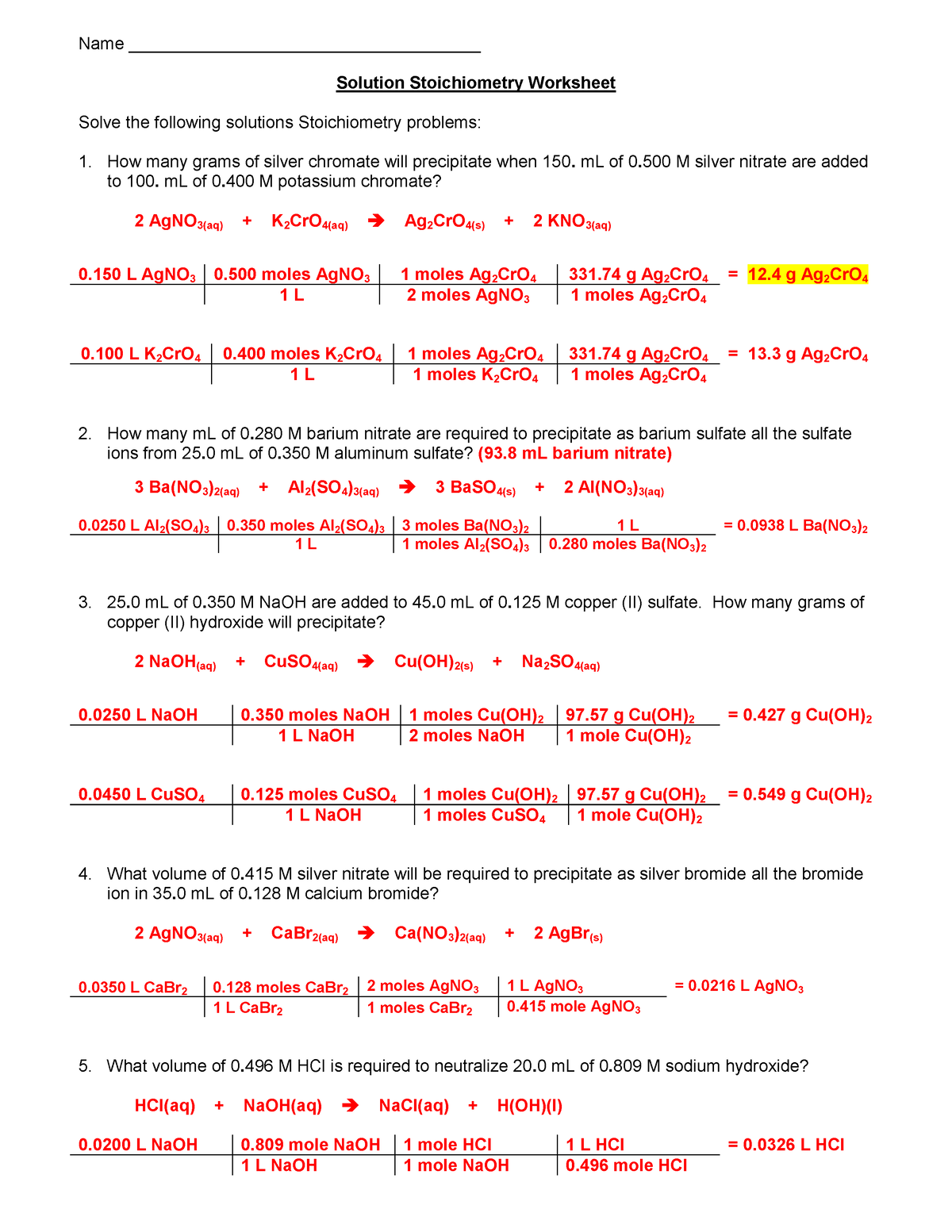
An AP Chemistry stoichiometry worksheet serves as the fundamental practice bridge between conceptual understanding and the mathematical precision required for the Advanced Placement exam. These worksheets provide the structured repetition necessary to master mole-to-mole ratios, limiting reactant identification, percent yield calculations, and the integration of gas laws and solution molarity into chemical equations.
In the current 2026 academic landscape, stoichiometry remains the "mathematical backbone" of the AP Chemistry curriculum. It is not merely a single unit but a pervasive skill that influences success in thermodynamics, equilibrium, and kinetics. To succeed, students must transition from simple "plug-and-chug" calculations to a deep, situational understanding of how matter is conserved and transformed during chemical reactions.
The Role of Stoichiometry in the AP Chemistry Curriculum
Stoichiometry is formally introduced in Unit 4 of the College Board’s Course and Exam Description (CED), but its applications are ubiquitous. Whether you are determining the amount of precipitate formed in a gravimetric analysis or calculating the volume of a gas produced in a combustion reaction, the underlying logic is always stoichiometric.
An effective AP-level worksheet does more than ask for molar masses; it challenges students to apply the Law of Conservation of Mass. In 2026, the AP Exam continues to emphasize the particulate nature of matter, meaning that worksheets now frequently include "particulate diagrams" where students must visualize molecules before and after a reaction to identify limiting reactants.
The "Mole Bridge" Concept
The central pillar of any stoichiometry worksheet is the mole bridge. Because we cannot measure moles directly in a laboratory setting, we use measurable quantities—mass, volume, and molarity—as entry points. The mole acts as the universal currency. A standard worksheet will guide you through:
- Mass to Moles: Using molar mass from the periodic table.
- Particles to Moles: Using Avogadro’s number ($6.022 \times 10^{23}$).
- Volume (Gases) to Moles: Using the Ideal Gas Law ($PV=nRT$) or molar volume at STP.
- Volume (Solutions) to Moles: Using Molarity ($M = n/V$).
Core Components of an AP-Level Stoichiometry Worksheet
To reflect the rigor of the 2026 exam, a high-quality worksheet must move beyond one-step conversions. Students should look for resources that integrate the following complex scenarios.
Limiting Reactant Problems
In real-world chemistry, reactants are rarely present in perfect stoichiometric proportions. One reactant will inevitably run out first, halting the reaction. Worksheets typically present these problems by providing the starting amounts of two or more reactants.
There are two primary methods taught for solving these:
- The Product Comparison Method: Calculate the amount of product formed from each reactant. The reactant that produces the smallest amount of product is the limiting reactant.
- The Reactant Comparison Method: Determine how much of Reactant B is needed to completely react with the given amount of Reactant A. If you have less than what is needed, Reactant B is limiting.
Theoretical, Actual, and Percent Yield
No laboratory reaction is perfect. Factors such as side reactions, incomplete mixing, or loss of product during filtration result in an actual yield that is lower than the theoretical yield (the maximum amount predicted by stoichiometry). Worksheets challenge students to calculate the efficiency of a reaction using the formula: $$\text{Percent Yield} = \left( \frac{\text{Actual Yield}}{\text{Theoretical Yield}} \right) \times 100$$
Solution Stoichiometry and Titrations
In AP Chemistry, many reactions occur in an aqueous state. Worksheets must therefore include problems involving molarity ($M$). Students often struggle with the "double-conversion" required here—converting volume and molarity to moles, performing the stoichiometric jump using the balanced equation, and then potentially converting back to a concentration for a final product.
Detailed Comparison of Stoichiometry Problem Types
Understanding the nuances of different problem types helps in selecting the right strategy during the timed AP Exam. The following table breaks down the most common worksheet categories encountered in 2026.
| Problem Type | Complexity | Key Equations/Constants | Common Pitfalls |
|---|---|---|---|
| Mole-to-Mole | Low | Balanced Equation Coefficients | Forgetting to balance the equation first. |
| Mass-to-Mass | Medium | Molar Mass ($g/mol$) | Using the coefficient in the molar mass calculation. |
| Limiting Reactant | High | BCA Tables or Product Comparison | Assuming the reactant with the smaller mass is limiting. |
| Gas Stoichiometry | High | $PV = nRT$; $R = 0.08206$ | Using $22.4,L$ for non-STP conditions. |
| Solution Stoichiometry | High | $M = n / V$ | Forgetting to convert $mL$ to $L$ before calculating. |
| Combustion Analysis | Very High | Conservation of Mass ($C \to CO_2$, $H \to H_2O$) | Failing to account for oxygen present in the original sample. |
Advanced Strategies for Solving Stoichiometry Worksheets
To master these worksheets, students should adopt professional habits that minimize errors and maximize clarity for AP graders.
The BCA (Before-Change-After) Table
While many students prefer dimensional analysis, the BCA Table is increasingly recommended by AP readers for limiting reactant problems.
- Before: List the initial moles of all reactants and products.
- Change: Use the stoichiometry of the balanced equation (multiplied by a factor '$x$') to show how much is consumed and produced.
- After: Calculate the final mole amounts.
This method is superior because it clearly shows the "excess" remaining, which is a frequent question on the Free Response Section (FRQ).
Dimensional Analysis and Units
Always include units in every step of your work. A common error on stoichiometry worksheets is "flipping" the conversion factor (e.g., putting $1,mol$ on the bottom when it should be on top). By writing out "grams of $O_2$" and "moles of $O_2$," you can visually confirm that your units cancel out, leaving only the desired unit for the final answer.
Significant Figures in 2026
The College Board typically allows for a variance of one significant figure. However, a worksheet is the best place to practice precision. Always use the molar masses provided on the official College Board Periodic Table, which are usually given to at least four significant figures. Rounding too early in a multi-step stoichiometry problem can lead to a "rounding error" that results in an incorrect final answer.
Finding and Using High-Quality Practice Resources
Not all worksheets are created equal. When searching for "ap chemistry stoichiometry worksheet" in 2026, look for resources that mirror the current exam style.
- College Board AP Classroom: This is the gold standard. The "Personal Progress Checks" contain stoichiometry problems that have been vetted for alignment with the current CED.
- ScienceGeek.net: A long-standing resource for chemistry students, offering interactive practice that provides immediate feedback on stoichiometric calculations.
- Flinn Scientific: Often provides rigorous laboratory-based stoichiometry worksheets that connect the math to physical observations.
- ChemLibreTexts: An excellent source for deep-dive theory if a particular concept on a worksheet, such as non-ideal gas stoichiometry, is proving difficult.
Troubleshooting Common Errors on Worksheets
If you find that your worksheet answers consistently disagree with the answer key, check for these frequent "AP Chemistry traps":
- Diatomic Elements: Remember that hydrogen, nitrogen, oxygen, fluorine, chlorine, bromine, and iodine exist as $H_2$, $N_2$, etc. Failing to use the correct molecular formula ($O_2$ instead of $O$) will result in a molar mass that is off by a factor of two.
- Hydrates: In mass-to-mass stoichiometry involving hydrates (e.g., $CuSO_4 \cdot 5H_2O$), the mass of the water must be included in the molar mass calculation.
- Incomplete Net Ionic Equations: On some worksheets, you may be asked for the stoichiometry of a precipitation reaction. Ensure you are focusing on the ions that actually form the precipitate, rather than the spectator ions, unless the question specifically asks for "total ion concentration."
- Intermediate Rounding: Keep the full number in your calculator until the very final step. If you round to two decimal places at every step of a five-step stoichiometry problem, your final result may be off by several percent.
The Importance of Particulate Representations
A major shift in AP Chemistry education over the last several years, continuing into 2026, is the move toward "conceptual stoichiometry." A worksheet should not just be numbers. It should include boxes representing a container. If the box shows 4 molecules of $H_2$ and 4 molecules of $O_2$, and the reaction is $2H_2 + O_2 \to 2H_2O$, you must be able to draw the 4 molecules of $H_2O$ and the 2 remaining molecules of excess $O_2$.
This visual mastery proves that you understand the ratio of the reaction, not just the algorithm for solving it. It is this level of understanding that distinguishes a score of a 4 from a 5 on the AP Exam.
Frequently Asked Questions
How do I identify a limiting reactant on an AP Chemistry worksheet?
To identify a limiting reactant, you must compare the number of moles of each reactant to their stoichiometric coefficients in the balanced equation. The easiest way is to calculate how many moles of a single product each reactant could theoretically produce. The reactant that produces the smallest amount of product is the limiting reactant. This is a critical skill because all subsequent calculations for product yield and excess reactants must be based on the limiting reactant.
Do I need to use 22.4 L/mol for gas stoichiometry problems?
You should only use the molar volume of 22.4 L/mol if the problem explicitly states that the gas is at Standard Temperature and Pressure (STP), which is $0^\circ C$ (273.15 K) and $1,atm$. In many AP Chemistry problems, the conditions are not at STP (e.g., $25^\circ C$ or $298,K$). In these cases, you must use the Ideal Gas Law ($PV = nRT$) to find the number of moles before proceeding with the stoichiometry.
What is the "one-off" rule for significant figures in AP Chemistry?
The "one-off" rule is an informal term used by AP Chemistry graders. Generally, you are expected to report your answer with the correct number of significant figures based on the data provided in the problem. However, credit is usually still awarded if your answer has one more or one less significant figure than the "ideal" number. Despite this, practicing strict significant figure rules on your stoichiometry worksheets is recommended to ensure you never lose points for precision on the FRQ section.
Why is my percent yield higher than 100% on my worksheet?
In theory, a percent yield cannot exceed 100% because that would violate the Law of Conservation of Mass. If you calculate a yield over 100% on a worksheet or in a lab report, it usually indicates one of three things: the product was not fully dried (contained excess water weight), there were impurities in the final product, or a calculation error occurred (often swapping the actual and theoretical yields in the formula).
How do I handle stoichiometry with multiple reactions?
For multi-step reactions (consecutive reactions), find the "intermediate" substance that is a product of the first reaction and a reactant in the second. Use stoichiometry to find the moles of the intermediate produced in the first step, and then use that amount as the starting point for the second step. You can also combine the equations into one "net" equation by scaling them so the intermediate cancels out, though this is often more complex for beginners.
Next Steps for Success
After completing a stoichiometry worksheet, the best next step is to attempt a released Free Response Question (FRQ) from a past AP Exam. Focus specifically on questions labeled "Quantitative Analysis" or "Chemical Reactions." Check your work against the official scoring guidelines to ensure your "setup"—the way you show your work—aligns with what AP readers expect. Mastering the worksheet is the first step; applying that knowledge under the pressure of a timed exam is the final goal.