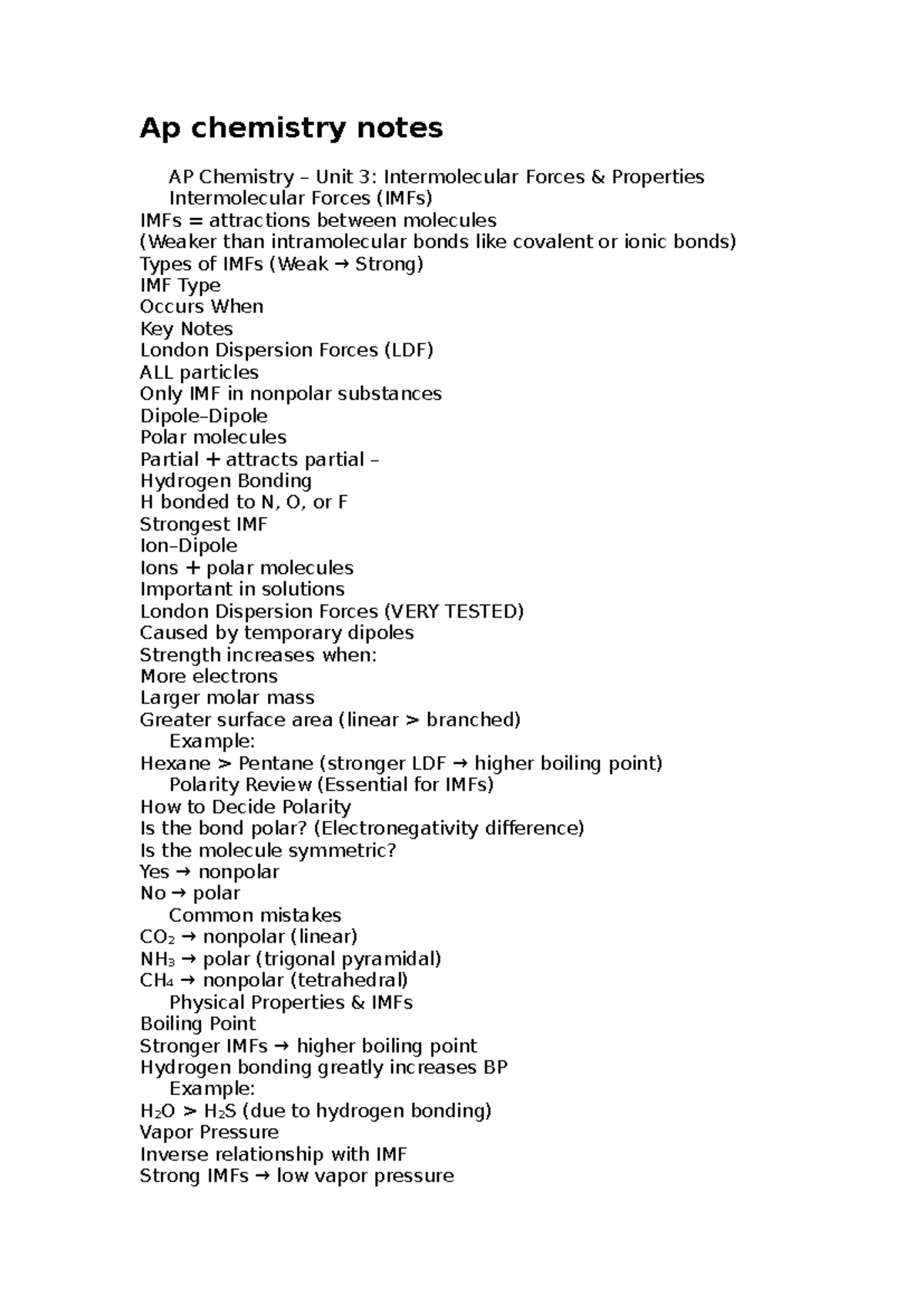
Intermolecular forces (IMFs) are the attractive forces that exist between molecules, determining the physical state, boiling point, and solubility of a substance. In AP Chemistry, understanding the hierarchy of London dispersion forces, dipole-dipole interactions, and hydrogen bonding is crucial for predicting how molecular structures dictate macroscopic properties and chemical behavior.
Understanding the Foundation: Intermolecular vs. Intramolecular Forces
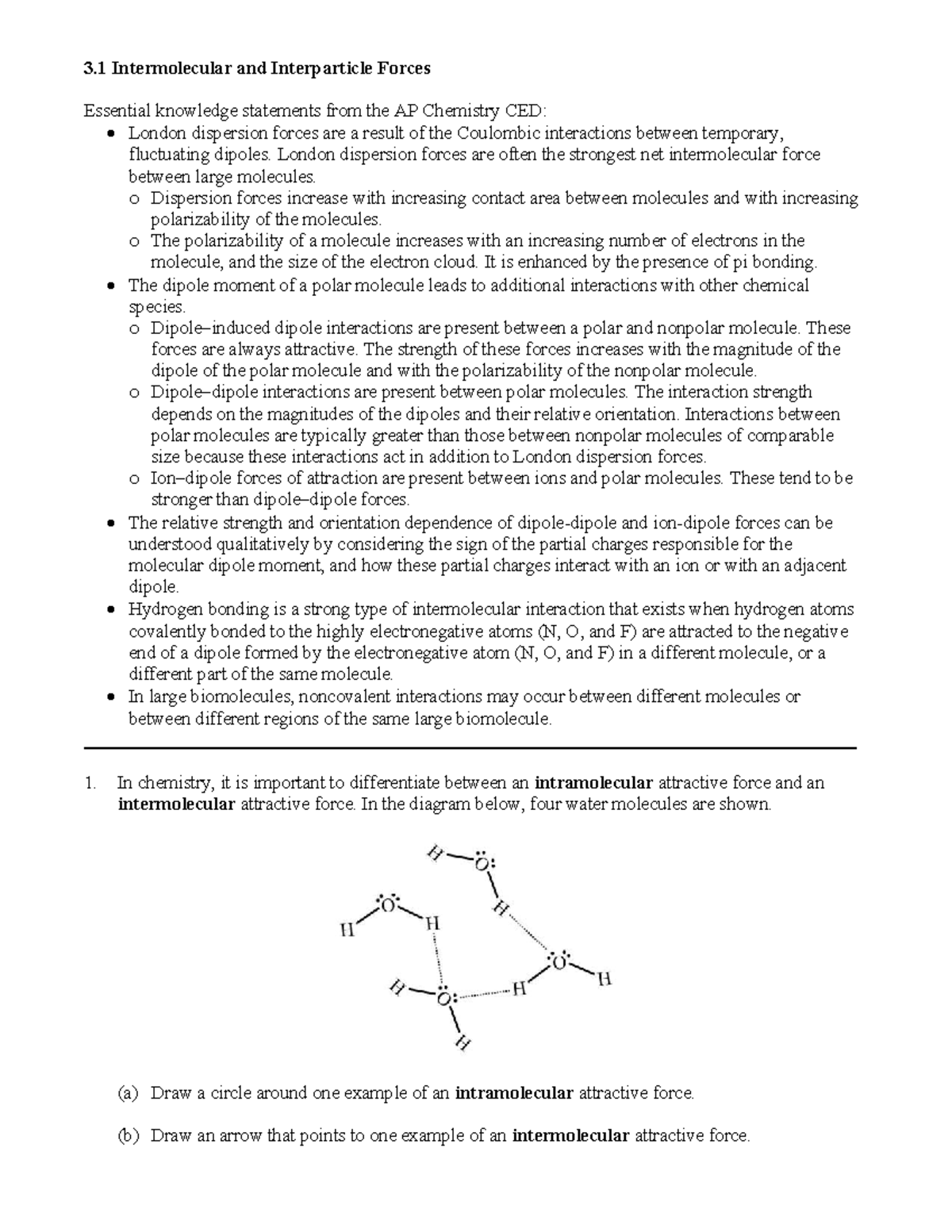
To succeed in AP Chemistry, students must first distinguish between forces that hold a single molecule together and forces that act between separate molecules. Intramolecular forces are the chemical bonds—ionic, covalent, or metallic—that hold atoms together within a molecule or lattice. These are significantly stronger than intermolecular forces and require substantial energy to break, typically during a chemical reaction.
Intermolecular forces (IMFs), by contrast, are the attractive forces between neighboring molecules. While much weaker than covalent or ionic bonds, IMFs are responsible for the existence of condensed phases (liquids and solids). When a substance boils or melts, it is the IMFs being overcome, not the intramolecular covalent bonds. For the 2026 AP exam, you must be able to articulate that phase changes are physical processes involving the disruption of IMFs, while chemical changes involve the breaking of intramolecular bonds.
All IMFs are fundamentally Coulombic in nature. They arise from the electrostatic attractions between positive and negative charges, whether those charges are permanent dipoles, temporary fluctuations in electron density, or full ionic charges.
The Hierarchy of Intermolecular Forces
The AP Chemistry curriculum categorizes IMFs into four primary types. Understanding the relative strengths and requirements for each is the cornerstone of Unit 3.
1. London Dispersion Forces (LDFs)
London dispersion forces are the only IMFs present in nonpolar molecules, but they exist in all molecules, whether polar or nonpolar. These forces result from the constant motion of electrons, which can create a temporary, instantaneous dipole in one molecule. This temporary dipole then induces a dipole in a neighboring molecule, leading to a weak attraction.
The strength of LDFs depends on the polarizability of the electron cloud. Polarizability is the ease with which an electron cloud can be distorted. In larger atoms or molecules with more electrons, the electron cloud is farther from the nucleus and more easily shifted. Therefore, as molar mass increases (and more specifically, as the number of electrons increases), the polarizability increases, leading to stronger London dispersion forces and higher boiling points.
2. Dipole-Dipole Interactions
Dipole-dipole forces occur between molecules that possess permanent dipoles—in other words, polar molecules. These molecules have an asymmetrical distribution of charge due to differences in electronegativity between bonded atoms and a molecular geometry that does not cancel those dipoles out.
In a liquid or solid, polar molecules align themselves so that the positive end of one molecule is near the negative end of another. These interactions are generally stronger than LDFs for molecules of comparable size. However, it is a common mistake to assume dipole-dipole forces are always stronger than LDFs; a very large nonpolar molecule can have stronger LDFs than a small polar molecule's dipole-dipole attractions.
3. Hydrogen Bonding
Despite the name, a hydrogen bond is an intermolecular attraction, not a covalent bond. It is a specific, particularly strong type of dipole-dipole interaction. For a hydrogen bond to form, a hydrogen atom must be covalently bonded to a highly electronegative atom—specifically Nitrogen (N), Oxygen (O), or Fluorine (F).
The high electronegativity of N, O, or F pulls the shared electrons away from the hydrogen, leaving the hydrogen nucleus (a bare proton) partially exposed. This creates a very strong partial positive charge that is attracted to the lone pair of electrons on an N, O, or F atom of a neighboring molecule. This force explains the unusually high boiling points of water ($H_2O$), ammonia ($NH_3$), and hydrogen fluoride ($HF$).
4. Ion-Dipole Forces
Ion-dipole forces occur between an ion (such as $Na^+$ or $Cl^-$) and a polar molecule (such as $H_2O$). This is the primary force responsible for the solubility of ionic compounds in water. When a salt dissolves, the polar water molecules surround the ions—the negative oxygen ends toward the cations and the positive hydrogen ends toward the anions—forming a hydration shell. These forces are generally stronger than hydrogen bonding because they involve a full ionic charge rather than just partial charges.
Comparing Intermolecular Forces
The following table summarizes the key characteristics of the primary IMFs encountered in the AP Chemistry curriculum.
| Force Type | Occurs Between... | Relative Strength | Example |
|---|---|---|---|
| London Dispersion | All molecules (only force for nonpolar) | Weakest (variable by size) | $CH_4, N_2, Ar$ |
| Dipole-Dipole | Polar molecules | Moderate | $HCl, SO_2$ |
| Hydrogen Bonding | Molecules with H-F, H-O, or H-N bonds | Strong | $H_2O, NH_3, DNA$ |
| Ion-Dipole | Ions and polar molecules | Strongest | $NaCl(aq)$ |
Impact of IMFs on Physical Properties
One of the most frequent tasks on the AP exam is to predict or explain the physical properties of a substance based on its IMFs.
Boiling and Melting Points
Boiling and melting points are direct measures of IMF strength. To transition from a solid to a liquid or a liquid to a gas, molecules must gain enough kinetic energy to overcome the attractive forces holding them together. Therefore, stronger IMFs lead to higher boiling and melting points. When comparing two substances, identify the types of IMFs in each. If one has hydrogen bonding and the other only has LDFs, the one with hydrogen bonding will typically have the higher boiling point.
Vapor Pressure
Vapor pressure is the pressure exerted by a gas in equilibrium with its liquid phase in a closed container. Molecules with weak IMFs can easily escape the liquid phase into the gas phase. Consequently, substances with weak IMFs have high vapor pressures (they are volatile), while substances with strong IMFs have low vapor pressures. This inverse relationship is a frequent target for multiple-choice questions.
Surface Tension and Viscosity
- Surface Tension: This is the resistance of a liquid to increase its surface area. Molecules at the surface are pulled inward by IMFs, creating a "skin." Stronger IMFs result in higher surface tension.
- Viscosity: This is a measure of a liquid's resistance to flow. Molecules that attract each other strongly do not slide past one another easily. Therefore, stronger IMFs lead to higher viscosity (thicker liquids).
Solubility and the "Like Dissolves Like" Rule
The principle of "like dissolves like" is an application of IMF theory. For a solute to dissolve in a solvent, the new attractions formed between the solute and solvent must be strong enough to overcome the attractions originally holding the solute together and the solvent together.
- Polar solutes (and ionic compounds) tend to dissolve in polar solvents because they can form dipole-dipole or ion-dipole attractions.
- Nonpolar solutes tend to dissolve in nonpolar solvents because they can interact via London dispersion forces.
- If you attempt to mix a polar solvent (like water) and a nonpolar solute (like oil), the water molecules' attraction to each other (hydrogen bonding) is much stronger than their attraction to the oil. Thus, the water molecules stay grouped together, and the oil is excluded, leading to immiscibility.
IMFs in Biological and Large Molecules
By 2026, the AP Chemistry exam continues to emphasize the application of chemistry to biological systems. IMFs play a vital role in the structure of life:
- DNA Structure: The two strands of the DNA double helix are held together by hydrogen bonds between nitrogenous bases (Adenine-Thymine and Guanine-Cytosine). These bonds are strong enough to hold the strands together but weak enough to be "unzipped" during replication.
- Protein Folding: The complex 3D shapes of proteins are maintained by a combination of hydrogen bonding, dipole-dipole interactions, and LDFs (hydrophobic interactions) between amino acid side chains.
- Synthetic Polymers: The strength and flexibility of plastics and fibers (like Nylon or Kevlar) are often due to extensive hydrogen bonding between polymer chains.
Strategies for the AP Exam: Avoiding Common Mistakes
To maximize your score in Unit 3, keep these technical nuances in mind:
- Don't use the word "Bond": Unless you are talking about hydrogen bonding, avoid using "bond" to describe IMFs. Use "forces," "interactions," or "attractions." Referring to dipole-dipole "bonds" can lead to point deductions for lack of clarity between inter- and intramolecular forces.
- Address Polarizability: When explaining why a larger nonpolar molecule has a higher boiling point than a smaller one, you must use the term "polarizable." State that the larger molecule has more electrons, leading to a more polarizable electron cloud and stronger temporary dipoles.
- Compare Comparable Masses: When comparing the strength of different types of IMFs (e.g., LDF vs. Dipole-Dipole), the comparison is most valid between molecules of similar size and mass. If the molecules are very different in size, the LDFs in the larger molecule might actually outweigh the dipole-dipole forces in the smaller one.
- Identify the specific H-bond: If asked to draw or describe a hydrogen bond, ensure the bond is between the H of one molecule and the lone pair of the N, O, or F of the other molecule.
Frequently Asked Questions
Why do some nonpolar molecules have higher boiling points than polar molecules?
This occurs when the nonpolar molecule is significantly larger than the polar one. A large nonpolar molecule (like $I_2$) has a very large, highly polarizable electron cloud, creating London dispersion forces that are stronger than the dipole-dipole forces in a small polar molecule (like $HCl$). Always check the size and electron count before assuming dipole-dipole is stronger.
Is a hydrogen bond a real chemical bond?
No. Despite the name, it is an intermolecular attraction. It is about 5% to 10% as strong as a typical covalent bond. It does not involve the sharing or transfer of valence electrons to form a new chemical species; rather, it is an electrostatic attraction between partial charges.
How does molecular shape affect London dispersion forces?
Long, linear molecules have more surface area contact with neighboring molecules than compact, spherical molecules of the same molar mass. Increased surface area allows for more points of attraction for LDFs, resulting in a higher boiling point. For example, n-pentane has a higher boiling point than neopentane because its linear shape allows for more effective "stacking" and induced dipoles.
What is the difference between an induced dipole and a permanent dipole?
A permanent dipole exists in polar molecules due to fixed differences in electronegativity. An induced dipole is a temporary shift in the electron cloud of an otherwise nonpolar atom or molecule, caused by the proximity of another charged or polar species.
Why is vapor pressure inversely proportional to IMF strength?
Vapor pressure measures the tendency of molecules to escape into the gas phase. Strong IMFs act like "molecular glue," holding particles in the liquid phase. The stronger the glue, the fewer molecules can break free at a given temperature, resulting in fewer gas particles and lower pressure.
Can hydrogen bonding occur with atoms other than N, O, and F?
In the context of the AP Chemistry curriculum, hydrogen bonding is strictly limited to H bonded to N, O, or F. While very weak "hydrogen-bond-like" interactions can occur with sulfur or chlorine in advanced organic chemistry, they are not considered true hydrogen bonds for the 2026 AP exam standards.
Final Recommendation for 2026 Students
When preparing for the AP Chemistry exam, do not simply memorize the types of intermolecular forces. Instead, practice the claim-evidence-reasoning (CER) method for Free Response Questions. Always start by identifying the IMFs present in each substance (Claim), describe the structural features like polarizability or electronegativity that create those forces (Evidence), and finally, link those forces to the specific physical property mentioned in the question (Reasoning). Mastering this explanatory chain is the most effective way to secure a 5 on the exam.