Annual yield is the total return an investor earns on an investment over one year, expressed as a percentage of the initial investment or its current market value. It serves as a vital tool for comparing the profitability of different assets, including stocks, bonds, and savings accounts.
What is Annual Yield and Why Does It Matter?
In the financial landscape of 2026, understanding annual yield is more critical than ever. As market volatility and shifting interest rates influence portfolio performance, yield remains the primary metric for measuring the "cash-on-cash" return of an asset. Unlike total return, which includes both income and capital gains (the increase in the asset's price), annual yield focuses specifically on the income generated—such as dividends, interest, or rent—relative to the cost or value of the investment.
For an investor, the annual yield is the "paycheck" an investment provides. Whether you are a retiree looking for steady income to cover living expenses or a growth-oriented investor looking to reinvest dividends for compounding, the yield tells you how hard your capital is working for you on a recurring basis. It allows for an "apples-to-apples" comparison across diverse sectors; for instance, it helps you decide whether a bond paying 5% interest is more attractive than a stock with a 3.5% dividend yield, accounting for their respective risk profiles.
The Critical Distinction: APY vs. APR
One of the most frequent points of confusion for investors is the difference between Annual Percentage Yield (APY) and Annual Percentage Rate (APR). While they sound similar, the mathematical difference can significantly impact your long-term wealth.
Annual Percentage Rate (APR)
APR represents the simple interest rate over a year. It does not account for the effects of compounding within that year. APR is most commonly used in the context of debt, such as mortgages, auto loans, or credit cards. If you have a loan with a 6% APR, you are essentially paying 0.5% interest per month on the principal.
Annual Percentage Yield (APY)
APY is the "effective" annual rate because it accounts for compounding interest. Compounding occurs when the interest you earn is added back to your principal, and you subsequently earn interest on that interest. Because of this, the APY will always be equal to or higher than the APR.
In 2026, with most digital banking platforms offering daily or monthly compounding, the gap between APR and APY is a vital consideration for savers. For example, a high-yield savings account with a 4.00% APR compounded monthly results in an APY of approximately 4.07%. Over a decade with a large balance, that 0.07% difference represents a meaningful amount of additional capital.
How Annual Yield Manifests Across Asset Classes
Annual yield is not a monolithic concept; its calculation and implications vary depending on what you are investing in. Understanding these nuances prevents investors from making flawed comparisons.
1. Dividend Yield (Stocks)
For equity investors, the annual yield is synonymous with the dividend yield. This is calculated by taking the total annual dividends paid per share and dividing them by the current share price.
- Formula: (Annual Dividends per Share / Current Share Price) x 100
- Strategic Meaning: A high dividend yield can indicate a stable, mature company (like a utility or consumer staple) that returns profits to shareholders. However, an exceptionally high yield in 2026 might be a "yield trap," signaling that the stock price has plummeted because the market expects the company to cut its dividend soon.
2. Bond Yields
Bonds are more complex because they have multiple types of yields.
- Coupon Yield: This is the fixed interest rate set when the bond is issued. If a $1,000 bond pays $50 a year, the coupon yield is 5%.
- Current Yield: This reflects the bond's annual interest relative to its current market price. Since bond prices move inversely to interest rates, if that $1,000 bond is now trading at $900, its current yield rises to 5.55% ($50 / $900).
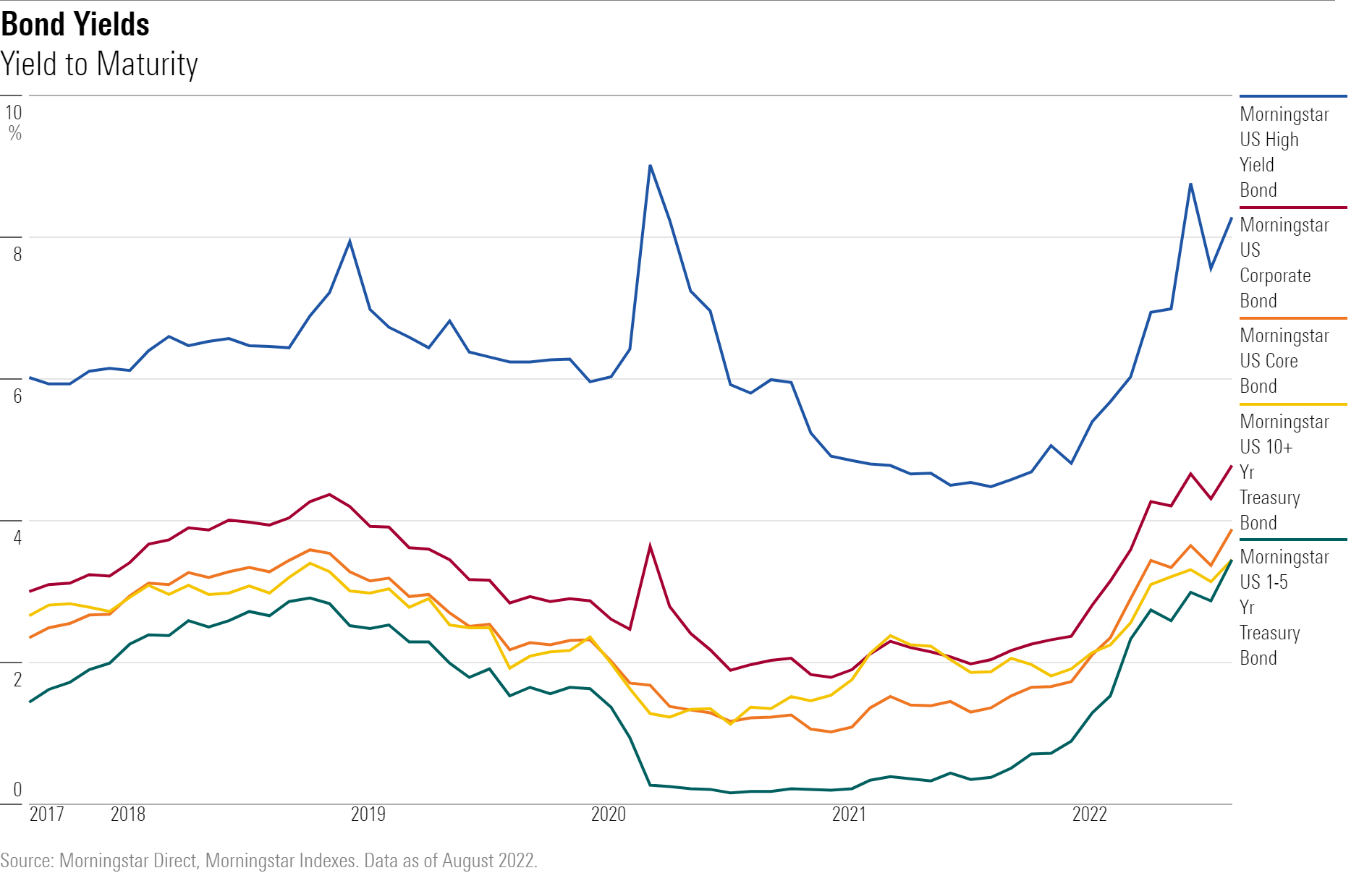
- Yield to Maturity (YTM): This is the most comprehensive bond metric. It calculates the total return an investor will receive if the bond is held until it matures, accounting for all interest payments and the gain or loss incurred if the bond was bought at a discount or premium.
3. Real Estate Yield (Cap Rate)
In real estate, investors look at the Capitalization Rate (Cap Rate). This is the net operating income (NOI) generated by a property divided by its current market value or purchase price. It excludes mortgage payments to focus strictly on the property's inherent profitability. A property that generates $60,000 in annual profit and is worth $1 million has a 6% yield.
4. Cash and Fixed Income
For certificates of deposit (CDs) and money market accounts, the annual yield is almost always quoted as APY. In the current 2026 economic environment, these yields are benchmarks against which all other riskier investments are measured.
| Investment Type | Yield Metric | Primary Source of Income | Sensitivity to Market Price |
|---|---|---|---|
| Savings Account | APY | Interest | Low |
| Corporate Bond | Yield to Maturity | Interest Payments | High |
| Common Stock | Dividend Yield | Cash Dividends | High |
| REITs | Dividend Yield | Rental Income | Moderate |
| Treasury Bills | Discount Yield | Imputed Interest | Low |
Nominal Yield vs. Real Yield: The Inflation Factor
A common mistake made by novice investors is looking only at the nominal yield—the percentage stated on the account statement or ticker tape. However, in 2026, professional investors prioritize the real yield.
The real yield is the nominal yield minus the rate of inflation. If your high-yield savings account offers an annual yield of 4.5%, but the annual inflation rate is 3%, your "real" purchasing power is only increasing by 1.5%. If inflation were to spike to 5%, your 4.5% yield would actually result in a "negative real yield," meaning your money is losing value over time despite the nominal gains.
When evaluating yields, always consider the current Consumer Price Index (CPI) or other inflationary markers to ensure that your yield is actually contributing to wealth accumulation rather than just treading water.
Calculating Annual Yield: Practical Examples
To master annual yield, an investor must be comfortable with the basic math behind it. While software handles most of this today, understanding the mechanics helps in identifying errors or marketing gimmicks.
Example A: The Stock Investor
Imagine you own 100 shares of a technology company. The current price is $150 per share. The company pays a quarterly dividend of $0.75.
- Calculate annual dividends: $0.75 x 4 = $3.00 per share.
- Divide by share price: $3.00 / $150 = 0.02.
- Convert to percentage: 0.02 x 100 = 2% Annual Yield.
Example B: The Bond Investor
You purchase a corporate bond for $950. The bond has a "par value" (face value) of $1,000 and a coupon rate of 4%.
- Calculate the annual interest payment: 4% of $1,000 = $40.
- Calculate current yield: $40 / $950 = 0.0421.
- Convert to percentage: 4.21% Current Yield. Note: Because you bought the bond at a discount (below $1,000), your yield is higher than the coupon rate.
Why Yield is a Pillar of Portfolio Strategy
Investors use annual yield to satisfy different strategic objectives. Depending on your stage of life and risk tolerance, your relationship with yield will change.
Income Generation
For those in or near retirement, yield is the primary source of cash flow. By building a "yield-focused" portfolio of bonds, dividend-paying stocks, and REITs (Real Estate Investment Trusts), an investor can live off the income generated without ever having to sell the underlying assets. This preserves the principal for heirs or long-term safety.
Reinvestment and Compounding
For younger investors, yield is the engine of compounding. By using a Dividend Reinvestment Plan (DRIP), the yield is used to purchase more shares of the asset. This creates a virtuous cycle: more shares lead to higher total dividends next year, which buys even more shares. Over 20 or 30 years, this often accounts for the majority of a portfolio's total growth.
Risk Assessment
Yield also serves as a risk barometer. In the credit markets, a "high-yield bond" (also known as a junk bond) offers a higher annual yield precisely because the risk of the company defaulting is higher. Investors demand a "risk premium"—extra yield—to compensate for the possibility of losing their principal. If an investment offers a yield significantly higher than its peers in 2026, it is usually a signal to investigate the issuer's financial health.
Common Mistakes and Yield Traps
The pursuit of high yield can lead investors into dangerous territory. It is essential to recognize when a yield is "too good to be true."
- Chasing the Highest Yield: Often, the highest yields are found in distressed companies or sectors. A stock with a 12% yield might look attractive, but if the company's earnings are falling, that dividend is unsustainable and likely to be cut, often accompanied by a massive drop in the stock price.
- Ignoring Taxes: Not all yields are taxed equally. Dividends may be taxed at "qualified" rates (lower), while interest from corporate bonds is usually taxed as ordinary income. In 2026, tax-equivalent yield calculations are necessary to compare taxable bonds with tax-exempt municipal bonds.
- Forgetting Total Return: A 6% yield is excellent, but if the underlying asset loses 10% of its value during the same year, your total return is -4%. Yield should never be viewed in total isolation from the asset's price stability.
FAQs About Annual Yield
Does a higher annual yield always mean a better investment?
No. A higher yield often reflects higher risk. In 2026, a very high yield relative to the market average can indicate that the market expects an upcoming dividend cut or that the issuer has a high risk of default. Always compare the yield against the asset's risk profile and total return potential.
How does compounding frequency affect my annual yield?
The more frequently interest is compounded (daily vs. monthly vs. annually), the higher your APY will be. Even if the nominal rate remains the same, daily compounding adds a small amount of extra interest to your balance every day, which then earns its own interest, leading to a higher effective annual yield.
Is annual yield the same as return on investment (ROI)?
Not exactly. Annual yield measures only the income (interest or dividends) generated by an investment over a year. ROI is a broader term that typically includes both the income generated and any capital gains or losses realized when the asset is sold.
Can annual yield change over time?
Yes, for most assets. For stocks, the yield changes whenever the company changes its dividend or when the stock price fluctuates. For bonds, while the "coupon yield" is fixed, the "current yield" changes as the bond's market price moves up or down in response to interest rate changes.
What is a "Tax-Equivalent Yield"?
This is a calculation used to compare the yield of a tax-exempt bond (like a municipal bond) with a taxable bond. Because you don't pay federal taxes on municipal bond interest, a 4% municipal yield might be equivalent to a 6% corporate bond yield for someone in a high tax bracket.
Practical Recommendation for 2026 Investors
When evaluating your portfolio this year, do not look at annual yield as a single number. Instead, adopt a three-step verification process. First, identify whether the quoted figure is APY or APR to understand the impact of compounding. Second, subtract the current 2026 inflation rate from your nominal yield to determine your "real" growth. Third, investigate the "payout ratio" of any high-yield stocks to ensure the income is sustainable. Diversifying your yield sources—combining the safety of Treasury-backed yields with the growth potential of dividend equities—remains the most robust strategy for maintaining income and protecting purchasing power.