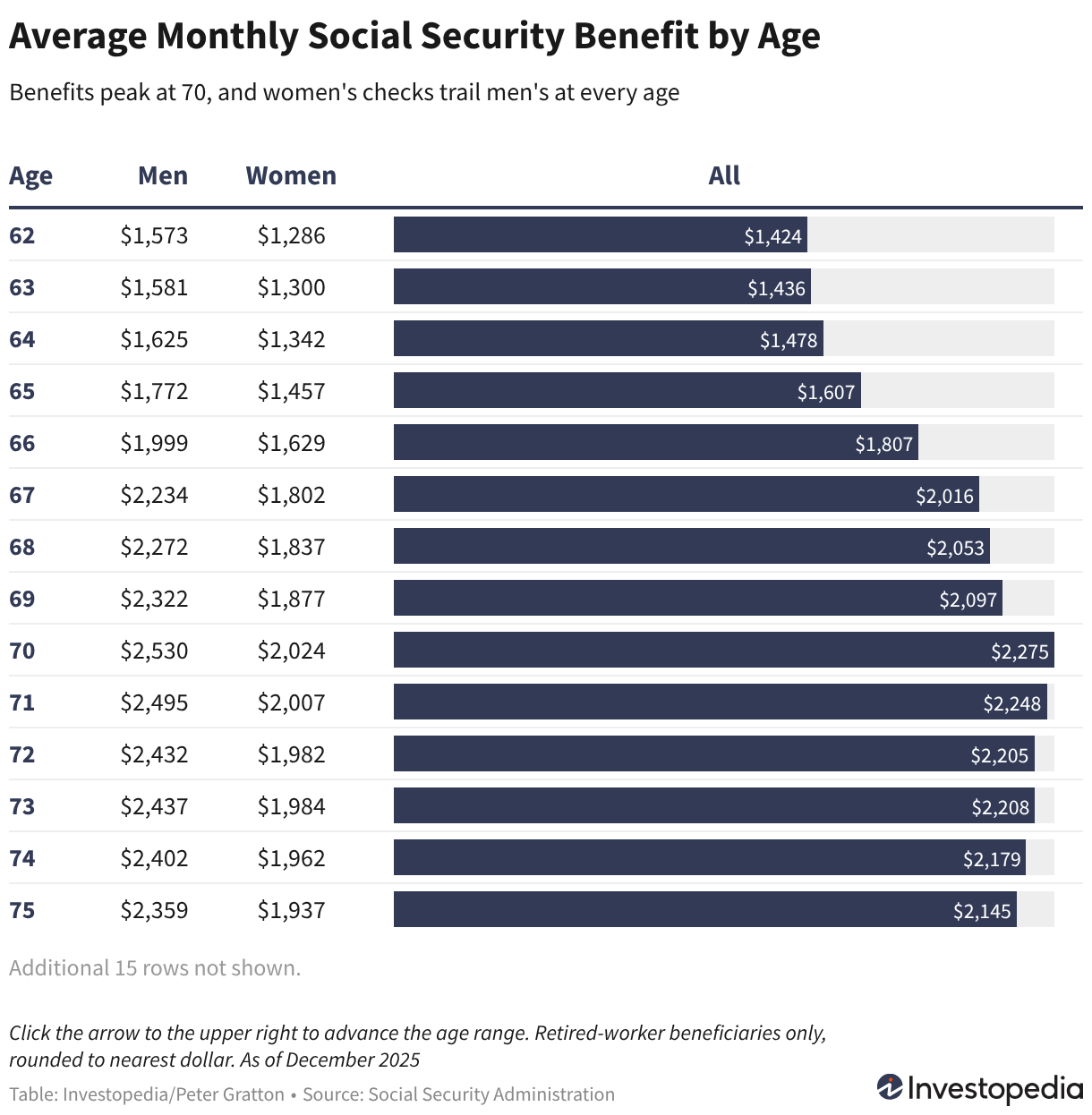
The average Social Security benefit for a retired worker claiming at age 62 is approximately $1,311 per month in 2026. This figure reflects the significant permanent reduction—up to 30%—applied to benefits when claimed at the earliest possible eligibility age rather than waiting for Full Retirement Age (FRA).
Social Security remains the cornerstone of retirement planning for millions of Americans. However, the decision of when to start collecting those benefits is often fraught with complexity. While age 62 is the earliest point at which one can access retired worker benefits, doing so comes with a substantial financial trade-off. In 2026, as cost-of-living adjustments (COLA) and wage indexing continue to shift, the average payment of $1,311 serves as a critical benchmark for those weighing early retirement against the benefits of delayed filing.
To understand why this average sits where it does, and whether it is a viable income stream for your specific needs, one must analyze the calculation methods, the impact of inflation, and the long-term consequences of "locking in" a lower monthly rate.
The Mechanics of the $1,311 Average Benefit
The figure of $1,311 is not a random number; it is the mathematical result of the Social Security Administration’s (SSA) benefit formula applied to millions of early claimants. To arrive at this average, the SSA looks at a worker’s Average Indexed Monthly Earnings (AIME) over their 35 highest-earning years.
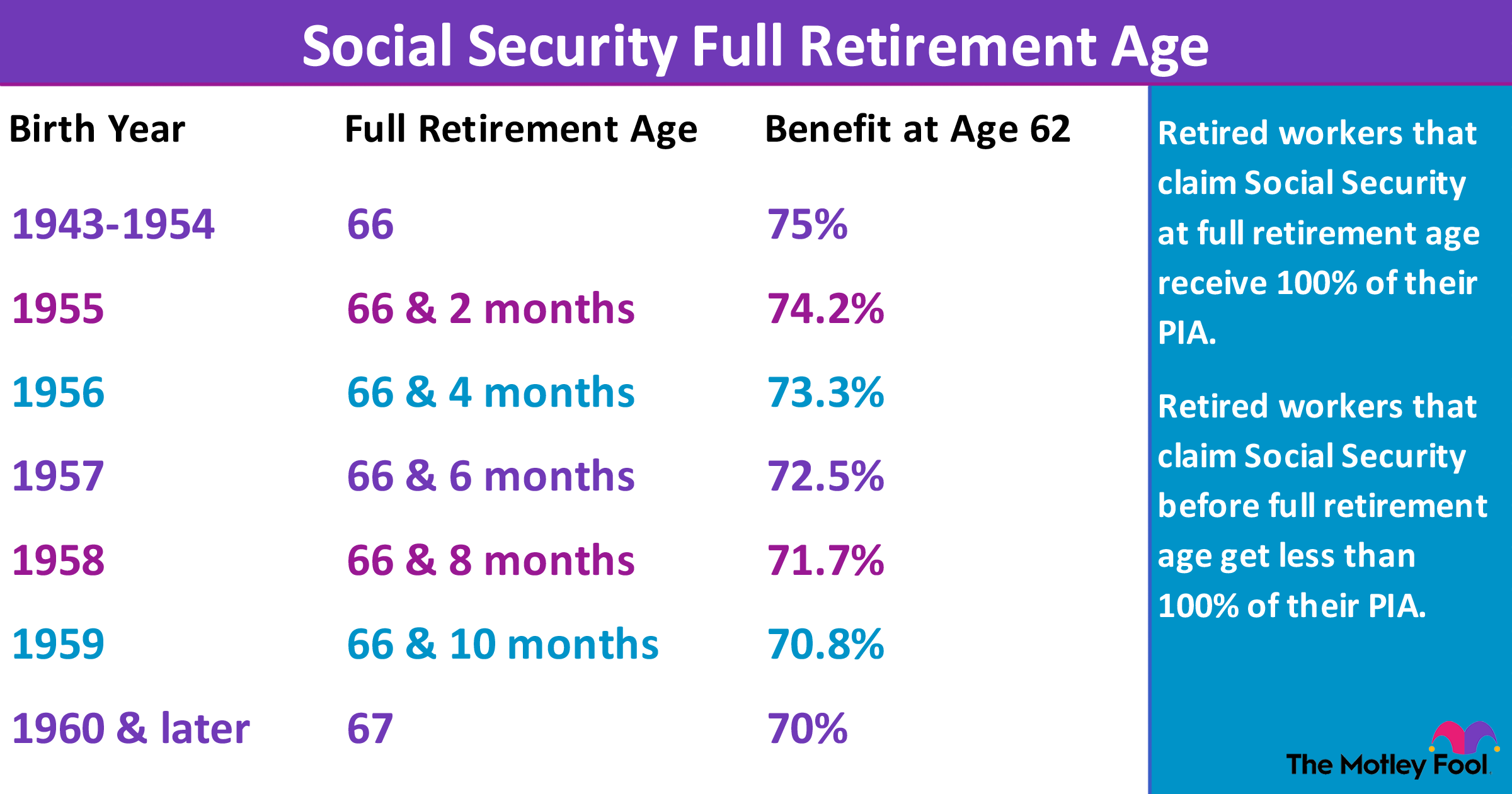
When a worker claims at age 62, the SSA calculates their Primary Insurance Amount (PIA)—which is the benefit they would receive at Full Retirement Age—and then applies an "actuarial reduction." For individuals reaching age 62 in 2026 (those born in 1964), the Full Retirement Age is 67. Claiming at 62 results in a 60-month early filing period.
The reduction formula is strict:
- The benefit is reduced by 5/9 of 1% for each month up to 36 months of early filing.
- The benefit is further reduced by 5/12 of 1% for each additional month beyond 36 months.
For a person with an FRA of 67, claiming at 62 results in a total permanent reduction of 30%. Therefore, the $1,311 average represents the "discounted" version of what these workers would have received had they waited. If the average early-retirement check is $1,311, the underlying average PIA for these individuals is approximately $1,872.
Factors Influencing the Average Payment in 2026
Several macroeconomic and individual factors contribute to the 2026 average of $1,311. It is important to note that this is a mean average; many individuals receive significantly less, while others receive more based on their specific work history.
1. The Role of Cost-of-Living Adjustments (COLA)
In 2026, Social Security benefits reflect several years of moderate to high inflation adjustments. COLA is designed to ensure that the purchasing power of Social Security benefits is not eroded by rising prices. For early retirees, the $1,311 average includes the compounding effects of recent COLAs applied to their initial benefit amounts. Even if a worker retired several years ago at age 62, their check has grown incrementally to reach this current average level.
2. Wage Indexing and AIME
The SSA indexes a worker's earnings to the national average wage index. This ensures that a dollar earned in 1990 is weighted appropriately against a dollar earned in 2025 when calculating the 35-year average. Because wages have generally trended upward, newer retirees often see slightly higher starting benefits than those who retired a decade ago, which contributes to the gradual rise in the "average" payment.
3. The 35-Year Rule
Many workers who claim at age 62 may not have a full 35-year history of high earnings. If a worker has only 25 years of social security-covered earnings, the SSA enters "zeros" for the remaining 10 years. This significantly drags down the AIME and, consequently, the final monthly payment. Those claiming at 62 are statistically more likely to have left the workforce early or had inconsistent earning years, which keeps the average around the $1,311 mark.
Comparing Age 62 Benefits to Delayed Filing
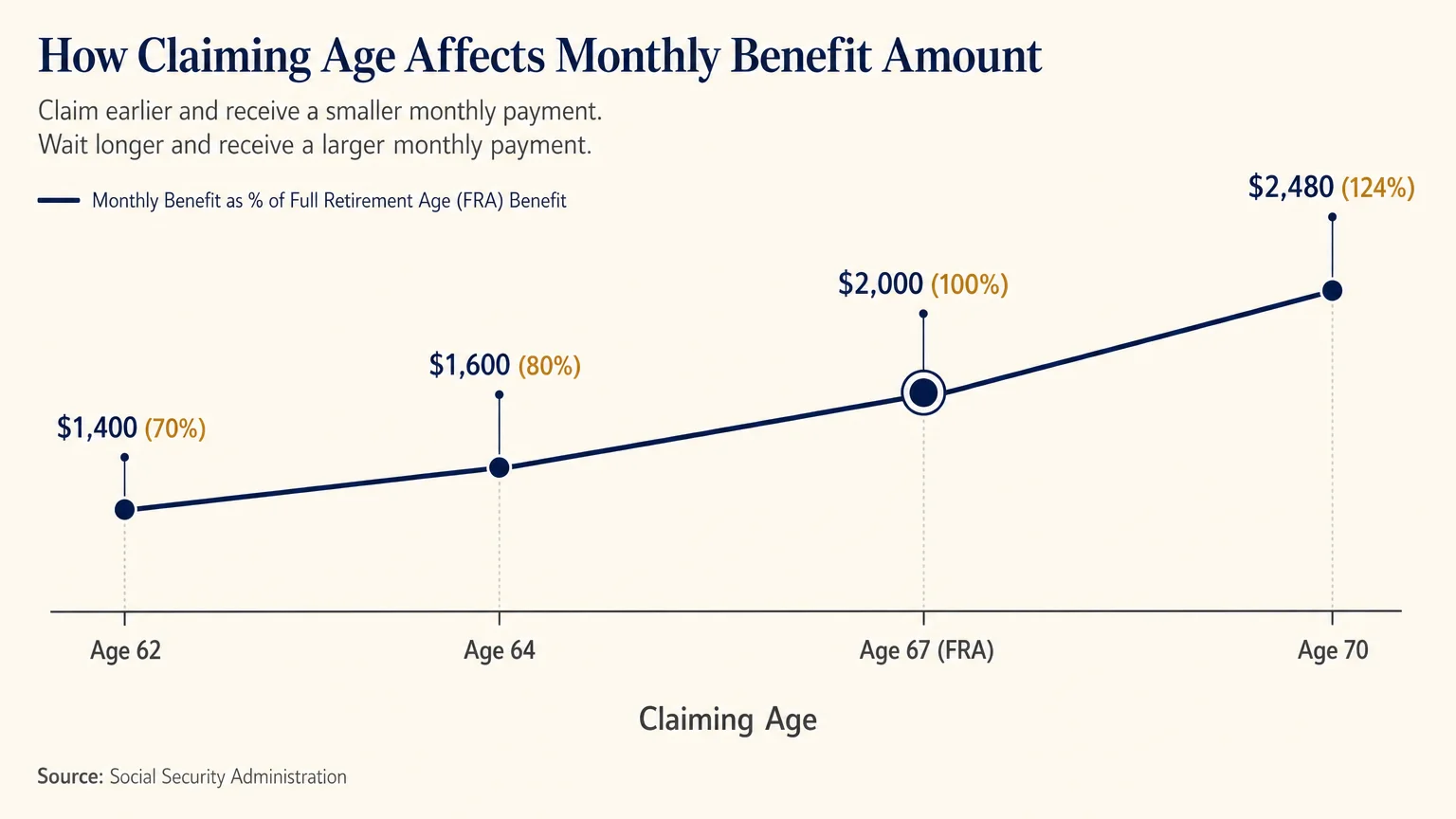
The decision to accept $1,311 per month at age 62 must be viewed in the context of what is left on the table. By delaying retirement, the monthly check increases significantly through two mechanisms: the elimination of the early-filing penalty and the addition of Delayed Retirement Credits.
| Retirement Age | Benefit Multiplier | Estimated Monthly Benefit (Based on $1,311 at 62) | Total Increase from Age 62 |
|---|---|---|---|
| 62 (Earliest) | 70% of PIA | $1,311 | 0% |
| 63 | 75% of PIA | $1,404 | +7.1% |
| 64 | 80% of PIA | $1,498 | +14.3% |
| 65 | 86.6% of PIA | $1,621 | +23.6% |
| 66 | 93.3% of PIA | $1,747 | +33.3% |
| 67 (FRA) | 100% of PIA | $1,872 | +42.8% |
| 70 (Maximum) | 124% of PIA | $2,321 | +77.0% |
Note: Estimates are based on a worker whose PIA is roughly $1,872, resulting in the $1,311 average at age 62 in 2026. Actual amounts vary by individual earning history.
As the table demonstrates, waiting until age 70 could potentially transform a $1,311 check into a $2,321 check. This represents a massive difference in standard of living over a 20-to-30-year retirement horizon.
The Impact of the Social Security Earnings Test
A critical consideration for those receiving the $1,311 average at age 62 is the Social Security Earnings Test. Many retirees at 62 are not fully retired; they may work part-time to supplement their income. However, if you are under Full Retirement Age, the SSA imposes a limit on how much you can earn from work while receiving benefits.
In 2026, if your earnings exceed the annual threshold (which is adjusted yearly for inflation), the SSA will temporarily withhold a portion of your benefits:
- The $1 for $2 Rule: For every $2 you earn above the limit, the SSA deducts $1 from your benefit payments.
- The Final Year Rule: In the year you reach FRA, the rule changes to $1 for every $3 earned above a much higher limit, up until the month you reach your FRA.
It is a common misconception that this money is "lost." Once you reach Full Retirement Age, the SSA recalculates your benefit amount to account for the months where benefits were withheld, effectively increasing your monthly check. However, for a senior relying on the $1,311 average, an unexpected withholding can cause significant short-term financial strain.
Taxation of Social Security Benefits
Receiving $1,311 monthly results in a gross annual income of $15,732 from Social Security alone. Whether this amount is taxable depends on your "combined income," which includes your Adjusted Gross Income (AGI), non-taxable interest, and one-half of your Social Security benefits.
- Individual Filers: If your combined income is between $25,000 and $34,000, you may have to pay income tax on up to 50% of your benefits. If it exceeds $34,000, up to 85% may be taxable.
- Joint Filers: If you and your spouse have a combined income between $32,000 and $44,000, you may pay tax on up to 50% of benefits. Above $44,000, the 85% rule applies.
For someone receiving only the $1,311 average and no other income, the benefits are generally not taxable at the federal level. However, if that person has a modest pension or 401(k) distributions, they can quickly cross the threshold where their "average" benefit is further reduced by the IRS.
Why Do People Choose the $1,311 Average at 62?
Despite the 30% reduction, age 62 remains one of the most popular ages to claim benefits. There are several rationales for this decision:
- Health Concerns: Individuals with a lower-than-average life expectancy may decide that taking "smaller checks for longer" results in a higher cumulative lifetime payout than waiting for "larger checks for shorter."
- Immediate Financial Need: For those who have lost employment or lack sufficient retirement savings, the $1,311 monthly payment is an essential lifeline for housing and healthcare costs.
- Investment Opportunities: Some retirees claim early with the intent of investing the $1,311, betting that market returns will outperform the "guaranteed" increase offered by the SSA for delaying. This is a high-risk strategy that rarely pays off unless market performance is exceptional and the individual lives a shorter-than-average life.
- The "Breakeven" Point: The breakeven age—the point at which the total value of higher delayed payments surpasses the total value of early payments—is typically between ages 77 and 81. Those who do not believe they will live well into their 80s often view age 62 as the most logical choice.
Practical Considerations for 2026 Retirees
If you are approaching age 62 in 2026 and are looking at the $1,311 average as your potential baseline, you must perform a comprehensive "gap analysis."
- Medicare Gap: Medicare eligibility does not begin until age 65. If you retire at 62 and take your $1,311 Social Security check, you must account for the cost of private health insurance for three years. This cost can easily consume 30% to 50% of your Social Security check.
- Spousal Impact: If you are the higher earner in a marriage, claiming at 62 doesn't just reduce your own check; it also reduces the potential Survivor Benefit for your spouse. If you pass away first, your spouse is entitled to 100% of your monthly benefit. If you locked in the $1,311 rate, that is the maximum they will receive, potentially leaving them in a difficult financial position later in life.
- Inflation Vulnerability: While Social Security has COLA, other sources of income (like some private pensions) may not. Relying on a $1,311 base makes you more vulnerable to "lifestyle creep" or spikes in the cost of essential services like long-term care.
Common Pitfalls to Avoid
When targeting the age 62 retirement window, many claimants fall into avoidable traps. One of the most significant is failing to verify their earnings record. You should access your "My Social Security" account at ssa.gov to ensure every year of work has been recorded accurately. An error in your 35-year history could mean the difference between receiving the $1,311 average and a significantly lower amount.
Another pitfall is the failure to coordinate with a spouse. Often, the best strategy involves one spouse claiming early while the other (usually the higher earner) delays until age 70. This provides some immediate cash flow while maximizing the long-term safety net.
Frequently Asked Questions
1. Is $1,311 the maximum I can get at age 62? No. The $1,311 figure is the average amount. The maximum possible benefit at age 62 in 2026 is significantly higher (around $2,800 to $2,900 for those who consistently earned at the "taxable maximum" for 35 years). However, the vast majority of workers fall closer to the $1,311 average because their lifetime earnings were not at the top of the Social Security tax scale.
2. If I start at $1,311, will my check ever increase? Yes, but only through Cost-of-Living Adjustments (COLA). The "base" amount you receive is locked in once you claim. You will not get a "raise" when you reach Full Retirement Age (67). The 30% reduction for filing at 62 is permanent for the rest of your life, though your monthly dollar amount will rise slightly each year to keep up with inflation.
3. Can I change my mind after I start receiving benefits at 62? You have a "do-over" window of 12 months. If you claim at 62 and then decide you want to wait, you can withdraw your application within the first 12 months. However, you must repay every dollar the SSA has sent you, including any tax withholdings or Medicare premiums paid on your behalf. After 12 months, you cannot withdraw the application, though you can "suspend" benefits once you reach Full Retirement Age to earn delayed credits.
4. Does the $1,311 average include spousal benefits? The $1,311 average is specifically calculated for "retired workers." Spousal benefits are generally lower, as a spouse is eligible for only up to 50% of the worker's PIA. If a spouse claims at 62, their benefit is further reduced to about 32.5% of the worker's PIA.
5. How does the 2026 economy affect this average? The 2026 average is influenced by the wage growth of the previous two years. If the economy saw significant wage inflation in 2024 and 2025, the AIME for new retirees at age 62 will be higher, pushing the average slightly above the $1,311 mark. Conversely, periods of stagnation keep the average lower.
Recommendation for Future Retirees
Before claiming your Social Security benefit at age 62, obtain a formal "Benefit Estimate" from the SSA. Compare the $1,311 average to your specific projected amount. If your projected benefit is your only source of income, strongly consider delaying at least until age 67 to avoid the 30% penalty. If you have a robust 401(k) or pension and your health is a concern, claiming at 62 may be a viable component of a larger financial plan. Always consult with a flat-fee financial advisor to model the "breakeven" scenarios specific to your health history and marital status.