An assigned risk plan for auto insurance acts as a state-mandated safety net that provides coverage to high-risk drivers who cannot secure a policy through the voluntary private market. It distributes these high-risk applicants equitably among all licensed insurance companies operating within that state, ensuring that every motorist who meets basic legal requirements can access mandatory liability coverage.
Finding oneself locked out of the standard auto insurance market can be a stressful and confusing experience. For drivers who have accumulated multiple moving violations, experienced major at-fault accidents, suffered from severe lapses in coverage, or possess a low credit score in jurisdictions where credit scoring is permitted, traditional insurance carriers routinely issue denials of coverage. When standard insurers decline an application, these motorists are forced to look toward alternative markets. Understanding what an assigned risk plan for auto insurance does, how it operates, and what to expect from its pricing and coverage structure helps navigate this complex regulatory environment effectively.
The Core Function of an Assigned Risk Plan
At its foundation, an assigned risk plan is an administrative mechanism designed to solve a fundamental market failure. Private insurance companies operate as for-profit entities that rely on risk-pooling and actuarial data to filter applicants and maintain profitability. When an individual’s statistical probability of filing a costly claim rises beyond a certain threshold, standard insurers choose to deny coverage to protect their capital reserves and loss ratios.
If left entirely to the private market, a significant segment of the driving population would remain completely uninsured. Because every state mandates minimum financial responsibility or liability insurance for registered vehicles, leaving high-risk motorists without any option to purchase coverage creates a regulatory contradiction. Assigned risk plans resolve this dilemma through a cooperative framework governed by state insurance commissioners.
The primary functions of an assigned risk plan include:
- Guaranteed Market Access: Providing a legally mandated channel through which any licensed driver with an operable vehicle can obtain basic liability insurance coverage, regardless of their past driving record or loss history.
- Equitable Risk Distribution: Allocating high-risk policyholders proportionally among all licensed voluntary auto insurance carriers doing business in the state, preventing any single company from bearing an unfair financial burden.
- Fulfillment of Legal Mandates: Ensuring that motorists comply with state financial responsibility laws, thereby protecting the general public and other drivers from uninsured road users.
- Standardized Policy Terms: Offering structured, baseline coverage forms that adhere strictly to state statutory minimums, removing predatory or overly complex variations in contract language.
How the Assignment Mechanism Operates
The operational mechanics of an assigned risk plan rely on state regulation and industry participation. These plans are frequently referred to under acronyms such as automobile insurance plans (AIPs) or automobile insurance risk pools, and they operate under the oversight of organizations like the Automobile Insurance Plan Service Office (AIPSO) in many jurisdictions.
When a driver applies for coverage through the plan, the application is processed centrally and then assigned to a specific private insurance carrier. The volume of high-risk drivers assigned to any given company is typically proportional to that company's market share in the state's voluntary insurance market. For example, if a major national carrier writes 10 percent of all voluntary auto insurance policies in a given state, that same carrier will be assigned approximately 10 percent of the drivers entering the assigned risk plan.
Once a company is assigned a driver, it must issue a policy and service it just like any other policyholder, handling premium billing, policy changes, and claim management. However, because these drivers represent an elevated probability of loss, the administrative and financial experience is managed according to strict state guidelines.
Eligibility Criteria and Prerequisites
Accessing an assigned risk plan is not an automatic right for anyone who simply applies; specific eligibility rules must be satisfied before an application can be processed. These prerequisites are designed to ensure that the plan serves as a true last resort rather than a first choice for convenience.
Before submitting an application to an assigned risk plan, drivers typically must meet several baseline requirements:
- Good Faith Application Effort: The applicant must demonstrate that they have been actively rejected or declined for auto insurance by standard, voluntary market carriers within a specified recent timeframe (usually the past 60 days).
- Valid Driver’s License: The applicant must possess a valid driver’s license or legal driving privileges in the state where coverage is sought. Drivers whose licenses are currently suspended or revoked generally cannot obtain a policy until their driving privileges are formally reinstated.
- In-State Registration: The vehicle to be insured must be registered in the state where the plan operates and must meet basic safety or inspection standards where required by law.
- Accurate Disclosures: All application materials must truthfully disclose past driving records, accidents, traffic violations, and household drivers. Omitting critical history can result in policy rescission or denial of coverage during a claim.
Coverage Limits and Policy Structure
One of the most common misconceptions about assigned risk plans is that they provide comprehensive coverage comparable to preferred-tier private market policies. In reality, assigned risk plans are structured to provide the minimum required protections necessary to satisfy state motoring laws.
While options vary depending on the jurisdiction, policies issued through these plans typically share specific structural characteristics:
| Feature | Voluntary Private Market | Assigned Risk Plan |
|---|---|---|
| Primary Goal | Competitive pricing and profit generation | Guaranteed coverage and market stabilization |
| Coverage Levels | Extensive options (comprehensive, collision, high liability limits) | Usually restricted to state minimum liability limits |
| Pricing | Based on detailed risk tiers, credit, and discounts | Surcharged rates reflecting high-risk status |
| Underwriting | Selective evaluation and individual risk assessment | Mandatory assignment based on market share |
| Availability | Subject to carrier underwriting guidelines | Universally available to eligible residents |
Most assigned risk plans focus strictly on providing statutory liability coverage—paying for bodily injury and property damage caused to others when the insured driver is at fault. Personal Injury Protection (PIP) or medical payments coverage may be included where mandated by state law.
Comprehensive and collision coverages, which pay for damage to the insured's own vehicle, are either severely restricted, subject to higher deductibles, or unavailable entirely through certain state plans. When available, adding physical damage coverage significantly increases the overall premium, leading many high-risk drivers to opt strictly for liability-only policies.
Cost Considerations and Financial Impact
Operating a vehicle insured through an assigned risk plan is invariably more expensive than purchasing coverage in the voluntary market. The pricing model reflects the severe statistical risk associated with the pool of drivers.
Insurance commissioners approve rating plans for assigned risk pools that incorporate heavy surcharges based on the driver's history. Factors that drive up costs in these plans include:
- Major Violations: Convictions for driving under the influence (DUI) or driving while intoxicated (DWI), reckless driving, or excessive speeding.
- Loss History: A frequent pattern of at-fault accidents within the past three to five years.
- Insurance Lapses: Extended periods of driving without active insurance coverage, which indicate elevated financial risk to the insurer.
- Surcharge Schedules: Point systems where points are accumulated for every ticket and accident, directly multiplying the base premium rate.
Because of these substantial costs, drivers are strongly encouraged to view assigned risk coverage as a temporary necessity rather than a permanent solution. Maintaining a clean driving record, avoiding moving violations, and letting past infractions age off official motor vehicle records allows motorists to transition back to the voluntary private insurance market after a few years.
Common Mistakes to Avoid When Using an Assigned Risk Plan
Navigating the assigned risk system requires careful attention to detail and strict adherence to administrative rules. Avoiding frequent pitfalls ensures uninterrupted coverage and prevents legal complications.
- Failing to Shop the Voluntary Market First: Submitting an application to an assigned risk plan without verifying recent declinations from standard carriers will result in immediate rejection of the application.
- Incomplete or Inaccurate Disclosures: Omitting a past accident, ticket, or resident driver from the application can be interpreted as material misrepresentation, leading to canceled coverage or denied claims.
- Allowing Payments to Lapse: Assigned risk carriers enforce strict billing schedules. Missing a premium payment often results in immediate cancellation notices with little room for grace periods.
- Ignoring Rehabilitation Timelines: Assuming that high premium rates are permanent. Most states allow drivers to requalify for voluntary market insurance after three consecutive years of clean driving.
Step-by-Step Application Process
Securing a policy through an assigned risk plan follows a formalized workflow that requires coordination between the applicant, an insurance producer, and the plan administrator.
- Obtain Rejection Notices: Gather written evidence or formal notices from standard insurance agents or companies documenting that coverage has been denied or offered only at prohibitive rates.
- Consult a Licensed Producer: Contact a licensed insurance agent or broker who is authorized and experienced in submitting applications to the state’s specific automobile insurance plan.
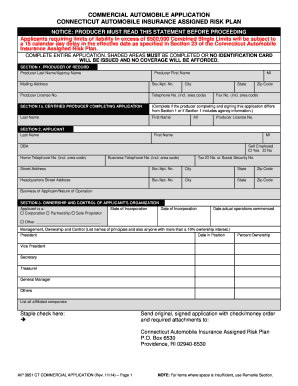
- Complete the Application Form: Fill out the standardized application accurately, providing detailed information regarding vehicle identification numbers (VINs), driver's license numbers, and complete driving history for all household members.
- Submit Required Deposits: Pay the initial binder deposit or down payment required by the plan administrator to activate temporary coverage while underwriting review takes place.
- Receive Policy Assignment: Await the official assignment notification designating which private insurance carrier will service the policy and issue the formal insurance documents.
Frequently Asked Questions
What happens if an insurance company refuses to take an assigned risk driver?
Private insurance companies cannot legally refuse an assignment made by a state-authorized assigned risk plan. Participation in the plan is a mandatory statutory condition for maintaining a license to sell auto insurance within that state. Refusing an assignment can result in severe regulatory penalties from the state department of insurance.
How long must a driver stay in an assigned risk plan?
There is no statutory minimum duration for remaining in an assigned risk plan. A driver can transition back to the voluntary private market as soon as their driving record improves sufficiently—such as after major violations or accidents pass the state's look-back window, typically three to five years—allowing them to meet standard underwriting guidelines.
Do assigned risk plans provide SR-22 filings?
Yes. Assigned risk plans routinely accommodate drivers who require an SR-22 (or FR-44 in certain states) certificate of financial responsibility, which is frequently mandated by courts or departments of motor vehicles following serious driving offenses. The assigned carrier will file the necessary paperwork directly with the state on behalf of the driver.
Are insurance rates uniform across all assigned risk plans?
No. Assigned risk plans are administered independently at the state level. Consequently, the governing boards, rating structures, surcharge formulas, and coverage options vary significantly from one state to another, reflecting local legal frameworks and loss costs.
Can commercial vehicles use an assigned risk auto plan?
Many states operate commercial automobile insurance plans alongside private passenger plans. These commercial pools provide liability coverage for businesses, taxis, limousines, and delivery trucks that face difficulties securing coverage in the standard commercial insurance market.
Practical Recommendations for High-Risk Drivers
If you find yourself requiring coverage through an assigned risk plan, approach the situation with a long-term strategy for financial recovery. Work closely with an independent insurance agent who understands both the assigned risk mechanism and the broader voluntary market. Request annual reviews of your driving and credit records to identify the exact date when moving violations or accidents will drop off your official motor vehicle report.
Prioritize safe driving habits, avoid all traffic infractions, and make every premium payment on time. By treating the assigned risk plan as a temporary bridge rather than a permanent home, you can successfully navigate a difficult period and return to competitive, affordable private market insurance.