A word that has the same or nearly the same meaning as another word is called a synonym. Derived from the Ancient Greek terms syn (meaning "together") and onoma (meaning "name"), synonyms allow writers and speakers to diversify their vocabulary, clarify intent, avoid repetitive phrasing, and adapt tone for different audiences.
What Is a Synonym? The Linguistic Basis of Word Equivalents
In linguistics, synonymy refers to the semantic relationship between lexical items (words, phrases, or expressions) that share identical or closely overlapping meanings within a given language. When two or more words can express the same core concept, they are considered synonymous.
While people often describe a synonym as simply "another word with the same meaning," language is rarely perfectly redundant. Linguists distinguish between strict (or absolute) synonymy and partial (or near) synonymy:
- Absolute Synonyms: Words that share identical meanings across every possible context, register, connotation, and grammatical structure. In natural human languages, absolute synonyms are exceptionally rare because languages tend to shed redundant terms or assign distinct nuances to them over time. Technical or regional terms—such as groundnut and peanut, or inflammable and flammable—are among the few practical examples.
- Near-Synonyms (Partial Synonyms): Words that share a primary meaning but differ in tone, emotional weight, regional usage, or grammatical constraint. For example, big, large, enormous, and massive all convey the idea of substantial size, but each carries distinct nuances and fits different stylistic situations.
Understanding how synonyms function requires examining not just dictionary definitions (denotations), but also the subtle cultural, emotional, and contextual layers (connotations) attached to individual words.
Types of Synonyms and Lexical Relationships
Words related by meaning fall into several categories based on how closely their definitions overlap and how they are used in practical communication.
- Lexical Relationships
- Absolute Synonyms (Identical in all contexts)
- Near-Synonyms (Overlapping meaning, differing nuances)
- Regional Variants (Geographic differences in vocabulary)
- Stylistic Variants (Formal vs. informal registers)
- Hypernyms & Hyponyms (Broad vs. specific categories)
1. Absolute (Exact) Synonyms
Absolute synonyms occur when two terms can be substituted for one another in any sentence without changing the truth value, emotional tone, or stylistic appropriateness of the statement. Because language naturally optimizes itself to avoid true redundancy, absolute synonyms usually arise from technical jargon, cross-dialect borrowings, or trade names.
- Examples: ceasefire and truce (in specific legal contexts); noun and substantive (in traditional grammar); furze and gorse (botanical common names).
2. Near-Synonyms (Cognate and Non-Cognate Pairs)
Near-synonyms share a central semantic core but carry differences in intensity, scale, or emotional resonance. Selecting the correct near-synonym allows for precise expression.
- Degree of Intensity: Warm vs. hot vs. scalding. While all describe high temperature, they sit at different points on a spectrum.
- Emotional Weight: Frugal vs. stingy. Both describe careful spending, but frugal carries a positive connotation of wisdom, whereas stingy implies selfishness.
3. Regional and Dialectal Variants
Language varies by geographical region, leading to distinct words that refer to the exact same object or concept across different English dialects.
- American English vs. British English:
- Elevator (US) / Lift (UK)
- Trunk (US) / Boot (UK)
- Sidewalk (US) / Pavement (UK)
- Flashlight (US) / Torch (UK)
4. Register and Stylistic Variations
The appropriate word often depends on the level of formality required by the situation. Words can be classified into formal, informal, slang, or technical registers.
- Formal: Commence, purchase, terminate, reside.
- Neutral: Start, buy, end, live.
- Informal / Casual: Kick off, snag, wrap up, hang out.
Key Factors Governing Word Choice
Replacing a word with a synonym is not a simple matter of swapping entries from a dictionary. To choose the right alternative, writers must evaluate four primary linguistic dimensions: connotation, register, collocation, and grammatical constraints.
Connotation vs. Denotation
Denotation is the explicit, literal dictionary definition of a word. Connotation is the implicit emotional, cultural, or social association attached to it.
| Base Word | Positive Connotation | Neutral Connotation | Negative Connotation |
|---|---|---|---|
| Thin | Slender, svelte | Thin | Skinny, scrawny |
| Persistent | Tenacious, resolute | Persistent | Stubborn, pigheaded |
| Curious | Inquisitive | Curious | Nosy, prying |
| Unusual | Unique, distinctive | Unusual | Weird, bizarre |
Replacing a neutral term like thin with scrawny fundamentally alters the tone of a sentence, transforming a neutral description into a negative critique.
Register and Audience
Writing for an academic journal, a legal brief, a corporate email, or a fiction novel requires different lexical registers. Using overly formal synonyms in casual writing can sound pompous, while using informal synonyms in professional documents can undermine credibility.
- Inappropriate Formal Register: "I shall commence my lunch now."
- Inappropriate Informal Register: "The supreme court shot down the proposed legislation."
- Balanced Register: "The supreme court rejected the proposed legislation."
Collocations (Natural Word Partnerships)
A collocation is a sequence of words that co-occur more often than would be expected by chance. Even if two words are dictionary synonyms, they may not form natural collocations with surrounding words.
- Correct: Heavy rain, strong coffee, make a promise.
- Incorrect / Unnatural: Thick rain, powerful coffee, do a promise.
While heavy and thick can both mean dense, English speakers naturally pair heavy with rain. Violating established collocations makes writing sound unnative or awkward.
Grammatical Fit
Some synonyms operate as different parts of speech or require specific prepositions. For example, discuss and talk about carry identical meanings, but discuss is transitive and takes a direct object, whereas talk requires the preposition about.
- Correct: "We need to discuss the budget."
- Correct: "We need to talk about the budget."
- Incorrect: "We need to discuss about the budget."
Comparison of Synonyms Across Registers and Contexts
The following table demonstrates how a single core concept can be expressed through different synonyms depending on formality, field, and intended nuance.
| Core Concept | Standard / Everyday | Formal / Academic | Technical / Specialized | Casual / Informal |
|---|---|---|---|---|
| To help | Help | Assist | Facilitate | Lend a hand |
| To show | Show | Demonstrate | Illustrate / Evince | Point out |
| Wrong | Wrong | Incorrect | Erroneous | Off base |
| Cheap | Cheap | Inexpensive | Economical | Dirt cheap |
| To build | Build | Construct | Fabricate | Put together |
| Gathering | Meeting | Assembly | Convocation | Get-together |
| To end | End | Terminate | Discontinue | Wrap up |
How to Find and Select the Best Synonym
Finding "another word with the same meaning" requires a structured approach to ensure accuracy and maintain writing flow.
- Step 1: Identify the exact concept and part of speech
- Step 2: Consult a reputable thesaurus or dictionary
- Step 3: Check connotations and register (formal vs. casual)
- Step 4: Verify collocations and prepositional pairings
- Step 5: Read the sentence aloud to check rhythm and natural flow
1. Consult Contextual Thesauri and Dictionaries
Traditional print and digital thesauri (such as Merriam-Webster’s Collegiate Thesaurus or Roget’s Thesaurus) group words by concept. However, modern digital tools—including Merriam-Webster and the Oxford English Dictionary—provide sample sentences and nuance notes that clarify exactly how a synonym functions in context.
2. Avoid "Thesaurus Syndrome"
"Thesaurus syndrome" occurs when a writer replaces simple, clear words with complex, obscure synonyms in a misguided effort to sound intelligent. This often leads to imprecise language and awkward phrasing.
- Over-complicated: "The equine organism traversed the verdant meadow with expeditious velocity."
- Clear and Effective: "The horse galloped quickly across the green field."
The best synonym is rarely the most obscure one; it is the word that conveys your precise meaning with maximum clarity.
3. Use Corpus Tools for Advanced Writing
For professional writers, translators, and academic authors, language corpora—such as the Corpus of Contemporary American English (COCA) or the British National Corpus (BNC)—allow users to search how native speakers naturally use words in real-world texts. These databases show common collocations, frequency, and register distribution.
Common Mistakes When Replacing Words
- Ignoring Polysemy (Multiple Meanings): Many English words have several distinct meanings depending on context. For instance, bank can mean a financial institution or the side of a river. Replacing bank with repository in a sentence about a riverbank creates confusion.
- Mismatched Prepositions: Changing a verb or adjective often requires changing the preposition that follows it. You are interested in something, but fascinated by it.
- Forcing Rhyme or Alliteration over Clarity: Selecting a synonym simply because it starts with a certain letter or matches a poetic meter can obscure the underlying message.
- Conflating Tone with Meaning: Substituting slang with an overly academic word inside dialogue can make characters sound unnatural and unconvincing.
Frequently Asked Questions
What is the term for a word with the exact same meaning?
A word with the same or nearly the same meaning is called a synonym. When two words share identical meanings across every possible context, they are known as absolute synonyms, though absolute synonyms are rare in natural language.
What is the difference between a synonym and an antonym?
A synonym is a word that shares a similar meaning with another word (e.g., happy and joyful). An antonym is a word that has the opposite meaning of another word (e.g., happy and sad).
What is the difference between a synonym and a homonym?
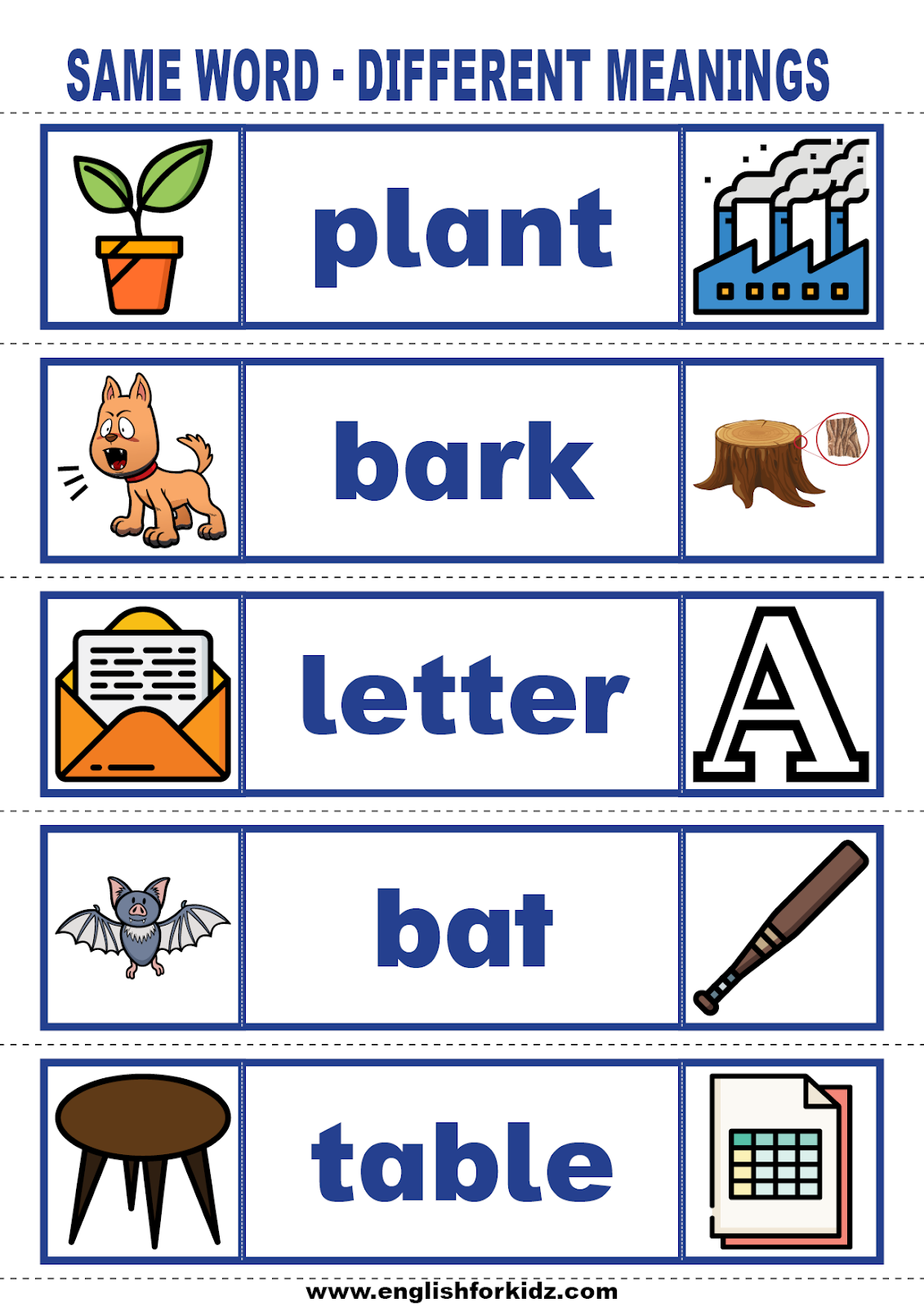
A synonym refers to two different words that share the same meaning (e.g., large and big). A homonym refers to two words that share the same spelling or pronunciation but have entirely different meanings (e.g., bark as the sound a dog makes versus bark as the outer layer of a tree).
Why do languages have multiple words for the same thing?
Languages develop synonyms through historical borrowings (such as French and Latin terms merging into Anglo-Saxon English), regional dialectal shifts, technological evolution, and the human desire for stylistic variety and emotional nuance.
How do synonyms help in writing and Search Engine Optimization (SEO)?
In general writing, synonyms prevent tedious repetition and keep readers engaged. In digital publishing and SEO, using natural synonyms and semantically related terms helps search engines understand the broader context of a topic without engaging in redundant keyword repetition.
Practical Recommendations for Writers
To expand your vocabulary and improve word selection:
- Read Widely across Genres: Exposure to diverse writing styles—academic papers, journalism, fiction, and technical reports—naturally expands your understanding of register and context.
- Prioritize Precision over Novelty: Choose synonyms that heighten clarity rather than those that simply sound impressive.
- Verify Usage in Sample Sentences: When using an unfamiliar synonym from a thesaurus, look up its full entry in a dictionary to verify its connotation and standard prepositions before adding it to your final draft.