AmTrust Financial Services is one of the largest providers of small-to-medium business workers' compensation coverage in California. Navigating an AmTrust workers' compensation claim in California requires complying with strict Division of Workers' Compensation (DWC) deadlines, completing mandatory forms like the DWC 1, utilizing designated Medical Provider Networks (MPNs), and understanding state-mandated benefit caps.
Overview of AmTrust Workers' Compensation Coverage in California
AmTrust North America operates as a primary underwriter for commercial insurance policies across the United States, holding a significant market share among small business insurance policyholders in California. In California, state law mandates that virtually all employers maintain workers' compensation insurance to protect workers against job-related injuries and occupational illnesses, regardless of who was at fault for the incident.
When an employee sustains a work-related injury or illness, AmTrust acts as the claims administrator. The company handles claim intake, assigns dedicated claims adjusters, oversees medical treatment authorizations through its medical networks, and disburses temporary disability (TD) or permanent disability (PD) benefit payments. Understanding how AmTrust processes claims under the statutory framework established by the California Labor Code ensures that injured workers receive timely benefits and employers fulfill their legal obligations.
Immediate Actions Required After a Workplace Injury
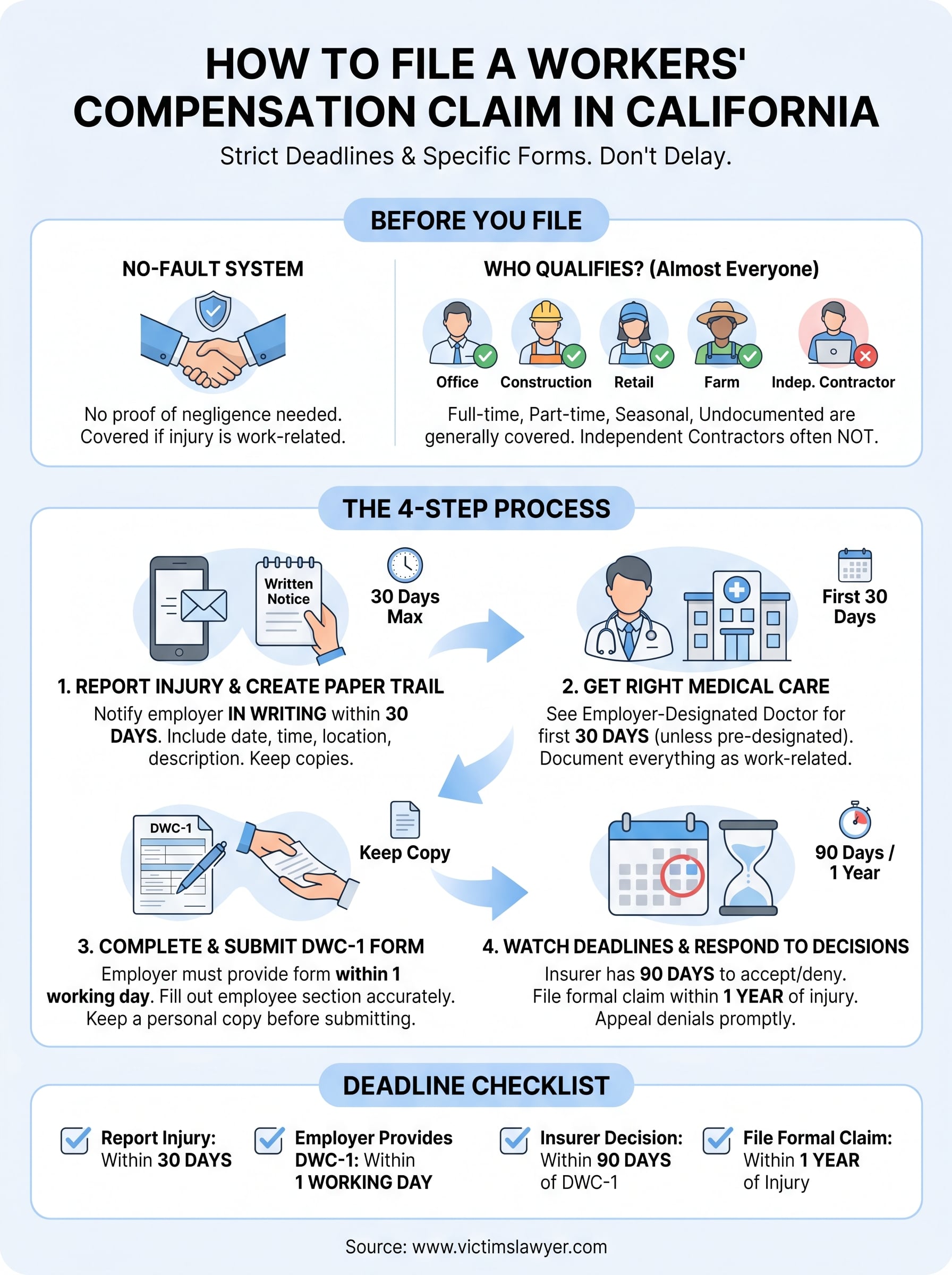
The timeline for a California workers' compensation claim begins the moment an injury occurs or when an occupational illness is identified. Both the employee and the employer must adhere to statutory deadlines to prevent claim delays or formal denials.
- Employee gives written notice to employer (within 30 days per Cal. Lab. Code)
- Employer provides DWC 1 Form within 1 working day of learning of the injury
- Employer completes section & submits claim to AmTrust (within 5 working days)
- AmTrust authorizes up to $10,000 in emergency medical care while investigating
- AmTrust accepts, denies, or delays claim decision (statutory 90-day limit)
Employee Obligations and Written Notice
Under California Labor Code § 5400, an injured worker must give written notice of an injury to their employer within 30 days of the incident or within 30 days of realizing that an illness or medical condition was caused by employment. Failure to provide timely written notice can imperil access to compensation benefits unless the employer already possessed knowledge of the injury.
Emergency medical treatment should always be sought immediately. If an emergency occurs, the injured worker must inform the treating hospital or urgent care center that the injury occurred on the job so that billing can be flagged for workers' compensation processing rather than personal health insurance.
Employer Responsibilities and Form DWC 1
Once an employer learns of a work-related injury—either verbally or in writing—they must provide the employee with a Workers' Compensation Claim Form (DWC 1) and a Notice of Potential Eligibility within one working day.
The employer must complete the "Employer" section of the DWC 1 form, return a signed copy to the employee, and send the completed document along with an Employer's Report of Occupational Injury or Illness (Form 5020) to AmTrust immediately. State guidelines require employers to report claims to their carrier within five working days of receiving knowledge of the injury.
Step-by-Step Guide to Filing a Claim with AmTrust
Filing an AmTrust workers' compensation claim in California involves a standardized sequence of reporting, investigation, and authorization steps.
Step 1: Submitting the Initial Claim Report
Employers must report claims directly to AmTrust through one of their official claim reporting channels:
- Online Portal: Policyholders can log into the AmTrust Online portal to file first reports of injury.
- Telephone Intake: Claims can be reported 24/7 by calling AmTrust’s dedicated call center at (877) 528-7878.
- Email or Fax: Completed DWC 1 and Form 5020 documents can be emailed to AmTrust's national intake desk at
amtrustclaims@amtrustgroup.comor submitted via state-specific fax lines.
Step 2: Claims Adjuster Assignment and Initial Coverage Review
Upon receiving the DWC 1, AmTrust assigns a specific claim number and a claims adjuster to manage the file. Under California law, while AmTrust investigates a claim to determine liability, the insurer must authorize up to $10,000 in medical treatment according to evidence-based treatment guidelines while the decision is pending.
Step 3: Accept, Deny, or Delay Determination
AmTrust has 90 days from the date the employer receives the DWC 1 form to accept or deny liability for the claim. If AmTrust does not deny the claim within 90 days, the injury is legally presumed to be compensable under California Labor Code § 5402, a presumption rebuttable only by evidence discovered after the 90-day period.
- Accepted Claims: AmTrust assumes financial responsibility for authorized medical care, temporary disability wage loss benefits, and eventual permanent disability compensation.
- Delayed Claims: AmTrust may issue a "Notice of Delay" if additional medical records, witness statements, or wage documents are needed to make a coverage decision.
- Denied Claims: If AmTrust denies the claim, it must issue a formal Notice of Denial explaining the legal or factual reasons for non-acceptance. The injured worker then has the right to dispute the decision through the state system.
Navigating AmTrust's Medical Treatment Rules in California
Medical treatment in California workers' compensation is strictly regulated. AmTrust relies on specialized networks and administrative protocols to manage healthcare access and cost.
AmTrust's Medical Provider Network (MPN)
AmTrust utilizes an approved Medical Provider Network (MPN) in California—a curated group of physicians, occupational clinics, surgeons, and specialists authorized to evaluate and treat industrial injuries.
Unless an employee pre-designated a personal physician prior to the injury (by submitting a written pre-designation form signed by the doctor to their employer), the employee must select an initial treating physician from the AmTrust MPN list. Injured workers have the legal right to change their primary treating physician (PTP) to another provider within the AmTrust MPN at any point during their treatment.
Utilization Review (UR)
All medical treatment recommendations made by a treating physician in an AmTrust claim are subject to Utilization Review (UR) pursuant to California Labor Code § 4610. The doctor submits a Request for Authorization (RFA) detailing proposed care, such as physical therapy, diagnostic imaging (MRI), surgery, or prescription medications.
AmTrust's UR physicians evaluate the RFA against the California Medical Treatment Utilization Schedule (MTUS), which provides evidence-based clinical guidelines. UR decisions must be rendered within statutory time limits:
- Prospective/Concurrent UR: Decision within 5 business days of receiving a complete RFA.
- Expedited UR: Decision within 72 hours if the worker's condition poses an immediate threat to life or health.
If AmTrust's UR process denies or modifies a treatment request, the decision cannot be overturned directly by a judge. Instead, the injured worker or their attorney must appeal the decision through Independent Medical Review (IMR), an administrative review process conducted by an independent organization (Maximus Federal Services) contracted by the state of California.
Structure of California Workers' Compensation Benefits
When an AmTrust workers' compensation claim is accepted, the injured employee becomes entitled to statutory benefits mandated by California law. These benefits fall into five main categories:
- California Workers' Compensation Benefits
- Medical Treatment (100% covered)
- Temporary Disability (2/3 wages)
- Permanent Disability (Rating %)
- SJDB Work Voucher ($6,000)
- Death Benefits (Dependents of deceased workers)
1. Medical Care
AmTrust must pay for all medically necessary treatment required to cure or relieve the effects of the industrial injury. This covers doctor visits, emergency hospital care, surgery, physical therapy, prescription drugs, medical equipment, and travel reimbursement for mileage to and from medical appointments. There are no copays or deductibles for the injured employee.
2. Temporary Disability (TD) Benefits
If an injured worker loses wages because a primary treating physician certifies that they cannot work, or that their employer cannot accommodate work restrictions, AmTrust must issue Temporary Disability payments.
- Rate: TD pays two-thirds (66.67%) of the employee's average weekly wage (AWW) prior to the injury, subject to state-mandated minimum and maximum weekly caps set annually by the DWC.
- Duration: For most injuries, TD benefits are limited to a maximum of 104 calendar weeks within a five-year window from the date of injury. For severe conditions such as severe burns or high-grade amputations, TD can extend up to 240 weeks.
3. Permanent Disability (PD) Benefits
If a work injury results in permanent physical or cognitive impairment that does not fully resolve after reaching Maximum Medical Improvement (MMI)—also known as Permanent and Stationary (P&S) status—the worker is entitled to Permanent Disability benefits.
PD is expressed as a percentage score from 1% to 99%, calculated using the American Medical Association (AMA) Guides to the Evaluation of Permanent Impairment (5th Edition), modified by age, occupation, and diminished future earning capacity in California. AmTrust pays PD benefits in bi-weekly installments according to statutory schedules set by state law.
4. Supplemental Job Displacement Benefit (SJDB)
If an injury results in permanent disability, and the employer does not offer a regular, modified, or alternative job lasting at least 12 months, the worker is eligible for an SJDB voucher valued at $6,000. This voucher can be used for retraining, skill enhancement, or tuition at accredited public or non-profit training institutions in California.
5. Death Benefits
If a workplace injury or occupational illness results in death, AmTrust provides financial support to the deceased worker’s total or partial financial dependents, alongside a burial expense allowance. Benefit amounts depend on the number of qualifying dependents.
Employer vs. Employee Roles in AmTrust Claims
Both parties must satisfy specific legal and administrative duties to keep a California workers' compensation claim compliant.
| Area of Responsibility | Injured Employee | Employer (AmTrust Policyholder) |
|---|---|---|
| Notification | Must report the injury in writing to a supervisor within 30 days of occurrence. | Must provide Form DWC 1 to the employee within 1 working day of receiving notice. |
| Claim Submission | Completes and returns the Employee section of the DWC 1 form. | Completes Employer section of DWC 1 and files Form 5020 with AmTrust within 5 business days. |
| Medical Authorization | Selects an authorized doctor within AmTrust’s Medical Provider Network (MPN). | Directs the injured worker to an MPN clinic for non-emergency treatment; provides MPN access details. |
| Work Status Communication | Provides work status notes (treating physician report) to employer after every appointment. | Evaluates work restrictions to determine if light-duty or modified work can be accommodated. |
| Dispute Filing | Submits Application for Adjudication of Claim with the local WCAB district office if disputed. | Coordinates with AmTrust claims adjusters and defense attorneys to present factual evidence. |
Resolving Disputes with AmTrust in California
If AmTrust delays, denies, or modifies benefits—or if there is a disagreement over medical treatment, disability ratings, or returning to work—California provides structured administrative mechanisms to resolve disputes.
- Dispute Arises with AmTrust
- Dispute Over Medical Treatment
- Submit appeal to Independent Medical Review (IMR via Maximus) within 30 days of UR decision
- Binding Administrative Determination (Overturns or upholds UR denial)
- Dispute Over Impairment / TD Rate
- Request Qualified Medical Evaluator (QME) panel from DWC Medical Unit
- File Application for Adjudication of Claim at local Workers' Comp Appeals Board (WCAB)
- Hearing before Workers' Compensation Judge
- Dispute Over Medical Treatment
Qualified Medical Evaluators (QME)
When there is a dispute regarding the diagnosis, permanent disability rating, work restrictions, or whether an injury is work-related, the claim cannot be decided solely by AmTrust or the employee's personal physician.
Either party may request a Qualified Medical Evaluator (QME) panel from the California Division of Workers' Compensation Medical Unit. The Medical Unit issues a panel of three neutral physicians in the relevant specialty. The injured worker (or their attorney) and AmTrust strike names from the panel until one physician is selected to perform an independent, binding medical evaluation. If the worker is represented by an attorney, the parties may instead agree on an Agreed Medical Evaluator (AME).
Independent Medical Review (IMR)
If AmTrust’s Utilization Review process modifies or denies a medical treatment request submitted by the treating physician, the decision can only be appealed through Independent Medical Review (IMR). The injured worker must submit an IMR application form within 30 calendar days of receiving the UR denial. An independent panel of medical specialists reviews the records against MTUS evidence-based guidelines. The outcome of the IMR is legally binding on AmTrust.
The Workers' Compensation Appeals Board (WCAB)
To formalize a legal dispute against AmTrust, an injured worker must file an Application for Adjudication of Claim with the local office of the Workers' Compensation Appeals Board (WCAB). Filing this form establishes formal jurisdiction over the claim and opens an official court file.
If negotiations or informal conferences fail, the parties present testimony, medical reports, and legal arguments before a Workers' Compensation Administrative Law Judge (WCJ), who issues a legally binding Decision and Award.
Common Challenges in AmTrust California Claims
Navigating an AmTrust claim can involve several common procedural obstacles.
Delayed Benefit Payments
If AmTrust fails to make temporary disability payments within 14 days of learning of disability, or fails to pay permanent disability installments on time, state law mandates an automatic 10% penalty on the delayed amount under California Labor Code § 4650, payable directly to the injured worker.
Treatment Delays Through UR Denial
Because AmTrust, like all California insurance carriers, relies heavily on Utilization Review guidelines, requests for diagnostic tests or specialized physical therapy are frequently delayed or denied on initial submission. Treating physicians must complete treatment requests with comprehensive medical evidence, linking requested procedures directly to MTUS guidelines to withstand UR scrutiny.
Misclassification of Employment Status
AmTrust actively reviews claims for proper worker classification. If an employer misclassifies a worker as an independent contractor (Form 1099) rather than an employee (Form W-2), AmTrust may deny liability. California's strict employment classification standards (under Assembly Bill 5 and Labor Code § 2775) create a strong legal presumption that workers providing services for a business are statutory employees entitled to coverage unless proven otherwise under the "ABC test."
Frequently Asked Questions
How do I check the status of my AmTrust workers' compensation claim in California?
Injured workers can check their claim status by contacting their assigned AmTrust claims adjuster via phone or email, using the claim number provided on initial correspondence. Policyholders and employers can check status updates directly through the AmTrust Online portal.
What should I do if AmTrust denies my medical treatment request?
If AmTrust's Utilization Review denies or modifies a treatment request, review the UR decision letter immediately. Complete and submit the included Independent Medical Review (IMR) application form to the state-designated organization (Maximus) within 30 days of receiving the denial.
Can I see my own doctor for an AmTrust workers' comp injury in California?
You may only see your personal doctor if you formally submitted a written Pre-designation of Personal Physician form to your employer prior to sustaining the workplace injury, and your physician agreed in writing to treat work injuries. Otherwise, you must choose a doctor within AmTrust’s Medical Provider Network (MPN).
How long does AmTrust have to accept or deny a claim in California?
AmTrust has up to 90 days from the date your employer receives the DWC 1 claim form to issue an acceptance or formal denial. However, AmTrust must authorize up to $10,000 in necessary medical treatment while the claim investigation remains pending.
What happens if AmTrust stops paying my Temporary Disability benefits?
If AmTrust stops issuing TD checks, they must issue a formal Notice of Action detailing the legal reason for termination (such as a doctor certifying you reached Maximum Medical Improvement or returned to work). If you dispute the benefit termination, you can request an expedited hearing before a judge at the local Workers' Compensation Appeals Board (WCAB).
Practical Guidance and Next Actions
Successfully managing an AmTrust workers' compensation claim in California relies on strict adherence to state procedures and open communication among all parties:
- Act Quickly: Report every work injury immediately to your supervisor in writing, and request a DWC 1 form within one day.
- Follow Network Protocols: Treat exclusively within AmTrust's Medical Provider Network (MPN) to avoid out-of-pocket expenses or uncompensated treatment.
- Maintain Documentation: Keep copies of all medical work status slips, treatment requests, DWC notices, and correspondence with your AmTrust claims adjuster.
- Monitor Deadlines: Respond to all Utilization Review (UR) notices within 30 days if filing for Independent Medical Review (IMR).
- Seek Professional Counsel When Needed: If AmTrust denies your claim, delays benefits unjustifiably, or disputes your disability rating, consult a qualified California workers' compensation applicant attorney. Initial legal consultations are generally free, and attorney fees are regulated by the WCAB (typically set at 12% to 15% of back benefits or eventual settlements).
Disclaimer: Workers' compensation laws in California are governed by statute and administrative regulations. This guide provides general informational coverage of the procedures involved in an AmTrust claim in California as of 2026. For individualized legal or medical advice regarding specific claim disputes, consult a licensed California attorney or certified specialist.