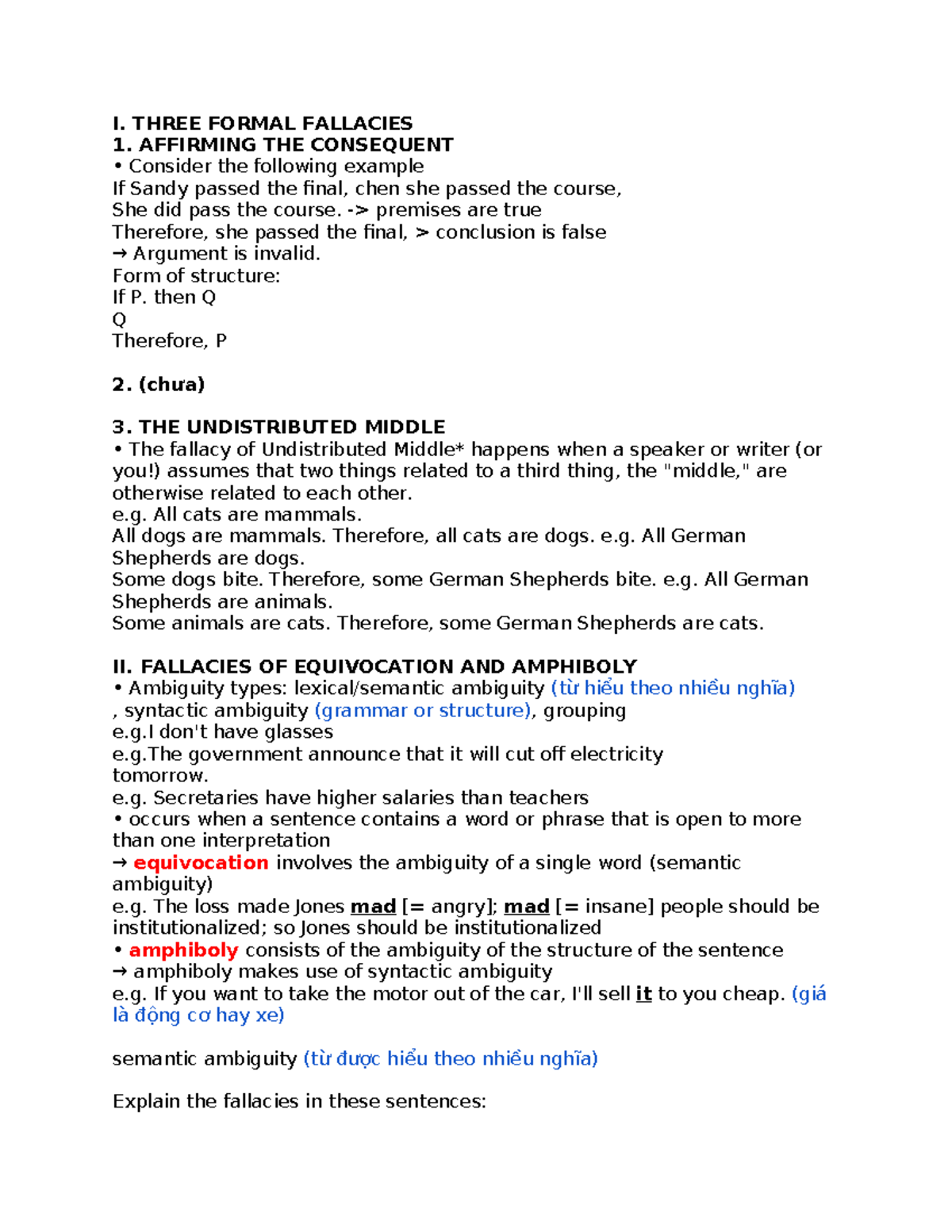
Affirming the consequent is a formal logical fallacy that occurs when an arguer assumes that because the outcome (the consequent) of a conditional statement is true, the cause (the antecedent) must also be true. Even if the initial conditional premise is completely accurate, this deduction is logically invalid because multiple causes can produce the same result.
Understanding the Formal Logic Behind Affirming the Consequent
To understand why affirming the consequent fails, you must first examine the basic structure of a conditional statement in formal logic. A conditional statement establishes a relationship between two propositions: a hypothesis or cause, known as the antecedent, and a result or conclusion, known as the consequent.
A conditional statement is generally written in the form: "If P, then Q."
- Antecedent ($P$): The clause following "if" (the condition).
- Consequent ($Q$): The clause following "then" (the outcome dependent on the condition).
In formal symbolic logic, affirming the consequent follows this three-step structure:
- Premise 1: If $P$, then $Q$ ($P \rightarrow Q$)
- Premise 2: $Q$ is true ($Q$)
- Conclusion: Therefore, $P$ is true ($\therefore P$)
Premise 1: If P, then Q. Premise 2: Q is true. Conclusion: Therefore, P is true. (INVALID)
The fundamental flaw in this structure lies in the distinction between sufficient conditions and necessary conditions. In the statement "If $P$, then $Q$," the antecedent ($P$) is a sufficient condition for $Q$ to occur, but it is not necessarily a necessary condition. $Q$ can still happen for entirely different reasons that have nothing to do with $P$. Assuming that $Q$ can only occur when $P$ occurs mistakes a sufficient condition for a necessary one.
In formal logic, an argument is valid if and only if it is impossible for all of its premises to be true while its conclusion is false. Because an argument affirming the consequent can have entirely true premises yet lead to a false conclusion, it is classified as structurally invalid regardless of the actual subject matter being discussed.
Real-World Examples of Affirming the Consequent
While symbolic logic highlights the structural invalidity of an argument, examining concrete examples reveals how often this fallacy appears in everyday conversations, professional diagnostic settings, business analysis, and legal proceedings.
1. Everyday Reasoning: Rain and Wet Streets
The most classic illustration of affirming the consequent demonstrates how simple counter-examples invalidate the argument structure:
- Premise 1: If it is raining heavily, then the street outside will be wet.
- Premise 2: The street outside is wet.
- Conclusion: Therefore, it is raining heavily.
Why the logic fails: While Premise 1 and Premise 2 may both be factual statements, the conclusion does not logically follow. The street could be wet for a variety of alternate reasons: a broken fire hydrant, a passing municipal street-sweeping truck, a melted snowpack, or a homeowner washing their driveway with a garden hose. Heavy rain is a sufficient explanation for a wet street, but it is not the only possible explanation.
2. Medical Diagnostics: Symptoms and Diseases
In medicine, falling into the trap of affirming the consequent can lead to misdiagnoses if clinicians mistake a symptom for definitive proof of a specific condition:
- Premise 1: If a patient has pneumonia, they will present with a persistent cough and fever.
- Premise 2: The patient presents with a persistent cough and fever.
- Conclusion: Therefore, the patient has pneumonia.
Why the logic fails: Many distinct respiratory illnesses—including influenza, bronchitis, COVID-19, or acute allergic reactions—can trigger a persistent cough and fever. While identifying the symptom ($Q$) justifies further diagnostic testing to investigate $P$, concluding outright that the patient suffers from pneumonia ($P$) based solely on the presence of symptom $Q$ is a logical error. In clinical practice, doctors use differential diagnosis to rule out competing causes rather than relying on a single fallacious deduction.
3. Business Analytics: Marketing Strategy and Revenue Growth
Corporate executives and data analysts frequently encounter fallacious reasoning when assessing cause-and-effect relationships in revenue and performance data:
- Premise 1: If our new digital advertising campaign is successful, our quarterly sales volume will increase.
- Premise 2: Our quarterly sales volume has increased.
- Conclusion: Therefore, our new digital advertising campaign was successful.
Why the logic fails: Sales volume might have increased due to macro-environmental shifts, such as a competitor going out of business, seasonal demand surges, broader economic inflation, or supply chain bottlenecks affecting alternative goods. Attributing success solely to the digital advertising campaign without isolating variables represents a standard business instance of affirming the consequent.
4. Forensic Science and Legal Arguments
In courtroom settings, attorneys and jury members must guard against fallacious conditional reasoning when reviewing circumstantial physical evidence:
- Premise 1: If the defendant entered the office room, their fingerprints would be left on the glass desk.
- Premise 2: The defendant's fingerprints were found on the glass desk.
- Conclusion: Therefore, the defendant entered the office room during the crime.
Why the logic fails: Finding the defendant's fingerprints on the desk confirms their physical contact with the object, but it does not establish when or under what circumstances that contact occurred. The fingerprints could have been deposited days prior during regular business hours, or transferred indirectly via secondary touch transfer. Equating the presence of physical evidence ($Q$) with the prosecution's specific timeline narrative ($P$) violates formal logic rules.
Comparing Formal Fallacies and Valid Deductive Forms
To evaluate arguments effectively, you must contrast affirming the consequent with valid forms of deductive logic like Modus Ponens and Modus Tollens, as well as its twin formal fallacy, Denying the Antecedent.
The table below breaks down these four classic logical structures side-by-side:
| Argument Form | Premise 1 (Conditional) | Premise 2 | Conclusion | Logical Status |
|---|---|---|---|---|
| Modus Ponens (Affirming the Antecedent) | If $P$, then $Q$ | $P$ is true | Therefore, $Q$ is true | Valid |
| Modus Tollens (Denying the Consequent) | If $P$, then $Q$ | $Q$ is false ($\neg Q$) | Therefore, $P$ is false ($\neg P$) | Valid |
| Affirming the Consequent | If $P$, then $Q$ | $Q$ is true | Therefore, $P$ is true | Invalid (Fallacy) |
| Denying the Antecedent | If $P$, then $Q$ | $P$ is false ($\neg P$) | Therefore, $Q$ is false ($\neg Q$) | Invalid (Fallacy) |
Analyzing Valid Forms
Modus Ponens (Affirming the Antecedent): This valid rule of inference dictates that if the conditional statement "If $P$, then $Q$" is accepted as true, and $P$ actually occurs, then $Q$ must necessarily follow.
- Example: If an employee works more than 40 hours, they earn overtime pay. Alex worked 45 hours. Therefore, Alex earned overtime pay.
Modus Tollens (Denying the Consequent): This valid rule dictates that if $P$ implies $Q$, but $Q$ is proven false, then $P$ could not have occurred. If the necessary outcome did not happen, the initial trigger could not have taken place.
- Example: If the device is turned on, the power light glows green. The power light is not glowing green. Therefore, the device is not turned on.
Analyzing the Fallacies
Affirming the Consequent: As established, this attempts to move backward from the truth of the result ($Q$) to force the truth of the initial condition ($P$).
Denying the Antecedent: This related formal fallacy occurs when an arguer denies the cause to falsely claim the result cannot happen.
- Form: If $P$, then $Q$. $P$ is false. Therefore, $Q$ is false.
- Example: If it is raining, the ground is wet. It is not raining. Therefore, the ground is not wet. (Invalid, because someone could be spraying a garden hose on the ground).
Truth Tables and the Logical Proof of Invalidity
In formal truth-functional logic, we demonstrate the invalidity of an argument by constructing a truth table. A truth table maps out every possible combination of truth values (True = T, False = F) for the propositions $P$ and $Q$.
A conditional statement ($P \rightarrow Q$) is defined as true in all cases except when a true antecedent ($P = \text{T}$) leads to a false consequent ($Q = \text{F}$).
Consider the complete truth table for $P$, $Q$, and $P \rightarrow Q$:
| Row | $P$ | $Q$ | $P \rightarrow Q$ (Premise 1) | Premise 2 ($Q$) | Conclusion ($P$) |
|---|---|---|---|---|---|
| 1 | T | T | T | T | T |
| 2 | T | F | F | F | T |
| 3 | F | T | T | T | F |
| 4 | F | F | T | F | F |
Interpreting the Table
To test an argument's validity, we must isolate every row where all premises are True (these are known as critical rows). If there is even one critical row where the conclusion is False, the entire argument form is structurally invalid.
- Look at Row 1: Premise 1 ($P \rightarrow Q$) is True, Premise 2 ($Q$) is True, and the Conclusion ($P$) is True.
- Look at Row 3: Premise 1 ($P \rightarrow Q$) is True, Premise 2 ($Q$) is True, but the Conclusion ($P$) is False.
Because Row 3 demonstrates a scenario where both premises are true while the conclusion is false, affirming the consequent fails the formal definition of logical validity.
Why People Fall for Affirming the Consequent
If affirming the consequent is demonstrably invalid, why does it feature so prominently in everyday human speech and debate? Several psychological and linguistic phenomena explain our susceptibility to this error.
1. Equating Conditionals with Biconditionals
In everyday natural language, human beings frequently use simple conditional phrasing ("If $P$, then $Q$") when they actually mean a biconditional statement ("$P$ if and only if $Q$", written symbolically as $P \leftrightarrow Q$).
For example, a parent might tell a child: "If you eat your dinner, you can have dessert."
Strictly speaking in formal logic terms, this leaves open the possibility that the child could get dessert for cleaning their bedroom or taking a bath. However, in human conversation, the implied social contract is biconditional: eating dinner is the only way to receive dessert. Because spoken conversation relies heavily on implied context, people routinely process standard conditional logic as if it were biconditional, leading them to affirm the consequent without realizing it.
2. Confusing Deductive Validity with Abductive Probability
Another primary source of confusion stems from blending deductive certainty with abductive reasoning (often called inference to the best explanation).
- Deductive Reasoning: Demands absolute mathematical certainty. If the premises are true, the conclusion must be true.
- Abductive Reasoning: Looks at an observed outcome ($Q$) and evaluates which hypothesis ($P$) represents the most probable or plausible explanation.
In medical diagnostics, scientific hypothesis testing, and criminal investigations, professionals regularly use abductive reasoning. If a doctor sees a characteristic symptom, that symptom serves as probabilistic evidence favoring a specific disease.
The fallacy occurs when someone takes an abductive probability ("This evidence makes Hypothesis $P$ plausible") and asserts it as a deductive certainty ("This evidence absolute proves Hypothesis $P$ is true").
Deductive Logic (Certainty): "Q is true, so P MUST be true." -> FALLACY Abductive Logic (Probability): "Q is true, so P is ONE POSSIBLE explanation to investigate." -> VALID METHOD
Practical Strategies to Spot and Correct the Fallacy
Developing strong critical thinking skills requires active habits to identify invalid conditional reasoning in articles, speeches, data presentations, and daily conversations.
Step 1: Translate the Argument into Symbolic Frameworks
When confronted with an argument that sounds persuasive but feels slightly off, translate the core claims into explicit conditional statements:
- Identify the conditional claim: What is being set up as the cause ($P$), and what is the outcome ($Q$)?
- Identify the evidence presented: Is the speaker asserting that the cause happened, or that the outcome happened?
- Check the direction of inference: Are they reasoning forward from cause to effect (valid), or backward from effect to cause (invalid)?
Step 2: Formulate Counter-Examples (The "Alternative Cause" Method)
The fastest practical way to refute an instance of affirming the consequent is to construct an immediate counter-example that yields the exact same outcome through a different mechanism.
- Argument: "If the power grid fails, the lights in this building will turn off. The lights are off, so the power grid must have failed."
- Counter-Example: "Or someone simply flipped the wall light switch off, or a fuse blew locally in this single room."
If you can demonstrate at least one plausible alternative cause for $Q$, you prove that $P$ is not the sole explanation, successfully exposing the logical flaw.
Step 3: Differentiate "If" Statements from "If and Only If" Statements
When drafting your own arguments or analyzing policy documents, pay strict attention to language precision:
- Use "If $P$, then $Q$" when $P$ is merely one of several potential triggers for $Q$.
- Use "Only if $P$, then $Q$" or "$P$ if and only if $Q$" when $P$ is the sole, exclusive prerequisite for $Q$.
By choosing precise language, you prevent your audience from misinterpreting a standard conditional relationship as a biconditional guarantee.
Frequently Asked Questions
What is the difference between affirming the antecedent and affirming the consequent?
Affirming the antecedent (known formally as Modus Ponens) is a valid deductive argument structure: if "If $P$ then $Q$" is true, and $P$ occurs, then $Q$ must follow. Affirming the consequent is an invalid logical fallacy: it works backward by observing $Q$ and assuming $P$ must have caused it, ignoring alternative causes.
Is affirming the consequent an informal fallacy or a formal fallacy?
Affirming the consequent is a formal fallacy. This means the error lies entirely within the structural architecture of the argument itself, rather than in the truth of the content, linguistic ambiguity, or contextual distraction (which characterize informal fallacies like ad hominem or straw man arguments).
Can an argument that affirms the consequent still have a true conclusion?
Yes. A fallacious argument structure can produce a true conclusion by coincidence. For example: "If it is snowing, it is cold outside. It is cold outside. Therefore, it is snowing." If it happens to be snowing while you speak, the conclusion is factually true, but the reasoning used to reach it remains logically invalid.
How does affirming the consequent relate to scientific testing?
Scientific testing relies on empirical falsification (Modus Tollens) rather than trying to deductively prove hypotheses through affirming the consequent. If a hypothesis predicts outcome $Q$, observing $Q$ does not deductively prove the hypothesis absolute true; it merely fails to disprove it and provides supporting evidence. Scientists must run control groups to eliminate alternate explanations for $Q$.
Final Recommendations for Clear Reasoning
To keep your logical reasoning sharp and your arguments sound across professional and academic environments, follow these practical steps:
- Map conditional claims early: When analyzing complex reports or arguments, explicitly label the antecedent ($P$) and consequent ($Q$) to trace the direction of logic.
- Search for alternative causes: Whenever you observe a result, brainstorm at least two alternative pathways that could lead to that same outcome before settling on a conclusion.
- Separate certainty from probability: Reserve deductive claims for structures that guarantee absolute logical necessity. Frame real-world observational data as probabilistic evidence rather than absolute proof.
- Audit your writing for implicit biconditionals: Review your communication to ensure you do not inadvertently frame a sufficient condition as if it were the sole necessary cause.