An occupational associate degree is a two-year postsecondary credential designed to provide students with the specific technical skills and knowledge required to enter a particular workforce immediately upon graduation. Unlike academic associate degrees, which focus on broad foundational education for university transfer, occupational degrees prioritize "hands-on" training in high-demand fields like healthcare, technology, and the skilled trades.
The educational landscape of 2026 places a premium on specialized skills. As the labor market continues to shift toward technical proficiency, understanding the nuances of an occupational associate degree—including its structure, benefits, and limitations—is essential for any student looking to maximize their return on investment in higher education.
Defining the Occupational Associate Degree
At its core, an occupational associate degree is an "applied" program. While a traditional Associate of Arts (AA) or Associate of Science (AS) might spend 75% of its curriculum on general education requirements like history, literature, and sociology, an occupational degree flips this ratio. The primary objective is competency in a specific craft or technical discipline.
These degrees are typically offered by community colleges, technical institutes, and private vocational schools. They are often developed in consultation with local industries to ensure that the curriculum aligns with current employer needs. In 2026, this alignment is more critical than ever, as rapid advancements in automation and AI require a workforce that can operate and maintain complex systems.
The Primary Types of Occupational Associate Degrees
Not all occupational degrees carry the same designation. Depending on the institution and the field of study, you will likely encounter three primary versions of this credential.
Associate of Applied Science (AAS)
The AAS is the most common occupational degree. It is designed for students who want to enter the workforce immediately but may still want the option to pursue a Bachelor of Applied Science (BAS) later in their careers. It usually includes a small core of general education classes (about 15 to 20 credits) to satisfy regional accreditation standards.
Associate of Occupational Studies (AOS)
The AOS is a more specialized, "terminal" degree. It often eschews general education requirements almost entirely, focusing exclusively on technical coursework. Because it lacks the standard academic core, AOS degrees are often the most difficult to transfer to four-year universities. These are frequently found at private, for-profit technical colleges.
Associate of Applied Arts (AAA)
Similar to the AAS but focused on creative industries, the AAA prepares students for immediate employment in fields such as graphic design, commercial photography, or music production. Like the AAS, it emphasizes portfolio development and practical application over theoretical study.
Occupational vs. Academic Associate Degrees: Key Differences
Choosing the right degree requires understanding how the occupational path differs from the academic path. The "best" choice depends entirely on whether your goal is a four-year university degree or a high-paying job within 24 months.
| Feature | Occupational Associate (AAS/AOS) | Academic Associate (AA/AS) |
|---|---|---|
| Primary Goal | Immediate workforce entry | Transfer to a 4-year university |
| Curriculum Focus | Technical, hands-on, and job-specific | Broad general education and theory |
| General Education | Minimal (approx. 25% of credits) | Heavy (approx. 75% of credits) |
| Transferability | Limited; often requires a BAS program | High; designed for 2+2 transfer |
| Duration | Typically 2 years (60-70 credits) | Typically 2 years (60 credits) |
| Typical Fields | Nursing, HVAC, Cyber Security, Welding | Psychology, English, General Science |
| Cost Consideration | Often higher lab fees for specialized equipment | Generally lower costs at public colleges |
High-Demand Fields for Occupational Degrees in 2026
The utility of an occupational degree is directly tied to the demand for the specific skill set it provides. In 2026, several sectors are experiencing significant labor shortages, making an occupational associate degree a powerful tool for economic mobility.
Healthcare and Allied Health
Healthcare remains the most robust sector for AAS graduates. Degrees in Nursing (ADN), Radiologic Technology, Respiratory Therapy, and Dental Hygiene offer some of the highest starting salaries for associate-level graduates. These programs are highly regulated and usually require programmatic accreditation to ensure graduates can sit for national licensing exams.
Information Technology and Cybersecurity
As digital infrastructure becomes more complex, companies are prioritizing skills over four-year degrees. Occupational degrees in Network Administration, Cybersecurity Operations, and Cloud Computing provide the "boots on the ground" training needed to manage enterprise systems. Most of these programs also incorporate industry-standard certifications (like CompTIA or Cisco) into the curriculum.
Advanced Manufacturing and Skilled Trades
The "silver tsunami" of retiring tradespeople has left a massive gap in the workforce. AAS degrees in Mechatronics, Automotive Technology, HVAC/R, and Electrical Technology are in high demand. These programs often utilize state-of-the-art simulation labs and physical shops, providing students with hundreds of hours of supervised practice.
Curriculum Structure: What to Expect
A typical 60-credit occupational associate degree is structured to maximize time spent on core competencies. Students should expect a rigorous schedule that mimics a professional work environment.
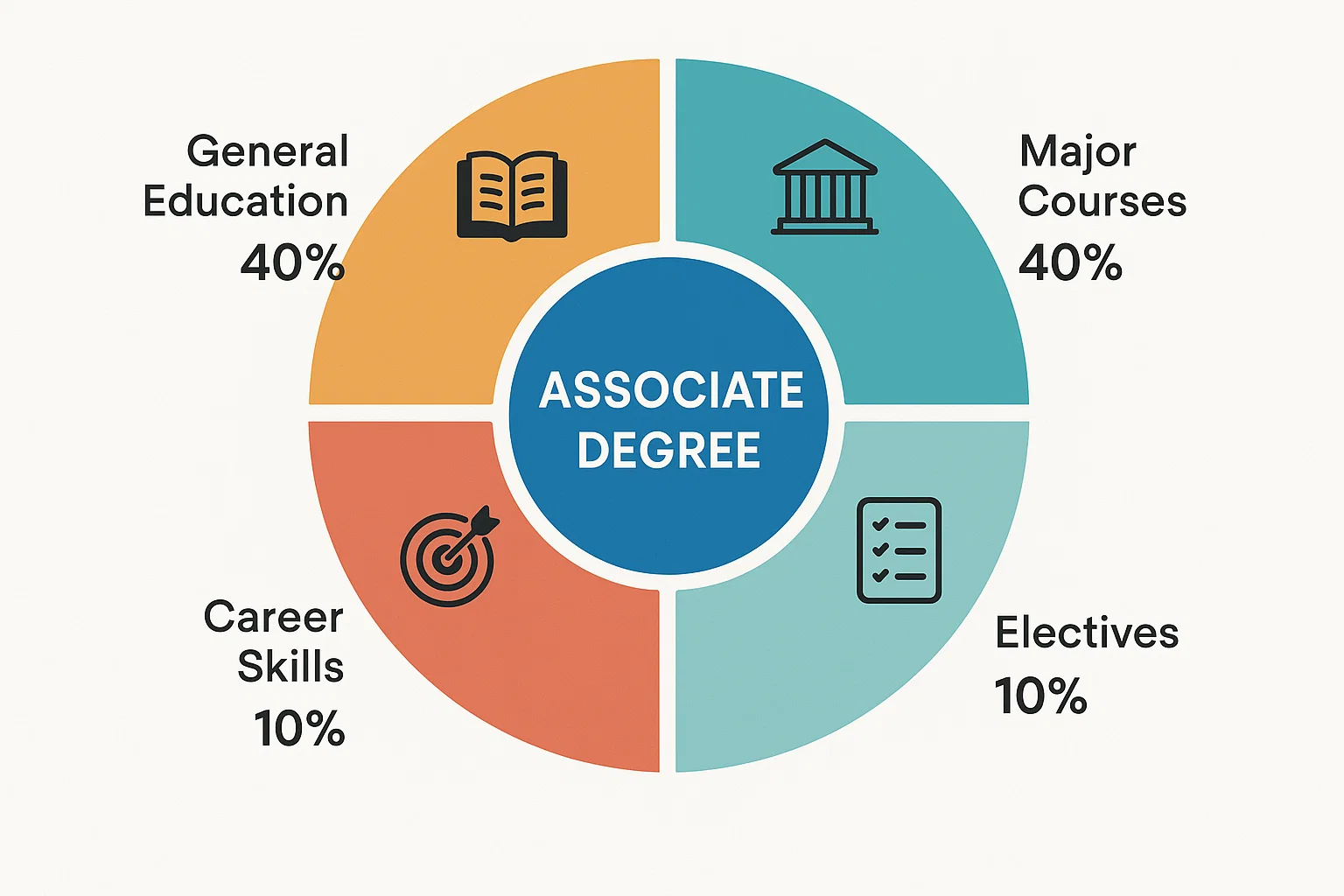
- General Education Core (15-18 Credits): Even in an applied program, you will likely take Applied Mathematics, Technical Writing, and perhaps an Introductory Psychology or Communications course. These are designed to provide the "soft skills" employers value.
- Core Technical Requirements (30-36 Credits): This is the "meat" of the degree. If you are studying Welding, these credits are spent in the booth. If you are in Cyber Security, these are spent in the server lab.
- Electives/Specializations (6-9 Credits): Many programs allow for a minor specialization. For example, an Automotive student might specialize in Electric Vehicle (EV) systems.
- Clinical, Internship, or Capstone (3-6 Credits): Most reputable occupational degrees require a "real-world" component. For healthcare students, this means clinical rotations in a hospital. For technical students, it may involve a cooperative education (Co-op) placement with a local company.
The Importance of Accreditation and Transferability
One of the most common pitfalls for students is a failure to understand accreditation. This is the process by which independent bodies verify the quality and rigor of an educational program.
Institutional Accreditation
In the United States, institutional accreditation is generally divided into what was formerly known as regional and national accreditation. As of 2026, the Department of Education has moved toward a more unified system, but "regionally" accredited public community colleges still hold the gold standard for credit transfer. If you plan to ever earn a bachelor’s degree, ensure your school is accredited by a recognized agency like the Higher Learning Commission (HLC) or the Southern Association of Colleges and Schools (SACSCOC).
Programmatic Accreditation
For many occupational fields, institutional accreditation is not enough. You must also look for programmatic accreditation. For example:
- Nursing: Accreditation Commission for Education in Nursing (ACEN).
- Engineering Tech: ABET (Accreditation Board for Engineering and Technology).
- Physical Therapy Asst: CAPTE (Commission on Accreditation in Physical Therapy Education).
Without programmatic accreditation, you may be ineligible for federal financial aid or, more importantly, unable to take the state licensing exams required to work in your field.
Financial Analysis: Cost and ROI
The financial appeal of an occupational associate degree lies in its efficiency. In 2026, the average annual tuition at a public two-year college remains significantly lower than at four-year public or private institutions.
Return on Investment (ROI) Considerations:
- Time to Market: Entering the workforce two years earlier than a bachelor's student allows for two additional years of compound earnings and experience.
- Starting Salaries: According to the U.S. Bureau of Labor Statistics (BLS), many "Associate's Entry Level" roles, such as Air Traffic Controllers or Nuclear Technicians, command salaries well above the median for all occupations.
- Employer Assistance: Many technical industries offer tuition reimbursement programs for AAS graduates who wish to eventually pursue a bachelor's degree while working.
However, students should be cautious of high-cost, for-profit technical schools where the debt incurred may outweigh the starting salary of the target profession. Always compare the total program cost against the average entry-level salary in your specific geographic region.
The Pros and Cons of an Occupational Degree
Advantages
- Focused Learning: You don't spend time on subjects that aren't relevant to your career.
- Career Readiness: You graduate with the specific tools and certifications needed to start working on Day 1.
- Lower Opportunity Cost: Shorter time in school means less debt and earlier entry into the labor market.
- Practical Skills: The emphasis is on doing, not just reading, which appeals to many kinesthetic learners.
Disadvantages
- Limited Transferability: If you change your mind and want to study a different subject at a university, you may find that only a few of your "technical" credits will transfer.
- Narrow Scope: Because the training is so specific, if that industry declines (e.g., a specific manufacturing technology becomes obsolete), you may need significant retraining.
- The "Terminal" Label: Some employers still view the AAS as a "terminal" degree, which can occasionally create a glass ceiling for management-level positions.
How to Verify the Quality of a Program
Before enrolling in an occupational program in 2026, perform the following due diligence:
- Ask for Placement Rates: Reputable schools should be able to tell you exactly what percentage of last year's graduates are working in their field of study.
- Inspect the Facilities: A technical degree is only as good as the equipment you train on. If the lab equipment is 10 years old, your skills will be out of date before you graduate.
- Review the Advisory Board: Check if the program has an advisory board of local business leaders. This ensures the curriculum is relevant to what employers are currently hiring for.
- Confirm Financial Aid Eligibility: Ensure the school participates in federal Title IV funding, which allows you to use Pell Grants and federal student loans.
Frequently Asked Questions
Can I transfer an AAS degree to a 4-year university?
Yes, but it is often more difficult than transferring an AA or AS degree. Many universities now offer Bachelor of Applied Science (BAS) or "Degree Completion" programs specifically designed to accept the technical credits from an AAS degree. Always check for "articulation agreements" between your community college and local universities.
Is an occupational associate degree respected by employers?
In technical fields, it is often preferred. Employers in the trades, healthcare, and IT often value the hundreds of hours of hands-on experience an AAS student has over the theoretical knowledge of a generalist bachelor's graduate.
How long does it take to complete?
Most programs are designed to be completed in two years (four semesters) of full-time study. However, many students attend part-time while working, which can extend the timeline to three or four years.
What is the difference between an AAS and a Certificate?
A certificate program is even shorter (usually 6 to 12 months) and focuses only on a very narrow skill set. An AAS degree includes the general education and broader technical theory that provides a more rounded professional foundation and better long-term career mobility.
Are there online occupational associate degrees?
Yes, particularly in fields like Cyber Security, Accounting, and Health Information Management. However, for trades like Welding or Automotive Tech, most programs are "hybrid," meaning you do theory online and practical labs in person.
Practical Recommendation
If your primary goal is to enter a stable, well-paying career as quickly as possible, an occupational associate degree is an excellent choice. To succeed, prioritize public community colleges or not-for-profit technical institutes to keep costs low. Before signing any enrollment papers, verify that the program has programmatic accreditation and a strong track record of placing students into jobs within your specific field. For those who remain undecided about a long-term career path, an Associate of Science (AS) may be the safer route to preserve transfer options.