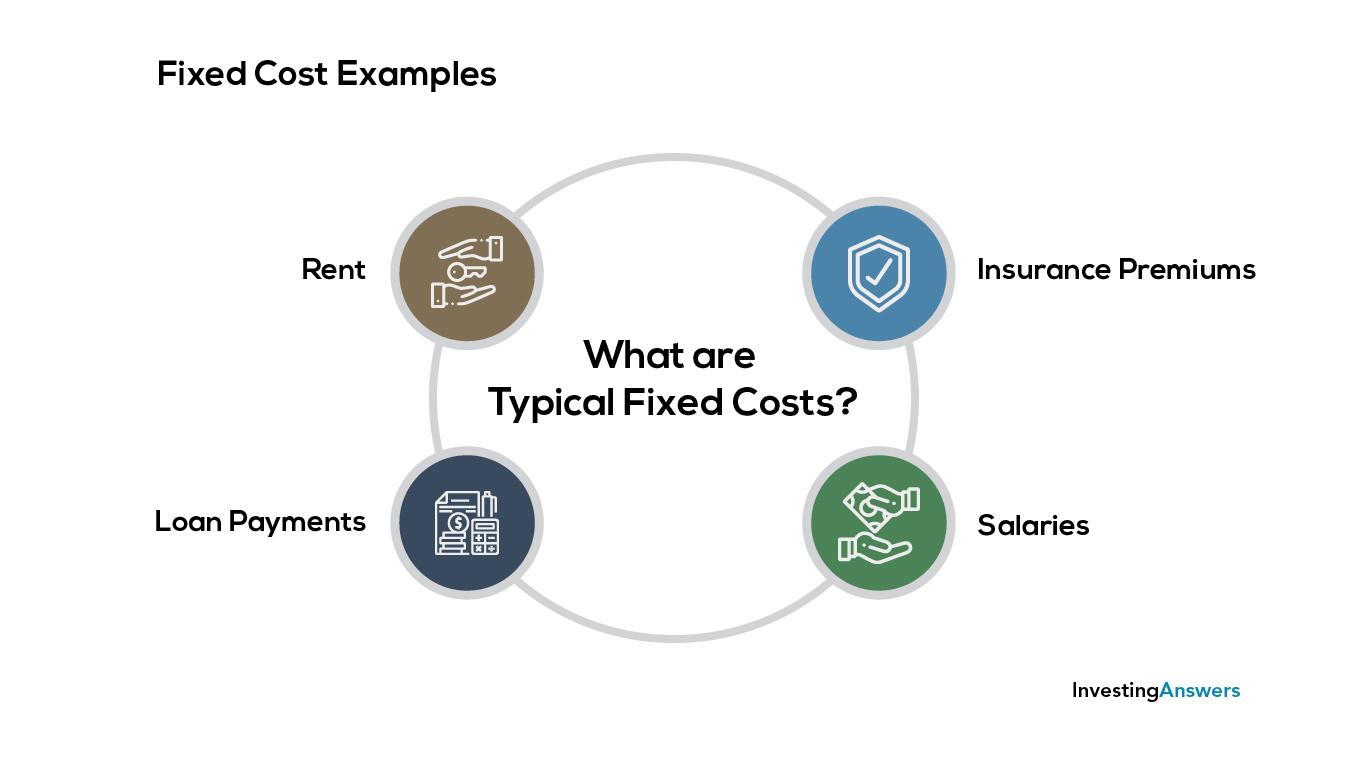
A quintessential example of a fixed cost in business is commercial rent. Regardless of whether a company sells one product or one million during a month, the monthly lease payment to the landlord remains constant. These costs are time-related rather than volume-related, forming the financial baseline of a company's total obligations.
In the fiscal landscape of 2026, understanding fixed costs is more than an accounting exercise; it is a survival strategy. While variable costs fluctuate with production levels, fixed costs represent the "nut" a business must crack every month just to keep the doors open. By mastering these expenses, business owners can better calculate their break-even points, manage cash flow during economic shifts, and scale their operations with greater precision.
The Fundamental Definition of Fixed Costs
Fixed costs are business expenses that do not change in response to the volume of goods or services produced or sold. They are often referred to as indirect costs or overhead. In accounting terms, these are expenses that stay the same within a "relevant range" of activity.
For instance, if a boutique bakery produces 100 loaves of bread or 1,000 loaves, the cost of the storefront lease remains identical. While the cost of flour and yeast (variable costs) will increase with production, the rent is decoupled from the output. In 2026, many businesses also face "step-fixed costs," which are expenses that remain constant up to a certain production level but "step up" once a specific threshold is crossed—such as needing to rent a second warehouse once the first is full.
Why the "Time" Factor Matters
Fixed costs are generally associated with the passage of time rather than the intensity of business activity. Most fixed costs are contractual or statutory, meaning they are governed by leases, employment agreements, or government regulations that mandate payments on a weekly, monthly, or annual basis. This predictability is a double-edged sword: it allows for accurate long-term budgeting but creates significant financial pressure during periods of low revenue.
Core Examples of Fixed Costs in Business
To fully grasp how these expenses impact a balance sheet, it is helpful to examine the most common categories found in modern business models.
1. Commercial Rent and Lease Payments
As previously noted, rent is the most visible fixed cost. Whether a business operates out of a high-rise office in a major city or a small suburban warehouse, the monthly payment is a contractual obligation. In 2026, even as hybrid work models have stabilized, commercial real estate remains a significant fixed burden.
Lease agreements often include "escalation clauses" where the rent might increase annually, but because this increase is predetermined and not based on sales volume, it remains a fixed cost for the duration of the budget cycle.
2. Administrative Salaries
While factory workers might be paid hourly or by piece-rate (variable), management and administrative staff are typically paid a set annual salary. A Human Resources manager, an accountant, or a CEO receives the same paycheck regardless of whether the company had its best sales month or its worst. These personnel costs are fixed because the workload of administrative oversight does not fluctuate linearly with every single sale made by the company.
3. Software-as-a-Service (SaaS) Subscriptions
In the current 2026 business environment, software subscriptions have become one of the most prominent fixed costs. Most companies rely on platforms for CRM (Customer Relationship Management), ERP (Enterprise Resource Planning), and communication. If a company pays $1,500 per month for a set number of user licenses, that cost is fixed. It does not matter if those users send 10 emails or 10,000; the subscription fee remains unchanged.
4. Insurance Premiums
Insurance is a prerequisite for operating any legitimate business. Whether it is general liability, professional indemnity, workers' compensation, or property insurance, premiums are typically set for a policy term (usually six months or a year). The insurance company does not adjust your monthly premium based on how many customers walked through your door yesterday. This makes insurance a highly predictable, albeit unavoidable, fixed expense.
5. Interest on Debt
When a business takes out a term loan to fund expansion or purchase equipment, the interest payments on that loan are fixed costs. While the principal balance may decrease over time, the monthly interest obligation (in a fixed-rate loan) is a set amount that must be paid to remain in good standing with the lender. This is distinct from credit card interest, which may vary based on the balance carried.
6. Depreciation
Depreciation is a non-cash fixed cost that represents the gradual wear and tear of physical assets like machinery, vehicles, or buildings. Under standard accounting practices, such as the straight-line method, a business writes off a specific, unchanging portion of an asset's value every year. Because this deduction is based on the purchase price and estimated lifespan of the asset—not how much the asset was used—it is categorized as fixed.
Fixed Costs vs. Variable Costs: A Detailed Comparison
Understanding the interplay between fixed and variable costs is essential for calculating the "Contribution Margin," which is the amount of money left over from sales to cover fixed expenses and generate profit.
| Feature | Fixed Costs | Variable Costs |
|---|---|---|
| Relation to Volume | Unaffected by production levels. | Increases/decreases with production. |
| Frequency | Periodic (monthly, quarterly, annually). | Transactional (per unit sold). |
| Examples | Rent, Salaries, Insurance, SaaS. | Raw materials, Shipping, Sales commissions. |
| Budgeting Impact | Predictable and easy to forecast. | Harder to predict; varies with market demand. |
| Risk Factor | High risk during low-sales periods. | Lower risk as costs drop when sales drop. |
| Management Focus | Managed through long-term contracts. | Managed through supply chain efficiency. |
The Role of Fixed Costs in Break-Even Analysis
The primary reason businesses track fixed costs so closely is to determine their Break-Even Point (BEP). This is the moment when total revenue exactly equals total costs (both fixed and variable).
The formula for the break-even point in units is: BEP = Total Fixed Costs / (Price per Unit – Variable Cost per Unit)
If a company has $50,000 in monthly fixed costs and sells a product for $100 with a variable cost of $60, the contribution margin is $40 per unit. To break even, the company must sell 1,250 units ($50,000 / $40).
In 2026, with shifting consumer behaviors, businesses that maintain high fixed costs (high operating leverage) are more sensitive to sales fluctuations. If they sell more than the break-even point, their profits grow rapidly because the fixed costs are already "covered." However, if they fall short, the losses can be devastating because those fixed costs must still be paid in full.
Strategic Implications: Operating Leverage
Operating leverage is a measure of how much a firm's net operating income changes in response to a change in sales. A business with high fixed costs and low variable costs has high operating leverage.
The High Fixed Cost Model
Software companies often fit this profile. Developing the software involves massive fixed costs (salaries for developers, server infrastructure), but selling an additional copy of the software costs almost nothing (low variable cost). Once the high fixed costs are covered, almost every additional dollar of revenue goes straight to profit. This is why software companies are often highly valued; they are incredibly scalable.
The Low Fixed Cost Model
Conversely, a consulting firm or a retail store typically has lower operating leverage. If a consultant wants to take on more work, they may need to hire more people or pay for more hours, increasing their variable costs. While their risk is lower (they have fewer "must-pay" bills if business slows down), their profit margins don't expand as aggressively when sales skyrocket because their costs grow right alongside their revenue.
Practical Steps for Managing Fixed Costs in 2026
Given the importance of fixed costs to a company's bottom line, business leaders should follow these best practices for oversight and optimization:
- Conduct Regular Expense Audits: Every six months, review all "autopay" subscriptions and contracts. In the 2026 landscape, SaaS "creep" is common, where businesses continue to pay for fixed software licenses that are no longer in use.
- Negotiate Lease Terms: Rent is fixed, but it is not set in stone forever. When a lease is up for renewal, or during shifts in the local commercial real estate market, businesses should negotiate for better rates or "rent holidays" in exchange for longer-term commitments.
- Convert Fixed to Variable Where Possible: Many modern businesses are moving toward "fractional" services. Instead of hiring a full-time CFO (fixed cost), they might hire a fractional CFO for a set number of hours per month. This allows the business to scale the service down if necessary, effectively turning a portion of a fixed expense into a more flexible one.
- Monitor Step-Fixed Triggers: Be aware of the capacity limits of your current fixed assets. If you know your current warehouse can only hold 5,000 units, you must plan for the massive "step" in fixed costs that will occur once you hit unit 5,001.
- Maintain a Cash Reserve: Because fixed costs do not go away during lean months, a business should ideally maintain a reserve of 3 to 6 months' worth of fixed operating expenses. This ensures that a temporary dip in sales doesn't lead to an immediate default on rent or salaries.
Common Pitfalls and Mistakes
One of the most common mistakes in business accounting is misclassifying a cost. For example, some managers mistake "utilities" for a fixed cost. While there is often a base connection fee (fixed), the actual usage of electricity and water in a manufacturing plant often fluctuates with production, making it a "mixed cost."
Another pitfall is the "Fixed Cost Trap" during expansion. Businesses often take on large amounts of new fixed debt or expensive leases during growth phases. If the market cools—as seen in various cycles leading up to 2026—the business is left with an inflated overhead that it cannot easily reduce, leading to insolvency even if the business is still technically "generating sales."
Frequently Asked Questions
Is payroll always a fixed cost?
No. Payroll is only a fixed cost when it involves salaried employees whose pay does not change based on their output or hours worked. Hourly wages, sales commissions, and overtime pay are considered variable costs because they fluctuate based on how much the business is operating or selling.
Can fixed costs change over time?
Yes. "Fixed" does not mean "eternal." It simply means the cost doesn't change in relation to production volume. Rent can go up when a lease is renewed, and insurance premiums can increase annually. These are still fixed costs because the increase was not caused by selling more units of a product.
Why do investors care about fixed costs?
Investors look at fixed costs to determine a company's risk profile and scalability. A company with high fixed costs is considered riskier because it has a higher break-even point. However, it also has the potential for higher profit margins once that break-even point is surpassed, which is attractive to growth-oriented investors.
How does remote work affect fixed costs?
Remote work has allowed many businesses to eliminate or significantly reduce one of their largest fixed costs: office rent. By moving to a remote or hybrid model, companies can shift those funds into variable costs like project-based freelancers or performance-based marketing, which offers more flexibility during economic downturns.
Are advertising costs fixed or variable?
This is often debated, but advertising is generally considered a discretionary fixed cost. While you might choose to spend more on ads when you want more sales, the cost of a $5,000-per-month billboard or a set social media retainer is fixed for the duration of that contract. It does not automatically increase just because the ad was successful and resulted in more sales.
Recommendation for Business Owners
To maintain a healthy financial standing in 2026, your first action should be to calculate your Current Fixed Cost Ratio. Total all your invariant monthly expenses (rent, salaries, insurance, debt interest, subscriptions) and divide them by your total monthly revenue. If your fixed costs exceed 40-50% of your revenue, your business may be vulnerable to market volatility. Aim to optimize your overhead by reviewing service contracts and considering shared-resource models to keep your "survival threshold" as low as possible without sacrificing operational quality.