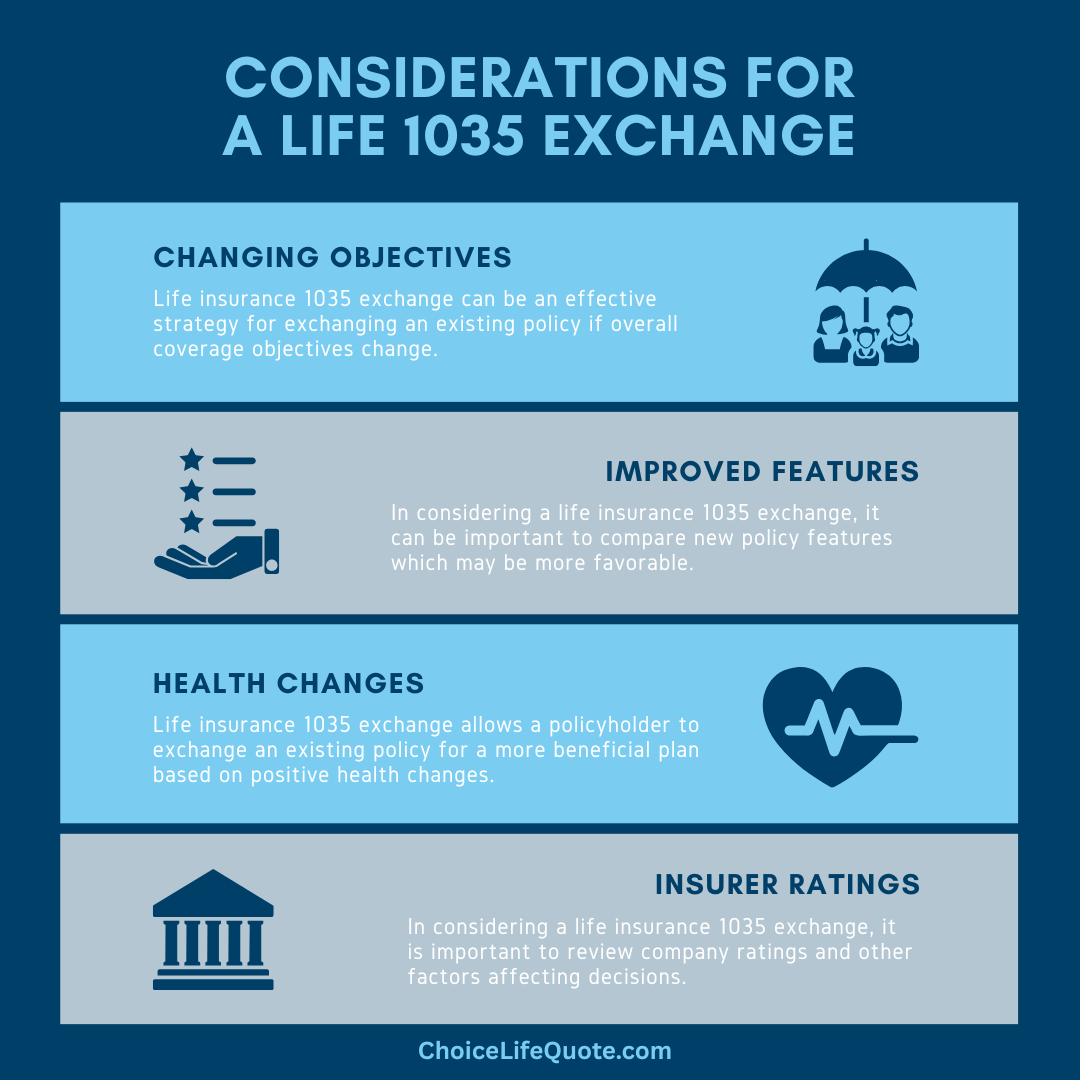
Company-owned life insurance (COLI) policies are eligible for tax-free 1035 exchanges under Section 1035 of the Internal Revenue Code. To qualify, the exchange must involve the same policy owner and the same insured individual, while strictly adhering to IRC Section 101(j) notice and consent requirements to maintain the tax-exempt status of the death benefit.
As of 2026, business entities frequently utilize Section 1035 exchanges to modernize their executive benefit strategies, optimize cash value growth, or transition to carriers with more favorable fee structures. While the process is a staple of corporate financial planning, it requires rigorous attention to detail regarding ownership structures and federal tax reporting. Navigating the intersection of corporate tax law and insurance regulation is essential for any CFO or human resources director overseeing these assets.
Understanding the Section 1035 Exchange in a Corporate Context
Section 1035 of the Internal Revenue Code was designed to allow policyholders to update their insurance coverage without triggering a taxable event on the accumulated "inside buildup" or gains within the policy. In a standard environment, surrendering a life insurance policy with a cash value greater than the total premiums paid (the cost basis) results in taxable ordinary income. A 1035 exchange bypasses this by treating the transaction as a continuation of the original contract in a new form.
For a corporation, the stakes are often higher than for an individual. COLI policies are frequently used to fund non-qualified deferred compensation (NQDC) plans, provide key-person protection, or offset future retiree health liabilities. In 2026, the financial landscape demands that these assets perform efficiently. If a policy purchased a decade ago no longer meets the company's internal rate of return (IRR) targets or has excessive mortality charges, the 1035 exchange provides a mechanism to pivot to a high-performing contemporary product without losing 21% or more of the gains to corporate income tax.
The Role of "Like-Kind" Requirements
To be eligible for 1035 treatment, the exchange must meet "like-kind" criteria. According to the IRS, the following exchanges are permissible:
- A life insurance contract for another life insurance contract.
- A life insurance contract for an endowment contract.
- A life insurance contract for an annuity contract.
- A life insurance contract for a qualified long-term care contract.
Crucially, the exchange cannot move backward in terms of "risk." For instance, you cannot exchange an annuity for a life insurance policy tax-free because an annuity does not contain the same life insurance risk element. For most corporations, the exchange is almost always life-for-life to maintain the death benefit liquidity.
The Absolute Requirement of the "Same Insured" Rule
One of the most common misconceptions in corporate finance is that a company can exchange a policy on a departing executive for a new policy on a current executive. This is strictly prohibited under Revenue Ruling 90-109.
The IRS maintains that for a 1035 exchange to be valid, the person insured under the new policy must be the same person insured under the old policy. If a company attempts to change the insured individual during the exchange, the IRS views this as a "material change" that constitutes a sale and purchase, rather than an exchange.
Consequences of Changing the Insured
If the insured is changed:
- Taxation of Gains: The entire gain in the original policy (Cash Surrender Value minus Cost Basis) becomes immediately taxable to the corporation as ordinary income.
- Loss of Basis Transfer: In a valid 1035 exchange, the cost basis of the old policy carries over to the new one. In a failed exchange, the basis starts over at the amount of the new premium, losing the historical credit of the previous years.
- Reporting Penalties: Inaccurate reporting of the transaction on Form 1099-R can lead to audits and penalties from the IRS.
In the corporate world of 2026, where executive turnover is high, companies must instead decide whether to keep the policy on the former executive as a "dead-firm" policy (provided original consents allow it) or surrender it and face the tax consequences.
Navigating IRC Section 101(j) and COLI Best Practices
Since the enactment of the Pension Protection Act of 2006, COLI policies have been subject to IRC Section 101(j). This section dictates that unless specific notice and consent requirements are met, the death benefit of a COLI policy—which is normally tax-free—becomes taxable income to the corporation to the extent it exceeds the premiums paid.
When performing a 1035 exchange in 2026, the question of whether a new "Notice and Consent" form is required is paramount.
Is New Consent Required for a 1035 Exchange?
Generally, if the original policy was compliant with 101(j), a 1035 exchange to a new policy on the same insured person is often considered a continuation of the original coverage. However, the IRS has issued guidance suggesting that "material changes" to a policy could trigger the need for new consent.
Most conservative tax advisors and insurance carriers in 2026 recommend obtaining fresh notice and consent during the 1035 exchange process. This ensures that:
- The employee is aware of the new policy amount.
- The employee consents to the corporation being the beneficiary.
- The corporation remains protected against the death benefit becoming taxable.
Failure to secure this consent during an exchange could inadvertently turn a multi-million dollar tax-free death benefit into a massive tax liability for the company in the future.
Financial and Accounting Benefits of COLI Exchanges
Beyond the tax-free transition, companies initiate 1035 exchanges for several strategic financial reasons. As we look at the corporate environment in 2026, these factors are often the primary drivers for the exchange.
Improving Policy Performance
Older COLI policies might be tied to fixed interest rates or older mortality tables (such as CSO 2001). Newer products, including Private Placement Life Insurance (PPLI) or Variable Corporate Owned Life Insurance (VCOLI), may offer:
- Lower M&E Charges: Mortality and Expense (M&E) charges have generally trended downward as life expectancy has increased.
- Better Investment Options: Modern VCOLI policies allow corporations to allocate cash value into a wider array of institutional funds or even alternative investments.
- Enhanced Cash Value Access: Newer products may have lower surrender charges or more favorable loan provisions.
Consolidating Carriers
Large enterprises often end up with a "patchwork" of policies from various carriers due to mergers and acquisitions. A series of 1035 exchanges allows the Treasury department to consolidate these assets under a single carrier or a unified administration platform, reducing the overhead of tracking multiple policy statements and values.
Accounting for Cash Value (ASC 325-30)
Under US GAAP, specifically ASC 325-30, corporations must report the Cash Surrender Value (CSV) of COLI as an asset on their balance sheet. Changes in the CSV are reported in the income statement. A 1035 exchange allows the company to move the asset to a more productive vehicle without the "hit" to the income statement that a taxable surrender would cause.
Comparative Analysis: 1035 Exchange vs. Policy Surrender
To understand the value of an exchange, it is helpful to compare the mechanics of a 1035 transfer against a standard surrender and repurchase.
| Feature | Section 1035 Exchange | Policy Surrender & Re-purchase |
|---|---|---|
| Tax on Gain | Deferred (No immediate tax) | Taxed as Ordinary Income |
| Cost Basis | Carries over from old policy | Resets to new premium amount |
| Insured Person | Must remain the same | Can be changed (New application) |
| Surrender Charges | Usually triggers new charge period | Triggers new charge period |
| Underwriting | Required (New policy) | Required (New policy) |
| IRS Reporting | Reported as non-taxable exchange | Reported as taxable distribution |
| 101(j) Compliance | Documentation must be verified | New Notice and Consent required |
The Step-by-Step 1035 Exchange Process for Corporations
Executing a 1035 exchange for a corporate-owned policy is more complex than an individual exchange due to the corporate resolutions and board approvals often required.
1. Policy Audit and Feasibility Study
Before initiating an exchange, the company should conduct a thorough audit of the existing policy. This includes requesting an "In-Force Illustration" to see the projected performance of the current policy and comparing it against a "Proposed Illustration" from a new carrier.
2. Selection of the New Carrier and Product
The company must select a product that aligns with its specific goals—whether that is maximizing death benefit for key-person insurance or maximizing cash accumulation for an NQDC plan. In 2026, many companies prefer "Institutionally Priced" COLI, which features lower commissions and higher early-year cash values.
3. Corporate Authorization
The board of directors or an authorized committee must typically pass a resolution authorizing the exchange. Because COLI is a corporate asset, the decision to move it must be documented to satisfy fiduciary duties and internal audit requirements.
4. Notice and Consent (101(j) Compliance)
The company must provide the insured employee with a written notice explaining that the company intends to purchase a new policy on their life and stating the maximum face amount. The employee must provide written consent before the new policy is issued.
5. Application and Underwriting
The company applies for the new policy. The insured individual will likely need to undergo medical underwriting (exam, blood work, records review), although some "Simplified Issue" products may be available for large groups of executives.
6. Absolute Assignment and Direct Transfer
To satisfy the IRS, the exchange must be handled "carrier-to-carrier." The corporation does not receive a check. Instead, the company assigns the old policy to the new carrier. The new carrier then surrenders the old policy and applies the proceeds directly to the new contract.
Caution: If the corporation receives the cash directly, the 1035 exchange is invalidated, and the gains become taxable.
Common Pitfalls and Troubleshooting
Even with clear eligibility, several errors can disqualify a COLI 1035 exchange or create unforeseen liabilities.
The Problem of Policy Loans
If the old policy has an outstanding loan, the exchange becomes complicated. If the loan is forgiven or extinguished during the exchange, the IRS treats the forgiven loan amount as "boot." Boot is taxable to the extent of the gain in the policy. To avoid this, the new policy must usually be issued with a "loan carryover," where the new carrier accepts the debt alongside the cash value.
Timing and the "Step Transaction" Doctrine
The IRS may scrutinize exchanges that happen too close to other transactions. For example, if a company surrenders a policy and then buys a new one two weeks later, they cannot retroactively claim it was a 1035 exchange. The paperwork must be established before the old policy is liquidated.
State Premium Taxes
While a 1035 exchange is federally tax-free, some states may impose a premium tax on the funds moving into the new policy. However, many states provide exemptions for 1035 exchange proceeds. In 2026, it is vital to consult with a tax professional familiar with the specific statutes in the company's state of domicile.
Frequently Asked Questions
Can a company exchange a policy on a retired employee?
Yes, provided the company still has an insurable interest (which is generally maintained if the policy was legally owned since the period of employment) and the "Same Insured" rule is followed. However, you must ensure that the original 101(j) consent covered the post-employment period.
What happens if the original insurance company is insolvent?
Special rules apply to policies held by companies in receivership. Generally, the IRS allows for 1035 treatment even if the full cash value cannot be transferred at once due to court-ordered moratoriums, provided the taxpayer follows the procedures in IRS Revenue Procedure 92-44.
Is a 1035 exchange available for "Split-Dollar" life insurance?
Yes, but it is significantly more complex. In a split-dollar arrangement, the ownership and rights to the cash value/death benefit are divided between the company and the employee. Both parties must typically consent to the exchange, and the underlying split-dollar agreement must be amended to reflect the new policy.
Can we exchange a COLI policy for an annuity to fund a pension?
Technically, a life insurance-to-annuity 1035 exchange is permitted. However, the corporation must be careful of the "Non-Natural Person" rule. Under IRC Section 72(u), annuities held by entities (like corporations) generally do not receive tax-deferred growth unless they are held as an agent for a natural person. This often makes this specific exchange less attractive for businesses.
Do 1035 exchanges trigger a new contestability period?
Yes. Almost all new life insurance policies come with a new two-year contestability period and a new two-year suicide clause. This means the new carrier can investigate the original medical application if a claim occurs within the first two years of the new policy's life.
Practical Recommendations for 2026
For companies evaluating their COLI portfolio in 2026, the 1035 exchange remains the most powerful tool for asset optimization. To ensure a successful execution:
- Perform a Benchmarking Study: Before initiating an exchange, use a third-party consultant to verify that the new policy's projected internal rate of return (IRR) significantly outperforms the current policy, accounting for new surrender charges.
- Verify 101(j) Records: Ensure that the original "Notice and Consent" forms are in the corporate archives. If they are missing, a 1035 exchange is an excellent time to rectify the documentation.
- Use a Direct Transfer: Never allow the cash value to pass through the company's bank accounts. Ensure the new carrier provides a "1035 Exchange Packet" to handle the carrier-to-carrier transfer.
- Review the Loan Status: If the policy has a loan, decide whether to pay it off before the exchange or ensure the new carrier can accommodate a "carryover loan" to avoid taxable boot.
By adhering to these guidelines, corporations can effectively modernize their life insurance assets, ensuring they continue to provide the necessary liquidity and funding for executive benefits without incurring unnecessary tax friction.