The journey of Aqib Talib from his early childhood in Cleveland, Ohio, to becoming a Super Bowl champion and five-time Pro Bowler is a definitive narrative of athletic resilience and elite technical mastery. Born in Cleveland before rising to prominence at the University of Kansas, Talib evolved into one of the premier "shutdown" cornerbacks of his generation, ultimately securing his legacy as a cornerstone of the Denver Broncos' legendary "No Fly Zone" defense and one of the most prolific defensive scorers in NFL history.
The Cleveland Foundation: Early Years and Geographic Transitions
To understand the competitive fire of Aqib Talib, one must look at his origins in Cleveland, Ohio. Born on February 13, 1986, Talib spent his formative years in the North Collinwood neighborhood. The "Cleveland grit" is a recurring theme in the biographies of athletes from the region, often characterized by a hard-nosed approach to competition and a defensive-minded physical toughness. Although his family eventually relocated to Richardson, Texas, during his middle school years, Talib frequently pointed to his Ohio roots as the source of his initial exposure to the sport and his aggressive playing style.
In Cleveland, football is more than a pastime; it is a cultural cornerstone. For a young athlete like Talib, the environment demanded early specialization in man-to-man coverage and ball-tracking skills. By the time he arrived at Berkner High School in Texas, he was already physically advanced, possessing the height and arm length that would later become his professional trademark. However, it was the combination of Texas’s high-intensity high school football circuit and his foundational Cleveland toughness that prepared him for the collegiate level.
The University of Kansas: A Collegiate Powerhouse
Aqib Talib’s path to stardom took a significant leap when he committed to the University of Kansas. Under the tutelage of coach Mark Mangino, Talib transformed from a talented prospect into a consensus All-American. His tenure at Kansas (2005–2007) remains one of the most decorated periods for any defensive player in the program's history.
The 2008 Orange Bowl and National Recognition
The pinnacle of Talib’s collegiate career was the 2007-2008 season. Kansas, traditionally viewed as a basketball powerhouse, surged to a 12-1 record. Talib was the heartbeat of a defense that thrived on turnovers. In the 2008 Orange Bowl against Virginia Tech, Talib delivered a performance that cemented his first-round draft status. He recorded a 60-yard interception return for a touchdown, earning the game’s Most Valuable Player honors.
During his three seasons at Kansas, Talib recorded 13 interceptions. What set him apart was his "ball-hawk" mentality—the ability not just to deflect passes but to high-point the ball and transition immediately into an offensive threat. This versatility was so pronounced that he also played significant snaps at wide receiver, scoring several offensive touchdowns. This dual-threat capability gave him a unique perspective on the field, allowing him to anticipate route breaks before the quarterback even released the ball.
Entering the Professional Ranks: The Tampa Bay Era
Aqib Talib entered the NFL as the 20th overall pick in the 2008 NFL Draft, selected by the Tampa Bay Buccaneers. His transition to the professional level was immediate in terms of impact but complex in terms of professional development.
In Tampa Bay, Talib was coached by defensive minds who emphasized the "Tampa 2" scheme, but Talib’s true strength lay in press-man coverage. Standing 6'1" with long arms, he could disrupt the timing of elite receivers at the line of scrimmage. During his four-plus seasons with the Buccaneers, he recorded 17 interceptions. Despite his on-field success, including a breakout 2010 season where he recorded six interceptions in just 11 games, his tenure was marked by disciplinary hurdles that occasionally overshadowed his elite production.
However, the "stardom" aspect of his career began to crystallize during this period. He wasn't just a cornerback; he was a momentum-shifter. His ability to read "out" routes and "comebacks" led to numerous game-changing plays, establishing him as a top-tier defensive back in a league that was becoming increasingly pass-heavy.
The New England Patriots: Technical Refinement
In 2012, a mid-season trade to the New England Patriots changed the trajectory of Talib’s career. Under Bill Belichick, Talib was asked to take on the "shadow" role—following the opponent's best wide receiver across the formation. This era required a higher level of tactical discipline and film study.
Talib’s arrival in New England was credited with stabilizing a struggling secondary. His presence allowed the Patriots to play aggressive man-coverage schemes that were previously impossible. In 2013, he earned his first Pro Bowl selection, totaling four interceptions and proving he could perform under the intense scrutiny of a championship-contending market. It was here that he refined the technical nuances of the position, such as "trail technique" and the use of the sideline as an extra defender.
The Denver Broncos and the "No Fly Zone"
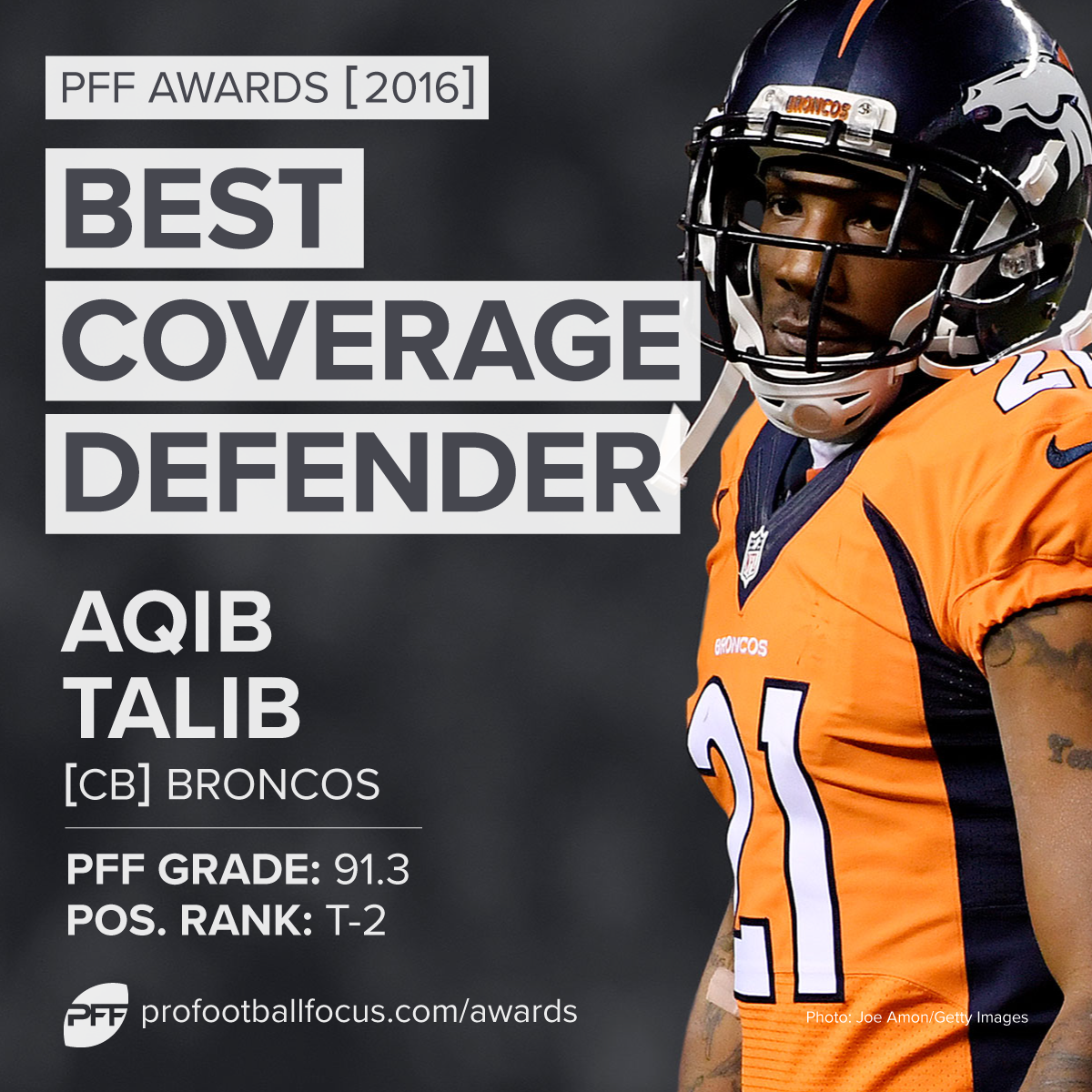
If Cleveland was where his journey started and Kansas was where he grew, Denver was where Aqib Talib reached the zenith of NFL stardom. Signing with the Denver Broncos in 2014, Talib joined a defensive unit that would eventually be known as the "No Fly Zone."
Alongside Chris Harris Jr., Bradley Roby, T.J. Ward, and Darian Stewart, Talib formed the most feared secondary of the mid-2010s. His four-year stint in Denver (2014–2017) was historically productive:
- Four consecutive Pro Bowl selections.
- First-team All-Pro honors in 2016.
- Six interceptions returned for touchdowns.
- Super Bowl 50 Champion.
The Road to Super Bowl 50
The 2015 Denver Broncos defense is frequently cited among the greatest in NFL history. While Von Miller provided the pass rush, Talib provided the "lockdown" capability that allowed the blitz to get home. In Super Bowl 50, the Broncos faced a high-powered Carolina Panthers offense led by MVP Cam Newton. Talib’s physical play on the perimeter was instrumental in neutralizing the Panthers' deep-threat passing game, ultimately leading to a 24-10 victory and Talib’s first Super Bowl ring.
Technical Analysis: What Made Aqib Talib Elite?
Talib’s rise to stardom was not merely a product of athleticism; it was a result of specific technical attributes that modern scouts still use as a benchmark for the cornerback position.
1. Physicality and Jam Technique
Unlike smaller "scrapper" corners, Talib used his 6'1" frame to dominate the line of scrimmage. His "jam"—the initial strike to a receiver's chest at the snap—was designed to disrupt the 1.5-second timing window essential for West Coast offenses. By knocking receivers off their "stem," he forced quarterbacks to hold the ball longer, leading to sacks for his defensive line.
2. Route Recognition and "Baiting"
As he matured, Talib became a master of "baiting" quarterbacks. He would often play with a slight cushion, giving the appearance that a receiver was open on a hitch or slant route. Once the quarterback committed to the throw, Talib’s elite "click-and-close" speed allowed him to undercut the route. This specific skill is why he ranks among the all-time leaders in Pick-Sixes.
3. High-Pointing the Ball
Due to his background as a high school and college receiver, Talib possessed exceptional hands. Most cornerbacks are taught to "play the hands" of the receiver; Talib played the ball as if he were the intended target. This allowed him to win 50/50 jump-ball situations against taller receivers and tight ends.
Career Statistical Summary and Accolades
By the time Talib reached the final stages of his career with the Los Angeles Rams and a brief stint with the Miami Dolphins, his resume was already Hall of Fame-caliber. As of 2026, he remains a prominent figure in the discussion of the best defensive backs of the 21st century.
| Category | Career Total / Achievement | Significance |
|---|---|---|
| Interceptions | 35 | Consistent ball production over 12 seasons. |
| Pick-Sixes (TDs) | 10 | Ranked 4th all-time in NFL history. |
| Pro Bowl Selections | 5 | Recognized as elite in both AFC and NFC. |
| All-Pro Honors | 2 (1x First-team, 1x Second-team) | Elite status among peers. |
| Super Bowl Titles | 1 (Super Bowl 50) | The ultimate team achievement. |
| Passes Defended | 125 | High volume of disruptive playmaking. |
Legacy and the Transition to Media
Aqib Talib’s stardom didn't end when he hung up his cleats in 2020. His transition into the broadcasting booth was met with critical acclaim for his "fresh" and "authentic" style. He brought the same energy to the microphone that he brought to the field, offering fans a unique look into the mind of a defensive back.
His journey—beginning in the tough neighborhoods of Cleveland, traversing the collegiate landscape of Kansas, and culminating in the "No Fly Zone" in Denver—serves as a blueprint for the modern NFL cornerback. He proved that a player could be a specialist in man coverage while maintaining the ball skills of a premier receiver. His 10 career defensive touchdowns stand as a testament to his "score-first" mentality on defense, a rarity in a league where most defenders are content with simply forcing an incompletion.
Frequently Asked Questions
Where was Aqib Talib born and raised?
Aqib Talib was born in Cleveland, Ohio. He spent his early childhood there before moving to Richardson, Texas. He often credits his Cleveland roots for his physical and aggressive style of play, which became his signature in the NFL.
How many Super Bowls did Aqib Talib win?
Aqib Talib won one Super Bowl (Super Bowl 50) as a member of the Denver Broncos. He was a key starter for the "No Fly Zone" defense that defeated the Carolina Panthers in February 2016. He also appeared in Super Bowl LIII with the Los Angeles Rams.
What is Aqib Talib's record for interceptions returned for touchdowns?
Talib recorded 10 career interceptions returned for touchdowns (Pick-Sixes). This ranks him fourth all-time in NFL history, trailing only Rod Woodson, Darren Sharper, and Charles Woodson. This statistic highlights his unique ability to transform into an offensive player the moment he caught the ball.
Which college did Aqib Talib attend?
He attended the University of Kansas. He is widely considered one of the greatest players in the history of the Kansas Jayhawks football program, leading them to an Orange Bowl victory in 2008 and earning All-American honors.
Why was the Denver Broncos secondary called the "No Fly Zone"?
The nickname "No Fly Zone" was given to the Broncos secondary (composed of Talib, Chris Harris Jr., T.J. Ward, Darian Stewart, and Bradley Roby) because of their extreme efficiency in preventing passing yards and touchdowns. During their peak from 2014 to 2016, they were statistically the best pass-defense unit in the NFL.
Final Recommendation for Fans and Students of the Game
For those looking to understand the evolution of the cornerback position, studying Aqib Talib’s film from the 2015-2016 Denver Broncos season is essential. His career demonstrates that elite success at the professional level is a combination of geographic toughness, collegiate development, and the ability to adapt to different coaching philosophies (from Mangino to Belichick to Wade Phillips). Whether you are analyzing his Cleveland origins or his NFL stardom, Talib remains a masterclass in defensive playmaking. To truly appreciate his impact, one should focus on his "press-man" technique—specifically how he used his hands to redirect receivers—which remains a gold standard for defensive back coaches in 2026.