An APT (Advanced Persistent Threat) actor is a highly sophisticated, well-resourced group that conducts targeted, long-term cyberattacks to steal data or disrupt operations. Unlike opportunistic hackers, these entities—often state-sponsored—prioritize stealth and persistence, utilizing custom malware and zero-day exploits to maintain access to high-value networks for months or even years.
Advanced Persistent Threat (APT) actors represent the pinnacle of cyber risk in 2026. Their operations are characterized by a level of discipline, funding, and technical prowess that exceeds the capabilities of standard cybercriminals. To protect organizational assets, security professionals must move beyond basic perimeter defense and understand the specific methodologies, geopolitical motivations, and evolving technologies that drive these elite adversary groups.
Defining the APT Threat Landscape in 2026
In the current landscape of 2026, the term "APT" has evolved. While it traditionally referred exclusively to nation-state entities, the line between state-sponsored espionage and high-end organized crime has blurred. APT threat actors are defined by three core characteristics:
- Advanced: They possess significant technical expertise and resources. This includes the ability to discover and exploit zero-day vulnerabilities (flaws unknown to the software vendor) and create bespoke malware that evades traditional antivirus signatures.
- Persistent: Their objective is not a quick hit. If they are expelled from a network, they have "stay-behind" mechanisms and secondary access points to re-enter. They are patient, often moving "low and slow" to avoid triggering behavioral alerts.
- Threat: They are active human adversaries, not automated scripts. They react to the defenses they encounter, pivoting their tactics in real-time to overcome security measures.
As we look at the current year, the integration of generative AI into the APT toolkit has accelerated. These groups now use AI to craft indistinguishable spear-phishing lures, automate the discovery of vulnerabilities in proprietary code, and develop polymorphic malware that changes its structure to bypass detection engines.
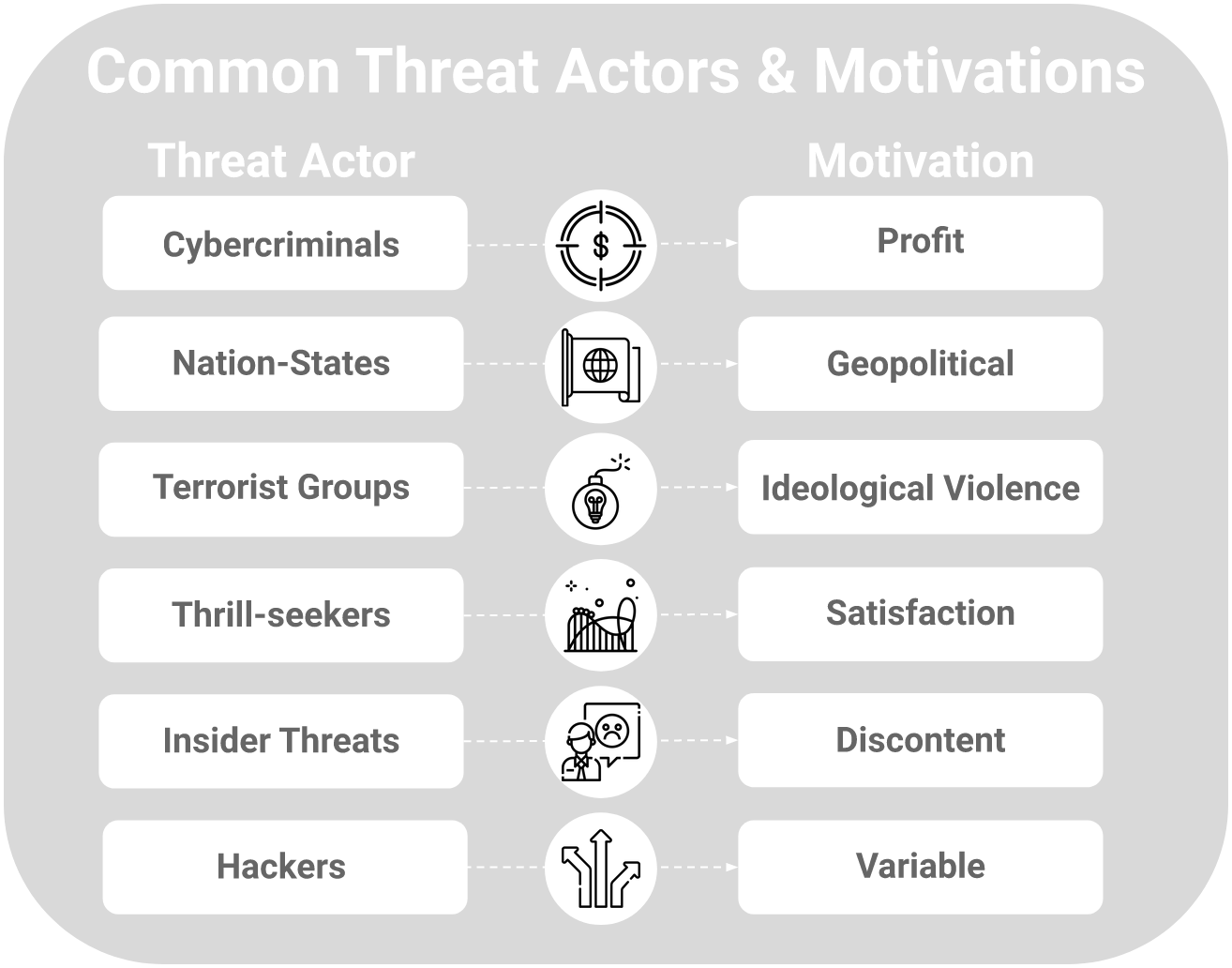
Primary Motives of APT Groups
Understanding why an APT actor is targeting your industry is the first step in building a tailored defense. Motives generally fall into four categories:
Strategic and Political Espionage
This is the most common driver for nation-state actors. The goal is to obtain classified government information, diplomatic communications, or military secrets. These actors target government agencies, think tanks, and defense contractors. By 2026, the focus has shifted heavily toward influencing democratic processes and monitoring dissident activities abroad.
Intellectual Property Theft and Economic Advantage
Many APT groups focus on "commercial espionage." Their mission is to steal trade secrets, research and development data, and proprietary manufacturing processes to give their home nation’s industries a competitive edge. This is particularly prevalent in the aerospace, pharmaceutical, and semiconductor sectors.
Financial Gain
While most APTs are motivated by policy or power, some—most notably those linked to the Democratic People's Republic of Korea (DPRK)—operate primarily to generate revenue. These groups target cryptocurrency exchanges, central banks, and the SWIFT banking system to circumvent international sanctions.
Critical Infrastructure Disruption
In times of geopolitical tension, APT threat actors may shift from data theft to sabotage. This involves gaining access to Industrial Control Systems (ICS) and Supervisory Control and Data Acquisition (SCADA) networks. Their goal is to maintain a "pre-positioned" presence in power grids, water treatment facilities, and transportation hubs, ready to cause physical disruption if a conflict arises.
The Lifecycle of an APT Attack: The Kill Chain
APT operations follow a structured lifecycle, often mapped to the MITRE ATT&CK framework. Understanding these stages allows defenders to implement "defense-in-depth."
Phase 1: Reconnaissance
The actor gathers intelligence on the target. This includes technical data (IP ranges, cloud providers, software versions) and human intelligence (employee roles, social media profiles, and organizational hierarchies). In 2026, much of this is automated via AI-driven scraping of public and leaked data.
Phase 2: Initial Access
The actor breaks into the perimeter. Common methods include:
- Spear-Phishing: Highly targeted emails containing malicious attachments or links.
- Vulnerability Exploitation: Using a zero-day or an unpatched known vulnerability in an edge device like a VPN or firewall.
- Supply Chain Attacks: Compromising a trusted third-party software vendor to gain access to all their customers (similar to the historic SolarWinds or 3CX incidents).
Phase 3: Establishment and Persistence
Once inside, the actor installs a "web shell" or a backdoor. They may create new administrator accounts or modify legitimate system tools to ensure they can return even if the initial entry point is closed or the system is rebooted.
Phase 4: Lateral Movement and Privilege Escalation
The initial point of entry is rarely the final goal. The actor moves through the network, seeking out the "crown jewels." They use techniques like "Pass-the-Hash" to steal credentials and escalate their permissions from a standard user to a Domain Administrator.
Phase 5: Exfiltration or Impact
The final stage involves collecting the desired data, compressing it, and sending it out to a Command and Control (C2) server. To avoid detection, they often mask this traffic as legitimate HTTPS or DNS requests. In the case of a disruptive attack, this is when the payload (e.g., wiper malware) is executed.
Profiles of Prominent APT Threat Actors
The following table outlines several of the most active APT groups monitored by global intelligence agencies as of 2026.
| Group Alias | Suspected Origin | Primary Target Sectors | Signature TTPs |
|---|---|---|---|
| APT29 (Cozy Bear) | Russia | Government, Think Tanks, NATO | Use of legitimate cloud services (Microsoft 365, Google Drive) for C2 traffic to blend in. |
| APT41 (Double Dragon) | China | Tech, Healthcare, Gaming | Dual-mode operation: state-sponsored espionage by day, financially motivated crime by night. |
| Lazarus Group | North Korea | Crypto Exchanges, Banks | High-volume cryptocurrency theft and use of destructive "wiper" malware. |
| APT35 (Charming Kitten) | Iran | Academia, Human Rights, Gov | Heavy reliance on social engineering and impersonating journalists or researchers. |
| Sandworm | Russia | Energy, Critical Infrastructure | Expert in Industrial Control Systems (ICS) and causing physical grid outages. |
Defending Against APT Actors in 2026
Traditional signature-based security is ineffective against APT threat actors. Because they use custom code, there is no "signature" to match. Defense must focus on behavior, identity, and resilience.
Implementing Zero Trust Architecture
The "Zero Trust" model operates on the principle of "never trust, always verify." In 2026, this is the baseline for APT defense. It requires every user and device to be authenticated and authorized for every single access request, regardless of whether they are "inside" the network. This significantly hampers an APT actor's ability to move laterally once they gain an initial foothold.
AI-Driven XDR (Extended Detection and Response)
As APTs use AI to attack, defenders must use AI to detect. XDR platforms collect data from endpoints, networks, cloud workloads, and identity providers. AI algorithms then analyze this data for "living off the land" (LotL) techniques—where attackers use legitimate system tools (like PowerShell or WMI) for malicious purposes. Detecting these subtle anomalies is the only way to catch a silent APT presence.
Threat Intelligence Integration
Organizations should subscribe to high-quality threat intelligence feeds that provide indicators of compromise (IoCs) and, more importantly, tactics, techniques, and procedures (TTPs) associated with specific APT groups. This allows security teams to proactively hunt for threats within their environment rather than waiting for an alert.
Robust Supply Chain Management
Since APTs frequently target the software supply chain, organizations must implement strict vendor risk management. This includes requiring a Software Bill of Materials (SBOM) for all third-party software, which allows the organization to quickly identify if they are running a vulnerable library or component discovered by an APT group.
Incident Response and Recovery
When dealing with an APT, the standard "reimage and restore" approach is often insufficient. Because APTs are persistent, they may have embedded themselves in backups or firmware.
- Scope the Intrusion: Before taking action, use forensics to determine the full extent of the actor's reach. If you kick them out of one system prematurely, they may trigger a destructive "fail-safe" or retreat deeper into the network.
- Eradication: This involves changing all credentials, wiping affected systems, and, in some cases, replacing hardware if firmware-level persistence is suspected.
- Post-Incident Hardening: An APT attack reveals the specific weaknesses in your architecture. Post-remediation must focus on closing those gaps, such as implementing stricter firewall rules or multi-factor authentication (MFA) across all legacy systems.
Frequently Asked Questions (FAQ)
What is the difference between a cybercriminal and an APT actor?
While both engage in illegal activities, cybercriminals are usually motivated by quick profit and use widely available tools to target as many victims as possible. APT actors are highly targeted, often government-funded, and possess the patience and resources to conduct long-term operations against specific high-value targets.
Can small businesses be targeted by APT threat actors?
Yes. While APTs often target large corporations or governments, they frequently use smaller businesses as "stepping stones." If a small business is a supplier or service provider to a larger target, the APT group may compromise the smaller entity first to gain a trusted path into the ultimate target's network.
How do I know if my organization is being targeted by an APT?
Signs include unusual outbound network traffic (especially to unknown IP addresses at odd hours), large-scale data transfers, unauthorized account creation, or the presence of "living off the land" activity where system tools are used in ways they shouldn't be. Professional "threat hunting" services are often required to confirm an APT presence.
Is it possible to completely stop an APT attack?
Absolute prevention is difficult because APT actors have the resources to find a way in eventually. However, by using a Zero Trust approach and rapid detection tools, you can minimize the impact, prevent data exfiltration, and make the cost of the attack so high that the actor may move on to an easier target.
Does insurance cover APT attacks?
Many cyber insurance policies in 2026 have specific clauses regarding "acts of war" or "state-sponsored" attacks. If an attack is officially attributed to a nation-state, some insurers may attempt to deny the claim. It is critical to review your policy's definitions of "cyber-warfare" and attribution requirements.
Final Recommendations for Security Leaders
To stay ahead of APT threat actors in 2026, organizations must transition from a reactive posture to a proactive one. This begins with Tabletop Exercises (TTX) that specifically simulate an APT intrusion, testing not just the technical response but the executive decision-making process regarding communication and legal obligations.
Furthermore, prioritize the Human Element. Even the most advanced APTs often rely on a single employee clicking a link. Robust, continuous security awareness training—tailored to the specific threats your industry faces—remains the most cost-effective defense. Finally, ensure your Logging and Monitoring strategy is comprehensive; you cannot defend what you cannot see. Retaining high-fidelity logs for at least 12 months is essential for the long-term forensic investigations that APT incidents require.