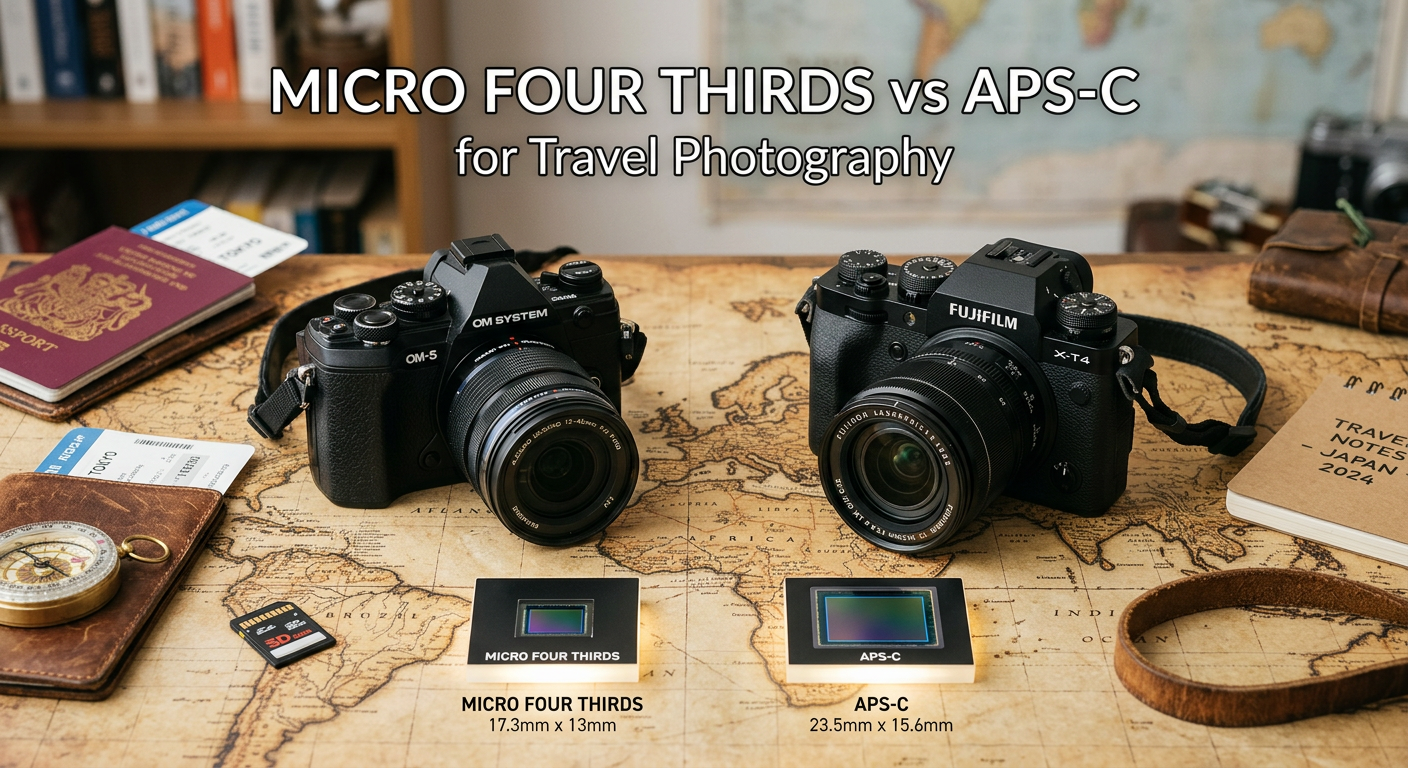
Choosing between APS-C and Micro 4/3 depends on your priority: APS-C offers superior low-light performance and shallower depth of field, while Micro 4/3 provides unmatched portability and industry-leading image stabilization. Most professionals lean toward APS-C for versatility, whereas hikers and wildlife enthusiasts often prefer the reach and compact form factor of Micro 4/3.
The debate between sensor sizes has evolved significantly by 2026. While full-frame cameras have become more affordable, the APS-C (Advanced Photo System type-C) and Micro 4/3 (MFT) formats remain the primary choices for enthusiasts, travelers, and hybrid creators who value a balance between performance and portability. Understanding the nuances of these two systems requires looking beyond simple pixel counts and focusing on the physical realities of sensor design, lens ecosystems, and the specific demands of your shooting style.
The Physical Foundation: Sensor Size and Aspect Ratio
The fundamental difference between these two systems is the physical surface area of the sensor. An APS-C sensor generally measures approximately 23.5mm x 15.6mm (though Canon’s version is slightly smaller at 22.2mm x 14.8mm). In contrast, a Micro 4/3 sensor is standardized at 17.3mm x 13.0mm.
This difference in size results in different crop factors relative to a standard 35mm full-frame sensor. APS-C sensors have a crop factor of 1.5x (or 1.6x for Canon), while Micro 4/3 sensors have a 2.0x crop factor. This means a 50mm lens on an APS-C body provides a field of view equivalent to 75mm on full-frame, whereas the same 50mm lens on an MFT body behaves like a 100mm lens.
Furthermore, the aspect ratios differ. APS-C uses a 3:2 ratio, which mirrors traditional 35mm film. Micro 4/3 uses a 4:3 ratio, which is taller and more square. This affects how you compose your shots; the 4:3 ratio is often preferred by those who print standard-sized photos (like 8x10s) or shoot for social media platforms where vertical height is an asset. APS-C’s wider ratio is more naturally suited for cinematic video and traditional landscape photography.
Image Quality, Low Light, and Dynamic Range
One of the most persistent truths in digital imaging is that larger sensors generally perform better in challenging lighting conditions. Because an APS-C sensor has roughly 50% to 60% more surface area than a Micro 4/3 sensor, it can host larger individual pixels (photosites) for any given resolution. Larger pixels are more efficient at capturing photons, which translates to a higher signal-to-noise ratio.
In practical terms, an APS-C camera in 2026 typically offers about a one-stop advantage in high-ISO noise performance over an MFT camera. If an MFT image starts to show grain at ISO 3200, an APS-C camera can usually reach ISO 6400 before showing similar levels of degradation. This makes APS-C the preferred choice for indoor events, concerts, and astro-photography where light is at a premium.
Dynamic range—the ability to preserve detail in both the brightest highlights and the darkest shadows—also tends to favor APS-C. The larger sensor can hold more charge per pixel, reducing the likelihood of "clipped" highlights. However, it is important to note that by 2026, computational photography and advanced sensor architectures (like Stacked CMOS and Back-Illuminated sensors) have narrowed this gap. High-end MFT cameras like those from OM System utilize sophisticated multi-exposure modes to simulate higher dynamic range, which can effectively bridge the gap for static subjects.
Depth of Field and the "Bokeh" Factor
For many photographers, the ability to blur the background—often called bokeh—is a primary creative goal. Sensor size plays a direct role in how much depth of field you can achieve. To get the same field of view and the same depth of field as a full-frame camera at f/2.8:
- An APS-C user would need a lens at roughly f/1.8.
- A Micro 4/3 user would need a lens at roughly f/1.4.
Because APS-C is physically larger, it is much easier to achieve a shallow depth of field with standard lenses. If you are a portrait photographer who loves creamy, obliterated backgrounds, APS-C provides a significant mathematical advantage. While "Pro" grade f/1.2 lenses exist for the Micro 4/3 system, they are expensive and heavy, somewhat negating the system's size advantage. APS-C remains the "sweet spot" for photographers who want professional-looking subject separation without moving to the much larger and more expensive full-frame ecosystem.
The Portability Paradox: Body vs. Lens
The Micro 4/3 system was designed from the ground up to be mirrorless and compact. The "Micro" in the name refers specifically to the reduced flange distance and smaller lens mount. In 2026, the size advantage of MFT remains its most compelling selling point, but there is a nuance: it is the lenses, not necessarily the camera bodies, that save the most weight.
While you can find very small APS-C bodies, the lenses must still produce an image circle large enough to cover the bigger sensor. This means a high-quality 300mm f/4 lens for APS-C will always be significantly larger and heavier than a 300mm f/4 lens for Micro 4/3. For wildlife and sports photographers, this is a game-changer. Carrying a 600mm-equivalent reach in a backpack that fits under an airplane seat is a feat currently only possible with the MFT system.
Conversely, some modern APS-C systems, particularly the Fujifilm X-Series, have embraced a "compact-first" philosophy. However, once you start adding fast f/1.4 primes or f/2.8 constant-aperture zooms, the APS-C kit will inevitably weigh more and take up more volume than an equivalent MFT setup.
Video Performance and Stabilization
By 2026, both formats have become powerhouses for video, but they excel in different areas. Micro 4/3 has long been a favorite of videographers due to the Panasonic Lumix GH series. Smaller sensors are easier to read out quickly, which often results in less "rolling shutter" (the jello effect seen during fast camera movements).
Micro 4/3 also holds a definitive lead in In-Body Image Stabilization (IBIS). Because the sensor is smaller and lighter, the internal stabilization motors can move it more rapidly and precisely. This allows MFT users to shoot handheld video that looks as if it were on a gimbal, or take multi-second long exposures without a tripod.
APS-C cameras are catching up, with Sony and Fujifilm implementing high-end IBIS systems, but the laws of physics still give the edge to MFT. If your work involves a lot of run-and-gun filmmaking or hiking without a tripod, the stabilization of a Micro 4/3 system is a massive technical benefit.
Comparison of Key Specifications
| Feature | Micro 4/3 (MFT) | APS-C |
|---|---|---|
| Sensor Dimensions | 17.3 x 13.0 mm | ~23.5 x 15.6 mm |
| Crop Factor | 2.0x | 1.5x (1.6x for Canon) |
| Aspect Ratio | 4:3 (Taller) | 3:2 (Wider/Standard) |
| Low Light Performance | Good (Aided by IBIS) | Excellent (Native Advantage) |
| Background Blur | Harder to achieve | Easier to achieve |
| Lens Size | Smallest & Lightest | Medium |
| Reach (Telephoto) | Superior (2x multiplier) | Moderate (1.5x multiplier) |
| Best For | Wildlife, Travel, Vlogging | Portraits, Street, General Purpose |
Ecosystem and Future-Proofing in 2026
When choosing a system, you are also choosing a lens mount and a manufacturer's roadmap.
- Micro 4/3: This is an open standard shared primarily by OM System (formerly Olympus) and Panasonic. This means you can use an Olympus lens on a Panasonic body with full autofocus compatibility. The lens library is arguably the most mature of any mirrorless system, with options ranging from budget-friendly "pancake" lenses to high-end professional glass.
- APS-C: This market is more fragmented. Fujifilm is the only major manufacturer that prioritizes APS-C as its primary professional format, resulting in the best native APS-C lens lineup. Sony offers excellent APS-C bodies, but many of their best lenses are designed for full-frame (making them bulky on APS-C bodies). Canon and Nikon also have APS-C (RF-S and Z-DX) lines, but their lens selections for these specific sensors are still more limited compared to Fuji or MFT.
In 2026, the trend has been toward specialization. MFT has carved out a niche in high-end wildlife and rugged outdoor photography, while APS-C has become the default for content creators who want the "cinematic look" without the cost of full-frame.
Frequently Asked Questions
Can I use full-frame lenses on an APS-C or Micro 4/3 camera?
Yes, you can use full-frame lenses on APS-C and MFT bodies via adapters or native mounts (like Sony E-mount). However, on an MFT body, the crop factor is 2.0x, meaning a 50mm full-frame lens becomes a 100mm equivalent. Furthermore, full-frame lenses are significantly heavier and more expensive, often defeating the purpose of using a smaller sensor body.
Is Micro 4/3 "dying" because of full-frame popularity?
No. While full-frame has become more popular, Micro 4/3 has found a dedicated audience in 2026 among wildlife photographers and videographers. Its unique advantages in stabilization and lens size cannot be replicated by larger sensors. As long as portability and reach are valued, Micro 4/3 remains a vital tool.
Which is better for street photography?
This is a subjective choice. Many street photographers prefer APS-C (specifically Fujifilm) for its film-like aspect ratio and slightly better low-light performance for evening shots. Others prefer Micro 4/3 because the cameras and lenses can be incredibly small, making them less intimidating and more discreet when shooting in public.
How does "Equivalence" affect my lens choice?
Equivalence helps you compare how a lens will look across different systems. To find the "full-frame equivalent" of an MFT lens, multiply both the focal length and the f-stop by 2. For an APS-C lens, multiply by 1.5. For example, a 25mm f/1.4 MFT lens is equivalent to a 50mm f/2.8 on full-frame in terms of field of view and depth of field.
Is APS-C better for printing large photos?
Generally, yes. The larger sensor area usually allows for higher resolutions (30MP-40MP) without sacrificing too much noise performance. While MFT can produce beautiful prints, APS-C provides more "headroom" for cropping and large-format printing due to the higher native signal quality.
Final Recommendation: Which Should You Buy?
The choice between APS-C and Micro 4/3 comes down to your primary subject matter and your tolerance for weight.
Choose APS-C if:
- You primarily shoot portraits and want a shallow depth of field (blurred backgrounds).
- You often shoot in low-light environments like dimly lit rooms or at night.
- You want a more traditional 3:2 aspect ratio for your compositions.
- You are interested in the Fujifilm ecosystem and its unique film simulations.
Choose Micro 4/3 if:
- Portability is your absolute priority; you want a kit that fits in a small jacket pocket or a day bag.
- You are a wildlife or sports photographer who needs maximum reach (the 2x crop factor is a massive benefit).
- You do a lot of handheld video and need the world's best in-body image stabilization.
- You prefer a 4:3 aspect ratio or frequently shoot vertical content for mobile platforms.
In 2026, neither system is "better" in an absolute sense. They are different tools designed for different tasks. If possible, visit a local camera store to hold both a Fujifilm X-T series (APS-C) and an OM System OM-1 (MFT) to see which ergonomics and lens sizes feel right for your hands and your creative vision.