Yes, an inch is significantly larger than a centimeter. Specifically, one inch is exactly equal to 2.54 centimeters. This means that a single unit of measurement in the imperial system (the inch) covers more physical distance than a single unit in the metric system (the centimeter). To visualize this, an inch is roughly the width of an adult’s thumb, while a centimeter is approximately the width of a standard pencil or a small staple.
Understanding the relationship between inches and centimeters is fundamental to navigating international standards in construction, engineering, fashion, and daily commerce. As of 2026, while most of the world utilizes the metric system for nearly all applications, the United States, Liberia, and Myanmar continue to use the imperial or US customary systems for many domestic purposes. This dual-system reality necessitates a clear understanding of how these two units compare and how to convert between them with precision.
The Mathematical Relationship Between Inches and Centimeters
The definitive relationship between the inch and the centimeter was standardized globally decades ago to ensure consistency in international trade and scientific research. Since 1959, the "international inch" has been defined as exactly 2.54 centimeters.
This fixed ratio is the cornerstone of all conversions. If you are looking at a ruler that features both units, you will notice that for every 1-inch mark, there are two full centimeter marks and a bit more than half of a third centimeter mark (0.54 to be exact).
Why the Ratio is Exactly 2.54
Prior to the mid-20th century, the exact length of an "inch" varied slightly between the United Kingdom and the United States. This caused significant issues in high-precision manufacturing, particularly during World War II when parts from different countries needed to be interchangeable. In 1959, the National Institute of Standards and Technology (NIST) and similar bodies in other English-speaking nations agreed to the International Yard and Pound Agreement. This agreement pinned the inch to the metric system, defining it as 25.4 millimeters (2.54 cm).
By defining the imperial unit through a metric constant, the world ensured that an inch in London is identical to an inch in New York or Tokyo, even though most of those locations use the centimeter as their primary daily unit.
Visualizing the Difference: Practical Examples
To understand the scale of "bigger" without a calculator, it helps to look at common household objects. Because an inch is 254% the size of a centimeter, the visual gap is quite large.
- The Adult Thumb: For most adults, the distance from the top knuckle to the tip of the thumb is roughly one inch.
- The Standard Staple: A standard office staple is approximately one centimeter wide. If you line up two and a half staples side-by-side, you would have the approximate length of one inch.
- A Standard AAA Battery: The diameter of a AAA battery is roughly 1 centimeter (actually about 1.05 cm). The length of that same battery is about 1.75 inches.
- A Quarter (US Coin): A US quarter has a diameter of roughly 0.95 inches, which is nearly 2.4 centimeters.
When comparing tools, a 10mm wrench is a common size in automotive repair. Because 10mm is exactly 1 centimeter, and an inch is 2.54 cm, a 10mm wrench is significantly smaller than a 1-inch wrench. In fact, a 1-inch wrench is roughly equivalent to a 25mm or 26mm wrench.
Historical Origins: Two Different Philosophies
The reason these two units are so different in size stems from their origins. The inch and the centimeter represent two different ways of thinking about the world.
The Origin of the Inch
The inch is an "anthropometric" unit, meaning it was originally based on the human body. Historically, it was defined as the width of a man's thumb. In some languages, the word for "inch" is derived from the word for "thumb" (for example, pouce in French). Later, King Edward II of England famously defined the inch as the length of "three grains of barley, dry and round, placed end to end." These definitions were practical for a medieval society where standardized metal rulers were rare, but they lacked the precision needed for modern science.
The Origin of the Centimeter
The centimeter is a "decimal" unit, born out of the French Revolution's desire for a rational, universal system. The meter was originally defined as one ten-millionth of the distance from the Earth's equator to the North Pole. A centimeter is simply one-hundredth (1/100) of that meter. The metric system was designed to be easily scalable by factors of ten, which is why there are 10 millimeters in a centimeter and 100 centimeters in a meter.
Converting Between Inches and Centimeters
In 2026, most digital devices and search engines can perform these conversions instantly. However, understanding the manual calculation is essential for professionals in the field who may not always have access to a digital interface.
The Conversion Formulas
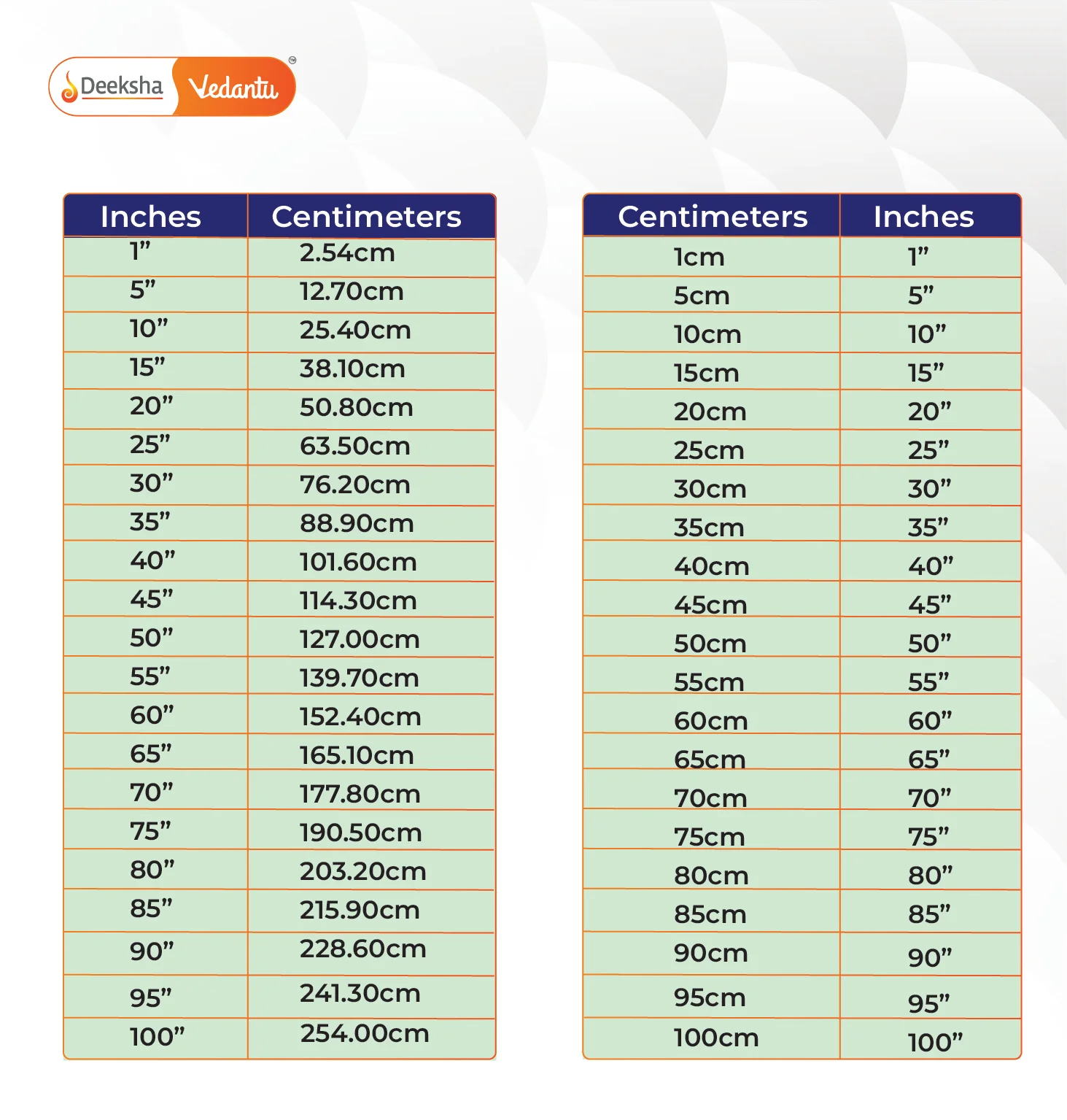
- To find Centimeters: Multiply the number of inches by 2.54.
- Formula: $Inches \times 2.54 = Centimeters$
- To find Inches: Divide the number of centimeters by 2.54.
- Formula: $Centimeters / 2.54 = Inches$
Mental Math Shortcuts
If you need a quick estimate and don't require surgical precision:
- The "Two-and-a-Half" Rule: Think of an inch as 2.5 cm. If you have 4 inches, $4 \times 2 = 8$, plus half of 4 (which is 2), equals 10 cm. The actual value is 10.16 cm, so this shortcut is very close.
- The 40% Rule: To go from centimeters to inches, multiply the centimeters by 0.4. For example, 10 cm times 0.4 equals 4 inches. (The actual value is 3.93 inches).
Comparison Table: Inches to Centimeters
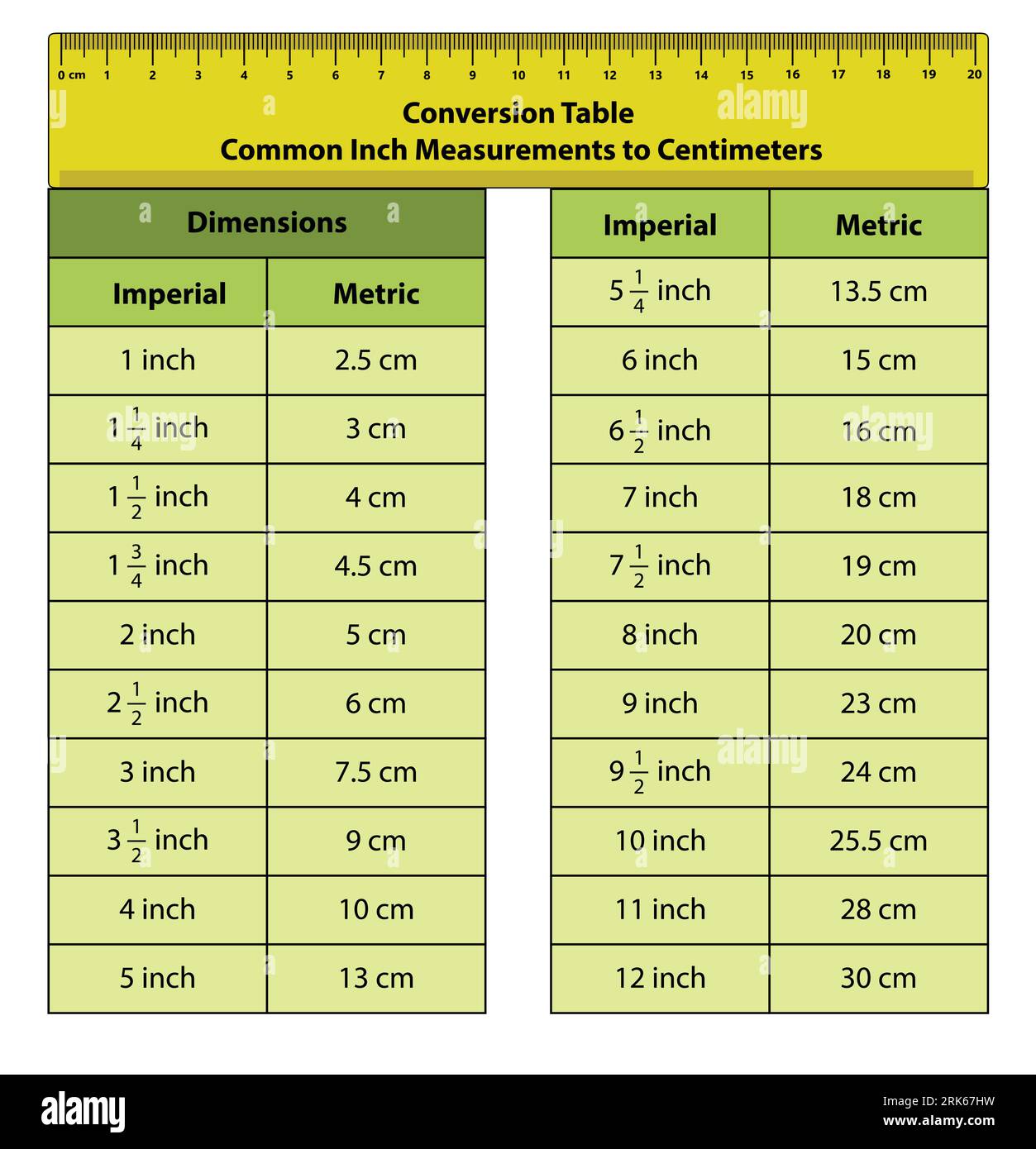
The following table provides quick reference points for common measurements used in domestic and professional settings.
| Inches (in) | Centimeters (cm) | Common Application Context |
|---|---|---|
| 0.39 in | 1 cm | Roughly the width of a fingernail |
| 1 in | 2.54 cm | Standard small hardware sizing |
| 2 in | 5.08 cm | Common width for straps or tape |
| 4 in | 10.16 cm | Average width of a hand (palm) |
| 6 in | 15.24 cm | Small handheld ruler length |
| 10 in | 25.4 cm | Standard dinner plate diameter |
| 12 in (1 ft) | 30.48 cm | Standard school ruler; one foot |
| 36 in (1 yd) | 91.44 cm | Yardstick; close to a meter (100 cm) |
| 39.37 in | 100 cm | The length of exactly one meter |
Practical Applications in Industry and Daily Life
The difference in size between these units impacts several industries in unique ways. Because the inch is a larger "bucket" of measurement, it is often used for larger-scale manual crafts, while the centimeter (and its smaller sibling, the millimeter) is preferred for high-precision manufacturing.
Electronics and Screen Sizes
In 2026, the global standard for measuring screens (TVs, smartphones, monitors) remains the inch. When a manufacturer advertises a 6.7-inch smartphone, they are measuring diagonally from one corner to the opposite corner. If you were to measure that same screen in centimeters, it would be approximately 17 cm. The "bigger" nature of the inch makes for simpler, rounder numbers in marketing.
Construction and Lumber
In the United States, construction is dominated by inches and feet. A "two-by-four" piece of lumber is a standard term, though its actual dimensions are 1.5 inches by 3.5 inches. If a builder were to use metric equivalents, they would be dealing with 38mm x 89mm. The inch allows for simpler fractional divisions (1/2, 1/4, 1/8) which many woodworkers find intuitive when using physical tape measures.
Clothing and Fashion
International clothing sizes often list both units. Waist sizes are frequently measured in inches globally (e.g., a "32 waist" in jeans), but European and Asian manufacturers often use centimeters for more precise tailoring measurements, such as inseams or sleeve lengths. A waist size of 32 inches is equivalent to 81.28 centimeters.
Science and Healthcare
In 2026, almost all scientific research and medical documentation utilize the metric system. When a doctor measures a patient's height, they may record it in centimeters (e.g., 180 cm) because it is more precise than inches without needing to use fractions. However, in the US, the patient likely thinks of their height as 5 feet 11 inches.
Common Pitfalls and Accuracy Issues
Because one inch is much larger than one centimeter, rounding errors can become significant very quickly.
The Danger of Rounding to "2"
Many people mistakenly round the inch to 2 centimeters for ease of use. If you are measuring a small object, like a 3-inch screw, using "2" as your multiplier gives you 6 cm, while the actual length is 7.62 cm. That 1.62 cm difference is over half an inch! In construction or engineering, this level of error can lead to structural failure or parts that simply do not fit.
Precision in CAD and 3D Printing
In modern computer-aided design (CAD) and 3D printing, the software must be explicitly told which unit system is being used. A common error involves importing a file designed in inches into a workspace set to centimeters. If the software doesn't automatically scale the object, a part intended to be 5 inches long will be printed as 5 centimeters long—rendering it nearly 60% too small.
Why the World Uses Both
It is often asked why the US hasn't fully "metricated" to join the rest of the world. The answer lies in "path dependency." The cost of changing every road sign, every machine tool, every architectural drawing, and every educational textbook in the United States would be trillions of dollars.
Furthermore, the imperial system's reliance on highly divisible numbers (12 inches in a foot) offers some mental advantages. The number 12 is divisible by 2, 3, 4, and 6. The number 10 (the base of the metric system) is only divisible by 2 and 5. This makes the inch and foot system particularly resilient in trades like carpentry where dividing lengths into thirds or quarters is a constant necessity.
However, for international consistency, the Bureau International des Poids et Mesures (BIPM) continues to promote the metric system (SI) as the sole universal language of measurement.
Summary and Next Steps
To recap, inches are bigger than centimeters. One inch is equivalent to 2.54 centimeters. If you are looking for a quick way to handle these units in your daily life, follow these recommendations:
- Buy a Dual-Scale Tape Measure: Always keep a measuring tool that shows both inches and centimeters. This eliminates the need for manual conversion and helps you develop a "feel" for both scales.
- Use 2.5 for Quick Estimates: If precision isn't vital, multiplying inches by 2.5 will get you very close to the centimeter value.
- Check Your Settings: If you are using digital design software, 3D printers, or GPS units, always verify the unit of measurement in the settings menu before starting a project.
- Memorize the Anchor Points: Remember that 12 inches is about 30 cm, and 1 meter (100 cm) is just under 40 inches (39.37").
By understanding that the inch is the larger unit, you can better navigate everything from international shipping requirements to simple home DIY projects with confidence and accuracy.