During NASA's 1970 Apollo 13 mission, Lunar Module Pilot Fred Haise became dangerously ill in deep space, suffering from a severe urinary tract infection and a 103°F fever triggered by extreme cold, acute dehydration, and strict water rationing. Concurrently, original Command Module Pilot Ken Mattingly was grounded days before launch due to German measles exposure, creating two distinct medical sagas within one historic mission.
| Astronaut | Role | Incident / Condition |
|---|---|---|
| Fred W. Haise Jr. | Lunar Module Pilot | Severe UTI / Kidney Infection in deep space (103°F fever, chills) |
| Thomas K. "Ken" Mattingly | Command Module Pilot (Original Prime Crew) | Grounded 72 hours pre-launch due to Rubella (German Measles) exposure |
| John L. "Jack" Swigert | Command Module Pilot (Backup / Prime Replacement) | Replaced Mattingly; managed cold, severe dehydration alongside crew |
Understanding the Apollo 13 Medical Crises: Two Intertwined Stories
When public interest turns to "Apollo 13's sick astronaut," it touches upon two separate medical events that shaped the mission. The first was an operational crisis on Earth: original Command Module Pilot Ken Mattingly was removed from the prime crew just 72 hours before launch after exposure to German measles (rubella). The second was a life-threatening physiological crisis in deep space: Lunar Module Pilot Fred W. Haise Jr. developed a debilitating kidney and urinary tract infection while surviving in the freezing, shut-down spacecraft.
Both incidents fundamentally altered how NASA approached crew health, medical isolation, emergency space medicine, and flight assignment protocols. While Mattingly's pre-flight quarantine drama played out in national headlines, Haise's physiological battle inside the Lunar Module Aquarius took place in near-freezing conditions, millions of miles from medical intervention.
Fred Haise's In-Flight Medical Emergency
The Environmental Triggers: Cold, Humidity, and Extreme Rationing
On April 13, 1970, approximately 55 hours into the mission, an oxygen tank in the Service Module exploded, causing a cascade of mechanical and environmental failures. To preserve electrical power and consumable resources for reentry, Flight Director Gene Kranz and the Mission Control team instructed Commander James A. Lovell Jr., Command Module Pilot Jack Swigert, and Lunar Module Pilot Fred Haise to power down the Command Module (Odyssey) and use the Lunar Module (Aquarius) as a lifeboat.
- Oxygen Tank Explosion (55 hrs)
- Power Down Command Module Odyssey / Move Crew to Lunar Module Aquarius
- Drinking Water Rationed (6 oz/day) / Sub-Zero Instrument Freezing
- Haise Develops Severe UTI/Kidney Infection & 103°F Fever
This survival strategy introduced severe environmental stressors that compromised the astronauts' immune systems:
- Extreme Water Rationing: Water was essential not only for hydration but also for cooling the Lunar Module's electronic systems via sublimators. To ensure the spacecraft systems remained cool until Earth entry, drinking water was strictly limited to approximately 6 ounces (177 milliliters) per astronaut per day—less than one-fifth of normal physiological requirements.
- Freezing Temperatures: Without electrical heaters operating, temperatures inside Odyssey plummeted to 38°F (3.3°C), and Aquarius remained barely above freezing. The crew lacked heavy thermal clothing and endured days of continuous shivering.
- Condensation and Moisture Accumulation: Moisture from the astronauts' breath condensed on interior metal walls and wiring panels, creating a damp, freezing environment that made resting nearly impossible.
- Altered Waste Disposal: To prevent altering the spacecraft's trajectory toward Earth, Mission Control instructed the crew to store urine onboard rather than venting it into space. The awkward mechanics of using urine collection bags in microgravity under freezing conditions led Haise to delay urination, worsening bacterial retention.
Clinical Progression of Haise's Illness
The combination of severe dehydration, systemic stress, cold exposure, and prolonged urine retention created ideal conditions for a bacterial infection.
By the fourth day of the mission, Haise began experiencing burning during urination, lower abdominal discomfort, and severe flank pain. The infection rapidly migrated upward from the bladder into the prostate and kidneys, producing acute pyelonephritis.
- Dehydration + Water Rationing + Delaying Urination in Microgravity
- Urinary Tract Infection (UTI)
- Retrograde Spread to Prostate & Kidneys
- Pyelonephritis: 103°F Fever & Shivering
As Apollo 13 rounded the Moon and swung back toward Earth, Haise's symptoms intensified dramatically:
- Fever: His body temperature rose to 103°F (39.4°C), causing intense internal heat while surrounded by sub-freezing cabin air.
- Severe Rigors and Chills: Haise experienced uncontrollable shivering fits, which accelerated muscle fatigue and increased metabolic oxygen consumption.
- Dehydration-Induced Hemoconcentration: Deprived of fluids, his vascular volume dropped, worsening tissue perfusion and exacerbating systemic toxicity from the infection.
Despite excruciating discomfort, Haise continued performing mission-critical calculations, assisting Lovell and Swigert with manual guidance maneuvers, and preparing the spacecraft modules for jettison prior to atmospheric reentry.
NASA's Onboard Medical Protocol and Emergency Interventions
NASA Flight Surgeon Dr. Charles Berry monitored the crew's vital signs constantly via bio-instrumentation telemetry transmitted back to Houston. When Haise's heart rate elevated and telemetry readings confirmed a dangerous spike in body temperature, Dr. Berry conferred with Mission Control.
| Item / Medication | Form / Dosage | Purpose / Application |
|---|---|---|
| Injectable Demerol | Auto-injector | Severe pain management |
| Morphine Sulfate | Tubex injectors | Traumatic pain control |
| Dexedrine (Dextroamphetamine) | Oral tablets (5 mg) | Central nervous system stimulant / fatigue |
| Dramamine (Dimenhydrinate) | Oral tablets (50 mg) | Motion sickness / nausea |
| Actifed | Oral tablets | Antihistamine / decongestant |
| Darvon (Propoxyphene) | Oral capsules (65 mg) | Moderate pain relief |
| Bandages & Topical Ointment | Dressings & Cream | Basic wound care / burns |
Treatment Limitations in Deep Space
The Apollo medical kit was equipped primarily for traumatic injury, space motion sickness, pain management, and acute fatigue. It lacked broad-spectrum oral or intravenous antibiotics required to eradicate a severe Gram-negative kidney infection.
Dr. Berry advised the crew to take available pain-relief medications from the medical kit, maximize fluid intake within the absolute limits of safe spacecraft cooling operations, and keep Haise wrapped in spare cloth and sleeping bag covers to control his shivering.
Haise persevered through the final 48 hours of the flight, remaining at his station through the critical jettisoning of the Service Module and Lunar Module, as well as the manual alignment maneuvers required for entry into Earth's atmosphere.
Pre-Flight Medical Grounding: The Ken Mattingly Rubella Incident
While Fred Haise faced an unexpected medical emergency in space, the Apollo 13 mission had already suffered a major health-related setback days before launch.
| Date | Event Description |
|---|---|
| April 1, 1970 | Backup Lunar Module Pilot Charles Duke contracts German measles (Rubella) from his child. |
| April 5, 1970 | NASA medical team identifies Duke's illness and tests all prime and backup crew members for rubella antibodies. |
| April 7, 1970 | Lab results confirm Jim Lovell, Fred Haise, and Jack Swigert have natural immunity. Ken Mattingly lacks immunity. |
| April 9, 1970 (72 Hours Pre-Launch) | NASA Director of Flight Crew Operations Deke Slayton and Dr. Charles Berry officially ground Mattingly to prevent an active fever crisis during lunar orbit. |
| April 9, 1970 | Backup Command Module Pilot Jack Swigert is promoted to the prime crew after intensive simulator validation. |
The Exposure Chain
Seven days before the scheduled launch date of April 11, 1970, backup Lunar Module Pilot Charles Duke contracted German measles (rubella) from a family friend's child. Duke had been working closely with both the prime and backup crews in spacecraft simulators and meeting rooms.
NASA Flight Surgeon Dr. Charles Berry immediately conducted blood antibody tests across both crews. The results revealed a critical vulnerability:
- Jim Lovell: Immune (had rubella antibodies).
- Fred Haise: Immune (had rubella antibodies).
- Jack Swigert (Backup CMP): Immune (had rubella antibodies).
- Ken Mattingly (Prime CMP): Non-immune (lacked antibodies).
- Charles Duke Contracts Rubella
- Exposes Prime & Backup Crews
- Blood Antibody Screening Tests
- Lovell, Haise, Swigert (IMMUNE / PROTECTED)
- Ken Mattingly (NON-IMMUNE / AT RISK)
- Grounded 72 Hours Pre-Launch
The Decision to Ground Mattingly
Medical projections indicated that if Mattingly had contracted the virus from Duke, the incubation period would cause symptoms—including high fever, skin rash, malaise, and severe headache—to manifest precisely when Apollo 13 was executing critical lunar orbit insertion and landing maneuvers.
Dr. Berry determined that operating the Command Module solo in lunar orbit while suffering an active viral infection presented an unacceptable risk to crew safety.
Despite protests from Mission Commander Jim Lovell—who preferred keeping his closely integrated team together—NASA Administrator Thomas O. Paine supported Berry and Deke Slayton. Mattingly was removed from the mission 72 hours before launch, and backup Command Module Pilot Jack Swigert was inserted into the prime crew.
Mattingly's Pivotal Role on the Ground
Irony marked the outcome: Ken Mattingly never developed German measles.
However, his grounding proved instrumental to Apollo 13's survival. Remaining in Mission Control at Houston, Mattingly possessed an intimate, expert knowledge of the Command Module's electrical power systems. Working round-the-clock inside the simulators alongside engineering teams, Mattingly developed and verified a novel power-up sequence that allowed the cold, frozen Odyssey to be successfully reactivated using only the limited battery reserves left in the entry capsule—a procedure that saved the crew during atmospheric entry.
- Replicated frozen Command Module state in simulator
- Designed step-by-step low-power boot sequence
- Managed strict amperage budget for entry batteries
- Transmitted verified procedure directly to Swigert
Comparative Analysis: Crew Status, Medical Parameters, and Environmental Conditions
To understand how physiological stress impacted Apollo 13, the following matrix compares the medical environments, risk factors, and health outcomes of the key individuals involved.
| Feature / Metric | Fred W. Haise Jr. | Thomas K. "Ken" Mattingly | John L. "Jack" Swigert |
|---|---|---|---|
| Mission Role | Lunar Module Pilot (Prime) | Command Module Pilot (Original Prime) | Command Module Pilot (Replacement Prime) |
| Primary Health Issue | Acute Pyelonephritis (Severe UTI / Kidney Infection) | Suspected Exposure to Rubella (German Measles) | Severe Dehydration and Acute Exhaustion |
| Onset Timing | In-flight (~90 hours MET) | Pre-flight (72 hours prior to launch) | In-flight (Cumulative over 142 hours) |
| Peak Symptoms | 103°F (39.4°C) fever, severe chills, flank pain | None (Asymptomatic; virus did not incubate) | Weight loss (11 lbs), hypothermia symptoms |
| Environmental Cause | Water rationing, freezing cabin (38°F), delayed urination | Viral contact via backup crew member Charles Duke | Sub-freezing cabin conditions, extreme sleep deprivation |
| Medical Intervention | Analgesics from onboard kit, fluid preservation, rest | Grounded from flight; placed under medical monitoring | Fluid preservation, thermal layering with spare cloth |
| Post-Mission Outcome | 14-day hospital recovery; full restoration of flight status | Flown on Apollo 16; later commanded Space Shuttle flights (STS-4, STS-51-C) | Elected to U.S. House of Representatives (CO-06) in 1982 |
Post-Splashdown Medical Evacuation and Recovery
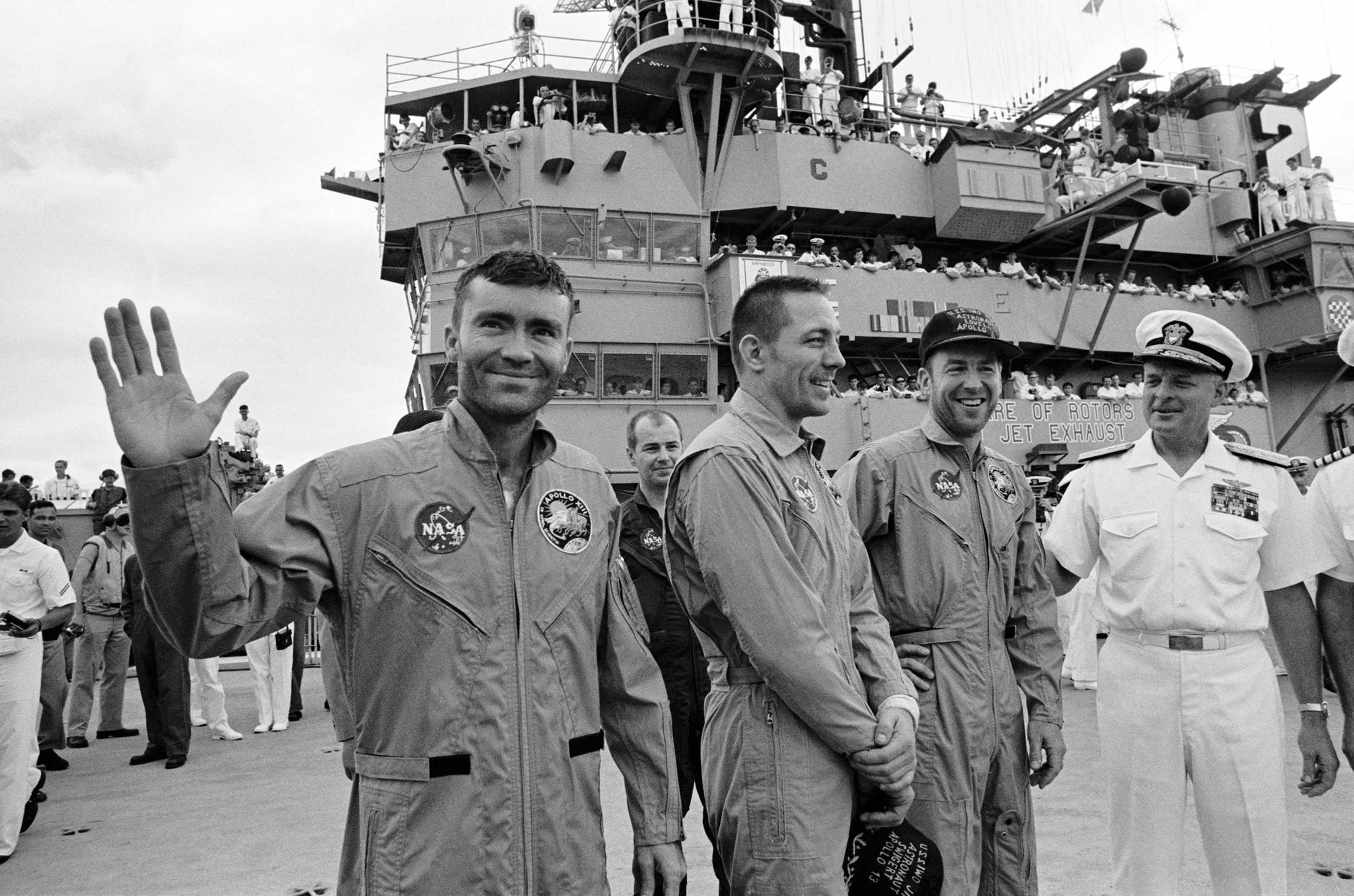
On April 17, 1970, Apollo 13 successfully reentered Earth's atmosphere and splashed down in the South Pacific Ocean near American Samoa. The primary recovery vessel, the aircraft carrier USS Iwo Jima (LPH-2), retrieved the spacecraft and crew.
| Metric | Finding / Observation |
|---|---|
| Weight Loss (Fred Haise) | 14.5 lbs (6.6 kg) lost due to acute dehydration |
| Total Crew Weight Loss | 31.5 lbs (14.3 kg) total combined loss |
| Haise Body Temperature | 103°F (39.4°C) recorded upon carrier arrival |
| Clinical Diagnosis | Acute bilateral pyelonephritis with severe dehydration and muscle breakdown |
| Treatment Protocol | Intravenous antibiotics (Penicillin/Ampicillin), rehydration fluids, 14 days strict bed rest |
Clinical Findings Aboard USS Iwo Jima
Upon landing, naval medical personnel immediately transferred the three astronauts to the ship's medical bay. Physical evaluations revealed that the crew had suffered extreme physical depletion:
- Fred Haise: Lost 14.5 pounds (6.6 kg) during the six-day flight. His body temperature remained elevated at 103°F. Blood tests showed elevated white blood cell counts (leukocytosis) confirming an active, advanced kidney infection.
- Jim Lovell: Lost 14 pounds (6.4 kg) due to severe fluid restriction and continuous operational stress.
- Jack Swigert: Lost 11 pounds (5.0 kg) and suffered from acute fatigue.
Haise was immediately placed on high-dose antibiotic therapy and aggressive oral rehydration. Flight medical staff noted that had the mission remained in space for another 24 to 48 hours, Haise's renal infection could have progressed to septic shock, a life-threatening systemic blood infection.
- Splashdown on USS Iwo Jima
- Diagnosis: Acute pyelonephritis (14.5 lbs weight loss / leukocytosis)
- Intensive antibiotic therapy & IV rehydration (14-day recovery)
- Full recovery: Assigned command of Space Shuttle Enterprise tests
Full Recovery and Subsequent Aviation Career
Following two weeks of hospital isolation and antibiotic treatment, Haise made a complete recovery without permanent kidney damage.
He retained his active astronaut status and was selected as Commander for the Apollo 19 mission; however, that flight was canceled due to budget cuts. Haise later served as Commander during the Space Shuttle Enterprise Approach and Landing Tests (ALT) in 1977, successfully landing the orbiter on dry lake beds after release from a Boeing 747 Shuttle Carrier Aircraft.
Lessons Learned: How Apollo 13 Transformed Space Medicine
The dual medical crises of Apollo 13 led NASA's Life Sciences Directorate and Space Medicine Division to institute major operational overhauls that remain fundamental to human spaceflight today:
| Category | Apollo 13 Lesson | Modern Spaceflight Protocol |
|---|---|---|
| Pre-Flight Isolation | Pre-flight exposure risk (Rubella) | Strict Health Stabilization Program (HSP) 14-day quarantine |
| Medical Pharmacy | Antibiotic deficiency in onboard kit | Broad-spectrum oral & IV antibiotics on ISS / Artemis |
| Water Allocation | Dehydration caused by thermal cooling needs | Redundant life-support water reserves decoupled from power |
| Telemetry & Sensing | Manual fever detection delayed by poor comms | Continuous real-time wireless health monitoring sensors |
- Formalization of the Health Stabilization Program (HSP): Prior to Apollo 13, pre-flight quarantine rules were loosely enforced. Following the rubella scare, NASA established a strict 14-day pre-launch quarantine protocol. Prime and backup crews were completely isolated from the public, media, and family members lacking cleared medical backgrounds. This protocol remains standard practice for crews launching to the International Space Station (ISS) and under the Artemis lunar program.
- Expansion of Onboard Medical Kits: NASA redesigned medical kits for Skylab, the Space Shuttle, and the ISS to include broad-spectrum antibiotics, IV fluid setup kits, enhanced urinary catheters, and advanced anti-inflammatory agents to address deep-space infections.
- Decoupled Life-Support Water Budgets: Spacecraft design guidelines were revised to guarantee that human drinking water allocations could never be sacrificed or depleted by spacecraft thermal control mechanisms.
- Microgravity Waste Management Upgrades: The physical difficulty of using sanitary urine collection devices under low-power, freezing conditions forced engineers to design automated, negative-pressure waste containment systems, laying the groundwork for modern space toilets used on the ISS and Orion spacecraft.
Frequently Asked Questions
Which astronaut was sick during the Apollo 13 flight?
Lunar Module Pilot Fred W. Haise Jr. was the astronaut who became ill during the flight. He developed a severe urinary tract infection that spread to his kidneys, running a 103°F (39.4°C) fever during the return trip to Earth.
Why did Ken Mattingly get replaced before Apollo 13 launched?
Ken Mattingly was replaced 72 hours before launch because he was exposed to German measles (rubella) by backup astronaut Charles Duke. Blood tests showed Mattingly lacked immunity, leading NASA doctors to fear he would become ill during critical flight operations in lunar orbit.
Did Ken Mattingly ever actually get the German measles?
No. Ken Mattingly never developed German measles. Despite being grounded, he worked extensively in simulators at Mission Control in Houston to design the critical power-up procedure that enabled Apollo 13 to safely reenter Earth's atmosphere.
How did Fred Haise catch a kidney infection in space?
Fred Haise developed the infection due to extreme dehydration, severe cold, and physical strain. After the onboard explosion, drinking water was rationed to roughly 6 ounces per day to save water for spacecraft equipment cooling. Cold conditions and awkward urine collection procedures in zero gravity led to bacterial retention and an acute kidney infection (pyelonephritis).
What medicine did the Apollo 13 crew have onboard for illness?
The Apollo 13 onboard medical kit contained pain relievers (such as Darvon and Demerol), stimulants (Dexedrine), motion sickness tablets (Dramamine), and decongestants (Actifed). It did not carry broad-spectrum antibiotics, so Haise could only take basic pain medication until landing.
Did Fred Haise fly in space again after Apollo 13?
Fred Haise did not return to deep space, as his scheduled command of Apollo 19 was canceled due to NASA budget reductions. However, he remained a senior test pilot and commanded the Space Shuttle Enterprise during its crucial Approach and Landing Tests (ALT) in 1977 before retiring from NASA.
Next Steps for Space History Researchers
To explore the primary records, medical telemetry, and technical logs from the Apollo 13 mission:
- Examine the official NASA technical debriefing files via the NASA History Division Apollo 13 Archive.
- Review transcriptions of mission communications through the Apollo 13 Flight Journal.
- Research modern astronaut medical isolation rules by reviewing the NASA Human Research Program Regulations.