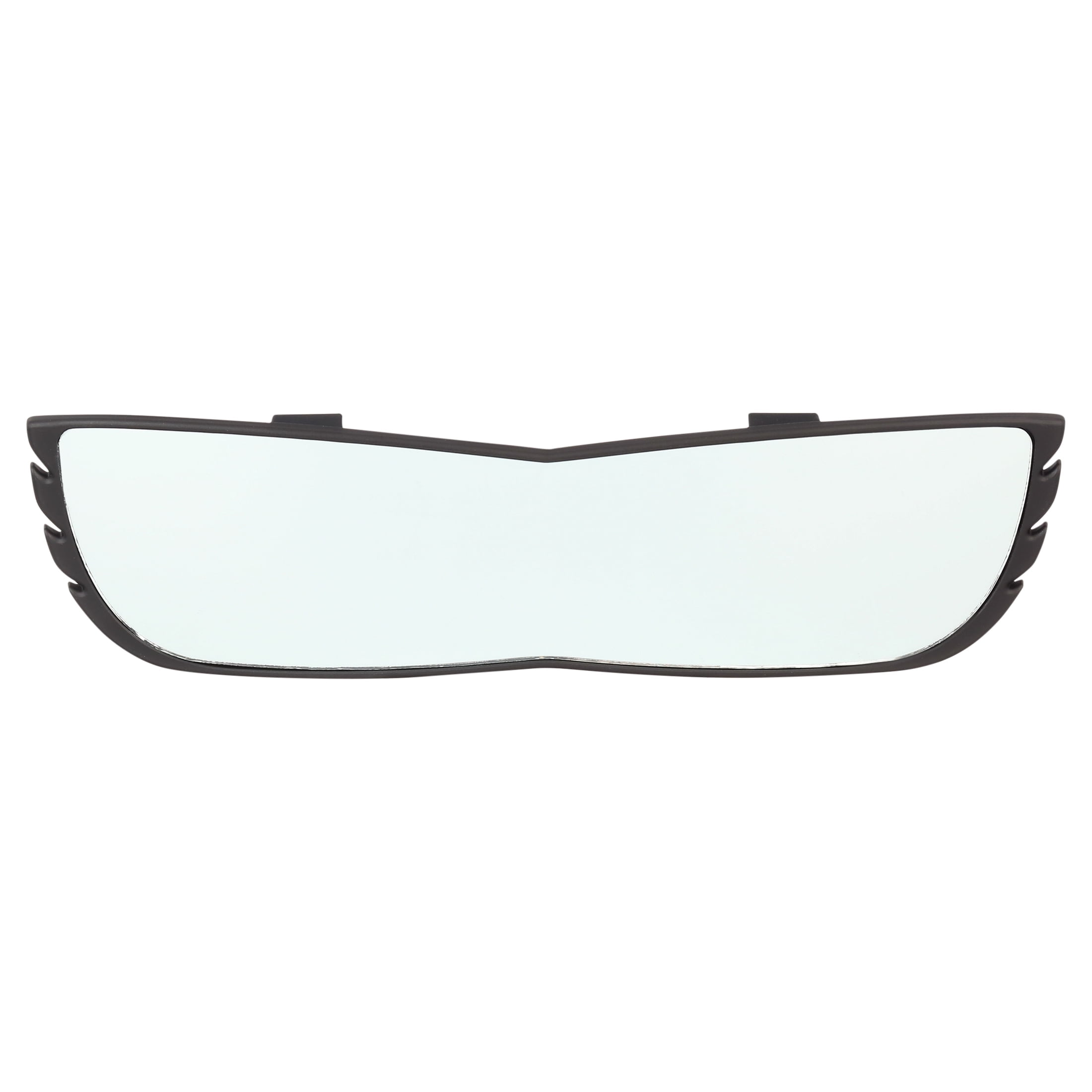
The Angel View mirror is a wide-angle, clip-on panoramic rear-view mirror designed to expand a driver’s field of view and minimize blind spots. Measuring approximately 12 inches across, its curved convex glass captures adjacent lanes without requiring extreme head turning, providing an affordable aftermarket visibility upgrade for most standard passenger vehicles.
What Is the Angel View Mirror?
The Angel View mirror is an aftermarket automotive safety accessory popularized through direct-to-consumer broadcasting and retail distribution by parent distributor brands like BulbHead. Designed as a universal clip-on attachment, it retrofits directly over a vehicle's existing factory-installed internal rear-view mirror.
Standard factory interior mirrors utilize flat (planar) glass panels mandated by automotive equipment safety guidelines, such as Federal Motor Vehicle Safety Standard (FMVSS) No. 111 in the United States. While planar mirrors provide an accurate 1:1 spatial representation of distance, their narrow lateral scope leaves substantial unmonitored zones along the rear quarter panels of a passenger car—commonly known as blind spots.
The Angel View addresses this structural limitation by employing a oversized curved glass panel. Spanning nearly 12 inches (30.5 cm) wide, the convex optics bend incoming light rays inward toward the driver's pupils. This optical geometry effectively stretches the interior field of view up to approximately 160 degrees. By consolidating the sightline across multiple highway lanes into a single vantage point, the device aims to reduce the necessity of physical shoulder checks when changing lanes or merging.
Key Technical Specifications and Build Quality
Evaluating the utility of any automotive auxiliary device requires a close inspection of its material construction, mechanical tension systems, and optical characteristics. The Angel View is engineered around lightweight synthetic housing materials to avoid placing excessive strain on factory windshield mount points.
| Feature / Specification | Details |
|---|---|
| Mirror Type | Panoramic Convex Optical Glass |
| Frame Material | Molded ABS Plastic |
| Dimensions | ~12 in L x 3 in W x 1 in D (30.5 cm x 7.6 cm x 2.5 cm) |
| Attachment Mechanism | Dual Spring-Loaded Rubberized Retractable Clips |
| Weight | ~8.5 ounces (240 grams) |
| Compatibility | Fits factory mirrors between 2.2 in and 3.5 in tall |
| Surface Treatment | Non-glare tint / clear convex reflective surface |
Optical Construction
The optical substrate utilizes a low-distortion glass layer backed by reflective silvering. The curvature radius is calibrated to provide wide-angle coverage without creating extreme optical distortion (commonly called the "fisheye effect"). However, because it is a convex surface, light rays diverge before reaching the driver's eyes, causing ambient targets to appear smaller and further away than they are in real space.
Frame and Mounting Hardware
The external casing consists of high-impact Acrylonitrile Butadiene Styrene (ABS) plastic, designed to withstand intense temperature fluctuations within enclosed vehicle cabins. The mounting assembly relies on a vertical spring-tension clip system. Two fixed upper hooks slide over the top rim of the stock mirror, while two lower spring-loaded legs extend downward, pulling tight against the bottom rim to secure the unit in place.
Installation Process and Fitting Guidance
Installing the Angel View mirror requires no tools, adhesives, or permanent modifications to the vehicle's cabin interior. However, performing a proper fitment procedure is essential to prevent vibration, sliding, or physical damage to the factory mirror assembly.
- Clean the Stock Mirror: Wipe down the front surface, plastic frame, and rear housing of the factory interior mirror using a microfiber cloth and rubbing alcohol. Dust and vinyl dressings can cause rubberized pads to slip under road vibration.
- Engage Top Hooks: Position the top fixed hooks of the Angel View unit over the top edge of the factory mirror.
- Extend Lower Clips: Pull down on the lower spring-loaded clips to expand the bracket space until the bottom edge clears the factory mirror's lower frame.
- Release into Position: Gently release the spring-loaded clips so they clamp firmly onto the bottom bezel of the factory mirror housing.
- Check Mechanical Stability: Grasp the frame gently and wiggle it horizontally and vertically. If the mirror moves independently of the factory base, re-center the clips to ensure maximum friction against the rubber pads.
- Adjust the Overall Sightline: Sit in the driver's seat in a normal driving posture. Adjust the windshield ball-joint pivot until the panoramic glass captures the full rear window profile as well as both rear side-quarter windows.
Real-World Driving Performance: Field Evaluation
Performance evaluations of the Angel View mirror center around four core driving dynamics: field-of-view expansion, depth perception shift, nighttime glare control, and stability over rough road surfaces.
Field-of-View Expansion
In standard sedan and compact SUV test environments, factory interior mirrors generally capture only the rear glass frame and small portions of the rear seat headrests. The Angel View broadens this perspective significantly. When properly adjusted, a driver can visually track an overtaking vehicle as it transitions from directly behind to the adjacent left or right lane, keeping it visible in the interior mirror panel until its nose enters the driver's peripheral side vision. This virtually eliminates the traditional rear-quarter blind spot.
Depth Perception and Object Scaling
Because the mirror uses convex optical technology, it alters distance perception. Drivers accustomed to 1:1 flat mirror reflection must adapt to the spatial compression. Objects trailing 30 feet behind the bumper appear noticeably further away than they actually are. Drivers must rely on their exterior side mirrors—which use flat glass on the driver's side—or perform quick visual verifications until they adjust to the convex scale factor.
Night Driving and Glare Reduction
Factory manual mirrors feature a bottom flip-lever that shifts a internal wedge prism to deflect bright high-beam headlights upward into the headliner while reflecting a dim image into the driver's eyes. Automatic dimming (electrochromic) mirrors use sensors and electric currents to darken a electrochromic gel layer.
The Angel View mirror covers both of these systems completely:
- Manual Flip-Levers: The physical clip-on frame covers the flip lever, rendering it completely inaccessible while installed.
- Auto-Dimming Sensors: The rear structure blocks the forward-facing and rearward-facing ambient light sensors, disabling electrochromic dimming functionality entirely.
To offset this limitation, the Angel View uses a specialized non-glare surface coating designed to suppress high-intensity light reflections from tailgating vehicles or LED headlights. While effective against ambient city illumination, intense high-beam optics directly behind the vehicle can still cause mild eye fatigue due to the wide area over which light spreads across the curved surface.
Vibration Damping and Frame Rigidity
A common flaw in clip-on automotive accessories is harmonic vibration caused by rough pavement, engine idle vibration, or stiff suspension setups. Because the Angel View weighs approximately 8.5 ounces, it adds cantilevered mass to the factory mirror's ball-joint pivot. On smooth asphalt and highway cruising, the rubberized spring clamps absorb minor vibrations effectively, producing a clear image. However, on gravel roads, expansion joints, or vehicles with degraded engine mounts, the added weight can cause the factory ball-joint mount to sag over time or create subtle optical blur.
Pros and Cons Analysis
Evaluating owner experiences and physical tests reveals clear trade-offs when adding a panoramic clip-on mirror to a modern passenger car.
Advantages
- Dramatically Expanded Field of View: Provides continuous optical coverage from the left rear window to the right rear quarter glass.
- Universal Tool-Free Installation: Clamps onto most standard automotive mirror designs within seconds.
- Cost-Effective Blind-Spot Assistance: Offers passive visual support for older vehicles lacking electronic Blind-Spot Monitoring (BSM) hardware.
- Reduced Head-Turning Strain: Useful for drivers with restricted cervical mobility or neck strain who find deep shoulder checks painful.
- Non-Destructive Attachment: Ideal for leased vehicles, as it leaves no adhesive residue, scratches, or altered wiring upon removal.
Drawbacks
- Altered Spatial Perception: Convex glass shrinks object size, requiring drivers to recalibrate distance judgment for approaching traffic.
- Disables Factory Dimming Systems: Blocks access to manual night-flip levers and covers auto-dimming electrochromic light sensors.
- Interference with Sun Visors: In smaller compact cars or models with tight interior clearances, the 12-inch wide frame can hit the driver or passenger sun visors when flipped down.
- Integrated Electronic Sensor Blockage: Blocks forward-facing dash cams, backup camera screens, or garage door control buttons built directly into modern smart mirror housings.
- Added Strain on Windshield Mounts: On older vehicles with weakened ball-joint mounts, the extra mass can cause the assembly to slip downward during transit.
Comparison: Angel View vs. Factory Mirrors vs. Electronic BSM
Understanding where the Angel View fits within the broader ecosystem of vehicle visibility solutions requires comparing mechanical, optical, and digital approaches.
| Evaluation Factor | Stock Flat Mirror | Angel View Mirror | Electronic BSM System |
|---|---|---|---|
| Horizontal Field of View | Narrow (~30-40°) | Wide (~140-160°) | Radar-based (Zone) |
| Spatial Scale Accuracy (Distance) | Accurate 1:1 Scale | Compressed Distance | N/A (Visual/Audio Alert) |
| Night Glare Mitigation | Lever / Auto-Dim | Non-Glare Coating | N/A |
| Sun Visor Clearance | Complete | Potential Impairment | Complete |
| Mechanical Installation Cost | Factory Included | Low ($15 - $30) | High ($500 - $1,500+) |
| Electrical Power Requirement | None (or 12V Auto) | None (100% Passive) | Vehicle 12V Bus System |
| Maintenance & Reliability | Maintenance-Free | Tension Check Req. | Sensor Calibration Req |
Direct Feature Contrast
While factory mirrors provide precise distance calibration, their tight lateral bounds mandate secondary physical checks. Electronic Blind-Spot Monitoring provides active light or chime warnings when sensor beams detect a vehicle in adjacent zones. However, electronic retrofit kits are expensive and difficult to wire. The Angel View fills an intermediary role: it offers a continuous, low-cost visual panorama without requiring wiring or electrical modifications, though it requires the driver to adjust to convex spatial distortion.
Vehicle Compatibility, Safety Regulations, and Limitations
Before adding a wide-angle clip-on mirror to your vehicle, review the operational limitations, interior clearances, and safety guidelines below.
Interior Clearances and Sun Visors
The primary physical fit issue for wide mirrors is sun visor clearance. Factory mirrors typically span 8 to 10 inches wide. Expanding that housing width to 12 inches leaves less side clearance. In compact sedans, subcompact crossovers, or sports cars, pulling the driver or passenger sun visor forward can strike the outer corners of the Angel View. Measure the gap between your lowered sun visors before purchasing to ensure at least 12.5 inches of unobstructed lateral clearance.
- Factory Interior Housing
- Stock Mirror
- Angel View Panoramic Extension
- 12-Inch Convex Surface
- Note: May contact sun visors
OEM Smart Features and Rear-View Camera Displays
Many modern vehicles feature internal electronics built into the stock rear-view mirror assembly:
- Embedded Display Screens: Vehicles with continuous video displays or backup camera imagery embedded inside the mirror glass will be completely covered by a clip-on mirror.
- Safety System Cameras (ADAS): Forward-facing cameras for Lane Keeping Assist or Automatic Emergency Braking are usually mounted to the windshield glass behind the mirror, rather than on the mirror frame itself. However, high-profile plastic trim covers on these sensor pods can interfere with the depth clearance of spring-loaded mounting clips.
- HomeLink & Emergency Buttons: Buttons built into the bottom or front bezel of factory mirrors (such as garage door openers, roadside assistance calls, or SOS features) will be obscured or squeezed by the clamping mechanism.
Legal and Safety Standard Considerations
Under regulations like the National Highway Traffic Safety Administration (NHTSA) FMVSS No. 111 rules in North America, primary interior vehicle mirrors are required to meet planar (flat reflection) standards so drivers can judge rear distances accurately. Because the Angel View is a consumer-installed auxiliary accessory placed over the factory glass, it is legally classified as an aftermarket interior attachment in most jurisdictions.
Drivers must remember that a panoramic mirror supplements—but never replaces—direct visual shoulder checks. While wide-angle glass reduces blind spots, blind-spot checks remain vital for spotting small road users like lane-filtering motorcycles, bicycles, and pedestrians.
Common Installation Mistakes and Troubleshooting
To ensure long-term stability and optimal visibility, avoid these common setup mistakes:
- Over-Tensioning or Off-Center Placement: Clamping the mirror off-center places uneven pressure on the internal spring mechanism. This can cause the mirror to shift diagonally over road bumps. Always center the frame precisely over the factory glass.
- Ignoring Loose Windshield Joints: If the added 8.5 ounces causes your factory mirror to droop over bumps, the internal ball-joint socket is worn out. You can tighten the joint tension screw located behind the factory mirror arm (if equipped) before attaching the auxiliary unit.
- Failure to Adjust Exterior Side Mirrors: Some drivers assume a panoramic interior mirror eliminates the need for side mirrors. Side mirrors should be adjusted outward so the side of your car is barely visible, working together with the panoramic center mirror for complete coverage.
- Misinterpreting Nighttime Tailgate Distances: Because convex glass makes trailing headlights look smaller and further away, leave extra space when executing lane changes in front of approaching traffic at night.
Final Verdict and Recommendation
The Angel View wide-angle panoramic mirror is a practical, budget-friendly visibility upgrade for older vehicles, larger SUVs with wide rear pillars, and drivers seeking extra visual awareness without paying for expensive electronic retrofits. Its tool-free installation and 160-degree viewing angle effectively eliminate traditional rear-quarter blind spots.
However, it is less suited for modern vehicles equipped with auto-dimming interior mirrors, embedded backup camera screens, integrated garage door buttons, or tight sun visor clearance. Drivers should also be ready to adapt to the minor distance distortion typical of convex optical glass.
Recommended Action: Measure your current interior mirror frame height (must be between 2.2 and 3.5 inches) and check for at least 12.5 inches of clearance between your lowered sun visors. If your vehicle uses a basic manual mirror, the Angel View provides an effective, high-value safety enhancement.
Frequently Asked Questions
Does the Angel View mirror work on all car models?
The Angel View fits most standard passenger cars, trucks, and SUVs equipped with traditional rear-view mirrors measuring between 2.2 and 3.5 inches in height. It may not fit thick, oversized, or uniquely shaped custom mirrors, nor will it work cleanly on vehicles with auto-dimming sensors, built-in backup camera screens, or tightly spaced sun visors.
Does the Angel View mirror eliminate all blind spots?
While the 160-degree curved convex glass dramatically widens your field of view—allowing you to track vehicles as they move into adjacent lanes—it does not completely replace the need for physical shoulder checks. Small targets like motorcycles, electric scooters, or pedestrians positioned low near the rear quarter panels can still fall outside the visual range.
Will the Angel View mirror damage my existing factory mirror?
No. The upper hooks and lower spring-loaded clips are lined with soft, textured rubber pads designed to grip the factory bezel securely without scratching glass or marring plastic trim.
Why do vehicles in the Angel View mirror look further away?
The Angel View uses convex optical glass to bend incoming light, capturing a wider view within a 12-inch frame. As a result, objects in the reflection appear smaller and further away than they are in real life. Drivers must keep this distance compression in mind when planning lane changes.
Can I still use my mirror's night mode with the Angel View attached?
No. The clip-on casing covers manual flip-levers and blocks the sensors used by auto-dimming mirrors. To help offset night glare, the Angel View uses a specialized non-glare surface coating designed to reduce bright headlight reflections.