Angel Stadium opened on April 19, 1966, as Anaheim Stadium, establishing a permanent Orange County home for the Los Angeles Angels franchise. Over six decades, the venue evolved from a mid-century modern baseball facility into an enclosed multi-purpose stadium for football and baseball, before undergoing a massive late-1990s restoration that established its current baseball-only configuration.
1. Architectural Roots and Construction (1964–1966)
The origins of Angel Stadium stem from the franchise's need for identity and independence. When Gene Autry founded the Los Angeles Angels as an American League expansion franchise in 1961, the team initially played at Wrigley Field in Los Angeles (a minor league venue unrelated to Chicago's ballpark) before moving to Chavez Ravine in 1962. At Chavez Ravine, the Angels functioned as secondary tenants to the Los Angeles Dodgers, operating under the stadium moniker "Chavez Ravine Stadium" during Angels home games. Seeking a home where his team would not be overshadowed, Autry negotiated with municipal leaders in Orange County to build a venue customized for his franchise.
The City of Anaheim offered a compelling location: 160 acres of agricultural land previously dominated by orange and strawberry groves. Positioned adjacent to the intersection of the Santa Ana Freeway (I-5), the Orange Freeway (SR-57), and the Garden Grove Freeway (SR-22), the site provided immediate vehicular accessibility for the rapidly growing suburban population of Southern California.
1964–1966 Site Layout:
- Santa Ana Freeway I-5 and Orange Freeway SR-57
- Anaheim Stadium (43,204 Seats)
- 230-ft Big A Sign (Original Outfield)
Groundbreaking officially occurred on August 31, 1964. The construction contract was awarded to the Del E. Webb Corporation, a prominent national firm known for large-scale structural projects. Designed by the architectural firm Charles Luckman Associates, the stadium was built for approximately $24 million—financed through municipal bonds issued by the City of Anaheim, which retained ownership of the land and structure.
When construction concluded in early 1966, the venue featured:
- A symmetrical playing field with natural grass surface.
- A seating capacity of 43,204 arranged in a traditional open-outfield horseshoe configuration.
- Direct view corridors pointing northeast toward the Santa Ana Mountains.
- Subterranean dugout structures and team clubhouses engineered to modern mid-century standards.
The inaugural Major League Baseball game took place on April 19, 1966, against the Chicago White Sox. Although the Angels dropped the regular-season opener 3–1 in extra innings before 31,660 fans, the venue immediately won praise for its clear sightlines, expansive parking lots, and modern amenities.
2. The Mid-Century Classic Era (1966–1978)
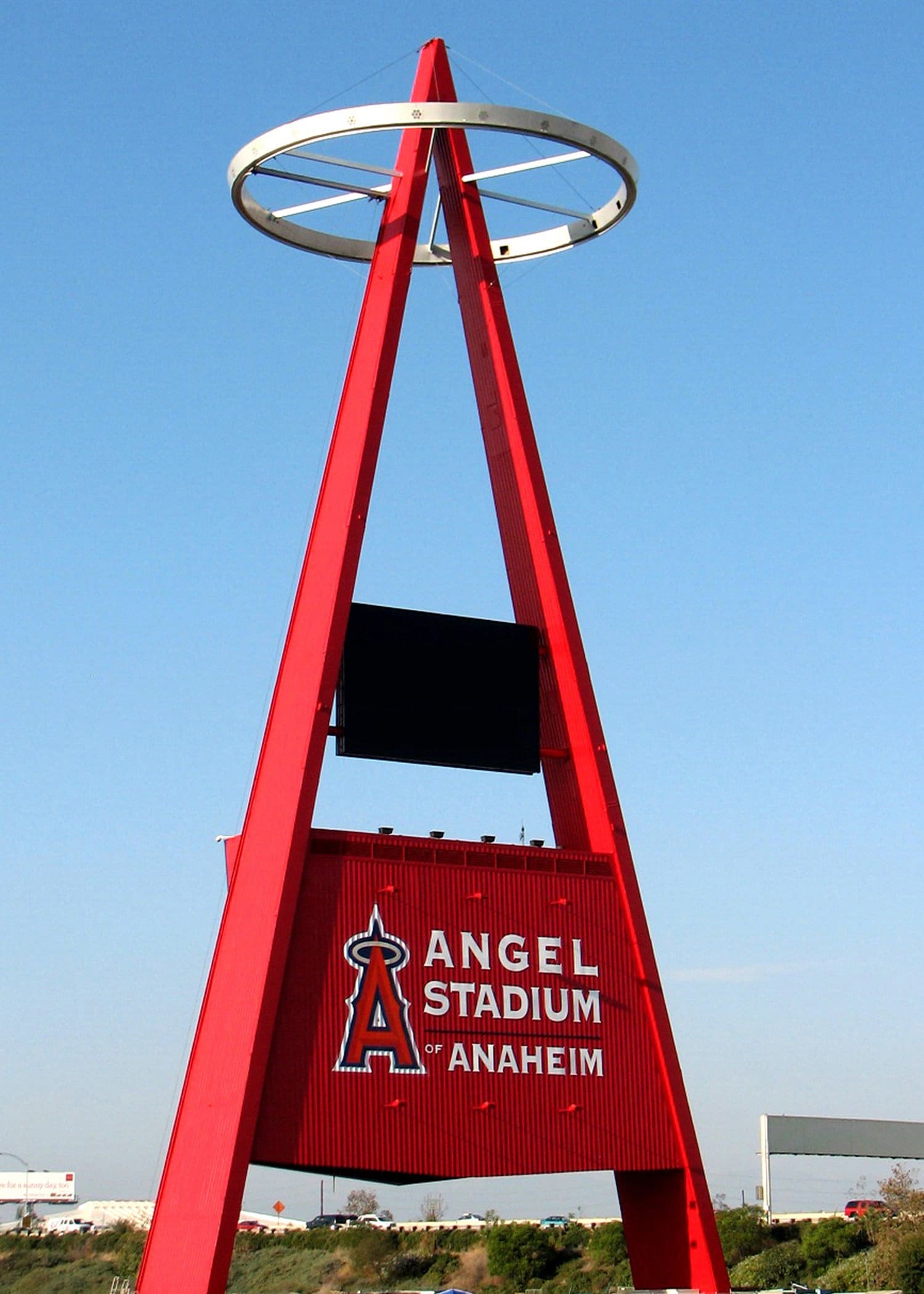
During its first thirteen seasons, Anaheim Stadium earned the nickname "The Big A" due to its defining architectural signature: a massive 230-foot-tall, 430-ton A-frame scoreboard erected past the left-center field fence. Engineered to double as both a functional electronic display and a visual beacon visible from surrounding freeways, the structure was crowned with a giant halo near its apex. The halo illuminated after every Angels victory, originating the popular team rallying phrase, "Light Up the Halo."
Big A Scoreboard Features:
- Illuminated Halo Ring
- Original Scoreboard Matrix (1966)
Architecturally, the original stadium exemplified mid-century sports design. The structural bowl was built primarily of reinforced concrete with minimalist cantilevered upper decks, eliminating structural support poles that had obstructed views in older ballparks like Fenway Park or Wrigley Field. The outfield remained completely unencumbered by seating grandstands, allowing coastal breezes to drift through the facility while offering fans views of Southern California hillsides.
This era hosted several historical baseball moments:
- 1967 MLB All-Star Game: On July 11, 1967, Anaheim Stadium hosted its first Midsummer Classic. The American League and National League battled through 15 innings—at the time the longest All-Star Game in history—before Tony Pérez hit a game-winning home run off Catfish Hunter to secure a 2–1 National League win.
- Nolan Ryan’s Pitching Mastery: Hall of Fame pitcher Nolan Ryan joined the Angels in 1972 and threw two of his seven career no-hitters at Anaheim Stadium (May 15, 1973, against the Kansas City Royals and September 28, 1974, against the Minnesota Twins). Ryan also set the modern Major League single-season strikeout record (383 strikeouts in 1973) while playing his home games on the Anaheim mound.
While built primarily for baseball, the venue occasionally hosted other large gatherings during this period, including Southern California Sun World Football League games (1974–1975), high school championship games, and major music concerts featuring artists such as The Who, The Rolling Stones, and Pink Floyd.
3. The Multi-Purpose Era and Football Enclosure (1979–1995)
By the late 1970s, sports venue architecture in North America favored dual-purpose facilities capable of housing both Major League Baseball and National Football League franchises. Seeking to capitalize on this trend, the City of Anaheim negotiated with Los Angeles Rams owner Carroll Rosenbloom to relocate the NFL franchise south from the Los Angeles Memorial Coliseum.
To accommodate professional football requirements, Anaheim Stadium underwent an extensive $33 million expansion between 1979 and 1980. The renovation completely altered the stadium’s original geometry:
- Outfield Enclosure: The open-air outfield was fully enclosed by a three-tiered concrete grandstand, transforming the facility from an open horseshoe into a closed oval bowl.
- Capacity Expansion: Seating capacity expanded significantly—reaching roughly 64,000 for baseball and 69,000 for football.
- Scoreboard and Sign Relocation: Because the new outfield grandstand occupied the space where the "Big A" scoreboard stood, engineers dismantled the 230-foot structure in 1979 and reassembled it near the southeastern edge of the parking lot, adjacent to the Orange Freeway (SR-57), where it was converted into a marquee sign. A new color video scoreboard matrix was installed atop the new outfield seating decks.
Stadium Layout Evolution:
- Before Renovation (1966–1978):
- Open Outfield Horseshoe Bowl
- Playing Field
- Big A Sign in Left Field
- After Renovation (1980–1995):
- Completely Enclosed Oval Bowl
- Playing Field
- Outfield Grandstands (69,000 Seats for NFL)
The Rams played their first regular-season game at Anaheim Stadium on September 7, 1980, against the Detroit Lions. For fifteen seasons (1980–1994), the facility operated as a dual-sport venue. In addition to the Rams, the stadium hosted the annual NCAA Freedom Bowl game from 1984 to 1994.
However, the conversion to a multi-purpose facility introduced significant operational and aesthetic drawbacks for baseball. The multi-tiered outfield seating pushed sightlines further from the diamond, created vast expanses of foul territory, and eliminated the ocean breeze and mountain views that had defined the venue's first decade. Furthermore, the conversion from grass to multi-use turf management created wear patterns during overlapping autumn schedules.
When the Rams relocated to St. Louis following the 1994 NFL season, the Angels were left as the sole primary tenant of an oversized, enclosed stadium that lacked the intimacy prized by baseball fans in the retro-ballpark era initiated by Baltimore's Camden Yards in 1992.
4. The Disney Renovation and Return to Baseball-Only Roots (1996–1998)
In May 1996, The Walt Disney Company, led by CEO Michael Eisner, purchased a controlling interest in the Angels franchise and assumed operational control of the venue. Disney executed a public-private partnership with the City of Anaheim to execute a $118 million comprehensive renovation aimed at stripping away the multi-purpose football modifications and rebuilding the stadium as a modern, baseball-only ballpark.
| Feature | Specification / Detail |
|---|---|
| Total Renovation Cost | $118 Million |
| Outfield Decks Demolished | ~14,000 Seating Modules |
| Post-Renovation Baseball Capacity | ~45,050 |
| Primary Feature Added | Outfield "California Design" Rock Formation & Waterfalls |
| Strategic Naming Rights (1998) | Edison International Field |
The reconstruction project ran from late 1996 through early 1998 and involved several major structural changes:
- Outfield Demolition: Contractors demolished the multi-tier concrete seating grandstands in outfield, removing approximately 14,000 seats. This reopened the outfield view toward the Santa Ana Mountains and restored the stadium's intimate scale.
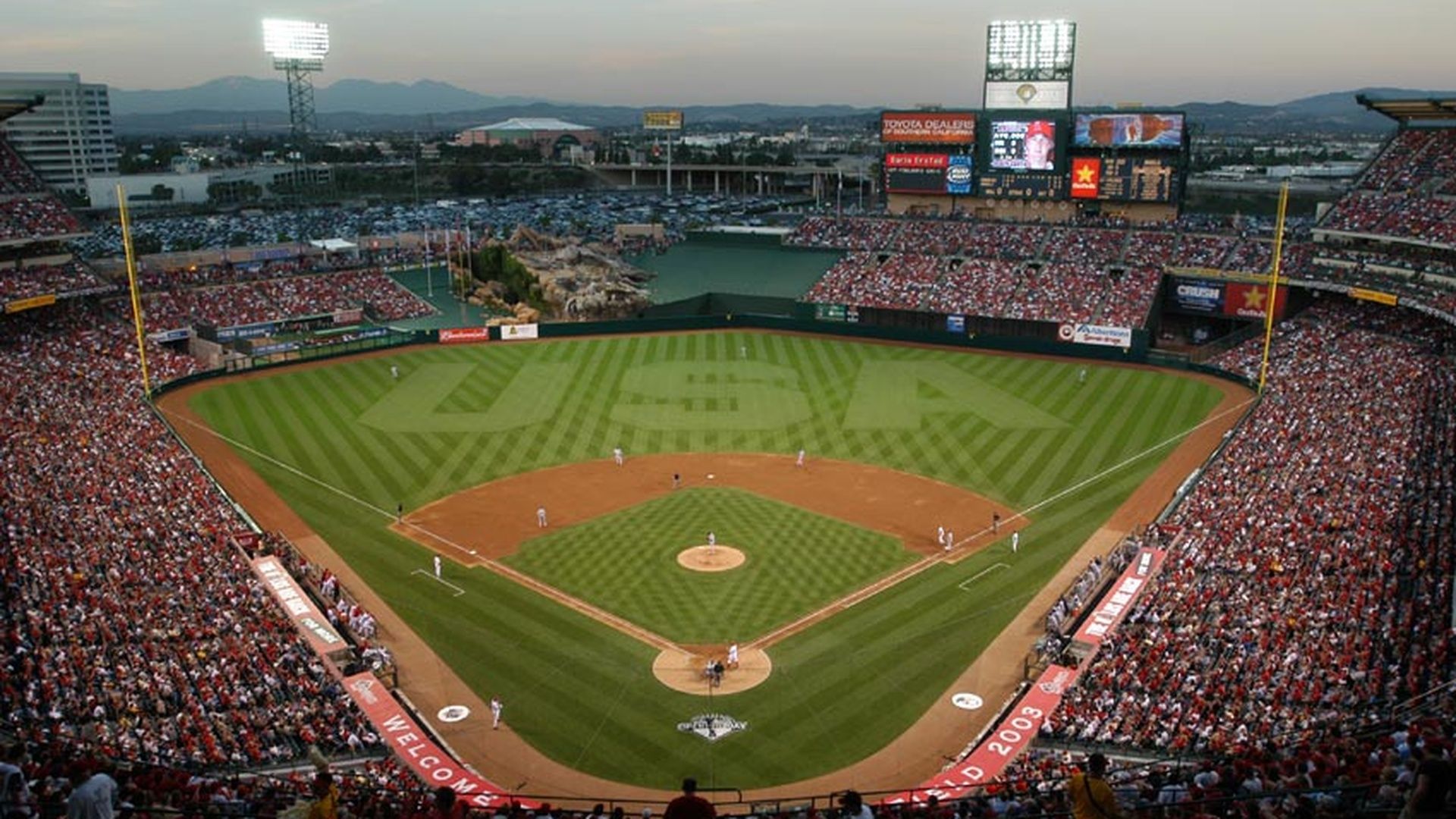
- The "Outfield Rock Outcropping": Designed by Walt Disney Imagineering, an artificial rock formation was constructed behind the center-field wall. Featuring artificial boulders modeled after Southern California topography, real pine trees, streaming water features, and hidden pyrotechnics, the rock pile became the signature architectural element of the modernized facility, sending cascading water sprays and fireworks into the air after home runs and victories.
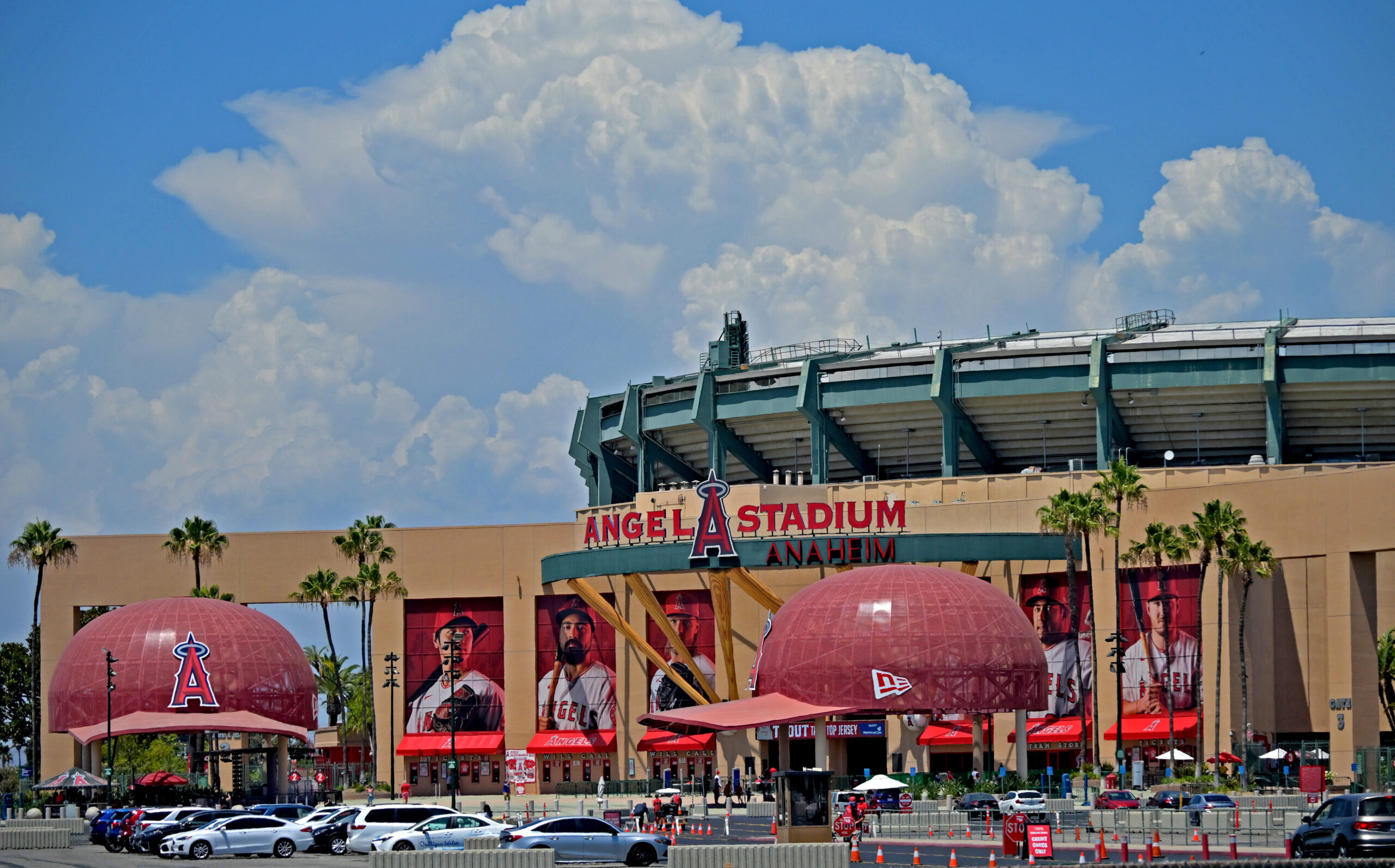
- Exterior and Concourse Overhaul: Terracotta exterior finishes, green steel paint, giant stylized team caps at the home-plate entrance plaza, modernized concourses, expanded restrooms, and upgraded concession infrastructure were introduced across all seating levels.
- Naming Rights: In 1998, the facility was officially renamed Edison International Field of Anaheim through a corporate sponsorship agreement with regional utility provider Edison International. Fans frequently abbreviated the venue's name to "Edison Field."
The renovated stadium debuted on Opening Day, April 1, 1998, returning seating capacity to approximately 45,050 and establishing the core aesthetic layout that remains intact today.
5. 21st Century Evolution, Championship Glory, and Modern Upgrades (1999–2026)
Following the corporate naming era, entrepreneur Arte Moreno purchased the franchise from Disney in 2003. Shortly thereafter, prior to the 2004 season, the venue was renamed Angel Stadium of Anaheim, which remains its official designation, though it is commonly referenced simply as Angel Stadium.
Historical Names:
- 1966–1997: Anaheim Stadium
- 1998–2003: Edison International Field of Anaheim
- 2004–Present: Angel Stadium of Anaheim
The 2002 World Series
The defining competitive chapter in the stadium's history occurred in October 2002. Angel Stadium hosted Games 1, 2, 6, and 7 of the 2002 World Series between the wild-card Anaheim Angels and the San Francisco Giants. On October 27, 2002, before a crowd of 44,598 fans, the Angels defeated the Giants 4–1 in Game 7 to secure the franchise's first World Series championship. The postseason run popularized cultural elements such as thundersticks and the stadium's video-board "Rally Monkey."
| Game | Date | Final Score | Attendance |
|---|---|---|---|
| Game 1 | October 19, 2002 | SF 4, ANA 3 | 44,603 |
| Game 2 | October 20, 2002 | ANA 11, SF 10 | 44,584 |
| Game 6 | October 26, 2002 | ANA 6, SF 5 | 44,837 |
| Game 7 (Clencher) | October 27, 2002 | ANA 4, SF 1 | 44,598 |
Infrastructure Modernization (2010–2026)
To keep the venue competitive with newer ballparks built in the 2000s and 2010s, ownership and stadium operations implemented ongoing technical updates:
- 2010 All-Star Game Upgrades: Ahead of hosting the 2010 MLB All-Star Game, stadium infrastructure was refreshed, including press box modernizations, suite enhancements, and updated sound systems.
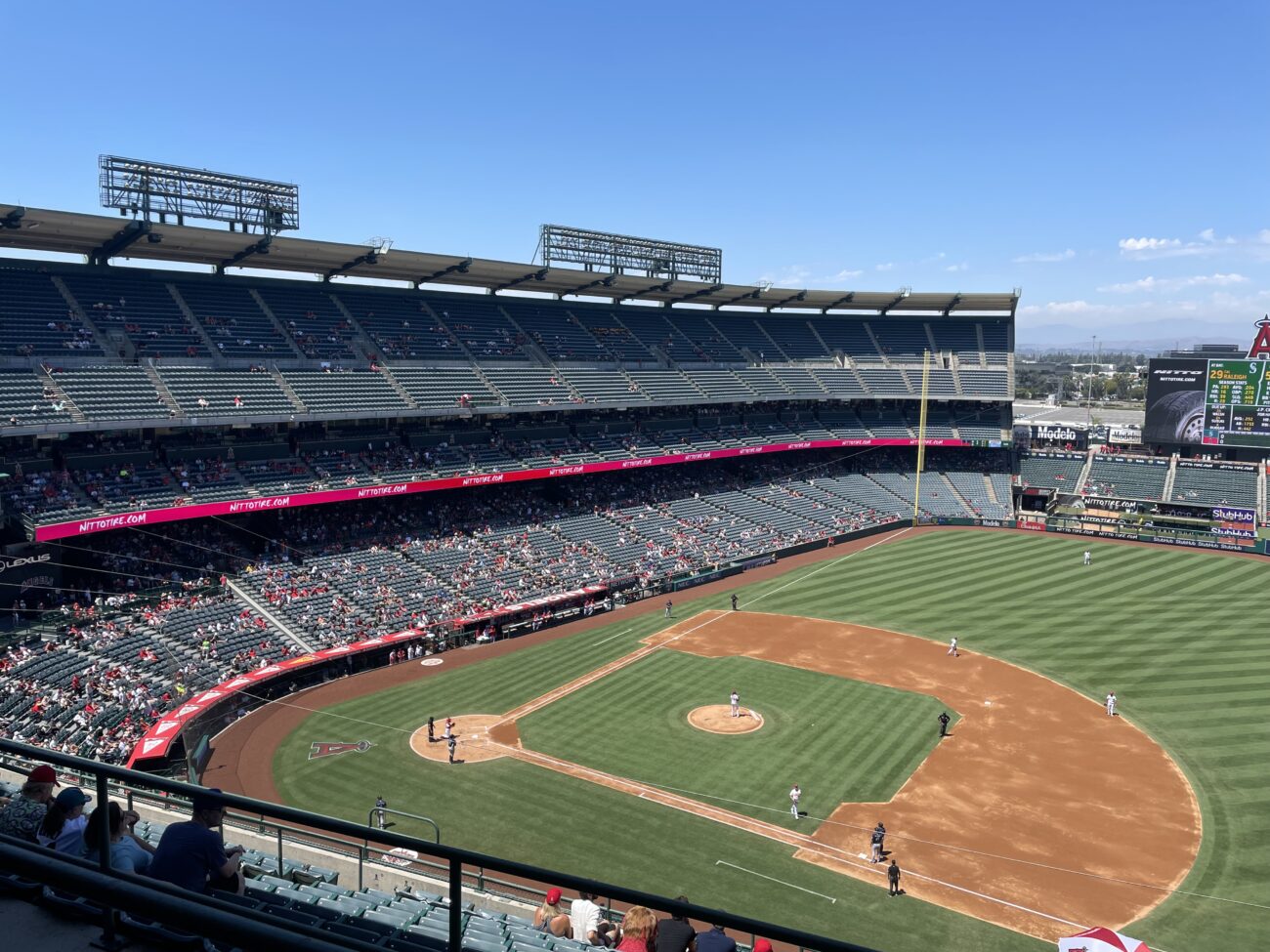
- Digital Video Display Upgrades (2018): Daktronics LED displays were installed in right-center field and left field. The main right-field display spans over 9,500 square feet, making it one of the largest video boards in Major League Baseball at the time of installation.
- LED Sports Lighting: High-efficiency LED lighting replaced metal-halide fixtures, improving broadcast clarity and permitting dynamic light shows linked to home runs and stadium celebrations.
- Outfield Wall Adjustments: In 2018, the out-of-town scoreboard along the right-field wall was modified, raising the home run line to 18 feet to clear the scoreboard structure, altering field dynamics for right fielders.
As of 2026, Angel Stadium stands as the fourth-oldest active ballpark in Major League Baseball, trailing only Fenway Park (1912), Wrigley Field (1914), and Dodger Stadium (1962), and holding the distinction of being the second-oldest venue in the American League.
6. Stadium Lease, Real Estate Transactions, and Municipal Relations
The political and financial history surrounding Angel Stadium’s land and lease agreements has involved extensive negotiations between team ownership and the City of Anaheim.
| Year | Development / Negotiation Milestone |
|---|---|
| 1964 | Land acquired by City of Anaheim; original bonds issued. |
| 1996 | Lease amended during Disney renovation project. |
| 2013–2019 | Lease opt-out discussions & long-term development talks. |
| Dec 2019 | City votes to sell 150-acre site to SRB Management for $320M. |
| May 2022 | Anaheim City Council voids the land sale deal. |
| 2022–2026 | Team operates under existing lease agreement through 2029 (with extension options through 2038). |
In December 2019, the Anaheim City Council approved a proposal to sell the stadium and surrounding 150 acres of parking lots to SRB Management—a business entity led by Angels owner Arte Moreno—for an agreed purchase price of $320 million. The proposed redevelopment plan envisioned constructing a surrounding mixed-use district containing apartments, retail centers, office space, parks, and either a heavily renovated Angel Stadium or a newly constructed replacement venue.
However, in May 2022, following federal investigations involving municipal corruption allegations surrounding former municipal officials, the Anaheim City Council voted unanimously to void the land transaction agreement. As a result, the municipal government retained ownership of the stadium site.
Under the prevailing lease terms, the Angels remain contracted to play at Angel Stadium through 2029, with three sequential five-year team extension options that could extend occupancy through 2038. Operational focus remains centered on maintaining structural integrity, updating mechanical systems, and evaluating long-term venue strategy within the existing footprint.
Chronological Timeline of Angel Stadium Transformations
The following table summarizes the structural, operational, and institutional timeline of Angel Stadium across its history:
| Year / Period | Key Event / Milestone | Primary Structural Changes | Seating Capacity | Primary Tenants & Naming |
|---|---|---|---|---|
| 1964–1966 | Initial Construction | Open-air horseshoe design; 230-ft "Big A" scoreboard installed in left field. | ~43,204 | California AngelsAnaheim Stadium |
| 1967 | First MLB All-Star Game | Hosts 15-inning Midsummer Classic; first national showcase. | ~43,204 | California AngelsAnaheim Stadium |
| 1979–1980 | Multi-Purpose Conversion | Outfield enclosed with 3-tier grandstand; "Big A" moved to parking lot. | ~64,000 (Baseball)~69,000 (Football) | California Angels, LA RamsAnaheim Stadium |
| 1995 | Rams Relocate | Los Angeles Rams move to St. Louis; stadium left over-sized for baseball. | ~64,000 | California AngelsAnaheim Stadium |
| 1996–1998 | Disney Restoration | Outfield grandstands removed; "Outfield Rock Outcropping" added. | ~45,050 | Anaheim AngelsEdison International Field |
| 2002 | World Series Victory | Angels defeat Giants in 7 games; host site for games 1, 2, 6, and 7. | ~45,050 | Anaheim AngelsEdison International Field |
| 2004 | Name Rebranding | Franchise transitions stadium naming back to team brand identity. | ~45,050 | Anaheim / LA AngelsAngel Stadium of Anaheim |
| 2018 | Digital Video Upgrade | Large Daktronics HD video wall added in right field; LED sports lights installed. | ~45,500 | Los Angeles AngelsAngel Stadium |
| 2022–2026 | Lease Stabilization | Land sale canceled; operations normalized under current municipal lease. | ~45,500 | Los Angeles AngelsAngel Stadium |
Signature Architectural and Cultural Elements
The "Big A" Sign
Standing 230 feet tall in the parking lot adjacent to the Orange Freeway (SR-57), the "Big A" remains a prominent structural landmark in Southern California. The structure weighs more than 400 tons and features an illuminated halo near its peak.
- 1966–1979: Served as the main scoreboard in left-center field inside the stadium bowl.
- 1979–Present: Serves as a highway marquee sign, announcing upcoming games, events, and illuminating its halo ring following Angels victories.
| Specification | Details |
|---|---|
| Structural Height | 230 Feet |
| Total Steel Weight | ~430 Tons |
| Structural Function | Left Field Scoreboard (1966–1979)Highway Marquee & Symbol (1979–Present) |
| Post-Game Tradition | Illuminated Halo signifies Angels victory |
The California Outfield Rock Outcropping
Constructed in 1998 by Walt Disney Imagineering, the artificial rock creation behind center field serves as the stadium's primary interior landmark. Designed to echo Southern California mountain landscapes:
- Incorporates real evergreen trees and regional flora set against artificial rockwork.
- Features recirculating pumps driving continuous waterfalls.
- Contains pyrotechnic modules that launch stream bursts and fireworks whenever an Angels player hits a home run or when the team secures a home win.
Field Dimensions and Playing Environment
Angel Stadium features an asymmetrical outfield layout with the following current measurements:
Outfield Field Layout:
- Left Field Line: 330 ft
- Left-Center: 390 ft
- Center Field: 400 ft
- Right-Center: 370 ft
- Right Field Line: 330 ft
- Home Plate
Left Field Line: 330 feet (Wall Height: 18 feet)
Left-Center Field: 390 feet (Wall Height: 8 feet)
Center Field: 400 feet (Wall Height: 8 feet)
Right-Center Field: 370 feet (Wall Height: 8 feet)
Right Field Line: 330 feet (Wall Height: 18 feet)
Frequently Asked Questions (FAQ)
When did Angel Stadium open, and what was its original name?
Angel Stadium opened on April 19, 1966, under its original name, Anaheim Stadium. It was constructed to provide a permanent home for the California Angels franchise after the team shared Chavez Ravine with the Los Angeles Dodgers from 1962 through 1965.
Why was the iconic "Big A" scoreboard moved to the parking lot?
The "Big A" sign was moved in 1979 to accommodate stadium expansions required for the Los Angeles Rams, who relocated to the venue in 1980. To seat nearly 69,000 football fans, the city enclosed the outfield with three-tiered grandstands, which required dismantling the 230-foot A-frame scoreboard from left field and reassembling it near the Orange Freeway as a marquee sign.
Where does Angel Stadium rank among the oldest active MLB ballparks?
Angel Stadium is the fourth-oldest active ballpark in Major League Baseball. Only Fenway Park in Boston (1912), Wrigley Field in Chicago (1914), and Dodger Stadium in Los Angeles (1962) are older. It is the second-oldest stadium in the American League.
How did the stadium transition back to a baseball-only facility?
Following the departure of the Los Angeles Rams to St. Louis after the 1994 season, The Walt Disney Company acquired management control of the Angels. Between 1996 and 1998, Disney and the City of Anaheim invested $118 million to demolish the enclosed outfield football seating, lower the overall seating capacity to approximately 45,000, and install the signature center-field rock outcropping.
What is the current stadium lease agreement status between the Angels and the City of Anaheim?
The Angels operate under a municipal lease agreement that runs through 2029. The contract includes three individual five-year options held by the team, which could extend the occupancy at Angel Stadium through 2038. A proposed 2019 transaction to sell the stadium land to team-affiliated management was officially canceled by the Anaheim City Council in May 2022.
Practical Guide for Exploring Angel Stadium History Today
For visitors interested in experiencing the historic and architectural features of Angel Stadium firsthand, the following steps offer an effective itinerary:
- View the "Big A" Sign: Prior to entering the venue gates, inspect the original 230-foot A-frame sign located in the eastern parking lot near State Route 57. The base features historical plaques detailing its original 1966 construction.
- Examine the Home Plate Gate Entrance: Walk through the main entrance plaza beneath the oversized red Angels caps (installed during the 1996–1998 Disney renovation), which serve as a popular gathering point and feature bricks commemorating key team milestones.
- Visit the Outfield Rock Formation: Access the main concourse behind sections 236–240 to view the artificial rock outcropping and waterfalls designed by Walt Disney Imagineering.
- Schedule an Official Ballpark Tour: The Angels offer guided stadium tours during select non-game days. These tours provide access to restricted historic areas, including the press box, the dugout, the underground tunnel system, and display cases featuring memorabilia from Nolan Ryan's no-hitters and the 2002 World Series trophy.