In Alaska, injured workers are entitled to reimbursement for travel expenses incurred while seeking medical treatment for a work-related injury. This benefit covers mileage for personal vehicle use, tolls, parking, and, in many cases, more complex travel like airfare or lodging. As of 2026, these reimbursements are governed by strict state regulations and specific IRS-aligned rates to ensure that transportation costs do not hinder a worker's recovery.
Under the Alaska Workers’ Compensation Act, medical benefits are a cornerstone of the support system provided to employees who suffer job-site injuries or occupational diseases. While much of the focus often lands on wage replacement (Time Loss benefits) or the payment of hospital bills, the logistical costs of reaching those medical providers can quickly become a financial burden. For workers in a state as geographically vast as Alaska, "mileage" can mean anything from a five-mile drive across Anchorage to a complex multi-modal trip from a rural village to a specialist in Seattle.
This guide provides a detailed analysis of how mileage reimbursement functions within the Alaska workers’ compensation system in 2026, including the current rates, the documentation required for a successful claim, and the legal timelines that both workers and insurance adjusters must follow.
Understanding Your Right to Medical Travel Reimbursement
The legal basis for mileage reimbursement in Alaska is found in Alaska Statute 23.30.095 and further clarified in the Alaska Administrative Code (8 AAC 45.084). The law mandates that the employer (or their insurance carrier) must furnish "reasonable and necessary" medical treatment. Courts and the Alaska Workers' Compensation Board have consistently interpreted this to include the cost of transporting the employee to the location where that treatment is provided.
The primary purpose of this benefit is to keep the injured worker "whole." Because a work-related injury is the reason the travel is necessary, the worker should not have to pay out of pocket for the fuel, wear and tear, or transportation fees required to access care. In 2026, as fuel costs and vehicle maintenance prices remain significant factors in the Alaskan economy, these reimbursements are more critical than ever for maintaining the financial stability of an injured employee.
It is important to note that this is a mandatory benefit. Employers cannot opt-out of paying mileage if the medical treatment itself is compensable. However, the burden of proof lies with the employee. You must document your travels and submit them through the proper channels to trigger the insurance company’s obligation to pay.
Eligibility Criteria: What Travels Are Reimbursable?
Not every trip related to your health is eligible for reimbursement. To qualify for mileage or travel payment in Alaska, the journey must be directly linked to the "reasonable and necessary" treatment of your accepted workers' compensation claim.
Eligible Medical Appointments
The most common eligible trips include visits to:
- Primary Care Physicians (PCP): General check-ups regarding your injury.
- Specialists: Visits to orthopedists, neurologists, or surgeons.
- Physical and Occupational Therapy: Regular sessions to regain mobility or function.
- Diagnostic Testing: Trips to imaging centers for MRIs, X-rays, or CT scans.
- Mental Health Services: If a psychological condition (such as PTSD or depression) has been accepted as part of your claim.
Pharmacy and Medical Supplies
You are also entitled to mileage reimbursement for trips to the pharmacy to pick up prescriptions related to your injury. Additionally, if you must travel to a specialized vendor to be fitted for a brace, crutches, or prosthetic device, those miles are compensable.
Employer-Requested Exams (IMEs)
If the insurance company requires you to attend an Independent Medical Examination (IME), they are legally obligated to pay for your travel in advance or reimburse you promptly. Because IMEs are often scheduled with doctors in specific hubs like Anchorage or Fairbanks—and sometimes even out of state—the travel costs can be substantial. In 2026, regulations continue to require insurers to provide "reasonable" travel arrangements for these mandatory appointments, which often include pre-paid airfare or hotel stays if the distance warrants it.
The 2026 Reimbursement Rates and Calculation
In Alaska, the mileage reimbursement rate for workers' compensation is generally tied to the federal standard mileage rate set by the Internal Revenue Service (IRS) for business purposes. The Alaska Department of Labor and Workforce Development, Division of Workers’ Compensation, typically adopts these rates to maintain consistency with national economic shifts.
Current 2026 Rates
As of January 1, 2026, the standard mileage rate for medical travel in Alaska follows the updated federal guidelines. While the exact figure is adjusted annually based on the cost of fuel, insurance, and vehicle depreciation, it historically hovers between $0.60 and $0.70 per mile.
| Expense Category | 2026 Reimbursement Standard |
|---|---|
| Personal Vehicle Mileage | IRS Business Standard Rate (e.g., $0.67 per mile) |
| Bridge and Road Tolls | 100% of Actual Cost (with receipt) |
| Parking Fees | 100% of Actual Cost (with receipt) |
| Public Transportation | Actual Cost of Fare (bus, train, etc.) |
| Air Travel (Rural/Remote) | Economy Class (requires pre-approval) |
| Per Diem (Meals/Lodging) | Based on State/GSA rates (if travel exceeds 12 hours) |
How to Calculate Your Claim
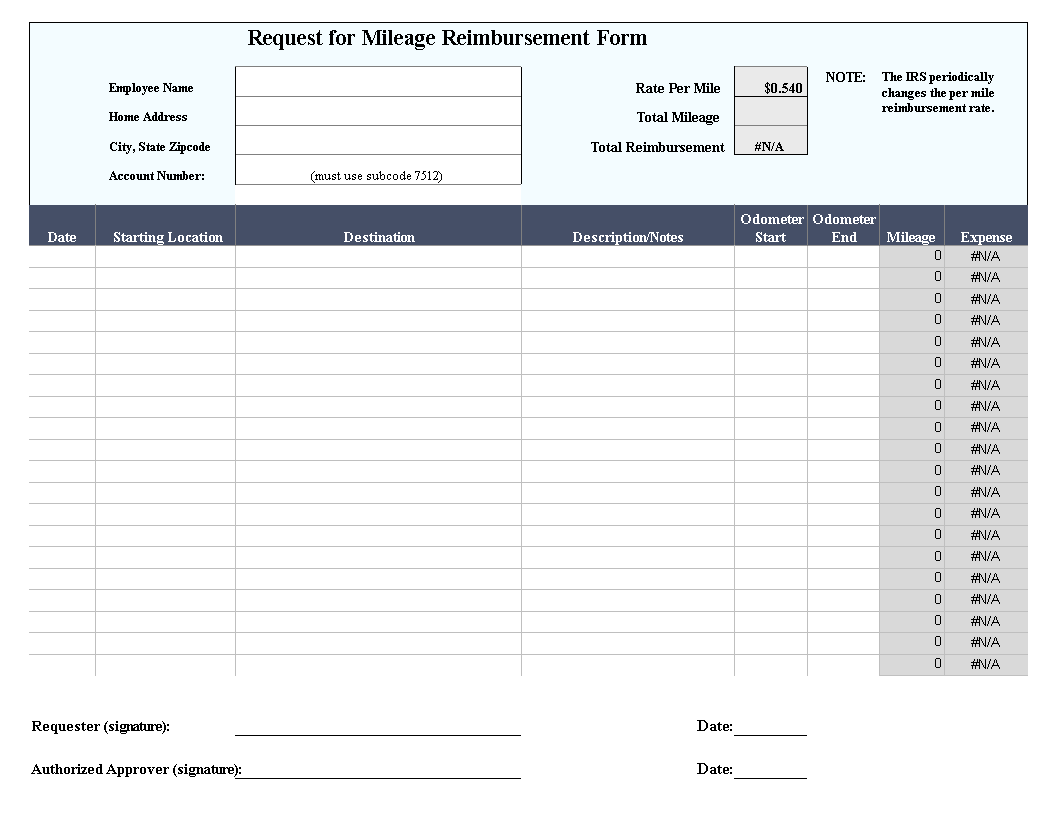
To calculate your reimbursement, you must track the "round-trip" distance from your home or workplace to the medical provider. You do not simply guess the mileage; you should use a reliable mapping service like Google Maps or record your odometer readings.
Formula: (Total Round Trip Miles) x (Current Year Rate) = Total Reimbursement Due
Example: If you drive 20 miles round trip for physical therapy three times a week, and the 2026 rate is $0.67, you are owed $13.40 per trip, or $40.20 per week.
Step-by-Step Guide to Filing for Reimbursement
The insurance company will not automatically send you a check for mileage; you must take proactive steps to claim it. The process is standardized to ensure that adjusters have the data they need to process the payment.
1. Document Everything
Keep a dedicated log in your vehicle or on your phone. For every appointment, record the date, the name of the doctor or clinic, and the total miles driven. If you paid for parking at a hospital garage or a toll on a bridge, keep the physical or digital receipt. In Alaska, receipts are generally required for any individual "other" expense (like parking) that exceeds $25.00, though it is best practice to keep all of them.
2. Use Form 07-6131
The Alaska Division of Workers’ Compensation provides a specific form for this purpose: Form 07-6131 (Workplace Travel/Medical Expense Reimbursement Request). While some insurance carriers have their own internal forms, Form 07-6131 is the state standard and must be accepted by all adjusters.
3. Submission Frequency
You should submit your mileage logs regularly. Most legal experts recommend submitting them once a month or once every 30 days. Waiting too long can result in a massive backlog of data that is harder for the adjuster to verify, leading to delays. Under 8 AAC 45.084(g), you must submit your request for reimbursement within one year of the date the expense was incurred. If you wait longer than 12 months, the insurer may legally deny the claim.
4. Wait for the Statutory Deadline
Once the insurance company receives your completed Form 07-6131 and supporting receipts, they have 30 days to either pay the claim or issue a formal controversion (denial). If they do not pay within 30 days and have no valid reason for the delay, you may be entitled to a late-payment penalty.
Rural Alaska and Specialized Travel Considerations
Alaska’s unique geography creates travel scenarios that are rarely seen in the lower 48 states. For many residents in the "Bush" or remote coastal communities, medical care requires more than a car ride.
Air Travel and Water Taxis
If your injury requires a specialist that is not available in your home community, the employer must pay for the necessary transportation. In 2026, this frequently involves commercial flights from hubs like Bethel, Nome, or Kotzebue to Anchorage. These trips must usually be authorized in advance by the insurance adjuster. If you book your own flight without prior authorization, you risk the insurer only paying what they consider a "reasonable" rate, which might be lower than what you paid.
Lodging and Per Diem
If the distance to your medical provider is so great that you cannot reasonably return home the same day (a common occurrence for rural Alaskans traveling to Anchorage), you are entitled to lodging and meal reimbursements.
- Meals: Usually paid at a flat "per diem" rate based on state guidelines.
- Lodging: Must be at a "reasonable" facility. Most adjusters have preferred hotels near major medical centers that offer medical rates.
The "Closest Available Provider" Rule
Insurance companies are only required to pay for travel to the closest provider capable of treating your condition. If you choose to see a doctor 100 miles away when an equally qualified specialist is available 5 miles from your house, the insurer may only be liable for the 5-mile reimbursement. If you have a specific medical reason for seeing a more distant provider (such as a previous surgical history with that doctor), ensure your physician documents the necessity of that choice.
Common Challenges and How to Resolve Them
Despite the clear regulations, disputes over mileage are common in the Alaska workers’ compensation system. Understanding these friction points can help you avoid delays.
Missing Information
The most frequent cause of delay is an incomplete Form 07-6131. If you forget to list the purpose of the visit or fail to include the date, the adjuster cannot verify the trip against the medical records they receive from the doctor. Ensure your log matches your medical bills perfectly.
Controversion of Medical Necessity
If the insurance company "controverts" (denies) a specific medical treatment—for example, if they claim you no longer need physical therapy—they will also stop paying the mileage for those visits. If you continue to go to therapy while fighting the denial, keep tracking your mileage. If you eventually win your case before the Board, you can claim all back-mileage with interest.
Rounding Errors
Avoid "rounding up" your mileage. If the distance is 14.2 miles, do not write 20. Adjusters often use software to verify distances between zip codes. Significant discrepancies can trigger an audit of your claim or, in extreme cases, accusations of fraud.
Late Payments
If the 30-day window passes and you have not received your check, the first step is to contact the adjuster in writing (email is best for the paper trail). If they still fail to pay, you may need to file a Claim for Adjustment of Compensation with the Alaska Workers' Compensation Board to seek the payment plus penalties and interest.
Summary of Key Rules for 2026
| Rule Component | Requirement |
|---|---|
| Submission Deadline | Within 12 months of the travel date. |
| Payment Deadline | Insurer must pay within 30 days of receipt. |
| Receipt Requirement | Generally required for parking, tolls, and non-mileage costs. |
| Standard Form | Alaska Form 07-6131. |
| Distance Verification | Based on the shortest practical route. |
Frequently Asked Questions
Can I get reimbursed for someone else driving me?
Yes. The reimbursement is for the vehicle use. Whether you are driving yourself or a friend/family member is driving you, the mileage is still owed because the expense was incurred to get you to treatment. However, you cannot claim "lost wages" for the friend who drove you; only the mileage is compensable.
Does mileage include trips to the lawyer’s office?
No. Alaska workers' compensation only covers travel for medical treatment, pharmacy visits, and insurance-mandated exams (IMEs). Trips to your attorney’s office or to attend a Board hearing are generally not reimbursable as medical travel, though in some legal settlements, these costs might be negotiated.
What if I don't have a car?
If you use public transportation, a taxi, or a ride-sharing service like Uber or Lyft because you do not have a vehicle or are medically unable to drive, the insurance company must reimburse the actual cost of the fare. You must provide receipts for these services. In many cases, if you are unable to drive due to the nature of your injury (e.g., a leg in a cast or heavy sedation), the insurer may be required to arrange for a specialized medical transport service.
Are there limits on how many miles I can claim?
There is no "cap" on the total number of miles, provided each trip is for authorized medical care. However, the insurer may investigate if the frequency of travel seems excessive compared to the treatment plan filed by your doctor.
What should I do if the insurer pays the wrong rate?
The rate is determined by the date of the travel, not the date you submit the form. If you traveled in 2025 but submitted the form in 2026, you must use the 2025 rate for those specific days. If the insurer uses the wrong year's rate, send them a polite correction notice with a copy of the state’s rate announcement.
Practical Recommendation and Next Actions
If you are navigating an Alaska workers’ compensation claim in 2026, the most effective way to ensure you receive your mileage reimbursement is to treat it like a professional business expense.
Next Actions:
- Download Form 07-6131: Obtain the latest version from the Alaska Department of Labor website.
- Establish a Routine: Every Sunday evening, update your mileage log using your calendar from the previous week.
- Use Digital Tools: Take photos of parking and toll receipts immediately so they aren't lost.
- Verify the Rate: Ensure you are using the correct IRS/State rate for the current calendar year.
- Monitor Your Mail: If you receive a "Notice of Controversion," check immediately to see if it affects your travel benefits.
For complex cases involving bush travel, out-of-state surgery, or chronic late payments, consulting with a qualified Alaska workers' compensation attorney can ensure that your rights are protected and that all indemnity benefits, including travel, are paid in full.
Professional-Advice Limitation: This article provides general information about Alaska workers' compensation laws as of 2026. It does not constitute legal advice. Laws and regulations are subject to change and interpretation by the courts. For specific legal guidance regarding your claim, consult with a licensed attorney in the State of Alaska.