Air Canada is consistently strict regarding carry-on size limits to ensure cabin safety and maintain flight schedules. In 2026, the airline utilizes automated sizing technology and manual gate checks to verify that every "standard item" and "personal item" adheres to the 55 x 23 x 40 cm and 33 x 16 x 43 cm limits respectively.
Whether you are flying a short-haul hop between Toronto and Montreal or a long-haul international route, understanding the nuances of Air Canada’s baggage enforcement is critical to avoiding unexpected gate-check fees or the inconvenience of being separated from your belongings. As overhead bin space becomes increasingly contested on high-load flights, the airline has reinforced its "one standard item, one personal item" policy with greater technical scrutiny.
The Official Air Canada Carry-On Dimensions for 2026
To navigate Air Canada’s strict enforcement, you must first master the specific measurements. Unlike some airlines that offer a total "linear inch" limit, Air Canada defines its requirements by height, width, and depth. These measurements are absolute and include the most protruding parts of your luggage.
Standard Item Dimensions
The standard item is your primary carry-on, typically a small suitcase or a large hiking backpack. The maximum dimensions are:
- Height: 55 cm (21.5 inches)
- Width: 40 cm (15.5 inches)
- Depth: 23 cm (9 inches)
It is vital to recognize that these measurements must include wheels and handles. A common mistake travelers make is purchasing a "21-inch" suitcase that measures 21 inches for the packing compartment alone, only to find that the wheels add another two inches, making the bag non-compliant.
Personal Item Dimensions
The personal item is intended to fit under the seat in front of you. This includes items such as a briefcase, laptop bag, small backpack, or purse. The maximum dimensions are:
- Height: 43 cm (17 inches)
- Width: 33 cm (13 inches)
- Depth: 16 cm (6 inches)
While Air Canada is often more lenient with the personal item if it is clearly small, they have become increasingly strict about oversized backpacks being used as "personal items." If your backpack is too tall to fit under the seat without obstructing your footwell, a gate agent may require it to be checked or counted as your "standard item."
Why Air Canada Is Strict About Carry-On Size
The strictness encountered by passengers in 2026 is not arbitrary; it is driven by operational efficiency and aircraft configuration. There are three primary reasons why agents are instructed to be rigorous at the boarding gate.
Overhead Bin Capacity
Modern aircraft like the Airbus A220 and the Boeing 787 Dreamliner have redesigned overhead bins, but they are still finite spaces. On a fully booked flight, there is mathematically not enough room for every passenger to bring an oversized bag. By enforcing the 23 cm (9 inch) depth limit, Air Canada ensures that bags can be placed on their sides (wheels-in or handle-in) to maximize the number of bags per bin.
On-Time Performance
One of the leading causes of departure delays is "cabin baggage management." When passengers bring oversized bags that do not fit, flight attendants must spend time rearranging luggage or removing bags to be checked into the hold at the last minute. By checking sizes at the gate or check-in counter, Air Canada mitigates these delays, ensuring the plane can push back on schedule.
Safety and Weight Distribution
While Air Canada does not officially have a weight limit for carry-on bags (provided the passenger can lift the bag into the overhead bin unaided), size limits help regulate the volume of items in the cabin. In the event of turbulence, properly stowed, right-sized luggage is less likely to shift or force a bin door open.
The "Sizer" Test: What to Expect at the Airport
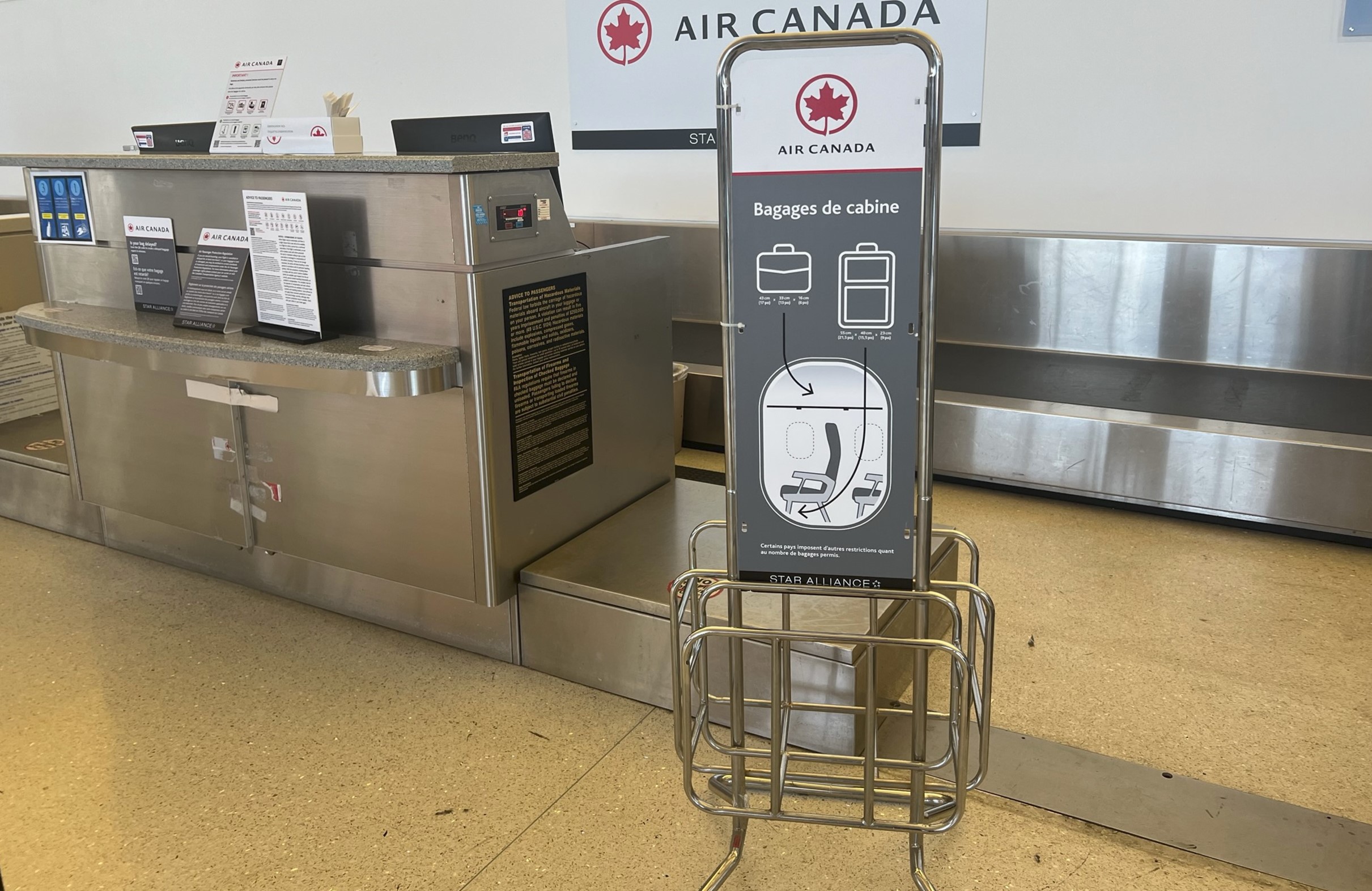
If you are flying with Air Canada in 2026, you will likely encounter the "Sizer"—a metal frame designed to the exact specifications of the airline's limits. There are two stages where your bag may be challenged.
The Check-In Counter
Even if you are not checking a bag, agents at the check-in or bag-drop counters often eye-ball carry-on luggage. If a bag appears bulky, they will ask you to place it in the sizer. If it does not fit easily, they will require you to check it as hold luggage, which may incur a fee depending on your fare class.
The Boarding Gate
The boarding gate is where most enforcement occurs. Air Canada gate agents are trained to look for "expandable" bags that have been zipped open, as these almost always exceed the 23 cm depth limit. If an agent tags your bag for a size check, you must be able to slide it into the sizer without using excessive force. If the wheels stick out or the handle prevents the bag from sitting flush, it is deemed non-compliant.
Aircraft Variations: Mainline vs. Express
The level of strictness can also depend on the type of aircraft operating your flight. Air Canada operates a diverse fleet, and what fits on one plane might not fit on another.
Mainline Flights (Airbus A320/A321, A220, Boeing 737/777/787)
On these larger jets, the overhead bins are relatively spacious. However, because these flights often carry 150 to 400 passengers, the competition for space is fierce. On these flights, agents are strict because the sheer volume of bags is the issue.
Air Canada Express (Jazz, Pal Airlines)
If you are flying on a smaller regional aircraft like a De Havilland Dash 8-400 or a Bombardier CRJ900, the overhead bins are significantly smaller. On many of these flights, even a "compliant" standard carry-on bag will not fit in the overhead bin.
In these cases, Air Canada uses a "Skycheck" service. You leave your bag on a cart at the end of the jet bridge before boarding, and it is placed in the cargo hold. Upon arrival, the bag is returned to you on the jet bridge rather than at the luggage carousel. While this is a free service for small aircraft, your bag must still meet the basic carry-on dimensions to qualify for Skycheck.
Air Canada Carry-On Rules at a Glance
The following table summarizes the requirements for passengers traveling in 2026.
| Item Category | Max Dimensions (L x W x H) | Weight Limit | Placement |
|---|---|---|---|
| Standard Item | 55 x 40 x 23 cm (21.5 x 15.5 x 9 in) | Must be able to lift unaided | Overhead Bin |
| Personal Item | 43 x 33 x 16 cm (17 x 13 x 6 in) | Must be able to lift unaided | Under the Seat |
| Infant Item | 55 x 40 x 23 cm (21.5 x 15.5 x 9 in) | N/A | Overhead Bin |
| Musical Instruments | Varies by size; see specific policy | N/A | Overhead Bin or Seat |
Note: Dimensions include wheels and handles. One standard item and one personal item are allowed per passenger.
Strategies to Avoid Carry-On Issues
To ensure you aren't forced to check your bag at the gate, consider these technical strategies for packing and luggage selection.
1. Choose "Global" Carry-On Sizes Over "Domestic" Sizes
Many luggage manufacturers sell "Domestic Carry-On" and "International/Global Carry-On" sizes. Domestic sizes (common in the USA) are often 22 inches tall. Air Canada's limit is 21.5 inches (55 cm). That half-inch difference is often exactly what prevents a bag from fitting into the Air Canada sizer. Always opt for the smaller international size to be safe.
2. Hard-Shell vs. Soft-Side Luggage
Hard-shell luggage is popular for protection, but it is unforgiving in a sizer. If your hard-shell bag is 24 cm deep, it will not compress. A soft-sided bag, however, can often be "squished" into the sizer if it isn't overpacked. If you are worried about being slightly over the limit, a soft-sided bag offers a better chance of passing the sizer test.
3. Mind the "Expandable" Zipper
Most modern carry-ons feature an expansion joint that adds 2 or 3 inches of depth. While this is great for road trips, using the expansion feature almost always makes the bag illegal for Air Canada carry-on. If you use the expansion zipper, you should plan to check the bag.
4. Know Your Boarding Zone
Air Canada boards in zones (1 through 5). Zones 1 and 2 are for Business Class, Premium Economy, and Elite Status members. Zones 4 and 5 are for Economy passengers. If you are in Zone 5, the overhead bins will likely be full by the time you board. Even if your bag is the perfect size, you may be asked to gate-check it. However, if your bag is the correct size, this gate-check is usually free of charge.
Special Items and Exceptions
Air Canada does allow for certain items to be carried in addition to your two-bag limit. These are generally not subject to the same "strictness" as standard luggage, but they must still be managed properly.
- Infant Care Bags: If you are traveling with an infant (under age 2), you are allowed one additional standard-sized bag for the infant's belongings.
- Medical Equipment: CPAP machines, canes, and other essential medical devices do not count toward your carry-on limit.
- Diplomatic Baggage: Authorized diplomatic couriers have specific allowances.
- Duty-Free Items: Reasonable amounts of duty-free purchases (liquor, perfume) are allowed, but they should ideally be consolidated into your existing carry-on if space permits to avoid scrutiny during boarding.
What Happens if Your Bag is Too Big?
If an agent determines your bag exceeds the limits, one of two things will happen:
- Voluntary Gate Check: On full flights, agents often ask for volunteers to check their bags for free. This is a good way to avoid the struggle of finding bin space.
- Mandatory Check: If you are caught with an oversized bag during the formal boarding process, the agent will tag the bag to your final destination. If your fare class (such as "Basic Economy") does not include a checked bag, you will be required to pay the standard checked bag fee plus a gate handling fee in some instances.
In 2026, Air Canada has streamlined its payment systems at the gate to accept mobile payments and credit cards quickly, making the enforcement process faster but more frequent.
Frequently Asked Questions
Does Air Canada weigh carry-on bags?
Air Canada does not have a specific weight limit for carry-on luggage in 2026. However, the rule is that you must be able to store your bag in the overhead bin "unaided." If a flight attendant or gate agent observes you struggling significantly with the weight, they may deem it a safety hazard and require it to be checked.
Can I bring a garment bag as a carry-on?
Yes, a garment bag can serve as your "standard item" as long as it fits within the 55 x 40 x 23 cm dimensions when folded. If the bag is long and cannot be folded, it will likely exceed the height limit and must be checked.
Are backpacks considered personal items or standard items?
A backpack can be either. A small "daypack" (under 43 cm tall) is generally considered a personal item. A large multi-day hiking pack or a "travel backpack" designed to replace a suitcase is considered a standard item. You cannot bring two large backpacks; one must fit the personal item dimensions.
Is Air Canada more strict on Rouge flights?
Air Canada Rouge (the leisure subsidiary) follows the same baggage policies as mainline Air Canada. However, because Rouge aircraft are often configured with more seats (and thus more passengers), the pressure on overhead bin space is even higher, leading to very strict enforcement at the gate.
What if my bag fits the sizer but the bin is full?
This is a common occurrence. If your bag is compliant but there is no space left, the agent will "gate-check" your bag. They will provide you with a claim tag, and your bag will be sent to the luggage carousel at your destination. This service is free for compliant bags when the bins are full.
Final Recommendations for Travelers
To ensure a seamless experience with Air Canada in 2026, the best approach is compliance over convenience. Measure your bag at home using the 55 x 40 x 23 cm standard, and do not assume that a bag labeled "carry-on" by a retailer is actually compliant with Air Canada's specific metrics.
If you suspect your bag is borderline, arrive at the gate early. If you are in a later boarding zone, consider checking your bag at the counter before passing through security; it is often less stressful than having it taken away during the boarding process. For those who must keep their bags with them, investing in a bag specifically designed for international dimensions is the most reliable way to navigate Air Canada's strict enforcement.