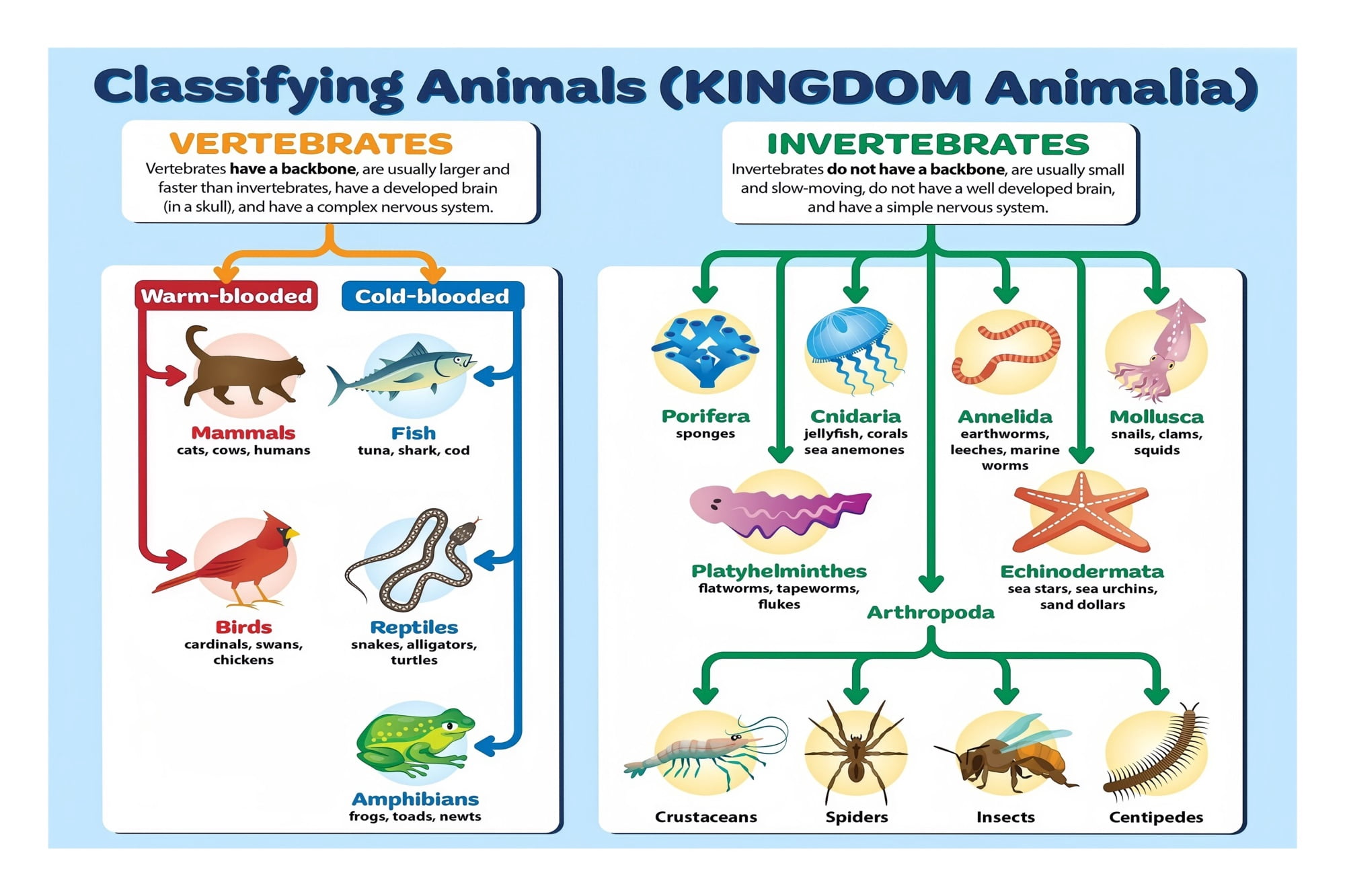
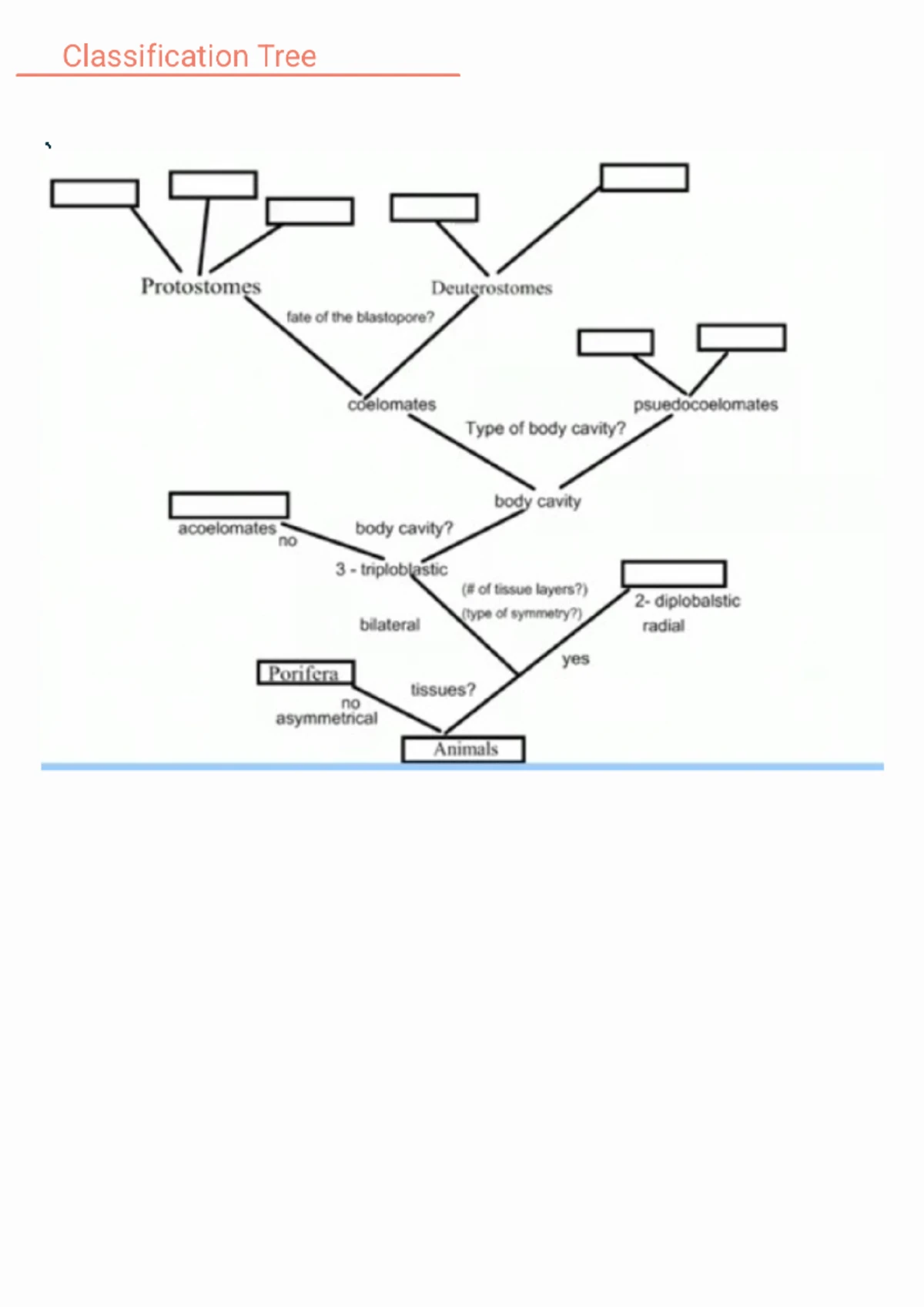
The classification of animal phyla organizes Kingdom Animalia (Metazoa) into distinct taxonomic groups based on shared evolutionary ancestry, body plans, embryonic development, and anatomical complexity. Biologists recognize over 30 animal phyla, categorized primarily by tissue organization, body symmetry, germ layer architecture, body cavity (coelom) structure, and developmental patterns like blastopore fate.
Fundamental Principles of Animal Classification
Taxonomists and evolutionary biologists classify animals using hierarchical traits established during early embryonic development and anatomical morphogenesis. Understanding these key body plan attributes provides the framework for distinguishing major animal lineages.
1. Cellular Organization and Tissue Layers
Animals are multicellular eukaryotic organisms divided broadly into two major structural grades:
- Parazoa (Porifera): Organisms lacking true specialized tissues or organs. Cellular aggregation forms distinct functional cell types (such as choanocytes and amoebocytes), but these cells do not organize into basal laminae-bound tissue layers.
- Eumetazoa: All other animals, possessing true tissues derived from embryological germ layers.
During gastrulation, embryonic cells differentiate into foundational tissue layers:
- Diploblastic: Organisms featuring two primary germ layers—an outer ectoderm (forming epidermal and neural structures) and an inner endoderm (forming the gut lining). Diploblastic animals typically display radial symmetry (e.g., Cnidaria).
- Triploblastic: Organisms featuring three germ layers—ectoderm, endoderm, and a middle mesoderm. Mesodermal tissue gives rise to muscle tissues, circulatory systems, connective tissues, and internal organs. All bilaterally symmetrical animals are triploblastic.
2. Body Symmetry and Cephalization
Body symmetry describes how an animal's anatomical structures are arranged around a central axis or plane:
Asymmetry: No body plane can divide the organism into mirror-image halves (e.g., most sponges).
Radial Symmetry: Body parts arranged concentrically around a central oral-aboral axis. Any longitudinal plane passing through the central axis produces mirror-image halves (e.g., adult jellyfish, sea anemones). Radial symmetry suits sessile or slow-moving organisms that interact with their environment equally from all directions.
Bilateral Symmetry: Anatomical organization along a single sagittal plane dividing the body into identical left and right halves. Bilateral symmetry correlates with cephalization—the evolutionary concentration of nervous tissue and sensory organs at the anterior (head) region, facilitating directional movement and active hunting.
Kingdom Animalia (Metazoa)
- Parazoa (No true tissues): Phylum Porifera
- Eumetazoa (True tissues)
- Diploblastic (Radial Symmetry): Phyla Cnidaria, Ctenophora
- Triploblastic (Bilateral Symmetry / Bilateria)
- Protostomes (Spiral cleavage, Blastopore becomes Mouth)
- Lophotrochozoa: Phyla Platyhelminthes, Mollusca, Annelida
- Ecdysozoa: Phyla Nematoda, Arthropoda
- Deuterostomes (Radial cleavage, Blastopore becomes Anus)
- Phyla Echinodermata, Chordata
- Protostomes (Spiral cleavage, Blastopore becomes Mouth)
3. Coelom (Body Cavity) Architecture
In triploblastic animals, the internal body cavity between the body wall and the alimentary canal dictates structural support, internal organ space, and hydrostatic movement capability:
- Acoelomate: Lacks an internal body cavity; the region between the ectodermal epidermis and endodermal gut is completely filled with solid mesodermal parenchyma tissue (e.g., flatworms).
- Pseudocoelomate: Features a body cavity (pseudocoel) derived from the persistent embryonic blastocoel. The space is fluid-filled and lies between the endoderm and mesoderm, lacking a lining of mesodermal peritoneum (e.g., roundworms).
- Coelomate (Eucoelomate): Possesses a true coelom derived entirely within the mesoderm, lined completely by a thin cellular layer called the peritoneum. This arrangement allows organ suspension, independent gut motility, and fluid transport systems (e.g., annelids, mollusks, arthropods, echinoderms, chordates).
4. Developmental Lineages: Protostomes vs. Deuterostomes
Triploblastic bilateral animals divide into two principal evolutionary clades based on early embryonic cell cleavage patterns and the developmental fate of the blastopore (the first opening formed during gastrulation):
| Embryological Trait | Protostomia | Deuterostomia |
|---|---|---|
| Cleavage Pattern | Spiral and determinate | Radial and indeterminate |
| Blastopore Fate | Becomes the mouth (anus forms secondary opening) | Becomes the anus (mouth forms secondary opening) |
| Coelom Formation | Schizocoelous: Solid mesodermal blocks split to form cavity | Enterocoelous: Mesodermal pouches bud off from the archenteron |
| Major Phyla Included | Arthropoda, Mollusca, Annelida, Nematoda, Platyhelminthes | Chordata, Echinodermata, Hemichordata |
Modern phylogenomics further subdivides Protostomia into two major superphyla:
- Lophotrochozoa: Animals possessing either a specialized ciliated feeding structure called a lophophore or a distinct trochophore larval stage (e.g., Mollusca, Annelida, Platyhelminthes).
- Ecdysozoa: Animals characterized by a non-living outer cuticle or exoskeleton that must be periodically shed through a process called ecdysis or molting (e.g., Arthropoda, Nematoda).
Comprehensive Overview of Major Animal Phyla
While zoologists identify roughly 35 distinct phyla within Kingdom Animalia, nine major phyla encompass the vast majority of animal species diversity and biomass.
1. Phylum Porifera (Sponges)
Poriferans represent the most basal clade of living animals. Primarily marine organisms, sponges possess an architectural framework centered around water circulation rather than complex organ systems.
- Key Anatomical Features: Asymmetrical body organization; lack of true tissues, organs, neurons, or digestive tracts; porous body wall perforated by ostia (incurrent pores) leading to a central cavity (spongocoel) and exiting via an osculum (excurrent opening).
- Cellular Specialization: Flagellated choanocytes (collar cells) line internal chambers, creating water currents to filter microscopic food particles. Mobile amoebocytes transport nutrients and secrete structural elements called spicules (composed of calcium carbonate or silica) or collagenous spongin fibers.
- Representative Taxa: Glass sponges (Hexactinellida), demosponges (Demospongiae), calcareous sponges (Calcarea).
2. Phylum Cnidaria (Jellyfish, Corals, Sea Anemones)
Cnidarians are diploblastic, radially symmetrical marine and freshwater eumetazoans exhibiting specialized stinging cells.
Key Anatomical Features: Radial symmetry organized around a central gastrovascular cavity with a single opening acting as both mouth and anus; diploblastic tissue structure separated by a gelatinous matrix called mesoglea; diffuse, non-centralized nerve net.
Diagnostic Cell Type: Cnidocytes containing explosive organelles called nematocysts, which discharge venomous harpoons for prey capture and defense.
Dimorphic Life Cycle: Many species alternate between two distinct body forms: a sessile, tubular polyp stage (oral surface directed upward) and a motile, umbrella-shaped medusa stage (oral surface directed downward).
Representative Taxa: Hydrozoans (Hydra, Portuguese man-o'-war), Scyphozoans (true jellyfish), Anthozoans (sea anemones, stony corals, soft corals), Cubozoans (box jellyfish).
Cnidarian Body Plans
- Polyp Form (Sessile)
- Tentacles
- Gastrovascular Cavity
- Base
- Medusa Form (Motile)
- Mouth
- Gastrovascular Cavity
- Tentacles
- Polyp Form (Sessile)
3. Phylum Platyhelminthes (Flatworms)
Platyhelminths are the simplest triploblastic animals, demonstrating bilateral symmetry and cephalization without an internal body cavity.
- Key Anatomical Features: Bilateral symmetry; triploblastic acoelomate construction; dorsoventrally flattened body maximizes surface-area-to-volume ratio for gas exchange via diffusion; incomplete digestive system (single opening) or complete loss of digestive tract in parasitic forms.
- Excretory System: Specialized protonephridia containing flame cells regulate osmotic balance and metabolic waste excretion.
- Ecological Guilds: Includes free-living carnivores and widespread endoparasitic lineages exhibiting complex multi-host life cycles.
- Representative Taxa: Turbellaria (planarians), Trematoda (flukes such as Schistosoma), Cestoda (tapeworms lacking a digestive tract).
4. Phylum Nematoda (Roundworms)
Nematodes are among the most abundant and ecologically diverse organisms on Earth, occupying terrestrial, aquatic, and parasitic niches.
- Key Anatomical Features: Unsegmented, cylindrical, tapering bodies covered by a thick, multi-layered chitinous cuticle; triploblastic pseudocoelomate architecture; hydrostatic skeleton maintained under high internal fluid pressure.
- Developmental Characteristics: Belong to the Ecdysozoa clade; undergo periodic molting (ecdysis) of the cuticle during growth; complete digestive system featuring a muscular pharynx and separate mouth and anus.
- Biological Significance: Free-living nematodes drive nutrient cycling in soils (Caenorhabditis elegans serves as a key model organism in developmental biology); parasitic nematodes cause major medical and agricultural conditions.
- Representative Taxa: Caenorhabditis elegans, Ascaris lumbricoides, hookworms (Ancylostoma), filarial worms (Wuchereria).
5. Phylum Mollusca (Mollusks)
Mollusca represents the second-largest animal phylum, displaying remarkable morphological diversification from slow-moving herbivores to intelligent marine predators.
- Key Anatomical Features: Triploblastic coelomate body plan divided into three primary regions: a muscular foot (used for locomotion), a visceral mass (housing internal organ systems), and a epidermal mantle (which secretes a calcium carbonate shell and encloses a mantle cavity containing gills or lungs).
- Diagnostic Structures: Feeding apparatus known as a radula—a chitinous ribbon lined with microscopic teeth used to scrape, cut, or drill food (absent in bivalves); open circulatory system with a heart pumping hemolymph through hemocoel spaces (closed circulatory system evolved independently in cephalopods).
- Representative Taxa:
- Gastropoda: Snails, slugs (exhibit developmental torsion, rotating visceral mass 180°).
- Bivalvia: Clams, mussels, oysters, scallops (hinged two-part shell, filter-feeding via enlarged ctenidia).
- Cephalopoda: Octopuses, squids, cuttlefish, nautiluses (closed circulatory system, highly developed brain, complex eyes, modified foot forming propulsion siphon and tentacles).
- Polyplacophora: Chitons (dorsal shell composed of eight overlapping articulated plates).
6. Phylum Annelida (Segmented Worms)
Annelids exhibit distinct body segmentation, allowing precise localized muscle control and structural specialization.
- Key Anatomical Features: Triploblastic eucoelomate organization characterized by metamerism—serial repetition of internal and external body segments divided by fluid-tight intersegmental septa; closed circulatory system containing respiratory pigments (such as hemoglobin); paired excretory organs called metanephridia in each segment.
- Locomotion: Hydrostatic skeleton operated via coordinated peristaltic contractions of outer circular and inner longitudinal muscle layers, aided by chitinous bristles called setae (or chaetae).
- Representative Taxa:
- Polychaeta: Marine bristle worms featuring fleshy, paddle-like lateral appendages called parapodia.
- Oligochaeta: Earthworms with reduced setae and no distinct head region.
- Hirudinea: Leeches, mostly freshwater ectoparasites or predators lacking setae, featuring anterior and posterior suckers.
7. Phylum Arthropoda (Arthropods)
Arthropoda is the most successful and diverse phylum in the animal kingdom, comprising over 80% of all described living animal species.
- Key Anatomical Features: Segmented body organized into functional body regions called tagmata (typically head, thorax, and abdomen, or cephalothorax and abdomen); rigid exoskeleton composed of chitin cross-linked with proteins (and reinforced with calcium carbonate in crustaceans); jointed, paired appendages specialized for feeding, locomotion, sensory reception, and defense.
- Physiological Adaptations: Must undergo ecdysis (molting) driven by ecdysteroid hormones to permit physical growth; open circulatory system with a dorsal heart pumping hemolymph into a hemocoel; specialized respiratory structures including tracheal systems (insects), book lungs (arachnids), or gills (crustaceans).
- Major Subphyla:
- Hexapoda: Insects (three tagmata, six uniramous legs, unique evolution of powered flight).
- Chelicerata: Arachnids, horseshoe crabs, sea spiders (body divided into cephalothorax and abdomen; possess chelicerae for feeding and pedipalps; lack antennae).
- Crustacea: Crabs, lobsters, shrimp, barnacles, isopods (primarily aquatic; biramous appendages; two pairs of antennae).
- Myriapoda: Centipedes (Chilopoda, predatory, one pair of legs per segment) and millipedes (Diplopoda, detritivorous, two pairs of legs per diplosegment).
8. Phylum Echinodermata (Echinoderms)
Echinoderms are exclusively marine deuterostomes exhibiting a unique evolutionary shift in body symmetry between larval and adult stages.
- Key Anatomical Features: Bilaterally symmetrical free-swimming larvae undergo metamorphosis into pentaradial (five-part radial) symmetrical adults; endoskeleton constructed of calcareous ossicles embedded within the dermis; complete absence of head or centralized brain (decentralized nerve ring and radial nerves).
- Water Vascular System: A unique hydraulic network of coelomic fluid-filled canals operating specialized hydrostatic projections called tube feet (podia). This system drives locomotion, gas exchange, sensory reception, and prey capture through hydrostatic pressure regulated by an opening called the madreporite.
- Representative Taxa: Asteroidea (sea stars), Ophiuroidea (brittle stars), Echinoidea (sea urchins and sand dollars), Holothuroidea (sea cucumbers), Crinoidea (sea lilies and feather stars).
9. Phylum Chordata (Chordates)
Phylum Chordata includes all vertebrate animals along with two basal invertebrate lineages. All chordates express four fundamental diagnostic anatomical characters at some point during their embryonic or adult development.
Four Defining Chordate Synapomorphies:
- Notochord: A flexible, rod-like longitudinal structure derived from mesoderm located dorsal to the gut; provides skeletal support and muscle attachment sites.
- Dorsal Hollow Nerve Cord: Formed by invagination of ectodermal tissue above the notochord; develops into the central nervous system (brain and spinal cord).
- Pharyngeal Slits or Pouch Openings: Perforations in the pharyngeal cavity connecting the throat to the exterior environment; originally evolved for filter feeding, later adapted for respiratory gas exchange (gills) or structural modifications of the inner ear, neck, and jaw in tetrapods.
- Post-Anal Tail: An muscular extension of the body extending posterior to the anus, adapted for aquatic propulsion or balance.
Subphyla Breakdown:
- Urochordata (Tunicates/Sea Squirts): Sessile marine filter-feeders; adults lose the notochord, tail, and nerve cord, retaining only pharyngeal slits, whereas free-swimming larvae display all four chordate traits.
- Cephalochordata (Lancelets/Amphioxus): Small, fish-like marine filter feeders that retain all four chordate characteristics throughout their entire adult life.
- Vertebrata (Craniata): Animals in which the embryonic notochord is largely replaced during development by a jointed, cartilaginous or bony vertebral column enclosing the spinal cord, along with a distinct cranium protecting a centralized brain.
Chordate Diagnostic Structure
- Head
- Dorsal Hollow Nerve Cord
- Notochord
- Pharyngeal Slits
- Gut/Digestive Tract
- Anus
- Post-Anal Tail
Comparative Matrix of Major Animal Phyla
The following diagnostic table details the anatomical, embryological, and physiological features distinguishing the primary animal phyla:
| Phylum | Symmetry | Germ Layers | Coelom Type | Digestive System | Segmentation | Distinctive Key Features |
|---|---|---|---|---|---|---|
| Porifera | Asymmetrical | None (Parazoa) | N/A | Absent (Intracellular) | Absent | Choanocytes, ostia, osculum, spicules/spongin skeleton |
| Cnidaria | Radial | Diploblastic | N/A | Incomplete (Gastrovascular) | Absent | Cnidocytes with nematocysts, polyp/medusa dimorphism, mesoglea |
| Platyhelminthes | Bilateral | Triploblastic | Acoelomate | Incomplete or absent | Absent | Dorsoventrally flattened, protonephridia (flame cells) |
| Nematoda | Bilateral | Triploblastic | Pseudocoelomate | Complete | Absent | Chitinous cuticle, ecdysis, hydrostatic skeleton under high pressure |
| Mollusca | Bilateral | Triploblastic | Coelomate | Complete | Absent | Mantle, muscular foot, visceral mass, radula, calcareous shell |
| Annelida | Bilateral | Triploblastic | Coelomate | Complete | Present (Metameric) | Setae/chaetae, metanephridia, closed circulatory system |
| Arthropoda | Bilateral | Triploblastic | Coelomate | Complete | Present (Tagmatized) | Chitinous exoskeleton, jointed appendages, ecdysis |
| Echinodermata | Pentaradial (Adults) | Triploblastic | Coelomate | Complete | Absent | Water vascular system, tube feet, endoskeletal calcareous ossicles |
| Chordata | Bilateral | Triploblastic | Coelomate | Complete | Present (Muscular/Skeletal) | Notochord, dorsal hollow nerve cord, pharyngeal slits, post-anal tail |
Minor and Specialized Animal Phyla
Beyond the nine major phyla, zoologists classify over two dozen minor phyla that occupy specialized ecological niches or represent critical evolutionary branching points:
- Ctenophora (Comb Jellies): Diploblastic, radially symmetrical marine predators that move via eight longitudinal rows of fused cilia called comb plates (ctenes). Unlike cnidocytes, ctenophores capture prey using sticky adhesive cells called colloblasts.
- Rotifera (Wheel Animalcules): Microscopic, pseudocoelomate aquatic animals characterized by a ciliated anterior structure (corona) used for swimming and filter feeding, along with a muscular grinding pharynx (mastax).
- Bryozoa (Ectoprocta): Colonial aquatic invertebrates that secrete rigid calcareous or chitinous exoskeletons (zooecia) and feed using a crown of ciliated tentacles called a lophophore.
- Hemichordata (Acorn Worms): Marine deuterostomes sharing traits with both echinoderms and chordates. They possess pharyngeal gill slits and a dorsal nerve cord, but lack a true notochord (possessing a stomochord instead).
- Tardigrada (Water Bears): Microscopic ecdysozoans with four pairs of clawed legs, famous for their ability to enter cryptobiosis—a state of suspended animation allowing them to survive extreme temperatures, radiation, and vacuum conditions.
Modern Evolutionary Trends and Molecular Taxonomy
Traditional animal classification relied on anatomical homology, embryology, and fossil evidence to build phylogenetic trees. However, the integration of modern genomic sequencing, microRNA profiling, and phylogenomic analyses has reorganized our understanding of evolutionary relationships within Metazoa.
- Modern Metazoan Tree of Life
- Metazoa (Animals)
- Parazoa (Porifera)
- Eumetazoa
- Radiata / Diploblasts (Cnidaria, Ctenophora)
- Bilateria (Triploblasts)
- Protostomia
- Lophotrochozoa (Mollusca, Annelida, Platyhelminthes)
- Ecdysozoa (Arthropoda, Nematoda)
- Deuterostomia
- Echinodermata
- Chordata
- Protostomia
- Metazoa (Animals)
Key Revisions from Molecular Phylogenetics
- Lophotrochozoa vs. Ecdysozoa: Molecular data disproved the traditional morphological grouping Articulata (which united Annelida and Arthropoda based on shared segmentation). Sequence data confirmed that Arthropoda belongs in the molting clade Ecdysozoa, whereas Annelida belongs to Lophotrochozoa. Segmentation in annelids and arthropods represents an example of convergent evolution or independent retention of ancient genetic toolkits rather than direct linear ancestry.
- Platyhelminthes Reclassification: Flatworms were historically viewed as primitive basal triploblasts due to their acoelomate structure. Genomic studies demonstrate that platyhelminths are simplified Lophotrochozoans that secondary lost their coelom and complete gut through evolutionary reduction.
- Basal Metazoan Relationships: The placement of Porifera versus Ctenophora as the most basal animal lineage ("sister group to all other animals") remains an active research topic in phylogenomics. High-throughput sequencing of nuclear genomes and mitochondrial DNA provides competing models depending on matrix parameters and site-heterogeneous amino acid substitution models.
Common Misconceptions in Zoological Taxonomy
- Misconception: "Invertebrate" is a formal taxonomic category.
- Fact: "Invertebrate" is a descriptive, non-taxonomic term of convenience describing any animal lacking a backbone. It encompasses over 95% of all animal species across more than 30 distinct phyla. Vertebrata represents merely a single subphylum within Phylum Chordata.
- Misconception: Adult sea stars are strictly radially symmetrical without bilateral heritage.
- Fact: Adult echinoderms exhibit pentaradial symmetry secondary to their developmental metamorphosis. Echinoderm larvae are bilaterally symmetrical, confirming their placement within the superclade Bilateria.
- Misconception: Simple body plans indicate "primitive" or "less evolved" organisms.
- Fact: All living animal phyla have evolved over identical timeframes since their divergence from common ancestors. Morphological simplification (such as loss of digestive tracts in tapeworms or loss of eyes in cave-dwelling arthropods) often represents specialized evolutionary adaptation rather than primitive retention.
Frequently Asked Questions
What are the main criteria used to divide animals into different phyla?
Anatomical tissue organization (Parazoa vs. Eumetazoa), germ layer number (diploblastic vs. triploblastic), body symmetry (asymmetrical, radial, bilateral), coelom type (acoelomate, pseudocoelomate, eucoelomate), and embryonic developmental patterns (protostome vs. deuterostome cleavage and blastopore fate) serve as the foundation for animal phyla classification.
How do protostomes and deuterostomes differ?
In protostomes (e.g., arthropods, mollusks, annelids), the embryonic blastopore develops into the mouth, cleavage is spiral and determinate, and the coelom forms via schizocoely (splitting of mesoderm). In deuterostomes (e.g., chordates, echinoderms), the blastopore develops into the anus, cleavage is radial and indeterminate, and the coelom forms via enterocoely (outpouching of the primitive gut).
Why are adult echinoderms classified as bilateral animals (Bilateria)?
Although adult echinoderms (such as sea stars and sea urchins) display pentaradial symmetry, their embryonic larvae are bilaterally symmetrical. Molecular phylogenetics and larval developmental biology confirm that echinoderms evolved from a bilateral ancestor, placing them firmly within the Bilateria clade.
Which animal phylum contains the highest number of species?
Phylum Arthropoda contains the largest number of described species, accounting for over 80% of all known living animal species. Insects (Subphylum Hexapoda), particularly beetles (Order Coleoptera), drive the vast majority of this species diversity.
What is the difference between a pseudocoelomate and a true coelomate?
A pseudocoelomate (e.g., Phylum Nematoda) possesses a body cavity that is only partially lined with mesodermal tissue—the fluid cavity sits directly between the mesoderm and endoderm. A true coelomate (e.g., Phylum Annelida, Chordata) possesses a coelom completely enclosed by mesodermal membranes (peritoneum), suspending internal organs independently of the outer body wall.
Practical Application and Next Steps
Understanding animal phyla classification is essential for studies in zoology, evolutionary biology, ecology, and comparative anatomy. To consolidate and apply this knowledge effectively:
- Examine Specimens in Laboratory Settings: Compare anatomical cross-sections of Planaria (acoelomate), Ascaris (pseudocoelomate), and Lumbricus (eucoelomate) under a microscope to visualize internal germ layer organization and coelomic cavities.
- Utilize Open Taxonomic Databases: Consult resources such as the World Register of Marine Species (WoRMS) or the National Center for Biotechnology Information (NCBI) Taxonomy Browser to explore modern phylogenetic trees and updated rankless clade designations.
- Analyze Comparative Genomics: Review current literature on animal phylogenomics published in journals such as Systematic Biology or Nature Ecology & Evolution to follow ongoing scientific discussion regarding basal metazoan relationships.
EDITORIAL CATEGORY METADATA: