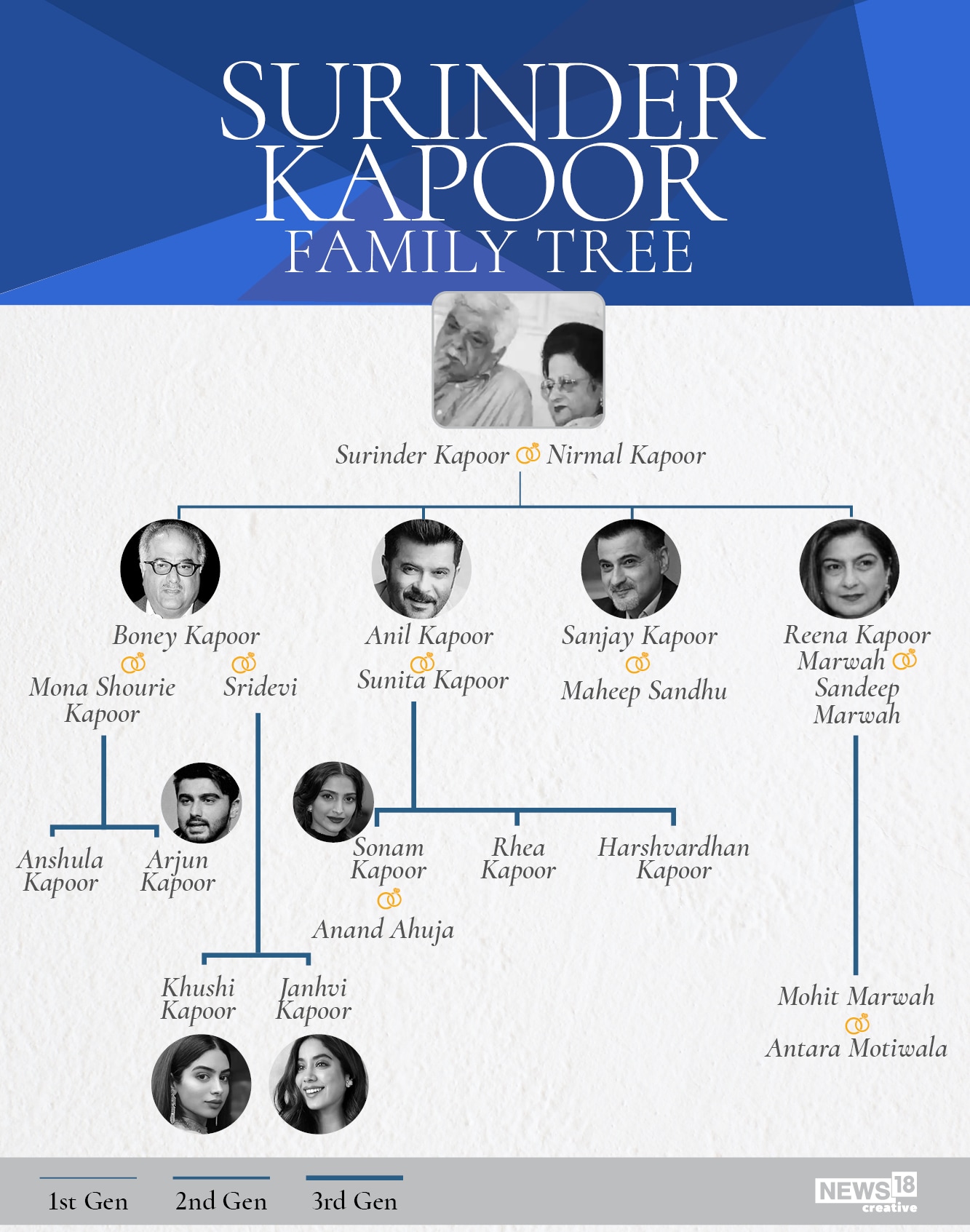
Anil Kapoor has two brothers who are established figures in Bollywood: his elder brother, Boney Kapoor, a leading film producer, and his younger brother, Sanjay Kapoor, an actor and producer. Together with their late father, film producer Surinder Kapoor, the brothers form the core of one of Hindi cinema’s most influential contemporary film dynasties.
While Anil Kapoor achieved global acclaim as a versatile leading actor, his brothers carved out distinct paths that shaped the landscape of Indian commercial cinema. Understanding the dynamic between Boney, Anil, and Sanjay offers a clear window into how family-run production houses, talent management, and cinematic collaboration operate within the Mumbai film industry.
The Kapoor Family Origins: Surinder Kapoor’s Lineage
To understand the professional trajectories of the Kapoor brothers, one must examine their roots in the film industry. Their father, Surinder Kapoor, was a respected film producer who moved to Mumbai (then Bombay) to work in Hindi cinema. Surinder Kapoor was a distant cousin of Prithviraj Kapoor—the patriarch of the iconic Raj Kapoor branch of the Kapoor family—which established a distant ancestral link between the two famous families, though both branches operated independently in Bollywood.
Surinder Kapoor began his career working closely with veteran actor Shammi Kapoor and producer Geeta Bali before transitioning into independent film production. He established the family banner, which would later evolve into various production companies run by his sons. Raised in Chembur, Mumbai, the three brothers—Boney (born Achal Kapoor), Anil, and Sanjay—grew up immersed in film sets, pre-production meetings, and the operational realities of filmmaking.
Rather than entering unrelated fields, all three brothers integrated into the entertainment ecosystem:
- Boney Kapoor focused on executive production, financing, and film scale.
- Anil Kapoor trained in acting, dance, and method performance to become a leading hero.
- Sanjay Kapoor pursued acting as a romantic lead in the mid-1990s before shifting into character roles and streaming media.
Their sister, Reena Kapoor, chose to remain away from the screen, though she married Sandeep Marwah, the founder of Asian Academy of Film & Television (AAFT) and Marwah Studios, keeping the broader family deeply tied to media education and production.
Boney Kapoor: The Visionary Producer of the Trio
Born Achal Kapoor on November 11, 1955, Boney Kapoor is the eldest of the three brothers. From an early age, Boney demonstrated an affinity for the business behind the camera, learning line production and finance under his father's tutelage. Over four decades, Boney became one of Bollywood's most ambitious film producers, known for mounting grand, large-budget commercial spectacles.
- Surinder Kapoor (Father)
- Boney Kapoor (Film Producer)
- Anil Kapoor (Actor)
- Sanjay Kapoor (Actor & Producer)
Key Milestones in Boney Kapoor's Career
Boney Kapoor launched his independent producing career in the late 1970s and early 1980s. He scored a major critical and commercial success with Hum Paanch (1980), an ensemble drama featuring Mithun Chakraborty, Sanjeev Kumar, and Shabana Azmi. The film served as a launching pad for his reputation as a producer capable of managing large, complex star casts.
In 1987, Boney produced the sci-fi superhero classic Mr. India, directed by Shekhar Kapur and starring Anil Kapoor alongside Sridevi. The film achieved massive success, setting new standards for visual effects, narrative pacing, and iconic villains (such as Amrish Puri’s Mogambo) in Indian cinema. Mr. India solidified Boney's reputation for high-risk, high-reward filmmaking.
Throughout the 1990s and 2000s, Boney produced several blockbuster titles, including:
- Roop Ki Rani Choron Ka Raja (1993): At the time of its release, it was one of the most expensive Indian films ever made. Although it struggled at the box office, it demonstrated Boney’s commitment to visual grandeur.
- Judaai (1997): A major commercial hit starring Anil Kapoor, Sridevi, and Urmila Matondkar.
- No Entry (2005): A multi-starrer comedy featuring Anil Kapoor, Salman Khan, and Fardeen Khan that became the highest-grossing Bollywood film of 2005.
- Wanted (2009): Directed by Prabhu Deva and starring Salman Khan, this action thriller is widely credited with reviving Salman Khan's box-office dominance in the modern era.
In recent years, Boney expanded his portfolio into South Indian cinema, producing major Tamil-language hits such as Nerkonda Paarvai (2019), Valimai (2022), and Thunivu (2023) starring Ajith Kumar, alongside high-profile Hindi biographical dramas such as Maidaan (2024).
Personal Life and Legacy
Boney Kapoor was first married to Mona Shourie Kapoor, with whom he had two children: actor Arjun Kapoor and tech/lifestyle entrepreneur Anshula Kapoor. Following their separation, Boney married legendary actress Sridevi in 1996. Together, they had two daughters: actress Janhvi Kapoor and actress Khushi Kapoor.
Sanjay Kapoor: Leading Man, Character Actor, and Producer
The youngest of the three brothers, Sanjay Kapoor, was born on October 17, 1965. Following in the performing footsteps of Anil, Sanjay sought a career in front of the camera, embarking on an acting journey that has spanned lead romantic roles, intense villainous characters, and streaming series.
Early Debut and Lead Roles (1990s)
Sanjay Kapoor made his formal Bollywood acting debut in the romantic drama Prem (1995), produced by his brother Boney Kapoor opposite Tabu. Though Prem experienced production delays, Sanjay gained immediate commercial success with his second release in the same year, Raja (1995), opposite Madhuri Dixit. Raja became a major box-office hit, establishing Sanjay as a recognizable romantic lead in the mid-1990s.
He followed this success with films like Sirf Tum (1999), a romantic drama featuring Priya Gill and Sushmita Sen that performed strongly at the box office and produced enduring popular songs. Throughout the late 1990s and early 2000s, Sanjay appeared in a variety of action and romantic projects, such as Auzaar (1997), Mohabbat (1997), and Koyelaanchal (2014).
Transition to Supporting Roles, Production, and OTT Platforms
As mainstream Bollywood evolved, Sanjay Kapoor adapted his career path. Rather than remaining restricted to conventional lead roles, he transitioned into character-driven parts, television projects, and production.
- Film Production: Sanjay launched his production banner, Sanjay Kapoor Entertainment, producing films like the action-thriller Tevar (2015), starring his nephew Arjun Kapoor and Sonakshi Sinha.
- Supporting and Antagonistic Roles: He delivered critically praised performances in films like Luck By Chance (2009), directed by Zoya Akhtar, and Mission Mangal (2019).
- Streaming Revival: Sanjay experienced a significant career resurgence via India's expanding OTT (over-the-top) streaming landscape. His performance in the anthology Lust Stories (2018), directed by Dibakar Banerjee, earned strong reviews. He followed this with prominent roles in streaming series such as The Fame Game (2022), opposite Madhuri Dixit, The Gone Game (2020–2022), and feature projects like Bloody Daddy (2023).
Sanjay Kapoor is married to Maheep Kapoor, an jewelry designer and television personality who starred in the unscripted reality series Fabulous Lives of Bollywood Wives. They have two children: Shanaya Kapoor, who launched her acting career in the 2020s, and Jahaan Kapoor.
Professional Collaborations: Movies Involving the Kapoor Brothers
One of the defining features of the Surinder Kapoor family is their frequent professional collaboration. Rather than working entirely in isolation, Boney, Anil, and Sanjay have frequently joined forces across production, acting, and co-starring roles.
Anil Kapoor and Boney Kapoor Collaborations
The producer-actor relationship between Boney and Anil resulted in some of the most lucrative commercial projects of the 1980s, 1990s, and 2000s. Boney’s scale as a producer complemented Anil’s intensity as a performer.
- Mr. India (1987): Boney produced while Anil starred as Arun Verma, a street violinist who gains an invisibility device to fight corruption.
- Roop Ki Rani Choron Ka Raja (1993): Co-starring Sridevi and Anil Kapoor, produced by Boney.
- Loafer (1996): An action comedy starring Anil Kapoor, produced by Boney.
- Judaai (1997): Boney produced this domestic drama featuring Anil opposite Sridevi and Urmila Matondkar.
- Pukar (2000): Produced by Boney, this action drama earned Anil Kapoor the National Film Award for Best Actor for his role as Major Jaidev Rajvansh.
- No Entry (2005): A hit comedy where Boney's production banner managed an ensemble cast led by Anil Kapoor and Salman Khan.
Anil Kapoor and Sanjay Kapoor Collaborations
While Anil and Boney worked continuously as actor and producer, Anil and Sanjay appeared on screen together less frequently to establish Sanjay’s independent identity as an actor. However, key projects feature both brothers:
- Mubarakan (2017): Directed by Anees Bazmee, this comedy film brought Anil Kapoor and Sanjay Kapoor together on screen, playing brothers/uncles in a multi-generational romantic mix-up alongside their nephew Arjun Kapoor.
- AK vs AK (2020): A meta-cinematic thriller starring Anil Kapoor and director Anurag Kashyap, featuring cameo appearances by Sanjay Kapoor and Sonam Kapoor as fictionalized versions of themselves.
The Next Generation: How the Brothers Expanded the Dynasty
The creative footprint of Boney, Anil, and Sanjay Kapoor extends into the next generation of actors, directors, and stylists. The cousins form one of the largest active networks of film talent in modern Bollywood.
Children of Boney Kapoor
- Arjun Kapoor: Made his acting debut in Ishaqzaade (2012) and established himself as a lead actor in commercial dramas (2 States, Gunday, Singham Again).
- Janhvi Kapoor: Debuted in Dhadak (2018) and earned acclaim for performance-driven roles in Gunjan Saxena: The Kargil Girl, Mili, and Ujhaaj / Devara.
- Khushi Kapoor: Entered the industry with the ensemble film The Archies (2023).
Children of Anil Kapoor
- Sonam Kapoor Ahuja: A National Film Award-winning actress known for films like Neerja, Raanjhanaa, and Khoobsurat, as well as her global profile in fashion.
- Rhea Kapoor: A film producer (Aisha, Veere Di Wedding, Crew) and celebrity fashion stylist.
- Harsh Varrdhan Kapoor: An actor and producer known for experimental, auteur-led projects such as Mirzya, Bhavesh Joshi Superhero, and Thar.
Children of Sanjay Kapoor
- Shanaya Kapoor: Made her formal industry entrance through brand endorsements, assistant direction work (Gunjan Saxena), and acting projects.
Comparative Overview of the Kapoor Brothers
To easily compare the profiles, primary industry roles, and notable works of the three brothers, the table below provides a detailed breakdown:
| Detail | Boney Kapoor | Anil Kapoor | Sanjay Kapoor |
|---|---|---|---|
| Position in Family | Eldest Brother | Middle Brother | Youngest Brother |
| Primary Industry Role | Film Producer | Actor / Executive Producer | Actor / Film Producer |
| Career Debut Year | 1980 (Hum Paanch) | 1979 (Hamare Tumhare) | 1995 (Prem) |
| Key Directing / Producing Collaborators | Shekhar Kapur, Anees Bazmee, Prabhu Deva | Subhash Ghai, Vidhu Vinod Chopra, Anees Bazmee | Dibakar Banerjee, Zoya Akhtar, Vikramaditya Motwane |
| Notable Feature Projects | Mr. India, Judaai, No Entry, Wanted, Maidaan | Tezaab, Mr. India, Nayaka, Slumdog Millionaire, Animal | Raja, Sirf Tum, Lust Stories, The Fame Game, Bloody Daddy |
| Primary Production Banners | BSK Network, Bayview Projects | Anil Kapoor Film & Communication Network | Sanjay Kapoor Entertainment |
| Notable Family Collaborations | Produced major films starring Anil and Arjun | Co-starred with Sanjay in Mubarakan; produced by Boney | Co-starred with Anil in Mubarakan; produced by Boney in Prem |
Technical and Business Impact of the Kapoor Brothers on Bollywood
Beyond individual filmography entries, the trio transformed several business and operational procedures within Hindi film production between 1980 and 2026:
1. Large-Scale Independent Financing
During the 1980s and 1990s, Indian cinema relied heavily on fragmented, regional distribution pre-sales. Boney Kapoor pioneered mounting films at international scales, shooting extensively in global locations (such as foreign schedules for Roop Ki Rani Choron Ka Raja) and investing in complex post-production pipelines before studio corporate financing became standard practice in India.
2. Transition from Traditional Heroic Roles to Character Realism
Anil Kapoor broke the convention of the traditional, invincible hero by accepting flawed, emotionally complex characters in movies like Eeshwar, Parinda, and Virasat. This allowed his younger brother, Sanjay, and later their children, to pursue non-traditional roles in indie films and streaming television without being locked exclusively into traditional romantic stereotyping.
3. Early Adoption of Streaming Platforms
While many legacy film stars hesitated to transition to subscription video-on-demand (SVOD) platforms, both Sanjay Kapoor and Anil Kapoor embraced OTT platforms early. Sanjay's roles in Lust Stories and The Fame Game demonstrated how veteran Bollywood actors could reinvent their public image through serialized digital dramas.
Key Takeaways for Bollywood Cinema Enthusiasts
When researching Anil Kapoor’s family background, it is essential to distinguish between the Surinder Kapoor branch (Boney, Anil, Sanjay) and the Raj Kapoor branch (Prithviraj, Raj, Rishi, Ranbir, Kareena).
- Anil Kapoor’s brothers are Boney Kapoor and Sanjay Kapoor.
- Boney Kapoor operates primarily behind the camera as a major film producer across Hindi, Tamil, and Telugu cinema.
- Sanjay Kapoor acts across films and streaming series while selectively producing feature films.
- The brothers maintain active professional networks, frequently combining their production banners and talent pool to support new directors, technical crews, and the next generation of Kapoor family actors.
Frequently Asked Questions
Is Boney Kapoor older or younger than Anil Kapoor?
Boney Kapoor is older than Anil Kapoor. Boney was born in November 1955, making him the eldest brother. Anil Kapoor was born in December 1956, and Sanjay Kapoor is the youngest of the three, born in October 1965.
Are Anil Kapoor’s brothers related to Ranbir Kapoor?
Yes, but remotely. Anil, Boney, and Sanjay Kapoor’s father, Surinder Kapoor, was a distant cousin of Prithviraj Kapoor (who was Ranbir Kapoor’s great-grandfather). While both families share ancestral ties originating from Peshawar, they operated as separate family units and independent professional banners within Bollywood.
Which movies feature both Anil Kapoor and Sanjay Kapoor together?
Anil Kapoor and Sanjay Kapoor featured together in the comedy film Mubarakan (2017), directed by Anees Bazmee, where they shared screen space alongside their nephew Arjun Kapoor. They also appeared as fictionalized versions of themselves in the meta-thriller AK vs AK (2020) on Netflix.
What was the name of Anil Kapoor’s father, and was he in the film industry?
Anil Kapoor's father was Surinder Kapoor. He was a well-known Hindi film producer who established the family's entry into Bollywood, producing classic films such as Pukar (1983), Sunayana (1979), and Hum Paanch (1980).
What production company does Boney Kapoor run?
Boney Kapoor has produced films under multiple family and corporate banners over his career, including Surinder Kapoor Productions, BSK Network & Entertainment, and more recently, Bayview Projects, which manages his Hindi and South Indian film ventures.
Did Sanjay Kapoor produce any Bollywood movies?
Yes, Sanjay Kapoor launched his own production banner, Sanjay Kapoor Entertainment. His notable production credits include the 2015 action-thriller film Tevar, starring Arjun Kapoor and Sonakshi Sinha.
Summary & Next Steps
If you are researching Bollywood film history or tracking family lineages in Indian cinema, understanding the distinction between Boney, Anil, and Sanjay Kapoor offers clear insight into how film production banners evolve over generations. To explore their work further, consider viewing their milestone collaborations—such as Mr. India (1987), Judaai (1997), and Mubarakan (2017)—to see how the brothers' producer-actor dynamics have operated across different eras of commercial cinema.