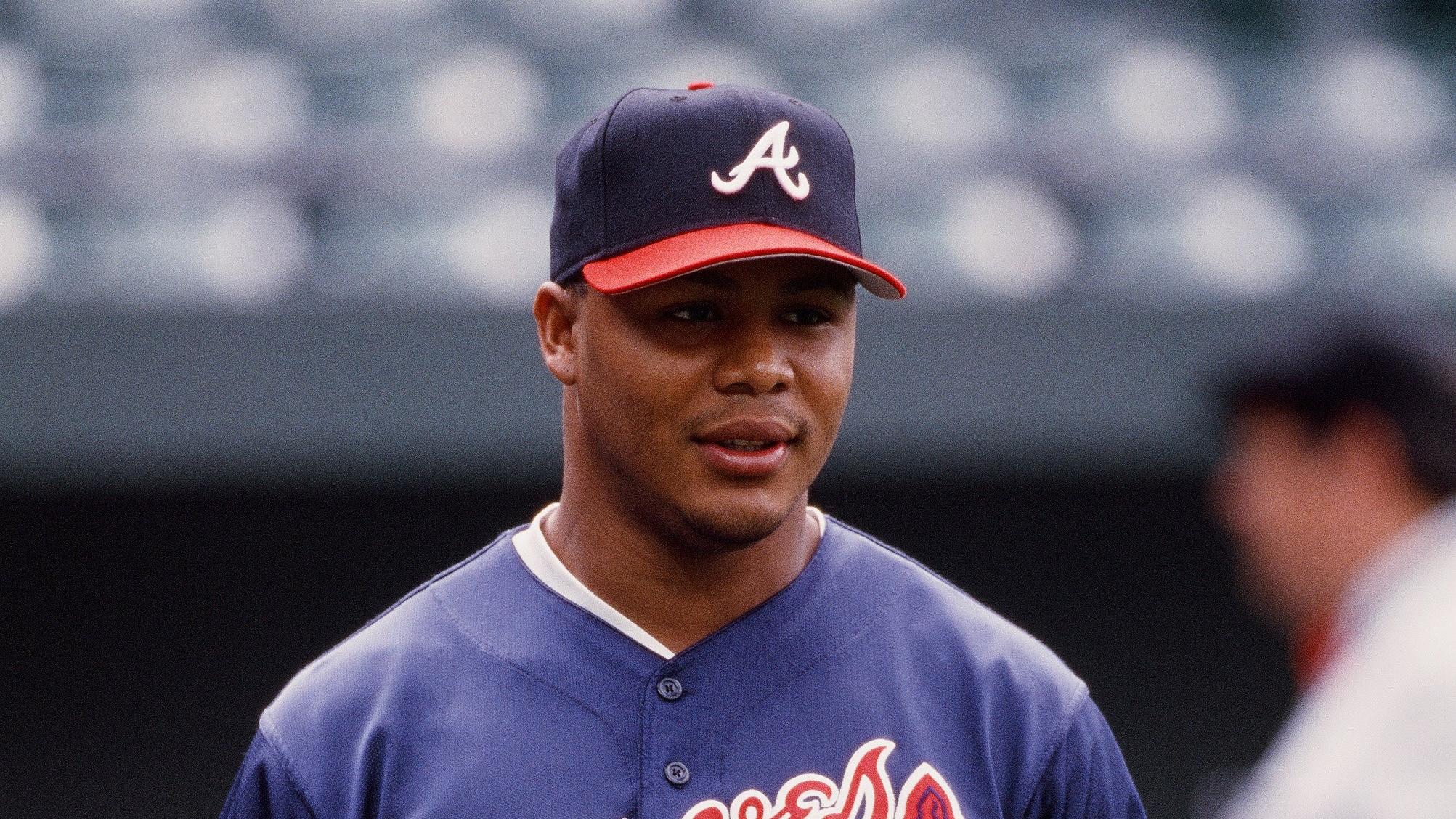
Over a 17-season Major League Baseball career primarily spent with the Atlanta Braves, Andruw Jones compiled 1,933 hits, 434 home runs, 1,289 RBIs, and a 62.7 Baseball-Reference Wins Above Replacement (bWAR). Famous for elite defense, Jones earned 10 consecutive Rawlings Gold Glove Awards (1998–2007) and posted a career .254/.337/.486 slash line.
Career Overview & Major League Footprint
Andruw Rudolf Jones emerged from Curaçao as one of the most complete outfield prospects in modern baseball history. Signing with the Atlanta Braves as an amateur free agent in 1993, he quickly climbed through the farm system due to a rare combination of explosive bat speed, base-running instinct, and defensive coverage. His major league debut in August 1996 set off a career defined by premier power hitting in the middle of the order and elite play in center field.
- 1996 Debut & WS History
- 1998–2007: 10 Gold Gloves
- 2005 Peak: 51 HR / 128 RBI
- 2008–2012: Late Career & Transition
Debut and Early Years with the Atlanta Braves (1996–1999)
Jones debuted for the Braves on August 15, 1996, at 19 years old. He captured national attention during the 1996 World Series against the New York Yankees by hitting home runs in his first two Series at-bats in Game 1. At 19 years, 180 days old, he became the youngest player to homer in a World Series, surpassing Mickey Mantle’s long-standing record.
By 1997, Jones established himself as Atlanta’s primary right fielder before transitioning permanently to center field in 1998. During this initial stretch, his athletic range allowed the Braves pitching staff—featuring Hall of Famers Greg Maddux, Tom Glavine, and John Smoltz—to pitch aggressively to the outfield, knowing deep fly balls were regularly caught. In 1998, Jones won the first of his 10 consecutive Gold Glove Awards while hitting 31 home runs, signaling his arrival as an elite two-way center fielder.
Peak Prime Years and Offensive Dominance (2000–2006)
Between 2000 and 2006, Jones ranked among the premier power hitters in the National League while anchoring the division-dominating Braves. During this seven-season stretch, he averaged 35 home runs and 104 RBIs per year while missing few games due to injury.
His peak offensive achievement occurred during the 2005 season. Jones led the Major Leagues with 51 home runs and drove in a league-leading 128 runs, earning a Silver Slugger Award and finishing second to Albert Pujols in National League Most Valuable Player voting. His 51 homers established an Atlanta Braves single-season record (later surpassed by Matt Olson in 2023). Jones matched his heavy home run production with consistent elite defense, winning Gold Gloves every year during his prime.
Late-Career Progression and Final MLB Stints (2007–2012)
Following the 2007 season—his final year in Atlanta—Jones signed a free-agent contract with the Los Angeles Dodgers for the 2008 season. His transition out of Atlanta was marked by steep declines in batting average and plate discipline, partly caused by knee injuries and weight fluctuations that reduced his physical mobility.
After a single season in Los Angeles, Jones adopted a bench and platoon role, making stops with the Texas Rangers (2009), Chicago White Sox (2010), and New York Yankees (2011–2012). Despite a lower overall batting average, he remained a useful reserve against left-handed pitching, adding 54 home runs during his final four MLB seasons. Jones spent his final two professional seasons (2013–2014) playing for the Tohoku Rakuten Golden Eagles in Japan's Nippon Professional Baseball (NPB), leading the club to a Japan Series championship in 2013.
Detailed Career Statistics Table
The table below outlines Andruw Jones’s traditional and sabermetric performance across his 17 Major League Baseball seasons.
| Season | Team | Games | AB | Hits | HR | RBI | BA | OBP | SLG | OPS | bWAR |
|---|---|---|---|---|---|---|---|---|---|---|---|
| 1996 | ATL | 31 | 106 | 23 | 5 | 13 | .217 | .265 | .443 | .708 | 0.5 |
| 1997 | ATL | 153 | 399 | 92 | 18 | 70 | .231 | .329 | .416 | .745 | 3.2 |
| 1998 | ATL | 159 | 582 | 158 | 31 | 90 | .271 | .321 | .515 | .837 | 7.4 |
| 1999 | ATL | 162 | 592 | 163 | 26 | 84 | .275 | .365 | .483 | .848 | 7.1 |
| 2000 | ATL | 161 | 656 | 199 | 36 | 104 | .303 | .366 | .541 | .907 | 8.2 |
| 2001 | ATL | 161 | 625 | 157 | 34 | 104 | .251 | .312 | .461 | .773 | 4.9 |
| 2002 | ATL | 158 | 560 | 148 | 35 | 94 | .264 | .366 | .513 | .879 | 6.7 |
| 2003 | ATL | 156 | 595 | 165 | 36 | 116 | .277 | .347 | .513 | .860 | 5.3 |
| 2004 | ATL | 154 | 570 | 149 | 29 | 91 | .261 | .341 | .488 | .829 | 4.7 |
| 2005 | ATL | 160 | 584 | 154 | 51 | 128 | .263 | .347 | .575 | .922 | 6.7 |
| 2006 | ATL | 156 | 565 | 148 | 41 | 129 | .262 | .363 | .531 | .894 | 5.6 |
| 2007 | ATL | 154 | 572 | 127 | 26 | 94 | .222 | .311 | .413 | .724 | 3.0 |
| 2008 | LAD | 75 | 209 | 33 | 3 | 14 | .158 | .256 | .249 | .505 | -1.6 |
| 2009 | TEX | 82 | 281 | 60 | 17 | 43 | .214 | .323 | .459 | .782 | 1.3 |
| 2010 | CHW | 107 | 278 | 64 | 19 | 48 | .230 | .341 | .486 | .827 | 1.8 |
| 2011 | NYY | 77 | 190 | 47 | 13 | 33 | .247 | .356 | .495 | .851 | 1.2 |
| 2012 | NYY | 94 | 233 | 46 | 14 | 34 | .197 | .294 | .408 | .701 | -0.8 |
| Total | -- | 2,196 | 7,599 | 1,933 | 434 | 1,289 | .254 | .337 | .486 | .823 | 62.7 |
Offensive Profile and Power Breakdown
Andruw Jones combined game-changing pull power with disciplined walk rates, serving as an middle-of-the-order threat for over a decade. While his career batting average of .254 reflects late-career drops, his run-creation metrics demonstrate significant offensive impact during his prime.
Offensive Evolution:
- 1998–2000: Speed & Line Drives
- High AVG (.271–.303)
- 20+ Stolen Bases
- 2001–2006: Pure Flyball Power
- Peak Power: 51 HR (2005)
- ISO over .250
- 2007–2012: Three-Outcome Role
- Low AVG, High BB Rate
- Platoon Power vs LHP
The 2005 MVP Runner-Up Campaign
Jones's 2005 season remains one of the finest power-hitting displays in Atlanta franchise history. He became only the 12th player in NL history to reach the 50-home-run landmark in a single season.
- Home Runs: 51 (NL Leader)
- Runs Batted In: 128 (NL Leader)
- Slugging Percentage: .575
- On-Base Plus Slugging (OPS): .922
- Total Bases: 336
- ISO (Isolated Power): .312
Jones's ability to drive the ball pulled to left field was crucial during 2005, as he hit 32 of his 51 home runs at Turner Field. His run production drove the Braves to their 14th consecutive division title, resulting in Jones winning the NL Hank Aaron Award alongside his Silver Slugger.
Plate Discipline, Strikeouts, and Slugging Patterns
Jones featured an offensive approach aligned with modern power analytics: high fly-ball rates, strong walk percentages, and higher strikeout totals.
- Walks (BB): 991 career walks (11.2% career walk rate).
- Strikeouts (SO): 1,748 career strikeouts (19.8% career strikeout rate).
- Isolated Power (ISO): .231 career ISO, illustrating high-level extra-base hit power.
- Home Run to Fly Ball Ratio (HR/FB): Consistently ranged between 15% and 21% during his Atlanta tenure.
Because Jones focused on hitting fly balls to generate power, his Batting Average on Balls in Play (BABIP) sat at .263 for his career. This fly-ball tendency produced lower seasonal batting averages, but maintained high slugging metrics (.486 career SLG) and strong walk counts that kept his On-Base Percentage (.337) comfortably above his raw batting average.
Elite Defensive Metrics: Center Field Excellence
While Jones generated 434 career home runs, his defensive ability set him apart from nearly all center fielders in baseball history. Modern sabermetric metrics consider Jones one of the finest defensive outfielders ever to play the game.
Outfield Defensive bWAR Leaders (All-Time)
| Player | Defensive bWAR |
|---|---|
| 1. Brooks Robinson* | 39.1 (3B - Baseline Comparison) |
| 2. Ozzie Smith* | 44.2 (SS - Baseline Comparison) |
| 1. Andruw Jones | 24.4 (Outfield Record) |
| 2. Roberto Clemente* | 18.1 |
| 3. Willie Mays* | 18.1 |
| 4. Jesse Barfield | 16.2 |
*Indicates Hall of Fame Member
The 10 Consecutive Gold Glove Streak
From 1998 through 2007, Jones won 10 consecutive Rawlings Gold Glove Awards in center field. He is one of only three outfielders in Major League history to earn 10 or more consecutive Gold Gloves, joining Willie Mays and Roberto Clemente (who each won 12).
Jones was known for positioning himself exceptionally shallow in center field. His elite top-end speed, rapid acceleration, and precise route efficiency allowed him to catch shallow line drives that normally dropped for base hits, while still retaining the range to turn around and track down deep fly balls hit over his head.
Defensive WAR (dWAR) and Advanced Range Metrics
According to Baseball-Reference, Jones accumulated 24.4 Defensive Wins Above Replacement (dWAR) during his career. This figure ranks 1st all-time among MLB outfielders and 22nd overall across all defensive positions in baseball history.
Defensive Profile Key Indicators:
- Career dWAR: 24.4 (1st All-Time Outfielders)
- Total Zone Runs (Rtz): +159 in Center Field
- Peak Defensive Season: 1999 (3.9 dWAR / +36 Defensive Runs Above Average)
- Career Outfield Assists: 123
Sabermetric analysis through Total Zone Runs ($R_{tz}$) estimates that Jones saved +159 runs above an average center fielder between 1996 and 2007. In 1999 alone, his defensive play accounted for 3.9 dWAR, one of the single highest single-season defensive values recorded by an outfielder in MLB history.
Sabermetric Evaluation & Hall of Fame Case
Jones’s candidacy for the National Baseball Hall of Fame relies on his total WAR, peak dominance, and historic status as an all-time elite defender.
Total WAR vs. Hall of Fame Center Field Standards (JAWS Analysis)
Developed by Jay Jaffe, the JAWS (Jaffe WAR Score System) metric evaluates a player’s Hall of Fame worthiness by averaging their total career WAR with their 7-year peak WAR (WAR7).
| Metric | Andruw Jones | Average Hall of Fame Center Fielder | Position Rank |
|---|---|---|---|
| Career bWAR | 62.7 | 71.6 | 11th |
| 7-Year Peak WAR (WAR7) | 46.4 | 44.7 | 11th |
| JAWS Score | 54.6 | 58.1 | 11th |
| Gold Gloves | 10 | 4.8 | T-2nd (Outfield) |
| Career Home Runs | 434 | 273 | 4th (CF) |
Jones’s 7-year peak WAR of 46.4 sits above the average Hall of Fame center fielder standard (44.7). His 62.7 career bWAR ranks higher than several enshrined center fielders, including Andre Dawson (64.8), Richie Ashburn (64.3), Duke Snider (65.9), Kirby Puckett (51.2), and Jim Wynn (55.7).
Critics of his Hall of Fame case point to his lower career batting average (.254) and his early physical decline after age 30. Supporters counter that his defensive value, combined with 434 home runs, makes him a uniquely qualified candidate.
Postseason Production and Big-Stage Performances
Jones was a key component of 10 consecutive Braves postseason teams from 1996 through 2005. Over 76 playoff games, he produced solid count statistics:
- Games Played: 76
- Plate Appearances: 309
- Home Runs: 10
- RBIs: 34
- Runs Scored: 35
- Walks: 33
His postseason highlights include hitting .400 (6-for-15) with two home runs during the 1996 World Series at age 19, along with a strong 2003 NLDS performance against the Chicago Cubs where he posted a 1.079 OPS with two home runs.
Frequently Asked Questions
How many home runs did Andruw Jones hit in his career?
Andruw Jones hit 434 home runs in his 17-year Major League Baseball career. His peak home run season came in 2005, when he led the Major Leagues with 51 home runs for the Atlanta Braves.
How many Gold Gloves did Andruw Jones win?
Andruw Jones won 10 Rawlings Gold Glove Awards. All 10 awards were won consecutively while playing center field for the Atlanta Braves from 1998 through 2007, placing him behind only Willie Mays and Roberto Clemente among outfielders.
What is Andruw Jones's career Wins Above Replacement (WAR)?
Andruw Jones accumulated 62.7 career bWAR (Baseball-Reference) and 67.0 fWAR (FanGraphs). His career included 24.4 Defensive WAR (dWAR), which ranks 1st all-time among outfielders in MLB history.
What teams did Andruw Jones play for during his career?
Jones played for five Major League franchises: the Atlanta Braves (1996–2007), Los Angeles Dodgers (2008), Texas Rangers (2009), Chicago White Sox (2010), and New York Yankees (2011–2012). He also played two seasons in Japan for the Tohoku Rakuten Golden Eagles (2013–2014).
How does Andruw Jones rank in all-time outfield defensive stats?
Jones holds the all-time MLB record for highest career dWAR among outfielders at 24.4. Additionally, advanced sabermetric metrics assign him +159 Total Zone Runs saved in center field during his 12 years in Atlanta.
Is Andruw Jones in the Atlanta Braves Hall of Fame?
Yes. Andruw Jones was inducted into the Atlanta Braves Hall of Fame in 2016. The Braves officially retired his jersey number 25 in September 2023 at Truist Park.
Historical Context and Statistical Legacy
When analyzing Andruw Jones’s career statistics, evaluate his resume by looking at his two distinct career phases:
- The Peak Phase (1996–2006): Focus on his 10-year prime where he averaged 5.7 bWAR per season, generated 363 home runs, and posted elite defensive metrics while winning 10 Gold Gloves.
- The Secondary/Late Phase (2007–2012): Account for how reduced mobility lowered his traditional statistics (batting average dropping to .254), while observing that his walk rates (11.2%) and isolated power (.231 ISO) remained productive in platoon roles.
To contextualize his overall value, evaluate Jones through modern sabermetric frameworks like JAWS and dWAR rather than relying solely on career hit counts or overall batting average. His combination of 400+ home runs and defensive metrics makes his career numbers a standard for measuring elite center field performance in modern baseball history.