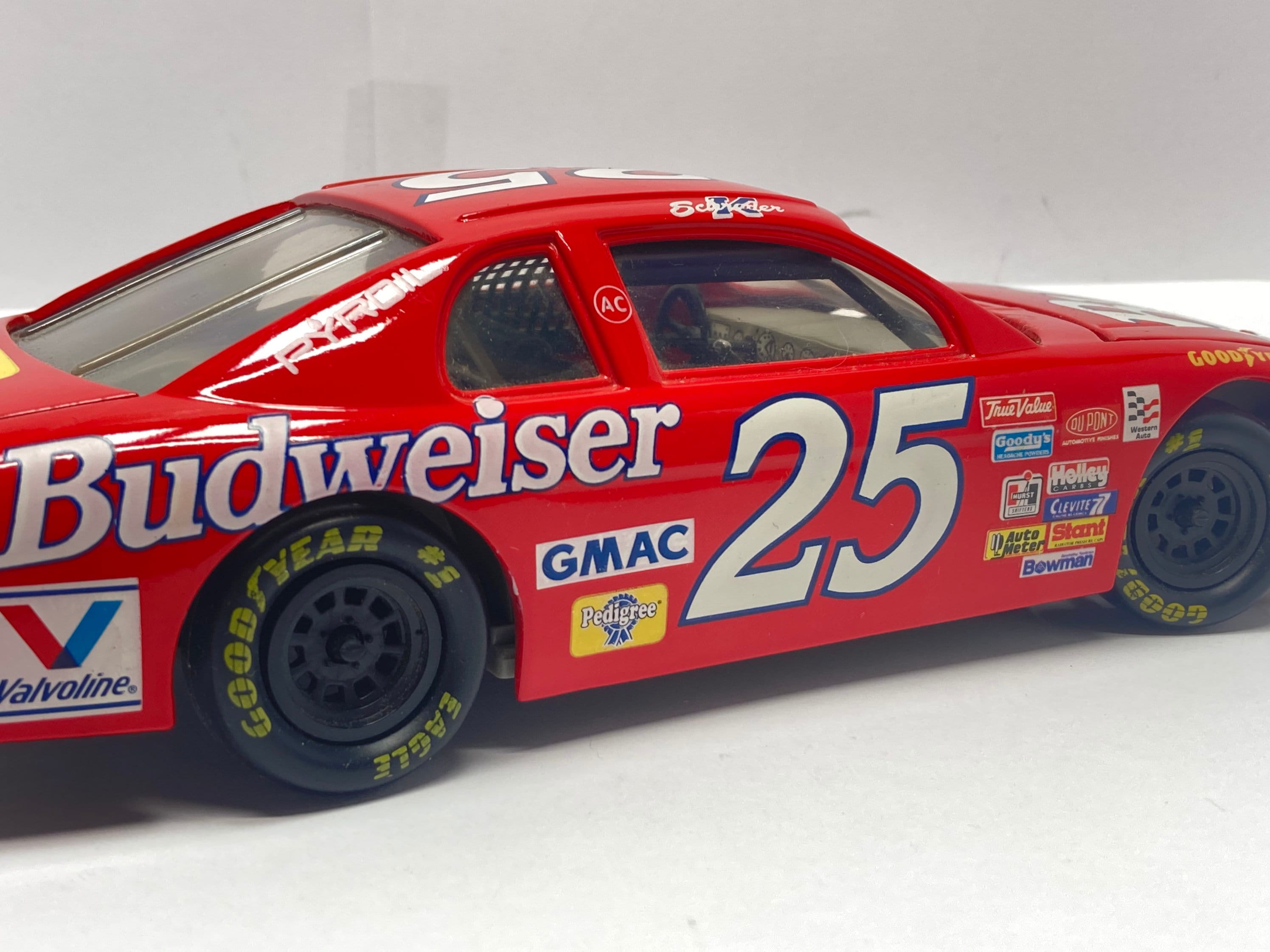
In 1991, Ken Schrader produced one of the most statistically impressive seasons of his NASCAR Winston Cup career, driving the No. 25 Kodiak Chevrolet Lumina for Hendrick Motorsports. Schrader secured two major victories at Talladega and Charlotte, captured the pole for the Daytona 500, and finished 9th in the final points standings with 10 Top-5 and 18 Top-10 finishes.
The Foundation of the 1991 Campaign
Entering the 1991 season, Ken Schrader was firmly established as a cornerstone of Rick Hendrick’s growing racing empire. This was Schrader's fourth season behind the wheel of the No. 25 car, a partnership that had already yielded wins and high points finishes. By 1991, the chemistry between Schrader, crew chief Ken Howes, and the Hendrick engine shop had reached a zenith. The team was operating with a high level of confidence, supported by the iconic green-and-white Kodiak sponsorship that became synonymous with Schrader’s persona.
The 1991 season was a transitional period for NASCAR. The sport was experiencing a massive surge in mainstream popularity, and the technical battle between manufacturers was intensifying. Hendrick Motorsports was at the forefront of this, utilizing the Chevrolet Lumina—a car that had replaced the Monte Carlo and was proving to be a versatile platform on both superspeedways and short tracks. For Schrader, the 1991 season was about more than just maintaining status; it was a year where he proved he could compete for wins against the likes of Dale Earnhardt, Ricky Rudd, and Davey Allison on any given Sunday.
Speed at Daytona: Setting the Tone
The 1991 season began with a statement of raw speed. During Speedweeks at Daytona International Raceway, Schrader clocked a qualifying lap that earned him the pole position for the Daytona 500. This was a significant achievement, as the Daytona 500 pole is one of the most prestigious honors in qualifying, showcasing the aerodynamic efficiency and horsepower of the Hendrick-built Lumina.
While Schrader led early portions of the "Great American Race," the 500 proved to be a challenging event for the No. 25 team in terms of race-day handling. Despite the blistering qualifying speed, Schrader finished 13th. However, the performance served notice to the garage: the No. 25 team had the speed to lead the field. This early-season momentum provided a cushion of confidence as the circuit moved to the smaller tracks and intermediate ovals where Schrader's dirt-track background often gave him an edge in car control.
The Historic Month of May
If one period defined Ken Schrader's 1991 season, it was the month of May. It is rare for a driver to capture two of the sport's "Crown Jewel" style events in such a short span, but Schrader accomplished exactly that by winning at Talladega Superspeedway and Charlotte Motor Speedway.
Victory at Talladega: The Winston 500
On May 6, 1991, at the Winston 500, Schrader demonstrated his prowess in restrictor-plate racing. Talladega is known for "The Big One," and the 1991 edition was no different, featuring high-speed drafting and intense pack racing. Schrader stayed near the front for most of the afternoon, navigating the turbulent air and avoiding the mid-race incidents that claimed several top contenders.
In the closing laps, Schrader found himself in a strategic battle with Dale Earnhardt and Darrell Waltrip. Using the draft to his advantage, Schrader took the lead late and held off a charging field to take the checkered flag. It was a victory of both horsepower and patience. This win was particularly special because it silenced critics who suggested Schrader was merely a "consistency" driver; it proved he could win the high-stakes, high-speed chess matches of the superspeedways.
Victory at Charlotte: The Coca-Cola 600
Less than three weeks after his Talladega triumph, Schrader entered the longest race on the NASCAR calendar: the Coca-Cola 600 at Charlotte Motor Speedway. The 600 is a grueling test of man and machine, starting in the heat of the afternoon and ending under the lights.
Schrader was dominant, leading 47 laps and maintaining a pace that few could match as the track temperature dropped. The No. 25 Kodiak Chevrolet was perfectly dialed in, allowing Schrader to move through the various lanes of the Charlotte asphalt. By the time the race reached its final 50 laps, Schrader had established himself as the man to beat. He crossed the finish line to secure his second win of the month, marking the first—and only—time in his Cup career that he would win multiple points-paying races in a single season.
Technical Analysis of the No. 25 Chevrolet Lumina
The success of 1991 can be largely attributed to the refinement of the Chevrolet Lumina. Introduced to the Cup Series in 1989, the Lumina was Chevrolet's answer to the Ford Thunderbird's aerodynamic advantages. By 1991, Hendrick Motorsports had mastered the Lumina’s body lines, particularly in the "nose" and "greenhouse" areas, which were critical for both downforce and drag reduction.
Under the hood, the Hendrick engine program was producing some of the most reliable small-block V8s in the sport. Schrader’s ability to run 600 miles at Charlotte without mechanical fatigue spoke volumes about the durability of the equipment. Furthermore, the 1991 season saw advancements in radial tire technology. Goodyear had fully transitioned the series to radials, and Schrader’s smooth driving style was well-suited to the way these tires communicated grip to the driver.
Statistical Breakdown: A Career-Best Year
While Schrader finished higher in the points standings in 1989 (5th), many historians and fans consider 1991 his "peak" year due to the quality of his performances and the caliber of the races he won. The 1991 season saw him compete against one of the most talented fields in NASCAR history, including prime Dale Earnhardt, a surging Ernie Irvan, and an incredibly consistent Ricky Rudd.
1991 Ken Schrader Season Statistics
| Metric | Value | Context |
|---|---|---|
| Wins | 2 | Talladega (May), Charlotte (May) |
| Poles | 1 | Daytona 500 |
| Top 5 Finishes | 10 | Including 2nd at Pocono and 3rd at Michigan |
| Top 10 Finishes | 18 | Achieved in 29 total starts |
| Points Standing | 9th | 3,484 total points |
| Laps Led | 338 | Significant presence in the lead pack |
| DNFs (Did Not Finish) | 4 | Primarily due to engine or crash damage |
| Average Start | 12.0 | Consistent qualifying performance |
| Average Finish | 12.8 | One of the best averages in the field |
The consistency shown in the "Top 10 Finishes" column is particularly noteworthy. In a 29-race schedule, finishing in the top ten 18 times means Schrader was a threat in 62% of the races he entered. This level of reliability was the hallmark of the No. 25 team throughout the early 90s.
The Competitive Landscape of 1991
To understand the magnitude of Schrader's 1991 season, one must look at his competition. Dale Earnhardt won his fifth championship that year, driving the No. 3 Goodwrench Chevrolet. Schrader's own teammate at Hendrick Motorsports, Ricky Rudd, finished second in the standings.
The fact that Hendrick Motorsports had two cars (the No. 5 and the No. 25) finishing in the top 10 of the standings signaled the beginning of the "multi-car team" dominance that would define the next three decades of the sport. Schrader’s role was vital; he provided a baseline of speed and data that helped the entire organization improve. While Rudd was often the "finesse" driver, Schrader was the "charger," often willing to take the car to the absolute limit of its mechanical grip.
Challenges and Second-Half Performance
Despite the highs of May, the second half of the 1991 season presented challenges. The team suffered four DNFs, which ultimately prevented Schrader from finishing higher than 9th in the points. Mechanical failures at Dover and Bristol proved costly in the championship hunt.
However, Schrader remained a fixture in the top five during the summer months. Notable performances included a runner-up finish at the Champion Spark Plug 400 at Michigan and a strong 3rd place at the Miller Genuine Draft 400 at Pocono. These races showed that even when the team wasn't winning, they were consistently the "best of the rest" behind the dominant Earnhardt and Rudd cars.
Legacy of the 1991 Season
As we look back from 2026, the 1991 season remains the definitive "Schrader Year." It was the season that validated his move to Hendrick Motorsports and cemented his status as an elite driver capable of winning the sport's biggest prizes. For fans of the era, the No. 25 Kodiak Chevrolet remains one of the most iconic diecast and memorabilia subjects, largely due to the success achieved during this specific 29-race stretch.
Schrader would go on to have a very long career, eventually becoming one of the most respected "elder statesmen" of the garage, known for his willingness to race anything, anywhere, at any time. But in terms of NASCAR Cup Series dominance, 1991 was the year where everything clicked—the speed, the strategy, and the results.
Frequently Asked Questions
How many races did Ken Schrader win in 1991?
Ken Schrader won two races in 1991. His first victory came at Talladega Superspeedway in the Winston 500 on May 6. His second victory occurred just a few weeks later at Charlotte Motor Speedway in the Coca-Cola 600 on May 26. These were his only points-paying wins that season.
Who was Ken Schrader’s crew chief during the 1991 season?
The crew chief for the No. 25 Hendrick Motorsports team in 1991 was Ken Howes. Howes played a critical role in the team's success, particularly in optimizing the Chevrolet Lumina's chassis for the high-speed intermediate tracks where Schrader excelled that year.
What car and sponsor did Ken Schrader have in 1991?
Schrader drove the No. 25 Chevrolet Lumina sponsored by Kodiak (a brand of smokeless tobacco). The car featured a distinctive green, white, and gold livery that remains one of the most recognizable designs from the Winston Cup era.
Why did Ken Schrader finish 9th in points despite two major wins?
While Schrader had a highly successful season, he suffered four DNFs (Did Not Finish) due to mechanical issues and accidents. In the 1991 Winston Cup points system (the Latford system), consistency was heavily rewarded. Competitors like Dale Earnhardt and Ricky Rudd had fewer "bad" weeks, which allowed them to accumulate more total points despite Schrader’s high-profile wins.
Was 1991 Ken Schrader's best NASCAR season?
Statistically, 1991 is considered his most successful season in terms of race wins (2) and career-defining moments (Daytona 500 pole and winning the Coca-Cola 600). While he finished 5th in the points standings in 1989, many experts point to 1991 as his peak performance year due to the level of competition he overcame.
Recommendation for Historical Research
For those looking to dive deeper into Ken Schrader’s 1991 season, the best next step is to review the full race broadcasts from the 1991 Winston 500 and the Coca-Cola 600. These broadcasts provide context on the pit strategies and on-track battles that stats alone cannot capture. Additionally, official season review publications from 1991 offer detailed insights into the technical upgrades Hendrick Motorsports implemented on the No. 25 chassis mid-season. Understanding the 1991 season is essential for any fan wanting to grasp the evolution of Hendrick Motorsports from a fledgling team into a NASCAR powerhouse.