American credit loan myths are widespread misconceptions regarding how credit scores are calculated, how debt is serviced, and how lenders evaluate applicants. Most of these myths persist because of outdated financial advice or a misunderstanding of how the three major credit bureaus—Equifax, Experian, and TransUnion—process consumer data. Understanding the factual mechanics of credit is essential for securing favorable interest rates and maintaining long-term financial health.
Financial literacy in the United States has often been passed down through anecdotal evidence rather than technical understanding. As we navigate the economic landscape of 2026, the integration of AI-driven scoring models and real-time data reporting has changed some aspects of borrowing, yet the core myths remain stubbornly present. Misinformation can lead to missed opportunities, such as avoiding a mortgage because of a perceived need for a 20% down payment or damaging a credit score by closing old accounts in an attempt to "clean up" a profile.
The Myth of the 20% Down Payment for Mortgages
One of the most persistent American credit loan myths is the belief that a homebuyer must provide a 20% down payment to secure a mortgage. This "rule of thumb" originated in a different era of banking and is no longer a requirement for the vast majority of loan products available in 2026. While a 20% down payment does allow a borrower to avoid Private Mortgage Insurance (PMI) and lowers the monthly payment, it is by no means a barrier to entry for the American housing market.
Current lending standards provide several pathways for those with lower cash reserves. Federal Housing Administration (FHA) loans continue to allow down payments as low as 3.5% for qualified borrowers. Furthermore, many conventional loan programs now offer 3% down payment options for first-time homebuyers. For veterans and active-duty service members, VA loans typically require 0% down, a benefit that remains a cornerstone of military compensation.
The danger of this myth is that it encourages potential homeowners to wait years to save a massive sum while property values potentially appreciate beyond their reach. In many markets, the cost of paying PMI for a few years is significantly lower than the cost of waiting and buying the same home at a higher price later. Borrowers should focus on their debt-to-income (DTI) ratio and credit score, which often carry more weight in the approval process than the size of the down payment alone.
Does Checking Your Own Credit Lower Your Score?
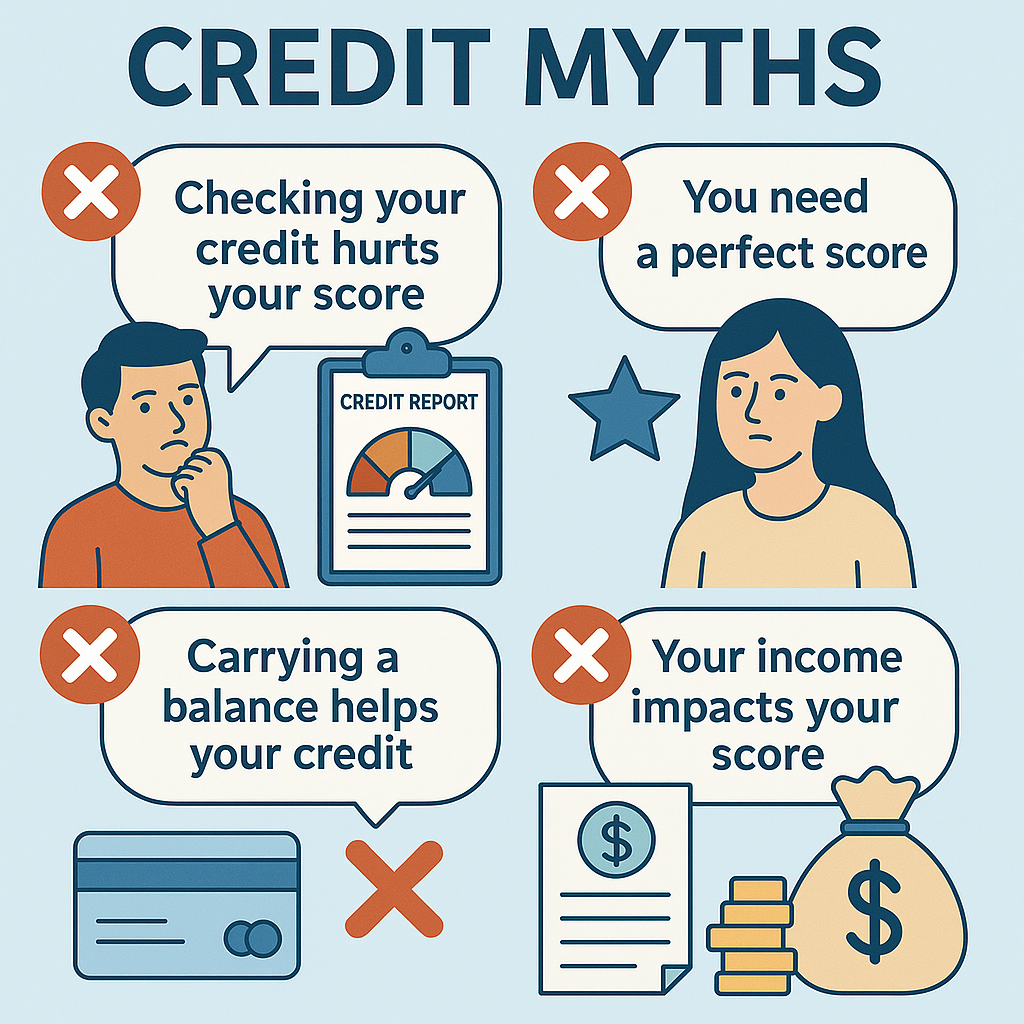
Many consumers avoid monitoring their credit reports because they fear that the act of checking will "ding" their score. This is a fundamental misunderstanding of the difference between "hard" and "soft" credit inquiries. Under the Fair Credit Reporting Act, consumers have a legal right to access their own credit information, and doing so has absolutely zero impact on their credit score.
When you check your own score through a banking app, a credit monitoring service, or AnnualCreditReport.com, it is classified as a soft inquiry. Soft inquiries are also used by lenders for "pre-approved" offers and by employers for background checks. These are not visible to other lenders and do not affect the mathematical algorithms used to calculate your FICO or VantageScore.
In contrast, a hard inquiry occurs when you apply for a specific loan or credit card, and a lender pulls your report to make a lending decision. While a single hard inquiry might lower a score by a few points temporarily, the systemic avoidance of monitoring one's own credit can be far more damaging. Without regular checks, errors or fraudulent activities can go unnoticed for months, leading to much larger credit complications down the line.
The Misconception of Carrying a Balance to "Build" Credit
Perhaps the most expensive myth in the American credit landscape is the idea that carrying a monthly balance on a credit card is necessary to build a high credit score. Some believe that if they pay their balance in full every month, the credit bureaus will think the card is not being used. This is factually incorrect and leads many Americans to pay unnecessary interest to large financial institutions.
Credit scores are influenced by "utilization," which is the ratio of your reported balance to your total credit limit. Lenders report your balance to the bureaus once a month—usually on your statement closing date. If you use the card and then pay it off before the due date, the "use" of the credit is still recorded, but you avoid interest charges. Carrying a balance from month to month does not improve your score more than paying it off in full; in fact, if that balance exceeds 30% of your limit, it will actively decrease your score.
In 2026, with average credit card interest rates remaining high, following this myth is a recipe for a debt spiral. The goal for a healthy credit profile is to demonstrate active use followed by responsible repayment. Paying interest is a fee for borrowing money, not a requirement for a high FICO score.
Closing Old Accounts and Its Impact on Credit Age
When individuals decide to simplify their finances, they often close old credit card accounts that they no longer use. The prevailing myth is that "cleaning up" the report by removing unused accounts shows lenders that you are not over-extended. However, the American credit scoring system actually rewards the length of credit history.
Closing an old account can hurt your score in two ways. First, it reduces the "average age" of your accounts. A consumer with a 15-year-old account and a 1-year-old account has a much stronger profile than someone who only has a 1-year-old account. Second, closing an account reduces your total available credit. If you have $10,000 in total limits across three cards and you close one with a $5,000 limit, your credit utilization will instantly double if you have any remaining debt, which could lead to a sudden drop in your score.
Unless an old card has a high annual fee that outweighs the credit-score benefit, it is generally better to keep the account open and use it for a small purchase once or twice a year to prevent the issuer from closing it due to inactivity.
The Legal Reality of Co-signing a Loan
There is a common belief that a co-signer is merely a "character reference" or a backup contact for the lender. In reality, co-signing is a binding legal obligation that makes you 100% responsible for the debt. If the primary borrower misses a payment, the lender does not wait to contact the co-signer—the late payment is reported to both individuals' credit bureaus simultaneously.
Co-signing can significantly impact your own ability to borrow in the future. Because the full amount of the co-signed loan appears on your credit report, it is factored into your debt-to-income ratio. Even if the primary borrower is making all the payments, a future mortgage lender may view that co-signed auto loan as your debt, potentially disqualifying you for a home loan. Before co-signing, one must understand that they are not just helping a friend or relative; they are entering into a full financial partnership with significant risk to their own credit reputation.
Comparison: Myth vs. Reality in American Lending
The following table clarifies common myths against the verified financial standards of 2026.
| Common Myth | Technical Reality | Impact on Borrower |
|---|---|---|
| Income affects credit score | Income is not a factor in credit scoring models. | High earners can have low scores; low earners can have high scores. |
| Debit cards build credit | Debit cards draw from existing funds and are not reported. | Using only debit prevents the establishment of a credit history. |
| Consolidating debt erases it | Consolidation moves debt; it does not eliminate the principal. | Can lower interest but may lead to more spending if habits don't change. |
| Paying a collection deletes it | Paid collections may stay on reports for 7 years. | Newer scores (FICO 9+) ignore $0 balance collections, but older ones don't. |
| Checking credit ruins it | Consumer-initiated checks are "soft pulls." | Regular monitoring is safe and recommended for fraud prevention. |
| Minimum payments are enough | Minimums barely cover interest and extend debt for decades. | Results in massive interest costs and very slow principal reduction. |
The Role of Alternative Data in 2026
By 2026, the definition of a "credit report" has expanded. A burgeoning myth is that only traditional loans and credit cards count toward a score. However, "Alternative Data" has become a significant factor in modern lending. Programs now allow consumers to opt-in to reporting their rent payments, utility bills, and even subscription services like streaming platforms to their credit files.
While this is a boon for "credit invisible" individuals, it also means that the myth that "utility bills don't matter" is increasingly false. While a single late water bill might not have historically triggered a credit drop, the integration of these data points into specialized scores means that financial consistency across all obligations is more important than ever. Lenders in 2026 use these expanded profiles to assess the risk of borrowers who may not have traditional credit depth but have a decade of on-time rent and utility history.
Student Loan Forgiveness and Refinancing Myths
Student loans are a unique area of American credit riddled with misinformation. One common myth is that student loans are automatically forgiven after 10 or 20 years of payment. In reality, forgiveness programs like Public Service Loan Forgiveness (PSLF) or Income-Driven Repayment (IDR) plans have very strict requirements, including specific employer types, loan types, and a precise number of qualifying payments.
Another myth is that you can never get rid of student loans in bankruptcy. While it remains more difficult than discharging credit card debt, recent legal shifts and updated guidance from the Department of Justice have made it more feasible for borrowers to prove "undue hardship." Furthermore, many borrowers believe they should never refinance federal loans into private ones. While federal loans offer protections (like forbearance and IDR), those with high-interest Graduate PLUS loans and stable, high-income jobs may find that private refinancing in 2026 offers significantly lower rates, though they must weigh the loss of federal protections carefully.
Frequently Asked Questions
Does carrying a small balance on my credit card help my score?
No. Carrying a balance only results in interest charges and does not benefit your credit score more than paying the balance in full. To maximize your score, focus on "utilization"—keep your reported balance below 10% of your limit and pay it off before the due date to avoid interest.
Will a "Credit Repair" company remove legitimate negative items?
No. Credit repair companies cannot legally remove accurate, verifiable, and timely information from your credit report. They primarily assist in disputing errors or outdated information. If a company claims they can "delete" a legitimate late payment from last year, they are likely engaging in deceptive practices.
Can my spouse's bad credit ruin my score?
No. Every individual has their own social security number and their own credit report. However, if you apply for a joint loan (like a mortgage), the lender will look at both scores. In many cases, the lender will use the "lower" of the two middle scores to determine the interest rate, which can make borrowing together more expensive.
Does my education level or job title affect my credit score?
No. FICO and VantageScore models do not consider your education, job title, or employer. While a lender may ask for these details on a loan application to verify your ability to repay, they do not factor into the numerical credit score itself.
If I pay off a debt in collections, does it immediately disappear?
Generally, no. A collection account remains on your credit report for seven years from the date of the original delinquency. While paying it off changes the status to "Paid Collection," which looks better to manual underwriters and is ignored by some newer scoring models, the historical record of the collection stays on the report for the full duration.
Recommendation for Borrowers
To navigate the complexities of the American credit system effectively in 2026, you should move away from anecdotal advice and rely on primary sources. Your first step should be to download your full credit reports from Experian, Equifax, and TransUnion to verify that all reported data is accurate. Use official tools provided by the Consumer Financial Protection Bureau (CFPB) to understand your rights regarding debt collection and credit reporting.
Instead of trying to "game" the system by carrying balances or avoiding credit altogether, focus on the fundamentals: pay every bill on time, keep your total debt utilization low (ideally under 10%), and only apply for new credit when necessary. If you are struggling with debt, seek out a non-profit credit counseling agency rather than a "for-profit" credit repair service. Consistent, long-term behavior is the only verified way to maintain a top-tier credit profile.