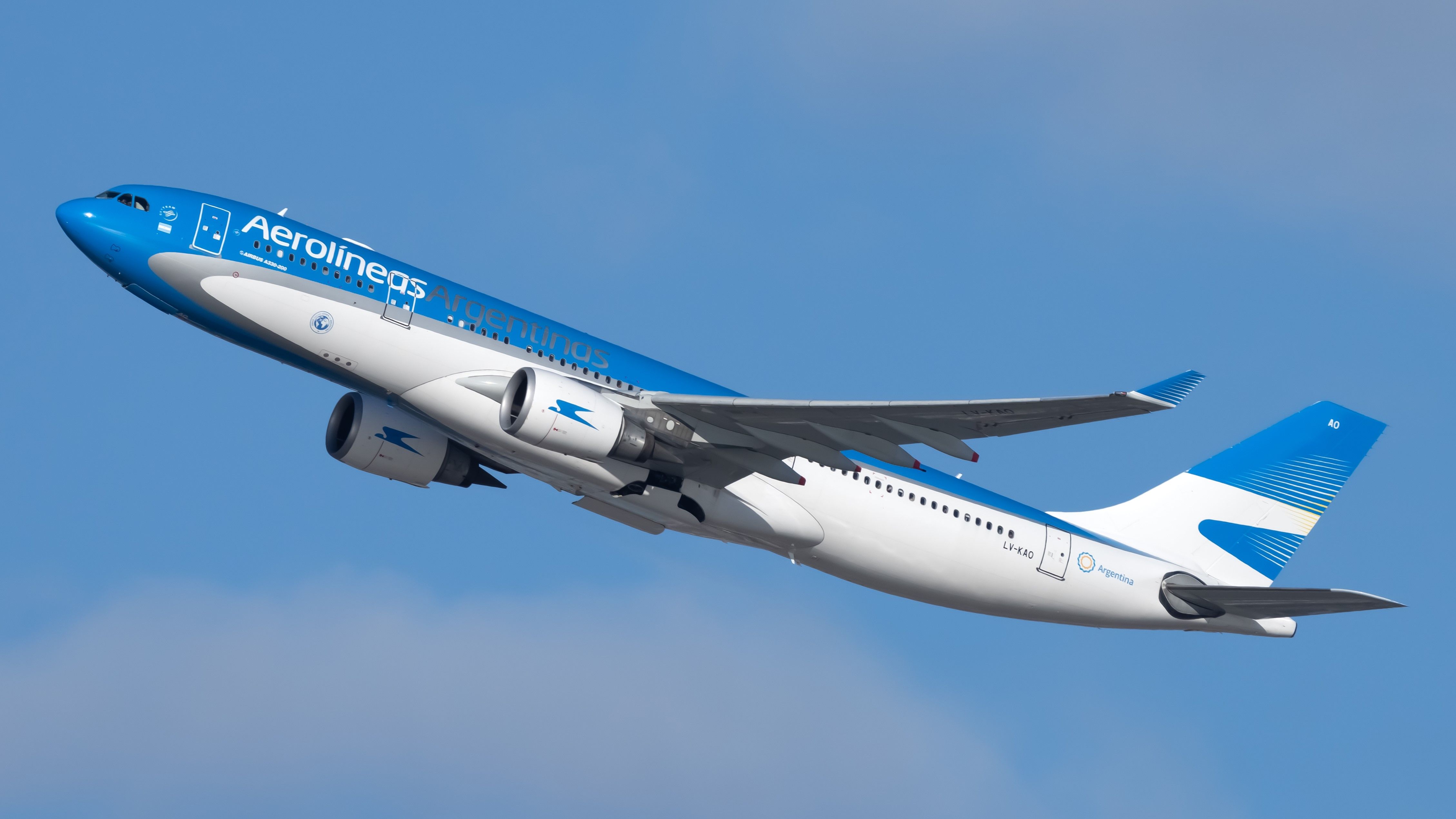
The Aerolíneas Argentinas fleet consists of roughly 80 commercial aircraft divided into three distinct operational segments: Embraer E190 regional jets, Boeing 737 narrowbody aircraft (including 737-700, 737-800, and 737 MAX 8 variants), and long-haul Airbus A330-200 widebody twin-jets. The airline also operates dedicated Boeing 737-800BCF freighters for domestic and regional cargo logistics.
Strategic Structure of the Aerolíneas Argentinas Fleet
As the flag carrier of Argentina, Aerolíneas Argentinas manages one of South America's most geographically demanding route networks. The country stretches over 3,700 kilometers from its northern tropical borders down to Tierra del Fuego in the Antarctic region, featuring operating conditions ranging from dense sea-level humidity to high-altitude Andean environments and harsh Patagonian crosswinds.
To serve this diverse landscape effectively, the airline utilizes a simplified, high-efficiency fleet structure built around three primary manufacturer families: Embraer for low-density regional links, Boeing for mainline domestic and medium-haul South American routes, and Airbus for long-haul intercontinental trips to North America and Europe.
Following the corporate integration of its domestic subsidiary Austral Líneas Aéreas in late 2020, Aerolíneas Argentinas unified all flight operations under a single air operator certificate (AOC). This consolidation streamlined maintenance workflows, standardized crew training protocols, and simplified fleet scheduling across its primary hubs at Aeroparque Jorge Newbery (AEP) and Ezeiza International Airport (EZE) in Buenos Aires.
| Segment | Aircraft Models |
|---|---|
| Regional Operations | Embraer E190 / E195-E2 |
| Narrowbody Mainline | Boeing 737-700 / 737-800 / 737 MAX 8 |
| Widebody Intercontinental | Airbus A330-200 |
| Dedicated Cargo | Boeing 737-800BCF |
Narrowbody Operations: Boeing 737 NG and 737 MAX Series
The backbone of domestic and regional passenger transportation for Aerolíneas Argentinas is its fleet of Boeing 737 aircraft. The carrier operates both Next-Generation (NG) models (-700 and -800) and modern MAX 8 variants.
Boeing 737 Mainline Fleet Distribution
- 737-700: Short-runway & low-demand domestic
- 737-800: High-density domestic & regional
- 737 MAX 8: Long-range narrowbody & efficiency
Boeing 737-700
The Boeing 737-700 is the smallest narrowbody variant in the mainline fleet. Powered by CFM International CFM56-7B engines, these aircraft seat between 128 and 137 passengers in a two-class configuration (Premium Economy / Club Economy and Economy).
- Primary Roles: Short-to-medium haul domestic routes requiring enhanced hot-and-high airfield performance, such as operations into high-altitude or length-restricted runways in northern and western Argentina.
- Operational Advantages: Exceptional field performance allows the 737-700 to operate out of regional airfields where larger aircraft face weight restrictions.
Boeing 737-800
The Boeing 737-800 forms the core workhorse for high-density domestic trunk routes and regional flights across South America (including destinations in Brazil, Chile, Uruguay, and Peru).
- Seating Capacity: Configured typically with 170 seats (8 in Premium Economy and 162 in Economy).
- Specifications: Equipped with CFM56-7B engines and Blended Winglets to reduce aerodynamic drag on longer stage lengths.
- Cabin Amenities: Modernized overhead bins, LED lighting schemes, and overhead flight info screens.
Boeing 737 MAX 8
Aerolíneas Argentinas was the launch customer for the Boeing 737 MAX 8 in South America, taking delivery of its first aircraft in late 2017. The MAX 8 features advanced technology CFM LEAP-1B engines and Advanced Technology winglets, delivering up to a 16% reduction in fuel consumption and carbon emissions compared to previous-generation narrowbodies.
- Seating Capacity: 170 passenger seats (8 Premium Economy / 162 Economy).
- Passenger Experience: Features the Boeing Sky Interior, lower cabin altitude feel, significantly reduced engine noise footprints, and individual USB charging ports at every seat.
- Deployment: Used extensively on high-demand domestic routes (e.g., Buenos Aires to Ushuaia, Bariloche, Mendoza, and Iguaçu) as well as mid-range international routes into Brazil, Colombia, and the Caribbean.
Regional Fleet Transformation: Embraer E190 and E195-E2
Regional operations linking smaller Argentine cities and providing feeder traffic to the main Buenos Aires hubs rely on the Embraer aircraft family.
Regional Fleet Evolution Plan
- Current: Embraer E190-E1 (96 seats, GE CF34 engines)
- Transiting to: Embraer E195-E2 (136 seats, PW1900G)
Embraer E190-E1
Inherited directly from the Austral Líneas Aéreas integration, the Embraer E190-E1 fleet provides essential connectivity across secondary regional routes where passenger demand does not justify a 170-seat Boeing 737-800.
- Engine: Dual General Electric CF34-10E turbofans.
- Seating Capacity: 96 seats formatted in a 2x2 layout in Economy (eliminating middle seats) and a 1x2 layout in Premium Economy.
- Key Destinations: Regional hubs such as Bahía Blanca, Rosario, Santa Fe, Corrientes, and Mar del Plata.
Fleet Modernization: The Shift to Embraer E195-E2
To replace aging E190-E1 units, Aerolíneas Argentinas committed to acquiring next-generation Embraer E195-E2 aircraft. The E195-E2 represents a major technological leap for the carrier's regional operations:
- Capacity Expansion: Increases regional seating capacity from 96 to approximately 136 seats per aircraft.
- Fuel Efficiency: Powered by Pratt & Whitney PW1900G Geared Turbofan (GTF) engines, reducing fuel burn per seat by over 25% compared to first-generation E-Jets.
- Noise and Emission Reduction: Reduces external noise footprints by up to 50% while complying with stringent global emissions standards.
Long-Haul Fleet: Airbus A330-200 Operations
For long-haul intercontinental routes, Aerolíneas Argentinas relies on the widebody Airbus A330-200. The airline standardized its long-haul fleet around the A330 platform following the retirement of its four-engine Airbus A340-300 and A340-200 aircraft.
Airbus A330-200 Network Hub
- Transatlantic: Madrid (MAD), Rome (FCO)
- North America: Miami (MIA), New York (JFK)
- Heavy Regional: Santiago (SCL), Miami, Sao Paulo (GRU)
Specifications and Configuration
The A330-200 widebody fleet features twin-aisle passenger comfort designed for flight durations exceeding 12 hours.
- Powerplant: Powered primarily by General Electric CF6-80E1 engines.
- Passenger Capacity: Typically arranged in a two-class configuration seating 265 to 272 passengers.
- Executive Class (Club Cóndor): 24 lie-flat or angle-flat business class seats arranged in a 2x2x2 or 1x2x1 layout depending on the specific cabin refurbishing batch. Seats feature direct power outlets, adjustable lumbar support, and personal inflight entertainment (IFE) screens.
- Economy Class: 241 to 248 seats in a standard 2x4x2 layout, offering individual seatback touchscreens, adjustable headrests, and USB ports.
Network Deployment
The Airbus A330-200 operates exclusively out of Ezeiza International Airport (EZE) and select high-demand domestic routes:
- Intercontinental Long-Haul: Daily non-stop services to major global destinations including Miami (MIA), Madrid (MAD), and Rome (FCO).
- Seasonal & Regional Spikes: Deployed on ultra-dense regional corridors such as Buenos Aires to São Paulo (GRU) during peak travel seasons, as well as heavy domestic Patagonian sectors like Ushuaia (USH) and Bariloche (BRC) during winter ski months.
Aerolíneas Argentinas Cargo Division
In early 2023, Aerolíneas Argentinas formally launched a dedicated air cargo business unit (Aerolíneas Argentinas Cargo) by inducting dedicated freighter aircraft into service.
| Specification | Details |
|---|---|
| Primary Role | Dedicated express freight and logistics |
| Payload Capacity | Up to 23,900 kg (52,600 lbs) |
| Main Deck Layout | 11 standard Pallet Positions |
| Key Cargo Categories | Agro-exports, industrial gear, e-commerce, pharma |
The addition of two converted Boeing 737-800BCF (Boeing Converted Freighter) aircraft allowed the carrier to move beyond using belly-hold cargo space on passenger flights.
- Logistics Focus: Transporting high-value exports, fresh agricultural produce (salmon, fruits, meat), industrial equipment for the mining and energy sectors, and urgent e-commerce packages across Argentina and neighboring Latin American countries.
- Strategic Partnerships: Operates integrated cargo services in partnership with domestic logistics firms and international freight forwarders, connecting regional industrial hubs like Córdoba and Tucumán directly to international export gateways.
Detailed Fleet Specifications Comparison
The table below outlines the core technical specifications, seating configurations, powerplants, and operational roles across the active passenger and cargo fleet of Aerolíneas Argentinas.
| Aircraft Model | Engine Type | Typical Seating (Business / Economy) | Range (km) | Primary Operational Role |
|---|---|---|---|---|
| Embraer E190-E1 | GE CF34-10E | 96 (8 Premium / 88 Economy) | 3,330 km | Low-density regional domestic & feeder routes |
| Embraer E195-E2 | P&W PW1900G | ~136 (12 Premium / 124 Economy) | 4,815 km | High-efficiency regional & medium domestic routes |
| Boeing 737-700 | CFM56-7B | 128–137 (8 Premium / 120–129 Econ) | 6,230 km | High-altitude, short-runway domestic destinations |
| Boeing 737-800 | CFM56-7B | 170 (8 Premium / 162 Economy) | 5,436 km | High-density domestic trunk routes & regional South America |
| Boeing 737 MAX 8 | CFM LEAP-1B | 170 (8 Premium / 162 Economy) | 6,570 km | High-efficiency domestic and long-range narrowbody routes |
| Airbus A330-200 | GE CF6-80E1 | 265–272 (24 Business / 241–248 Econ) | 13,450 km | Intercontinental long-haul (USA, Europe) & peak regional |
| Boeing 737-800BCF | CFM56-7B | Freighter (N/A) | 3,700 km | Domestic and regional dedicated air cargo transport |
Onboard Cabin Classes and Experience
Aerolíneas Argentinas offers distinct onboard products tailored to regional, short-haul, and long-haul traveler requirements.
Cabin Class Structures
- Domestic & Regional: Premium Economy (Club Economy)
- Long-Haul Intercontinental: Business (Club Cóndor)
- Standard All Flights: Economy Class
1. Club Cóndor (Business Class - Long-Haul Widebody)
Available exclusively on the Airbus A330-200 fleet, Club Cóndor serves international routes to North America and Europe.
- Seating: Lie-flat or deep-recline sleeper seats providing enhanced privacy, lumbar support controls, and direct aisle access depending on seat configuration.
- Amenities: Personal 12 to 15-inch touchscreen entertainment systems with noise-canceling headphones, premium amenity kits, and multi-course meals featuring Argentine wines.
- Priority Benefits: Dedicated check-in counters, priority baggage handling, fast-track security where available, and entry to the Salón Cóndor lounge at Ezeiza International Airport.
2. Premium Economy / Club Economy (Narrowbody & Regional)
Offered on domestic and South American regional flights operated by Boeing 737 and Embraer aircraft.
- Seating: Located in the first 2 to 3 rows of the cabin. On Boeing 737s, this consists of wider seats with extra legroom in a 2x2 layout. On Embraer E190s, seats feature extra pitch in a 1x2 configuration.
- Services: Complimentary hot or cold snack service, priority boarding, increased baggage allowances, and middle-seat elimination on specific regional layouts.
3. Economy Class
Standard seating provided across the entire fleet.
- Narrowbody & Regional: Ergonomic seating with pitch ranging from 30 to 32 inches. On-board Wi-Fi and streaming entertainment to personal electronic devices are available on select Boeing 737 MAX aircraft.
- Widebody (Airbus A330): Individual seatback entertainment screens pre-loaded with movies, TV shows, and audio channels, alongside universal USB charging ports.
Geographical & Extreme Environment Operational Challenges
Operating an airline fleet in Argentina requires specialized aircraft capabilities due to the country's diverse geographic terrain and meteorological phenomena.
| Extreme Environmental Challenge | Locations |
|---|---|
| High Altitude | San Carlos de Bariloche (BRC), Salta (SLA), Jujuy (JUJ) |
| Severe Winds | Ushuaia (USH), El Calafate (FTE), Comodoro Rivadavia |
| High Humidity | Puerto Iguazú (IGR), Resistencia (RES) |
High-Altitude Airfields
Airports located in the Andes foothills (such as Bariloche, Salta, and Jujuy) present high-altitude performance challenges, especially during hot summer months when low air density reduces engine thrust and wing lift. The thrust-to-weight margins of the Boeing 737-700 and Boeing 737 MAX 8 make them suited for these demanding environments, allowing full passenger payloads without significant weight penalties.
Severe Patagonian Winds & Crosswinds
Tier 1 southern destinations like Ushuaia (USH) and El Calafate (FTE) regularly experience severe mountain wave turbulence, low-level wind shear, and extreme crosswinds originating from Antarctic weather fronts.
- Fleet Suitability: The robust flight control systems and wide crosswind limits of the Boeing 737 NG/MAX and Airbus A330 platforms allow Aerolíneas Argentinas to maintain high dispatch reliability into Tierra del Fuego even during adverse winter conditions.
- Specialized Navigation: Fleet aircraft operating into Ushuaia are certified for Required Navigation Performance (RNP AR) approach procedures, allowing precise GPS-guided arrivals through narrow mountain valleys.
Fleet Sustainability and Future Modernization Strategy
Aerolíneas Argentinas has outlined strategic initiatives focused on reducing operational expenditure, lowering fleet carbon emissions, and streamlining maintenance management.
Sustainability & Fleet Objectives
Fuel Burn Reduction via CFM LEAP-1B & E195-E2
Noise Footprint Reduction around Urban Hubs (AEP)
Fleet Standardization (Boeing 737 & Airbus A330)
Phase-Out of Older Narrowbodies: Gradually replacing older Boeing 737-700 models with higher-capacity, fuel-efficient 737 MAX aircraft to lower fuel burn per seat-kilometer.
E-Jet Fleet Renewal: Transitioning from first-generation Embraer E190-E1s to next-generation E195-E2s to increase regional capacity while cutting fuel burn by 25%.
Widebody Efficiency Programs: Enhancing flight planning algorithms, weight reduction strategies (such as lightweight containers), and continuous descent operations (CDO) to reduce fuel consumption across intercontinental Airbus A330 operations.
Frequently Asked Questions
What aircraft models does Aerolíneas Argentinas currently operate?
Aerolíneas Argentinas operates a passenger fleet of Embraer E190 regional jets, Boeing 737-700, 737-800, and 737 MAX 8 narrowbodies, and long-haul Airbus A330-200 widebodies. The airline also operates Boeing 737-800BCF freighter aircraft for dedicated cargo transport.
Which Aerolíneas Argentinas aircraft has the newest cabin interiors?
The Boeing 737 MAX 8 fleet and recently inducted Airbus A330-200 aircraft feature modern interior configurations. They include Boeing Sky Interior LED lighting, individual USB/power ports, modernized overhead bins, and updated seat designs.
Does Aerolíneas Argentinas offer business class on domestic flights?
On domestic and short-haul regional flights, Aerolíneas Argentinas offers Premium Economy (also branded as Club Economy). Lie-flat Club Cóndor business class seating is reserved for long-haul intercontinental routes operated by the Airbus A330-200, though it is occasionally deployed on select high-density domestic routes like Ushuaia or Bariloche.
What is the difference between Aerolíneas Argentinas and Austral aircraft?
Austral Líneas Aéreas was a domestic subsidiary that operated a fleet of Embraer E190 aircraft. In late 2020, Austral fully merged into Aerolíneas Argentinas. All aircraft now operate under a single Aerolíneas Argentinas brand and air operator certificate.
Which plane flies non-stop from Buenos Aires to Miami and Europe?
Intercontinental non-stop flights from Buenos Aires (Ezeiza) to international destinations such as Miami (MIA), Madrid (MAD), and Rome (FCO) are operated exclusively by the widebody Airbus A330-200 fleet.
Booking and Travel Guidance
When booking flights on Aerolíneas Argentinas, choosing the optimal flight depends on your specific route and comfort preferences:
- Long-Haul Travel: If flying to North America or Europe, select flights operated by the Airbus A330-200 for full-service long-haul amenities, lie-flat Club Cóndor business seating, and personal seatback entertainment.
- Domestic Trunk Routes: For domestic flights between major hubs (e.g., Buenos Aires to Cordoba, Mendoza, or Bariloche), look for flights operated by the Boeing 737 MAX 8 to experience modern cabin interiors, lower cabin noise levels, and charging ports.
- Regional Feeder Routes: If traveling between secondary cities, expect to fly on the Embraer E190 or E195-E2, which feature a 2x2 seating configuration in Economy with no middle seats.
To verify your specific aircraft type before departure, inspect the detailed seat map during the flight selection process on the official Aerolíneas Argentinas website or app.