The Patek Philippe Reference 5960 endures as a masterclass in horological engineering because it brilliantly combines an annual calendar with a self-winding flyback chronograph into a remarkably wearable, intuitive package. Even years after its initial debut, the 5960 continues to win over collectors by offering peerless daily utility, a revolutionary in-house movement, and a balanced dial architecture that sets a benchmark for modern luxury sports complications.
The Genesis and Legacy of Patek Philippe Reference 5960
When Patek Philippe introduced the Reference 5960 in 2006, the release marked a watershed moment in the manufacturer's storied history. For the first time, the Geneva maison unveiled a self-winding chronograph movement developed and manufactured entirely in-house. Prior to the 5960, Patek Philippe relied heavily on modified external ebauches—most notably the legendary Lemania-based architecture found in the iconic Reference 3970 and 5970 perpetual calendar chronographs.
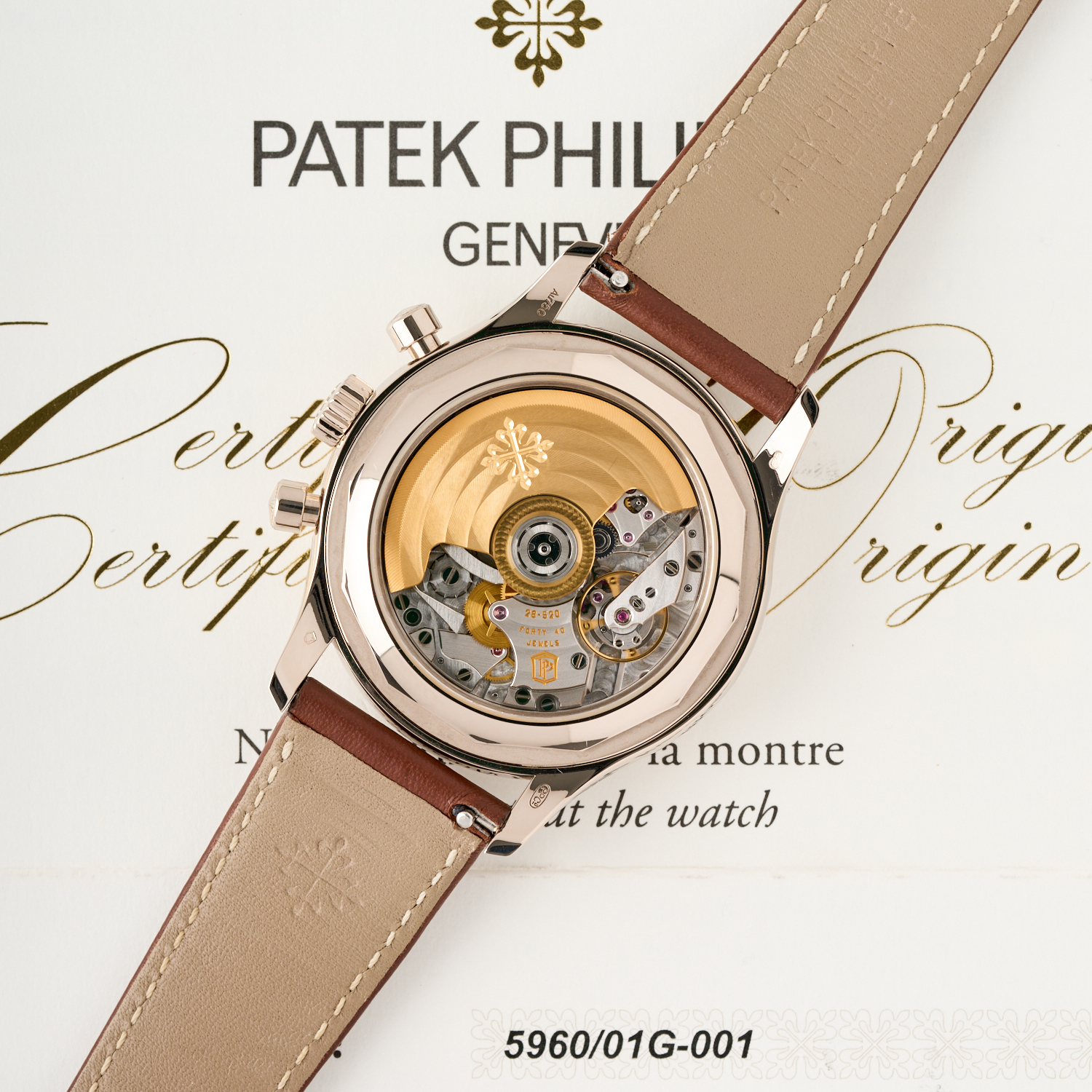
The introduction of Caliber CH 28-520 IR QA 24H represented a clean-sheet approach to modern watchmaking. Patek Philippe engineers set out to build a high-performance column-wheel chronograph equipped with a vertical clutch, which allowed the chronograph seconds hand to run continuously as a sweep second hand without causing unnecessary wear or amplitude drop in the balance wheel. Integrated seamlessly into this high-end timing mechanism was an annual calendar—a complication originally patented by Patek Philippe in 1996 with the introduction of the Reference 5035.
By merging the annual calendar—which automatically accounts for months with 30 and 31 days, requiring adjustment only once a year at the end of February—with a flyback chronograph, the 5960 carved out a distinct niche. It was neither a traditional dress watch nor a rugged sports watch; instead, it established a sophisticated category of everyday luxury complications designed for the active collector.
Decoding the Technical Excellence of Caliber CH 28-520 IR QA 24H
At the heart of why the 5960 wins against newer and flashier complications is the sheer mechanical sophistication packed into its movement. Understanding the architecture of Caliber CH 28-520 reveals why collectors hold this reference in such high regard.
| Movement Component | Technical Function & Advantage |
|---|---|
| Column Wheel | Ensures precise, crisp tactile feedback when starting, stopping, and resetting the chronograph. |
| Vertical Disc Clutch | Eliminates gear tooth "jump" on start; allows the chronograph hand to run continuously as a seconds hand. |
| Flyback Mechanism | Permits instant resetting and restarting of the chronograph with a single push of the reset pusher. |
| Annual Calendar Module | Automatically switches between 30- and 31-day months; requires manual correction only on March 1st. |
| 21k Gold Rotor | Heavy central oscillating weight ensures efficient winding and a clear view of the immaculate finishing. |
The integration of the vertical clutch is particularly crucial for daily wear. Traditional horizontal clutches can cause the chronograph hand to stutter or jump when engaged. The vertical clutch uses friction discs that lock together smoothly, ensuring that the chronograph can be left running indefinitely without compromising timekeeping precision.
Furthermore, the flyback function is an indispensable tool for active users. While a standard chronograph requires a three-step process of stopping, resetting, and restarting to time a new event, the flyback pusher allows the user to perform all three actions with a single press.
Dial Layout and Ergonomic Mastery
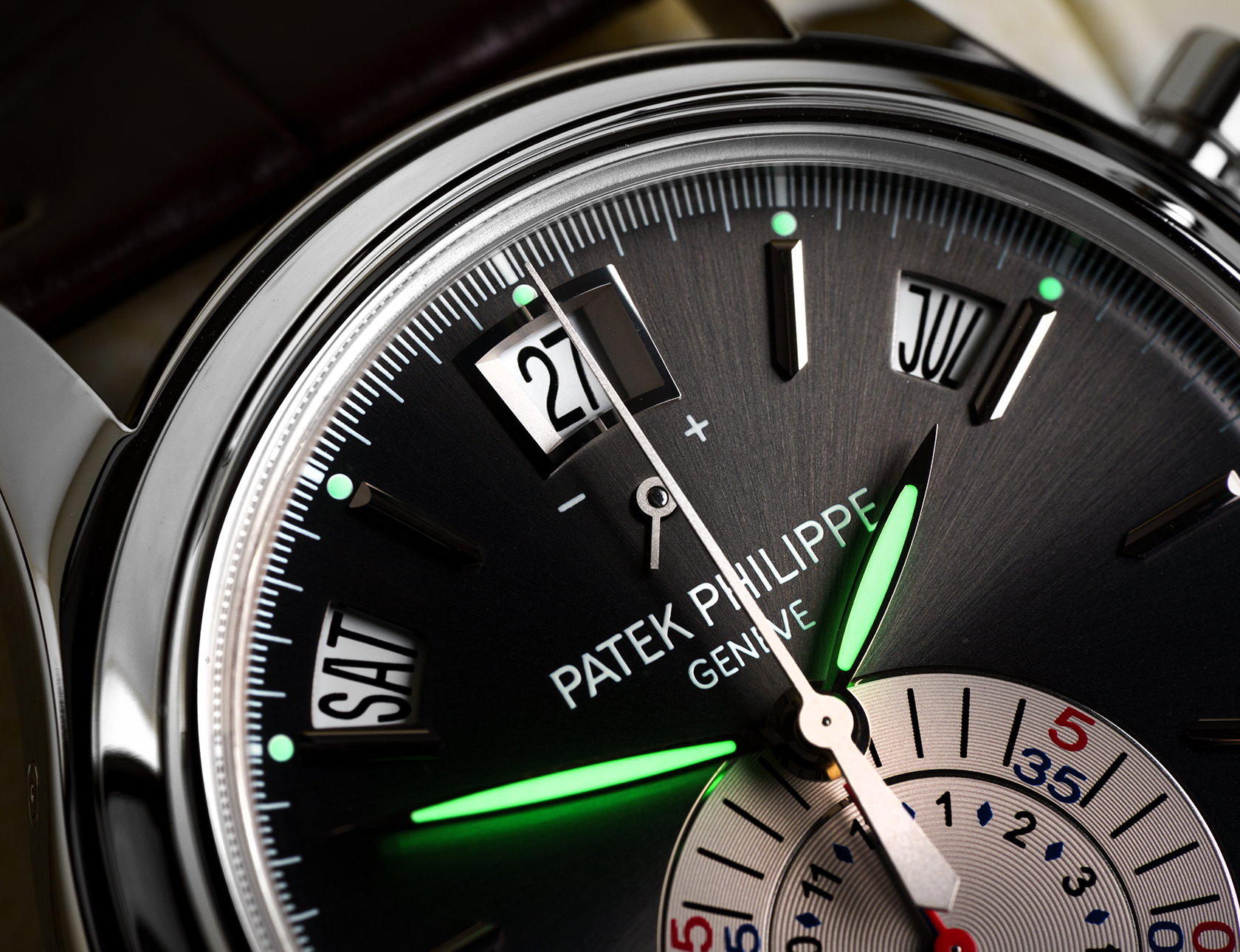
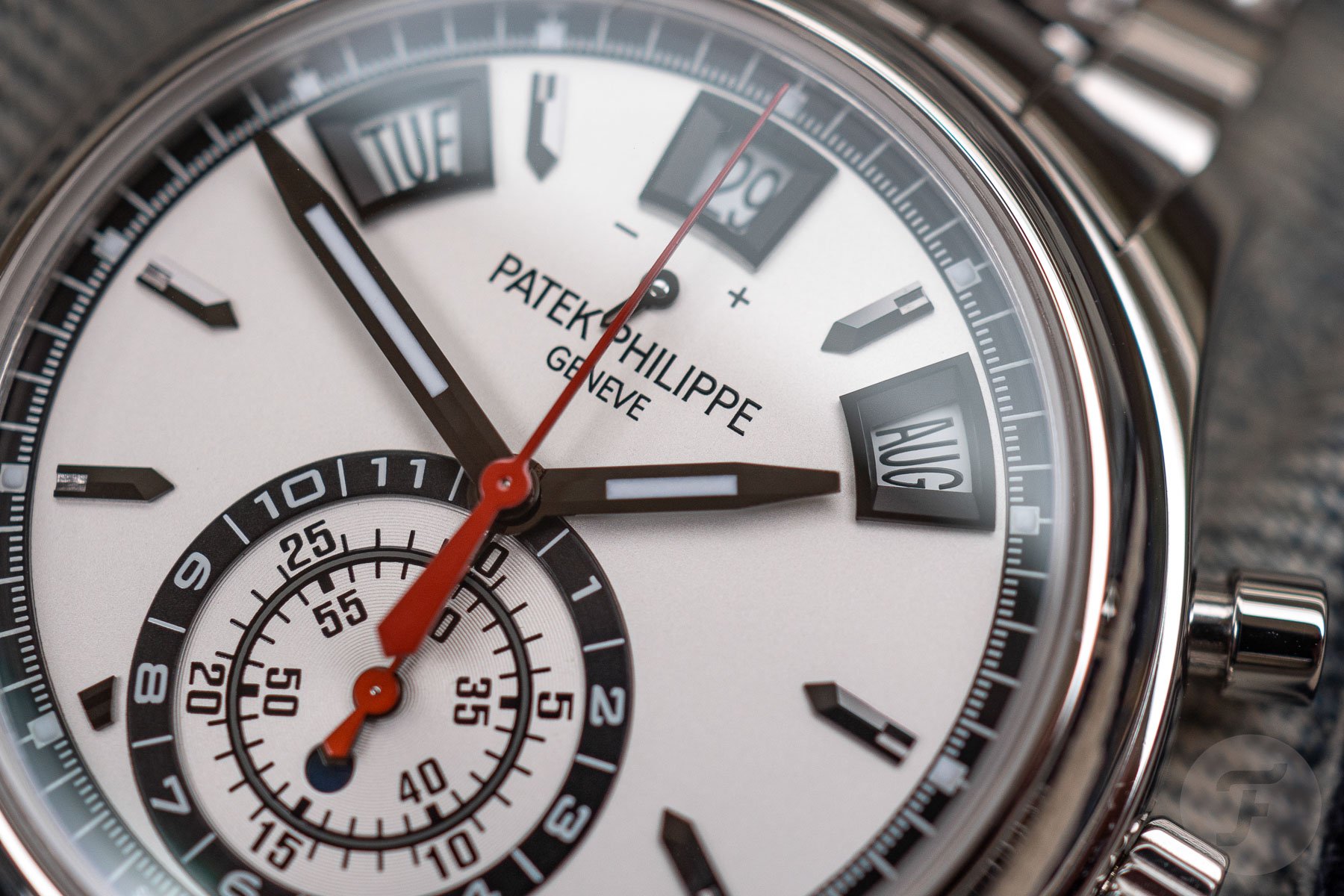
One of the most debated yet brilliant aspects of the Reference 5960 is its dial layout. Unlike traditional chronographs that clutter the dial with three separate sub-dials for running seconds, minutes, and hours, the 5960 streamlines the display by combining the chronograph minutes and hours into a single, highly legible sub-dial located at the 6 o'clock position.
This mono-counter design features two concentric scales: an outer track for elapsed minutes up to 30 minutes, and an inner track for elapsed hours up to 12 hours. This layout not only unclutters the primary dial real estate but also mimics the appearance of a secondary time zone or fuel gauge, lending the watch a distinct instrument-like aesthetic.
The annual calendar information is communicated through three beautifully framed apertures arranged in an arc across the upper half of the dial:
- Day of the week: Positioned between the 10 and 11 o'clock markers.
- Month: Positioned between the 1 and 2 o'clock markers.
- Date: Centered prominently right beneath the 12 o'clock logo.
Beneath the central axis, a subtle day/night indicator sits inside the 6 o'clock sub-dial, ensuring that the user does not attempt to adjust the calendar functions during the midnight hours when the gear train is actively engaged in changing the date. This thoughtful arrangement makes reading the calendar as natural as reading a standard date window, eliminating the need to decipher cramped sub-dials or tiny pointer hands.
Evolution of the Line: Metal Variations and Dial Aesthetics
The lifespan of the Patek Philippe 5960 spans multiple iterations, each bringing a unique personality to the collection. Tracing this evolution helps explain why the reference remains a cornerstone of modern collecting discussions.
The Platinum Pioneer (5960P)
Launched in 2006, the original Reference 5960P was crafted exclusively in platinum. Patek Philippe paired the heavy precious metal case with striking opaline silver or charcoal gray dials, accented by oxidized gold hands and faceted applied hour markers. True to Patek Philippe's tradition for platinum watches, a tiny, discreet diamond is set into the side of the case at the 6 o'clock position between the lugs. The platinum variants exude an understated weight and seriousness that appealed to purists who favored traditional precious metals.
The Steel Revolution (5960/1A)
In 2014, Patek Philippe surprised the industry by releasing the Reference 5960/1A in stainless steel. Stainless steel sports watches from the Holy Trinity of watchmaking—Patek Philippe, Audemars Piguet, and Vacheron Constantin—always generate intense market demand, and the 5960/1A was no exception. Featuring a silvery-white or dramatic black opaline dial with red chronograph accents, the steel variant shifted the watch's identity from a formal dress complication into an upscale luxury sports watch. Paired with a distinctive "rocket" bracelet featuring alternating polished and satin-finished links, the 5960/1A became an instant modern classic.
The Contemporary Gold Era (5960/01G)
By 2017, Patek Philippe transitioned the reference into white gold paired with a rich, varnished blue dial and a brown calfskin strap with a clevis prong buckle. This iteration bridged the gap between the formal gravity of the platinum models and the sporty versatility of the steel version, offering a warm, sophisticated aesthetic well-suited for everyday executive wear.
Why the 5960 Outperforms Competitors in Real-World Wearability
When evaluating complex timepieces, theoretical specifications mean little if the watch is uncomfortable, fragile, or frustrating to operate. The 5960 wins against many contemporary calendar chronographs because of its obsessive focus on everyday ergonomics.
- Case Proportions: Measuring 40.5mm in diameter and approximately 13.5mm in thickness, the 5960 strikes an ideal modern sweet spot. It slips effortlessly under a tailored shirt cuff while possessing enough wrist presence to anchor casual weekend attire.
- Correctors Placement: Adjusting the calendar is exceptionally user-friendly. Instead of requiring a sharp stylus to poke delicate case-side pin correctors—a notorious hazard for scratched platinum or gold cases—later iterations and thoughtful case designs streamlined adjustments, minimizing accidental damage.
- Legibility: The contrast between the dauphine hands, applied markers, and clean dial backgrounds ensures instant readability in variable lighting conditions, a common failing of overly complicated timepieces.
Comparing Patek Philippe 5960 to Other Complicated Icons
To truly understand why the 5960 continues to win, it is helpful to place it alongside other heavyweights in high horology.
| Reference / Model | Complications | Case Material Options | Primary Advantage | Primary Compromise |
|---|---|---|---|---|
| Patek Philippe 5960 | Annual Calendar, Flyback Chronograph, Day/Night | Platinum, Steel, White Gold | Intuitive mono-counter layout; high daily wearability. | Thick movement architecture compared to ultra-thin dress watches. |
| Patek Philippe 5990 | Flyback Chronograph, Dual Time, Date by Hand | Steel, Rose Gold | Exceptional travel utility with dual time zones. | Lacks an annual calendar mechanism; busier dial layout. |
| Patek Philippe 5270 | Perpetual Calendar, Chronograph, Moon Phase | White Gold, Yellow Gold, Rose Gold | Ultimate traditional grand complication prestige. | Significantly higher price point; requires manual winding (historically) or complex setup. |
| Rolez Daytona | Chronograph | Steel, Gold, Platinum | Ultimate rugged sport durability and liquidity. | Lacks calendar complications; purely a timing instrument. |
As this comparison illustrates, the 5960 occupies a unique sweet spot. It provides significantly more calendar utility than a standard chronograph like the Rolex Daytona or Patek's own timing references, while avoiding the delicate fragility and complex setting rituals of a full perpetual calendar like the 5270.
Common Collector Questions and Misconceptions
Is the annual calendar difficult to set after the watch stops?
Not at all. Patek Philippe designed the calendar correctors to be easily managed. Because it is an annual calendar, you only need to advance the date manually once a year on March 1st. If the watch runs out of power, quick-set correctors located on the case flanks allow you to align the day, date, and month in seconds.
Does the vertical clutch really make a difference for daily use?
Yes. On traditional horizontal clutch chronographs, leaving the chronograph running constantly causes unnecessary wear on the gear teeth and can negatively impact the watch's amplitude and timekeeping accuracy. The vertical clutch allows you to run the central chronograph hand continuously as a sweep seconds hand without any mechanical penalty.
Why is the steel 5960/1A so sought after?
Patek Philippe produces stainless steel watches in relatively small quantities compared to precious metals. When combined with a high complication like an annual calendar chronograph, the steel variant represents a rare breed in Patek's catalog, fusing sports-watch durability with haute horlogerie mechanics.
Practical Guidance for Prospective Buyers
For collectors considering acquiring a Patek Philippe 5960 in the secondary market, several critical factors warrant careful inspection:
- Service History: Caliber CH 28-520 is a complex integrated automatic movement containing hundreds of micro-mechanical parts. Ensure the watch has a documented service history from an authorized service center or a master watchmaker experienced in high-complication Patek movements.
- Case Condition: Whether looking at the soft platinum alloy or the sharp edges of the stainless steel bracelet variant, inspect the case for over-polishing. Patek Philippe's razor-sharp bevels and satin finishes require expert restoration to maintain collector value.
- Completeness: Premium references of this caliber demand a full collector set—including the original presentation box, certificate of origin stamped by an authorized dealer, push-pins (where applicable), and instruction booklets.
The Patek Philippe Reference 5960 proves that true horological victory does not belong solely to the loudest or most complicated timepiece in the room. By marrying an everyday annual calendar with a state-of-the-art flyback chronograph inside an ergonomically refined case, the 5960 secures its ongoing legacy as a triumphant benchmark of modern watchmaking.