The United States leads both the Americas and the world with an all-time total of 1,219 Olympic gold medals across Summer (1,105 gold) and Winter (114 gold) Games through 2024. Across the entire Western Hemisphere, member nations of Panam Sports have earned over 1,500 gold medals, with Canada, Cuba, Brazil, and Jamaica serving as major regional leaders.
Resolving Terminology: The United States vs. The Pan-American Region
When searching for the Americas' Olympic gold medal count, queries generally fall into two distinct analytical scopes:
- The United States of America (USA): Often referred to colloquially as "America," the U.S. represents the single most successful National Olympic Committee (NOC) in modern Olympic history.
- The Americas (Panam Sports Region): The collective group of 41 National Olympic Committees across North America, Central America, South America, and the Caribbean governed regionally by Panam Sports.
Understanding both tiers provides a complete picture of the Western Hemisphere's dominance in global sports. The U.S. accounts for roughly 80% of all gold medals won by nations in the Western Hemisphere, but several other American countries maintain elite global standing in specialized disciplines such as combat sports, sprinting, ice hockey, and volleyball.
The United States Gold Medal Tally: Summer and Winter Performance
The United States has accumulated more Olympic gold medals than any other nation in history. According to official historical records managed by the International Olympic Committee, the U.S. is the only NOC to have crossed the threshold of 1,000 Summer Olympic gold medals.
Total U.S. Olympic Gold Medals: 1,219
- Summer Games Gold Medals: 1,105
- Winter Games Gold Medals: 114
Summer Olympic Dominance
The U.S. made its Olympic debut at the inaugural 1896 Athens Games and has participated in every modern Summer Games except the boycotted 1980 Moscow Games. Through the Paris 2024 Olympic Games, American athletes have captured 1,105 Summer gold medals.
The foundation of this tally rests on two core sports: Athletics (Track & Field) and Swimming. Together, these two sports account for more than half of all U.S. Summer gold medals.
- Athletics: The U.S. has captured over 350 gold medals in track and field events, dominating sprint disciplines, hurdles, shot put, and pole vault across generations.
- Swimming: With over 260 gold medals, the U.S. swim program leads world standings, producing iconic multi-gold champions across every decade of modern competition.
- Wrestling & Boxing: Freestyle wrestling and boxing have historically contributed over 50 gold medals each to the U.S. total.
- Gymnastics & Basketball: The U.S. men's and women's basketball teams have won 17 and 10 gold medals respectively, while artistic gymnastics has expanded rapidly in gold production since the 1980s.
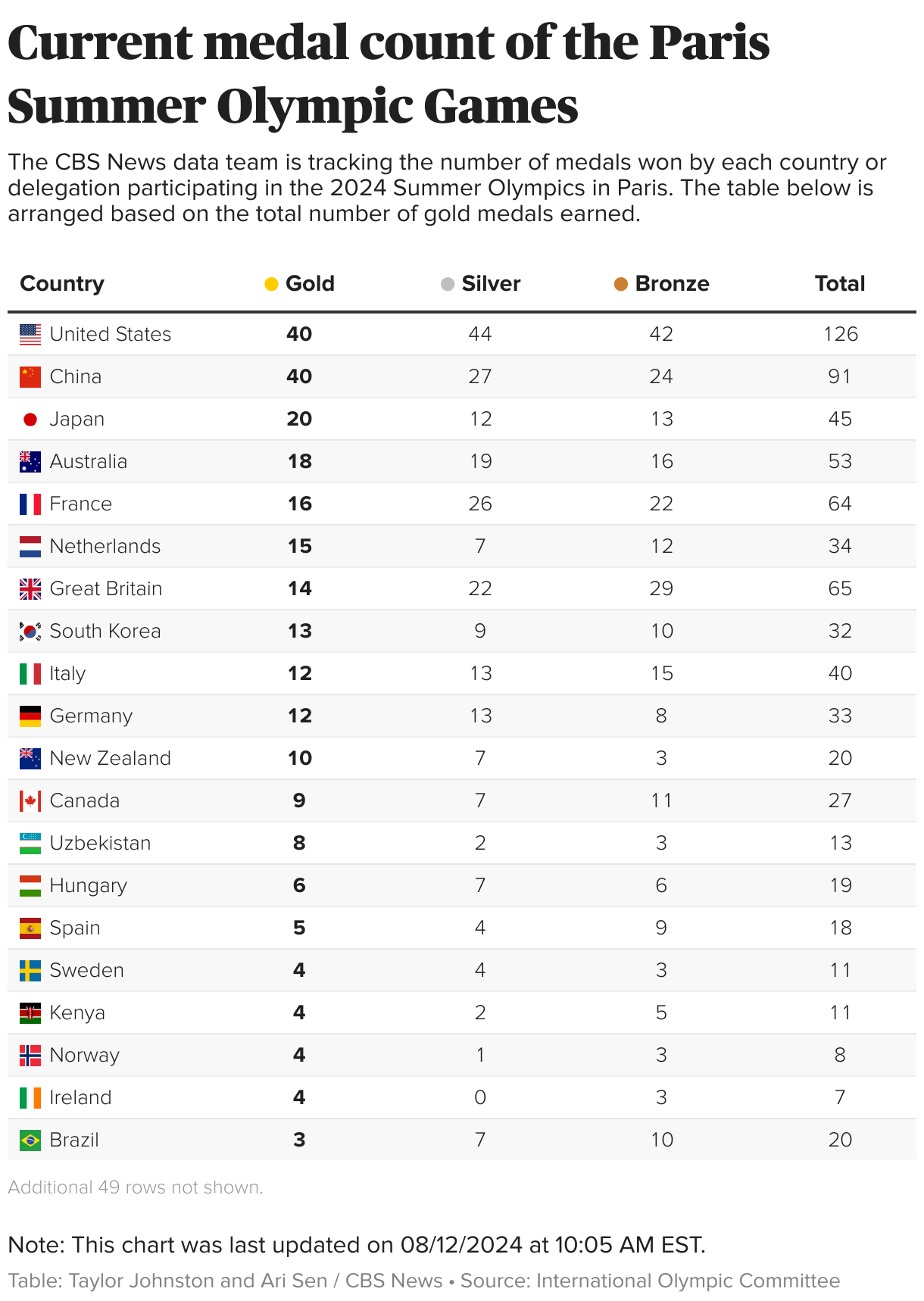
Historical peak performances for the U.S. occurred during host years, notably at the 1984 Los Angeles Games (83 gold medals) and the 1904 St. Louis Games (76 gold medals), alongside consistently high outputs at international venues such as Beijing 2008 (36 gold), Tokyo 2020 (39 gold), and Paris 2024 (40 gold).
Winter Olympic Records
While European nations like Norway and Germany frequently lead the Winter Olympic medal tables, the United States remains a top-tier Winter competitor. Through the Beijing 2022 Winter Games, the U.S. has secured 114 Winter gold medals, ranking among the top three nations in all-time Winter Olympic history.
Primary contributors to the U.S. Winter gold tally include:
- Speed Skating: Long-track speed skating is historically the most lucrative Winter sport for the U.S., yielding over 30 gold medals.
- Figure Skating: American skaters have earned more than 15 gold medals across men's, women's, and ice dance events.
- Snowboarding & Freestyle Skiing: Since snowboarding was added to the Olympic program in 1998, American athletes have dominated halfpipe and slopestyle events, contributing heavily to recent Winter gold tallies.
- Alpine Skiing: Legendary racers have sustained American presence on the downhill and slalom podiums across multiple Olympic cycles.
Regional Leaders: Gold Counts Across North, Central, and South America
Beyond the United States, several nations in the Western Hemisphere hold remarkable Olympic records, bringing the broader Americas gold tally to elite international standards.
| Americas Regional Olympic Gold Leaders | Golds |
|---|---|
| United States | 1,219 Golds |
| Canada | 155 Golds |
| Cuba | 86 Golds |
| Brazil | 40 Golds |
| Jamaica | 27 Golds |
| Argentina | 22 Golds |
| Mexico | 13 Golds |
Canada: Dual-Season Consistency
Canada is the second most decorated Olympic nation in the Americas, boasting a total of 155 gold medals (78 Summer, 77 Winter). Unlike the United States, whose gold tally is heavily weighted toward the Summer Games, Canada maintains near-parity between seasons.
Canada is a traditional powerhouse in ice hockey (14 total gold medals across men's and women's tournaments), short-track speed skating, freestyle skiing, and figure skating. In the Summer Games, Canada excels in rowing, track and field, swimming, and canoeing. Hosting the Games in Montreal (1976), Calgary (1988), and Vancouver (2010) played a crucial role in expanding national athletic infrastructure.
Cuba: Combat Sports and Track Supremacy
Cuba holds the third-highest gold medal count in the Americas, with 86 gold medals, all achieved during the Summer Olympic Games. Cuba has never won a medal at the Winter Olympics, making its position in the top rank of global Summer competition even more remarkable.
Cuba's Olympic identity is defined by its dominance in amateur boxing, where Cuban fighters have captured 43 gold medals—more than half of the nation's overall gold total. Additional gold contributions come from judo, Greco-Roman and freestyle wrestling, athletics (specifically jumping and throwing events), and volleyball.
Brazil: South America's Summer Olympic Engine
Brazil leads South America in total Olympic achievements, with 40 gold medals earned through the Paris 2024 Games. As the host nation of the Rio 2016 Games, Brazil accelerated its investment in high-performance sports programs, yielding dividends across multiple Olympic cycles.
Brazil's gold medal count is concentrated in team and dynamic sports:
- Volleyball & Beach Volleyball: Brazil is a global power, holding multiple gold medals across indoor and outdoor formats for both men and women.
- Sailing & Judo: Sailing has historically been one of Brazil's most consistent gold producers, alongside a judo program that regularly claims podium spots.
- Association Football (Soccer): Brazil's men's team captured back-to-back gold medals at Rio 2016 and Tokyo 2020.
- Skateboarding & Surfing: The inclusion of action sports has provided new avenues for Brazilian gold success.
Jamaica: Caribbean Sprinting Heritage
Jamaica holds one of the highest gold medal densities relative to population size of any country in the world. With 27 total gold medals through 2024, every single one of Jamaica's gold medals has been won in Athletics, specifically short and long sprints (100m, 200m, 400m, and relay events).
Driven by specialized high school track competitions (such as the Boys and Girls Championships) and world-class local coaching hubs, Jamaica dominated short-distance track events throughout the 2000s and 2010s, establishing an enduring Olympic legacy.
Argentina, Mexico, and Other Notable Contributors
- Argentina (22 Gold Medals): Historically strong in team sports such as field hockey, basketball, and polo, as well as individual disciplines like boxing and sailing.
- Mexico (13 Gold Medals): Success spans equestrian events, diving, boxing, athletics (race walking), and football.
- The Bahamas (8 Gold Medals): Outstanding track record in 400m sprint and relay events.
- Colombia (5 Gold Medals): Strong performances in weightlifting, BMX cycling, and athletics.
- Ecuador (4 Gold Medals): Achievements in race walking and weightlifting.
- Chile (3 Gold Medals): Gold medal success in tennis and shooting.
Comprehensive Data Table: Olympic Gold Medal Tallies Across the Americas
The following table summarizes the official all-time Olympic gold medal counts and overall medal totals for top-performing National Olympic Committees in the Americas through the Paris 2024 Summer Olympics and Beijing 2022 Winter Olympics. Historical statistical research supported by the International Society of Olympic Historians confirms these long-term totals.
| Country / NOC | Summer Gold | Winter Gold | Total Gold Medals | Total Medals Overall | Top Gold-Producing Sport |
|---|---|---|---|---|---|
| United States (USA) | 1,105 | 114 | 1,219 | 3,100 | Athletics (Track & Field) |
| Canada (CAN) | 78 | 77 | 155 | 552 | Ice Hockey / Speed Skating |
| Cuba (CUB) | 86 | 0 | 86 | 244 | Boxing |
| Brazil (BRA) | 40 | 0 | 40 | 170 | Volleyball / Beach Volleyball |
| Jamaica (JAM) | 27 | 0 | 27 | 93 | Athletics (Sprints) |
| Argentina (ARG) | 22 | 0 | 22 | 80 | Boxing / Team Sports |
| Mexico (MEX) | 13 | 0 | 13 | 78 | Athletics / Equestrian / Diving |
| Bahamas (BAH) | 8 | 0 | 8 | 16 | Athletics |
| Colombia (COL) | 5 | 0 | 5 | 38 | Weightlifting / BMX |
| Ecuador (ECU) | 4 | 0 | 4 | 10 | Athletics (Race Walking) |
| Chile (CHI) | 3 | 0 | 3 | 15 | Tennis / Shooting |
| Dominican Republic (DOM) | 3 | 0 | 3 | 15 | Athletics / Boxing |
Note: Data reflects combined official IOC records updated following the completion of the 2024 Olympic cycle.
Legendary Athletes Behind Regional Medal Tallies
Individual elite athletes have played a disproportionate role in accumulating gold medals for their respective nations in the Americas.
| All-Time Individual Gold Leaders (Americas) | Golds |
|---|---|
| Michael Phelps (USA) | 23 Golds |
| Carl Lewis (USA) | 9 Golds |
| Katie Ledecky (USA) | 9 Golds |
| Mark Spitz (USA) | 9 Golds |
| Caeleb Dressel (USA) | 9 Golds |
| Usain Bolt (JAM) | 8 Golds |
| Ray Ewry (USA) | 8 Golds |
Michael Phelps (United States)
American swimmer Michael Phelps is the most decorated Olympian of all time from any nation. Across four Olympic Games (Athens 2004, Beijing 2008, London 2012, and Rio 2016), Phelps won 23 gold medals (alongside 3 silver and 2 bronze). His 8 gold medals at the 2008 Beijing Games remain a single-Games record.
Katie Ledecky (United States)
Katie Ledecky stands as the most successful female swimmer in Olympic history, claiming 9 gold medals across distance freestyle events (800m, 1500m, 4x200m relay) between London 2012 and Paris 2024. Her dominance in distance events has made her one of the top gold medal contributors for Team USA.
Usain Bolt (Jamaica)
Jamaican sprinter Usain Bolt redefined track and field history by winning 8 gold medals across three consecutive Olympic Games (Beijing 2008, London 2012, and Rio 2016). Bolt achieved the historic "triple-triple" of 100m, 200m, and 4x100m relay golds (later adjusted to 8 total following a relay teammate's disqualification), accounting for nearly 30% of Jamaica's all-time gold medal count.
Carl Lewis and Mark Spitz (United States)
Both Carl Lewis (Athletics) and Mark Spitz (Swimming) captured 9 gold medals during their distinguished careers. Lewis accomplished the extraordinary feat of winning four consecutive gold medals in a single individual event (the long jump from 1984 to 1996), while Spitz set a legendary benchmark by winning 7 gold medals at the 1972 Munich Games.
Clara Hughes (Canada)
Canada's Clara Hughes represents a unique dual-season achievement. She is one of the few athletes in global history to win medals in both the Summer and Winter Olympic Games, earning gold in long-track speed skating (Winter) while also capturing bronze medals in road cycling (Summer).
Teófilo Stevenson and Félix Savón (Cuba)
Heavyweight boxers Teófilo Stevenson (1972, 1976, 1980) and Félix Savón (1992, 1996, 2000) each won 3 consecutive gold medals for Cuba, establishing a standard of dominance in Olympic amateur boxing that remains unmatched.
Key Factors Driving Olympic Success in the Western Hemisphere
The ability of nations across North, Central, and South America to accumulate over 1,500 gold medals relies on specific structural, institutional, and geographic advantages.
The NCAA Collegiate Pipeline
The United States collegiate sports system, governed by the NCAA, functions as a high-performance incubator not only for American athletes but for competitors across the entire Pan-American region. University athletic programs provide world-class facilities, elite coaching, sports science support, and top-tier competition.
Athletes from Canada, Jamaica, the Bahamas, Brazil, and several South American countries regularly train within the U.S. collegiate system, creating a regional hub for athletic development that translates directly into Olympic podium finishes.
Specialized National High-Performance Centers
Top-performing nations in the region have invested heavily in dedicated training facilities:
- United States: The U.S. Olympic & Paralympic Committee (USOPC) operates specialized Olympic Training Centers in Colorado Springs, Lake Placid, and Chula Vista.
- Canada: The Canadian Sport Institutes (CSI) network provides targeted sports science and technical coaching across winter and summer disciplines, supported by the Canadian Olympic Committee.
- Cuba: The National Institute of Sports, Physical Education and Recreation (INDER) recruits talent early through specialized regional sports schools (EIDE), focusing resources on combat sports and athletics.
- Brazil: The Brazilian Olympic Committee (COB) developed state-of-the-art training complexes in Rio de Janeiro following the 2016 Games to sustain long-term athlete pipelines.
Climate and Geographic Diversity
The Americas span from the Arctic Circle to Tierra del Fuego, offering unique geographic advantages for athletic training. Canada and the northern United States possess natural winter conditions and mountain ranges necessary for alpine and ice sports. Conversely, tropical and temperate regions in North America, the Caribbean, and South America support year-round outdoor training for swimming, track and field, sailing, and team sports.
Frequently Asked Questions
What is the total Olympic gold medal count for the United States?
The United States has won a total of 1,219 Olympic gold medals through 2024. This total includes 1,105 gold medals won at the Summer Olympic Games and 114 gold medals won at the Winter Olympic Games.
Which country in the Americas has the second-highest gold medal count?
Canada holds the second-highest gold medal count in the Americas, with a total of 155 gold medals (78 Summer gold medals and 77 Winter gold medals). Cuba ranks third overall with 86 gold medals, all won during the Summer Games.
Has any South American country won a Winter Olympic gold medal?
No nation in South America has won a Winter Olympic gold medal. All gold medals won by South American nations, including Brazil (40), Argentina (22), Colombia (5), Ecuador (4), and Chile (3), have been earned at the Summer Olympic Games.
Who is the individual athlete from the Americas with the most gold medals?
American swimmer Michael Phelps holds the record for the most gold medals by any athlete in the Americas and worldwide, with 23 Olympic gold medals. He is followed by U.S. athletes Carl Lewis, Mark Spitz, Katie Ledecky, and Caeleb Dressel, who have won 9 gold medals each, and Jamaican sprinter Usain Bolt, who won 8 gold medals.
Which single sport has yielded the most gold medals for the U.S.?
Athletics (Track & Field) is the U.S.'s most successful sport, contributing over 350 gold medals to the national tally. Swimming is second, contributing over 260 gold medals.
Strategic Guidance for Tracking Olympic Medal Data
For sports researchers, journalists, and Olympic historians analyzing regional performance metrics, maintaining accurate and verified statistics requires consulting primary data repositories:
- Verify Official IOC Databases: Use the International Olympic Committee's official results center to cross-reference historical medal reallocations resulting from retroactive anti-doping decisions or dispute resolutions.
- Distinguish Summer and Winter Tallies: Always separate Summer and Winter medal tallies when evaluating all-time rankings, as nations in the Caribbean and South America compete almost exclusively in Summer disciplines.
- Account for Historical NOC Changes: When evaluating historical regional totals, note that regional governing bodies like Panam Sports track historic achievements under current recognized National Olympic Committees.
By monitoring these established repositories, analysts can ensure precise tracking of gold medal counts across the Americas as new records are set in upcoming Olympic cycles.