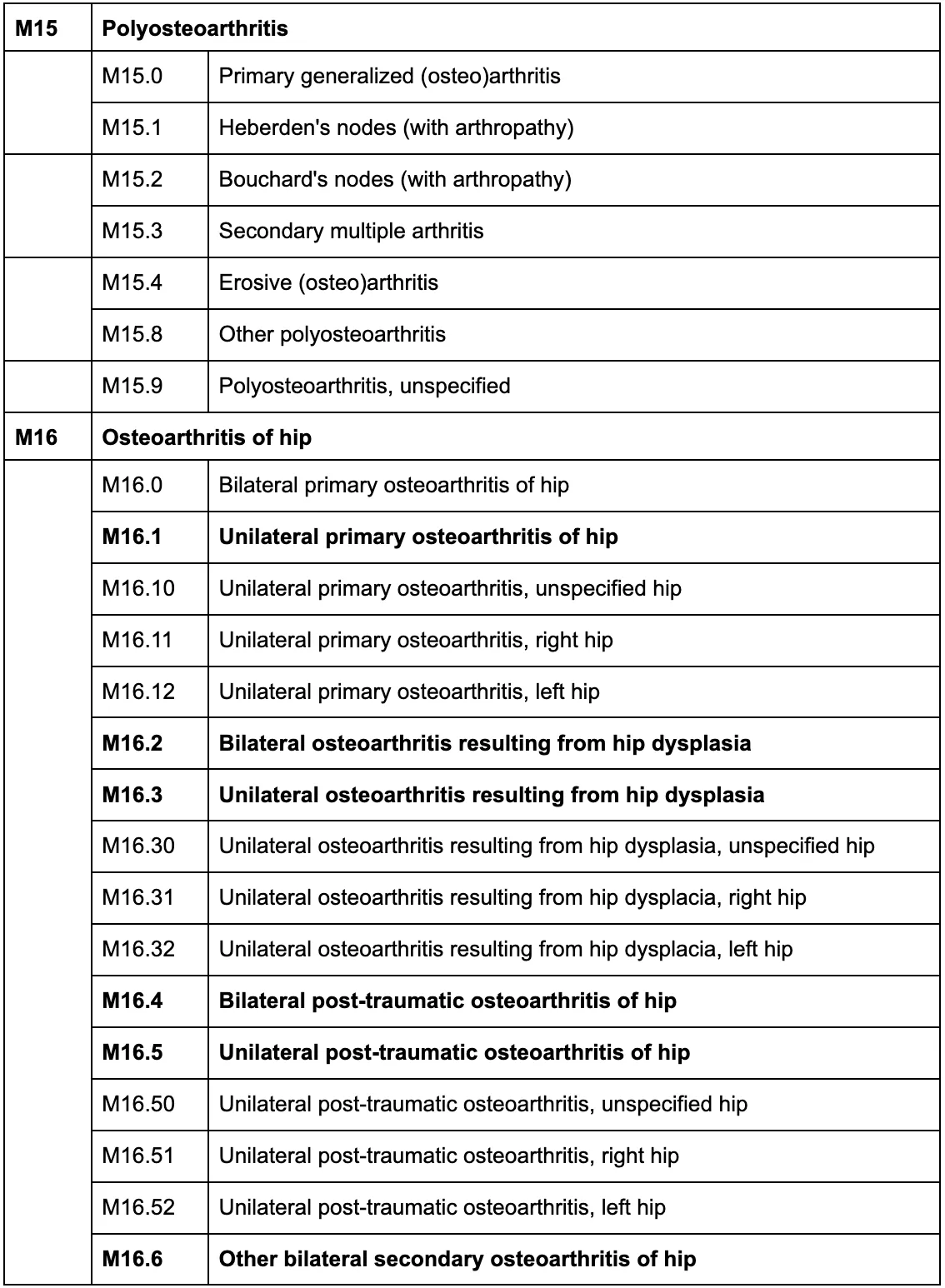
ICD-10 arthritis codes require a high degree of specificity regarding laterality, etiology, and the specific joints affected, moving far beyond the general descriptions used in previous coding systems. To code accurately in 2026, practitioners must document whether the condition is primary, secondary, or post-traumatic, while strictly adhering to "code first" conventions for underlying systemic diseases.
The transition to the International Classification of Diseases, 10th Revision (ICD-10), fundamentally changed how healthcare providers and medical billers approach the documentation of joint inflammation and degeneration. As we navigate the clinical landscape of 2026, the nuance required for these codes has become the benchmark for reimbursement and data accuracy. Arthritis is no longer a monolithic diagnosis; it is a complex web of site-specific and cause-specific identifiers. Understanding the intricacies of these codes is essential for reducing claim denials and ensuring that the patient's medical record reflects the true severity of their condition.
1. The Laterality Trap: Why "Unspecified" is a Financial Risk
One of the most significant shifts in the ICD-10-CM (Clinical Modification) system is the mandatory requirement for laterality. For almost every arthritis-related code, the provider must specify whether the condition affects the right side, the left side, or is bilateral. While this seems straightforward, it remains one of the most common points of failure in medical billing.
In the 2026 reimbursement environment, payers have increasingly automated their "unspecified" code filters. If a clinician documents "osteoarthritis of the knee" without specifying which knee, the resulting code (such as M17.9) is frequently flagged for manual review or immediate denial. The logic used by insurance carriers is that the clinical exam must have revealed which joint was symptomatic; therefore, an unspecified code represents incomplete documentation rather than a clinical reality.
Furthermore, bilateral codes (ending in .0) are not always a simple "shortcut." Some payers require the use of two separate codes—one for the right and one for the left—to trigger appropriate payment for bilateral procedures or injections. Providers must ensure that the electronic health record (EHR) reflects the specific joint to the highest level of detail to avoid these administrative hurdles.
2. The Hierarchy of "Code First" and Manifestation Rules
Arthritis is frequently a symptom or manifestation of an underlying systemic condition. ICD-10 maintains a strict "code first" hierarchy that surprises many who expect to lead with the joint pain diagnosis. For example, if a patient has arthritis due to Crohn’s disease or psoriasis, the underlying condition must be sequenced first.
This is particularly relevant for:
- Psoriatic Arthritis: You must code the psoriasis (L40.5 series) to identify the specific type of psoriatic arthropathy.
- Arthritis in Enteropathic Diseases: Conditions like Ulcerative Colitis or Crohn’s disease take precedence in the coding sequence over the joint manifestations.
- Systemic Lupus Erythematosus (SLE): The manifestation of arthritis is often bundled into the SLE code (M32 series), but specific joint complications may require secondary codes.
Failure to follow these sequencing rules in 2026 can lead to a "medical necessity" mismatch. If the primary code does not support the severity of the treatment (such as expensive biologic infusions), the claim may be rejected despite the arthritis being the reason for the visit.
3. The Specific Distinction Between Primary and Secondary Osteoarthritis
In ICD-10, the distinction between "primary" and "secondary" osteoarthritis (OA) is not merely academic; it is a clinical requirement for specific coding. Primary OA (often coded in the M15 to M19 range) refers to the "wear and tear" that occurs without a specific external trigger, typically associated with aging. Secondary OA, however, is caused by a pre-existing condition, such as a congenital deformity or a metabolic disorder.
A "surprising" detail for many is that post-traumatic osteoarthritis is categorized separately from both primary and secondary OA. If a patient develops arthritis in their ankle five years after a fracture, the coder must use the "post-traumatic" codes (e.g., M19.1 series). This requires the clinician to dig into the patient’s history to identify if a specific injury occurred at that site. From a data perspective in 2026, researchers use these distinctions to track the long-term outcomes of orthopedic surgeries and trauma interventions.
4. The Complexity of the "Multiple Sites" Convention
When a patient has arthritis in several different joints, coders often look for a "polyarthritis" or "multiple sites" code. However, the ICD-10-CM guidelines for the M15 series (Polyosteoarthritis) are more restrictive than they appear.
M15.0 (Primary generalized osteoarthritis) should only be used when the arthritis is present in multiple specific joint groups (such as the hands, spine, and knees simultaneously). If the patient only has arthritis in the left knee and the right hip, it is more accurate—and often required for billing—to code each site individually.
The "Multiple sites" code (often ending in .8) exists for some categories but is frequently excluded from the knee and hip sections. In these cases, there is no single code that covers both the hip and the knee; they must be reported as separate line items. This granularity ensures that if a patient receives a steroid injection in only one of those joints, the procedure code matches the specific diagnosis code for that exact location.
5. Gout Coding: Idiopathic vs. Lead-Induced vs. Drug-Induced
Gout is a form of inflammatory arthritis that received a massive expansion in ICD-10. One of the most surprising details is the sheer number of variations based on the cause of the uric acid buildup. Coding for gout (M10 and M1A series) now requires the professional to identify:
- The Cause: Is it idiopathic, due to renal impairment, drug-induced, or lead-induced?
- The Presence of Tophus: A "tophus" is a deposit of uric acid crystals. Whether a patient has tophaceous gout changes the code entirely.
- Laterality: Like other arthritis codes, the specific joint (e.g., the great toe, the ankle, the wrist) must be identified.
In 2026, the use of M1A (Chronic Gout) vs. M10 (Acute Gout) is a major focus for chronic care management. M1A codes require an additional character to specify whether there is a tophus present. This level of detail is used by payers to justify the long-term use of urate-lowering therapies (ULT) like allopurinol or febuxostat.
6. The Strict "Excludes1" vs. "Excludes2" Logic
The ICD-10 manual uses "Excludes" notes to prevent improper coding, and the distinction between "Excludes1" and "Excludes2" is a frequent source of confusion.
- Excludes1: This is a "pure" exclusion. It means "NOT CODED HERE." For example, you cannot code congenital osteoarthritis and acquired osteoarthritis for the same joint. They are mutually exclusive. If you report both, the claim will likely be rejected for a coding conflict.
- Excludes2: This means "NOT INCLUDED HERE," but the patient may have both conditions at the same time. An example would be a patient having both rheumatoid arthritis and osteoarthritis in the same joint. While rare, it is clinically possible, and an Excludes2 note allows both codes to be billed together if documented correctly.
Understanding these notes is vital for 2026 compliance. As EHR systems become more integrated, many will automatically block the entry of an "Excludes1" pair, but they may not always catch an "Excludes2" opportunity that could more accurately describe a complex patient’s status.
7. Site Specificity vs. Joint Specificity
A subtle but vital detail in the M-chapter of ICD-10 is the difference between a "site" and a "joint." For certain conditions, the code refers to the bone itself rather than the joint space. However, for arthritis, the focus is almost always on the articulation.
The "surprising" element here is how "Hand" arthritis is coded. Unlike the knee or hip, which are single joints, the "Hand" includes the carpus, metacarpus, and phalanges. ICD-10 provides specific codes for the "wrist" (M19.03) vs. the "hand" (M19.04). If the arthritis is specifically in the thumb (CMC joint), using a general "hand" code may be considered "under-coding." Providers in 2026 are encouraged to use the most distal site description available to justify specialized treatments like hand therapy or small-joint injections.
Comparison Table: Common Arthritis ICD-10 Code Structures
| Arthritis Type | ICD-10 Category | Key Requirement for 2026 | Laterality Required? |
|---|---|---|---|
| Rheumatoid Arthritis | M05 - M06 | Must specify Rheumatoid Factor (RF) status | Yes |
| Primary Osteoarthritis | M15 - M19 | Must specify the exact joint (Knee, Hip, etc.) | Yes |
| Post-traumatic OA | M19.1 | Requires documentation of a prior injury | Yes |
| Psoriatic Arthritis | L40.5 | Code psoriasis first; specify joint type | Yes |
| Gout (Chronic) | M1A | Must specify presence or absence of tophi | Yes |
| Polyosteoarthritis | M15 | Used only for generalized involvement | No (Systemic) |
Frequently Asked Questions
Can I use a single code for bilateral arthritis of the knees?
Yes, in ICD-10-CM, many arthritis codes include a specific character for "bilateral." For example, M17.0 is the code for bilateral primary osteoarthritis of the knee. However, you must verify with specific 2026 payer guidelines, as some private insurers still prefer the use of separate right (M17.11) and left (M17.12) codes to match their internal processing for surgical authorizations.
What is the difference between M05 and M06 in Rheumatoid Arthritis?
The primary difference is the presence of the rheumatoid factor (seropositivity). M05 codes are used for "Seropositive rheumatoid arthritis," which often implies a more aggressive disease course or extra-articular manifestations (like involvement of the lungs or heart). M06 is for "Other rheumatoid arthritis," which includes seronegative cases. Accurate distinction is critical for justifying the use of high-cost biologic medications.
Why was my claim denied for "unspecified" arthritis when I listed the joint?
This usually occurs because of a mismatch between the descriptor and the code. Even if you write "Arthritis of the Right Knee," if the coder selects M17.9 (Osteoarthritis of knee, unspecified), the insurance software will flag it. In 2026, many clearinghouses automatically reject codes ending in "9" (unspecified) or "0" (unspecified site) if more specific options are available in that category.
Does ICD-10 distinguish between localized and generalized arthritis?
Yes. Generalized osteoarthritis (M15.0) involves multiple joints across different areas of the body, whereas localized osteoarthritis (M16 for hip, M17 for knee, M18 for first carpometacarpal joint) focuses on a specific anatomical location. You should only use the generalized code if the clinical documentation supports widespread involvement rather than just multiple joints in a single extremity.
How do I code arthritis caused by a previous ligament tear?
This is classified as post-traumatic osteoarthritis. You should look at the M19.1 series. For example, M19.141 would be "Post-traumatic osteoarthritis, right hand." It is important to link the current arthritis to the previous trauma in the medical record to justify this specific code.
Practical Recommendations for 2026 Compliance
To ensure your arthritis coding remains accurate and reimbursable, focus on these three actions:
- Refine Clinical Documentation: Ensure that every note clearly states the laterality (Right/Left) and the specific joint (e.g., "acromioclavicular joint" vs. just "shoulder").
- Verify Etiology: Always check the patient's history for prior trauma or systemic diseases (like Psoriasis or Crohn's) that would require a "code first" sequence or a "post-traumatic" designation.
- Update EHR Templates: If your 2026 EHR still allows "unspecified" as a default option for arthritis, update your templates to require a laterality selection before the note can be finalized. This simple step can reduce claim denials by up to 30% in a typical orthopedic or rheumatology practice.
For more detailed coding guidelines, professionals should consult the official CMS ICD-10-CM Resources or the CDC’s National Center for Health Statistics.