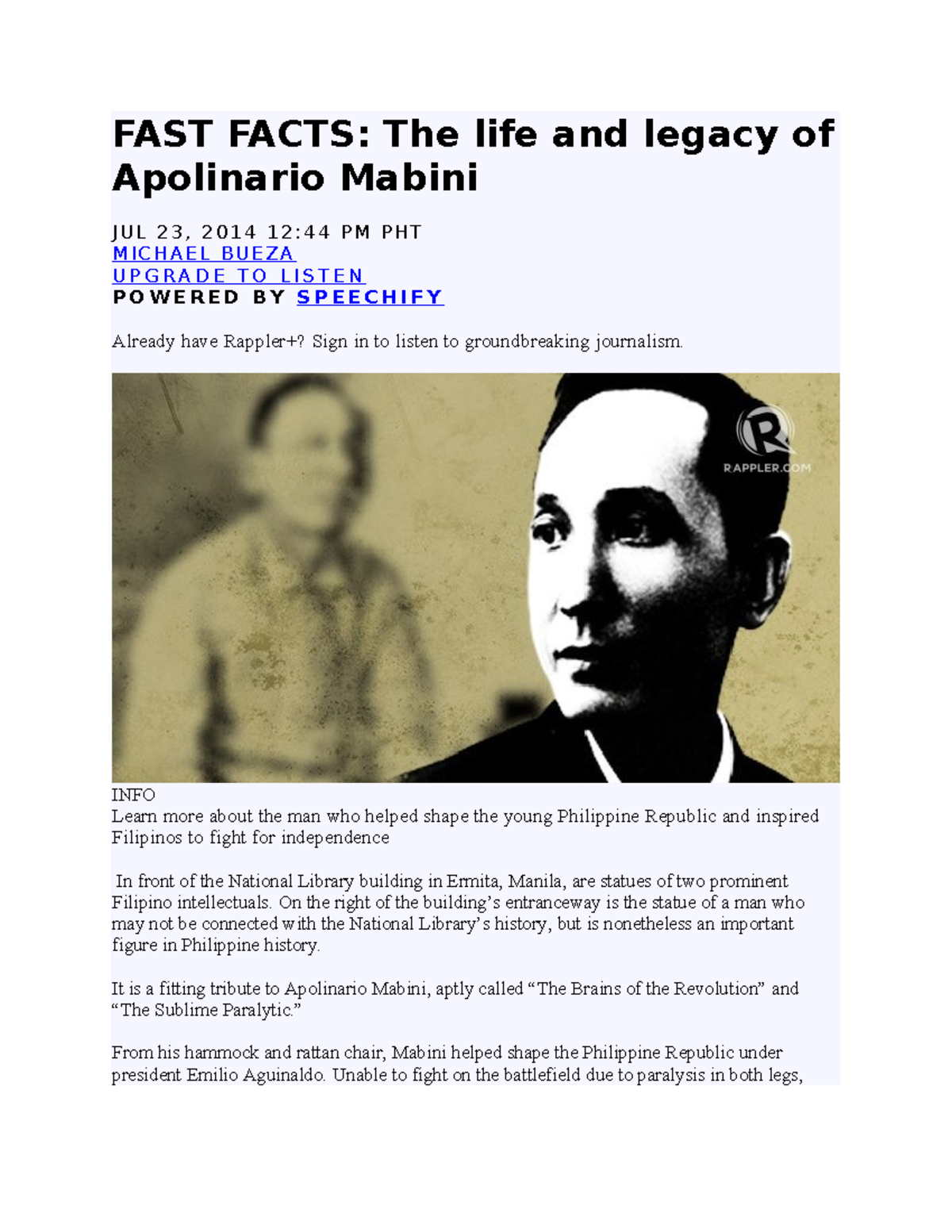
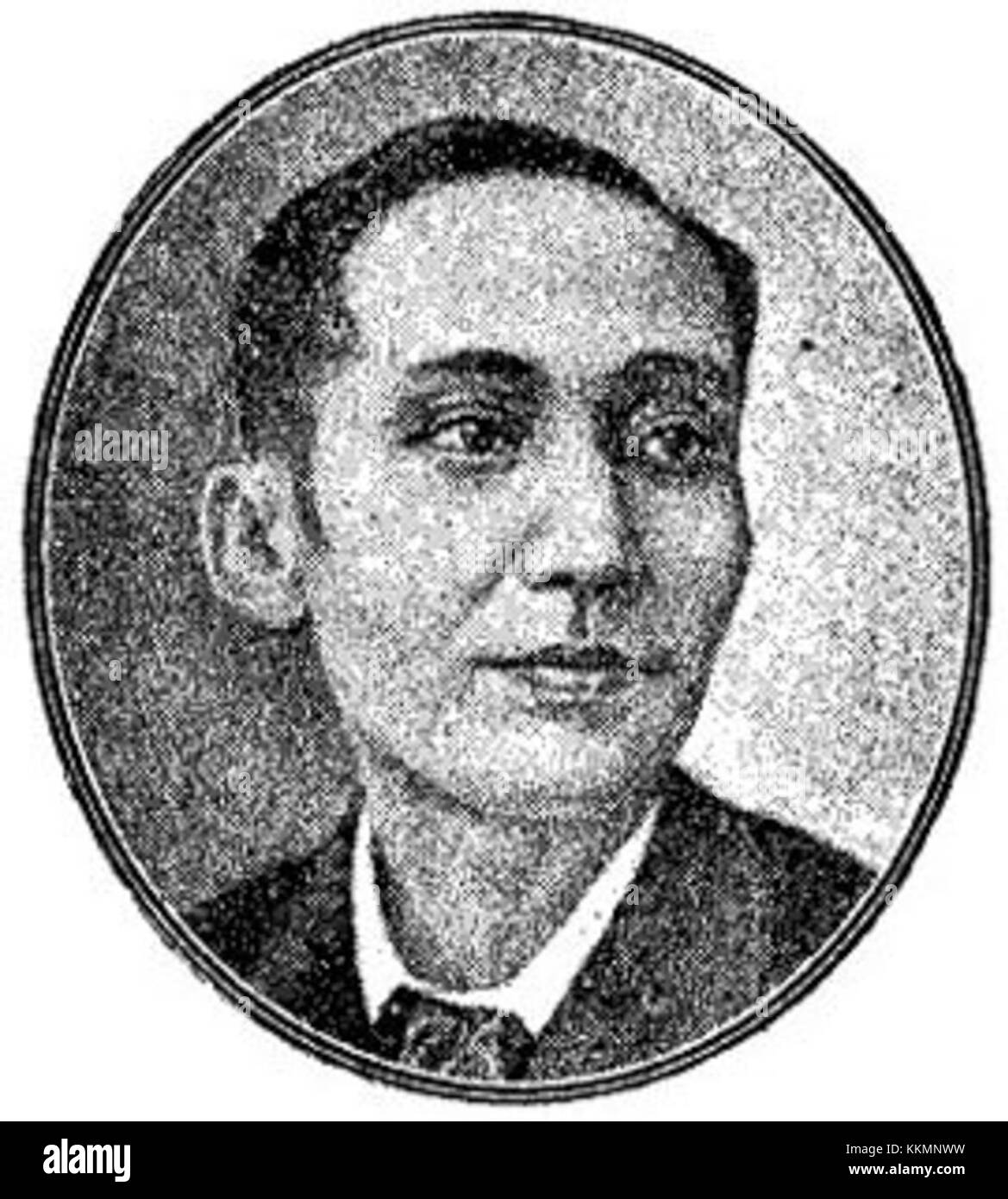
Apolinario Mabini was a Filipino legal scholar, statesman, and political philosopher who served as the first Prime Minister and Minister of Foreign Affairs of the First Philippine Republic. Known historically as the "Brain of the Revolution" and the "Sublime Paralytic," Mabini crafted the constitutional frameworks, decrees, and ethical treatises that guided the nation's fight for independence from Spain and the United States.
Early Life, Education, and Intellectual Foundations
Apolinario Mabini y Maranan was born on July 23, 1864, in the rural village of Talaga in Tanauan, Batangas. Raised in modest circumstances by his father, Inocencio Mabini, an uneducated peasant farmer, and his mother, Dionisia Maranan, a market vendor, Mabini displayed exceptional intellectual aptitude from an early age. His mother initially hoped he would enter the priesthood, but Mabini was drawn to the law, viewing it as a vehicle to address the institutional injustices suffered by Filipinos under Spanish colonial rule.
Mabini worked his way through school by tutoring wealthier students and serving as a stenographer. He completed his secondary education at the Colegio de San Juan de Letran in Manila, where he earned a Bachelor of Arts degree with high honors. He subsequently enrolled at the University of Santo Tomas (UST) to pursue a legal degree. In 1894, Mabini earned his Licentiate in Law and passed the bar examinations, establishing himself as a meticulous legal reasoner and draftsperson.
During his university years, Mabini engaged deeply with Enlightenment political philosophy, European constitutional law, and the writings of contemporary Filipino reformists. He joined the reform movement seeking administrative, educational, and political rights for Filipinos within the Spanish empire. Mabini became an active member of La Liga Filipina, an organization founded by Dr. José Rizal in 1892 to promote civic solidarity and socio-economic reforms. When the League fractured into conservative and radical factions, Mabini served as secretary for the Cuerpo de Compromisarios, attempting to maintain financial support for Filipino reformist writers published in Spain's La Solidaridad. Mabini also joined the Freemasons through the Luz de Oriente lodge, where he absorbed secular ideas regarding statecraft, civil liberty, and religious freedom that later defined his political career.
The Sublime Paralytic: Physical Disability and Revolutionary Awakening
In early 1896, before the outbreak of open armed rebellion, Mabini contracted an illness that caused total paralysis in both of his legs. Historical consensus attribute this condition to poliomyelitis, though earlier popular accounts speculated on severe rheumatoid arthritis. Despite losing the ability to walk at age 31, Mabini’s mental clarity and administrative capacity remained unimpaired.
- 1896: Onset of Polio Paralysis
- 1896-1897: Imprisonment at San Juan de Dios
- 1898: Chief Adviser to Emilio Aguinaldo
- 1899: First Prime Minister & Cabinet President
- 1901-1903: Exile in Guam & Final Writings
When the Katipunan—a secret revolutionary society led by Andrés Bonifacio—launched an armed uprising against Spanish rule in August 1896, Spanish authorities swept up suspected dissidents across Luzon. Mabini was arrested due to his former involvement with La Liga Filipina and his Masonic ties. Owing to his physical paralysis, Spanish authorities detained him at the Hospital de San Juan de Dios in Manila rather than executing or imprisoning him in Fort Santiago alongside other political prisoners.
His confinement spared him from the mass executions of late 1896 and early 1897. Released during a general amnesty issued by Governor-General Primo de Rivera in mid-1897, Mabini retired to the sulfurous hot springs of Los Baños, Laguna, to recuperate. During this period of isolation, Mabini synthesized his views on statecraft. Observing the collapse of Spanish administrative authority and the signing of the Pact of Biak-na-Bato between General Emilio Aguinaldo and colonial authorities, Mabini concluded that minor political reforms were insufficient. He embraced full national sovereignty as the only viable political path for the Philippines.
Prime Minister and Architect of the First Republic
Following the outbreak of the Spanish-American War in April 1898, General Emilio Aguinaldo returned from exile in Hong Kong to resume the revolutionary campaign. Recognizing the need for sophisticated constitutional guidance to transform a guerrilla insurgency into a legitimate nation-state, Aguinaldo summoned Mabini to his headquarters in Cavite in June 1898. Mabini arrived carried on a hammock, establishing a partnership that placed him at the center of the nascent government.
Mabini drafted the primary executive decrees that transformed Aguinaldo's temporary dictatorial regime into a formal Revolutionary Government on June 23, 1898. He established executive departments, organized local municipal assemblies, built a national tax collection framework, and designed an indirect electoral process for provincial delegates. Through these measures, Mabini sought to present foreign powers with evidence that the Filipino people possessed a functioning, orderly governance structure capable of upholding international law.
| Mabini's Administrative Matrix (1898-1899) |
|---|
| 1. EXECUTIVE DIRECTION: Directing foreign affairs, treaties, and executive decrees |
| 2. MUNICIPAL & PROVINCIAL REORGANIZATION: Establishing local civilian elections |
| 3. JUDICIAL FRAMEWORK: Formulating interim codes of procedure and civil justice |
| 4. DIPLOMATIC STRATEGY: Seeking international recognition of Filipino sovereignty |
When the Malolos Republic (the First Philippine Republic) was formally inaugurated in January 1899, Mabini was appointed President of the Cabinet—a position equivalent to Prime Minister—and Minister of Foreign Affairs. In this role, he directed internal governance, managed legal administration, and spearheaded diplomatic efforts to secure foreign recognition of Philippine independence.
Mabini frequently clashed with the conservative, wealthy elites (ilustrados) in the Malolos Congress led by Pedro Paterno and Felipe Buencamino. While Paterno and his allies favored a strong parliament to protect upper-class economic interests, Mabini advocated for a robust executive branch capable of swift, decisive governance during wartime. Mabini warned that an overbearing legislative body composed of wealthy landowners would destabilize the state while the nation faced foreign invasion. Political pressure from these conservative factions led to Mabini's resignation from the cabinet in May 1899. Despite his resignation, he remained a key legal adviser to the revolutionary movement.
Core Political Philosophy and Written Works
Mabini’s legacy rests on his foundational political, moral, and legal writings, which articulated a clear vision of democratic republicanism tailored to the Philippine context.
- Mabini's Intellectual Canon
- "El Verdadero Decálogo" (Moral & Civic Code)
- "Programa Constitucional" (Legal Governance Draft)
- "La Revolución Filipina" (Historical & Political Critique)
El Verdadero Decálogo (The True Decalogue)
Published in May 1898, El Verdadero Decálogo was designed to serve as a moral foundation for Filipino citizenship. Mabini believed that a successful political revolution required a simultaneous moral and civic transformation. Written in direct, imperative language, the document outlines ten fundamental commandments emphasizing love of God, personal integrity, national unity, and civic obligation.
Mabini famously declared that love of country must supersede regional and linguistic divisions, framing patriotism as a moral duty. He argued that independence was not merely an absolute separation from foreign rule, but the realization of individual liberty balanced by collective responsibility under the rule of law.
Programa Constitucional de la República Filipina
Drafted in 1898, Mabini's Constitutional Program of the Philippine Republic was an exhaustive draft constitution containing 130 detailed articles. The document drew upon Western democratic traditions while addressing unique local realities. Key provisions included:
- Separation of Church and State: Absolute legal division between ecclesiastical authorities and civil governance, a radical departure from three centuries of Spanish friar rule.
- Civil Liberties: Robust protections for free speech, freedom of the press, rights of assembly, and security against arbitrary search and arrest.
- Universal Primary Education: Free, compulsory public education managed by the state, which Mabini identified as necessary for a functioning democracy.
- Judicial Independence: A supreme court and lower tribunal hierarchy free from political interference by executive or legislative branches.
Although the Malolos Congress ultimately adopted a alternative draft written by Felipe Calderón, significant elements of Mabini’s legal philosophy influenced the administrative regulations of the short-lived republic.
La Revolución Filipina (The Philippine Revolution)
Written between 1901 and 1903 while imprisoned by American forces on the island of Guam, La Revolución Filipina is Mabini's masterwork of contemporary history and political critique. In this text, he provides an insider account of the revolution's origins, military victories, internal politics, and final defeat.
Mabini offered an uncompromising critique of the revolutionary leadership. He directly attributed the military failure of the republic to internal political divisions, moral shortcomings, and strategic errors by Emilio Aguinaldo. Mabini severely criticized the execution of Andrés Bonifacio and the assassination of General Antonio Luna, arguing that these actions eroded national unity, undermined military discipline, and compromised the moral integrity of the revolutionary leadership.
SUMMARY OF MABINI'S MAJOR WRITINGS
| Document Title | Year | Primary Focus & Core Contribution |
|---|---|---|
| El Verdadero Decálogo | 1898 | Civic ethics, national solidarity, moral duties |
| Ordenanzas de la Revolución | 1898 | Military discipline, civil-military administration |
| Programa Constitucional de la Rep. | 1898 | Separation of powers, civil rights, secular education |
| Contestación a las Preguntas... | 1899 | Legal arguments against U.S. territorial acquisition |
| La Revolución Filipina | 1903 | Critical historical analysis of revolutionary failures |
Resistance to American Imperialism, Exile, and Final Years
When the Philippine-American War erupted in February 1899, Mabini used his political writings to counter American claims of "benevolent assimilation." Writing for national newspapers and issuing diplomatic responses to the Schurman Commission, Mabini insisted that true peace required the unconditional recognition of Philippine sovereignty.
As American forces advanced across Central Luzon in late 1899, Mabini fled alongside the retreating government, continuing to draft state documents while traveling by litter. U.S. forces captured him in Cuyapo, Nueva Ecija, on December 10, 1899. Held as a prisoner of war in Manila, Mabini continued writing essays and articles criticizing the U.S. military occupation.
- December 1899: Captured in Nueva Ecija
- January 1901: Exiled to Asan, Guam
- February 1903: Takes Oath of Allegiance
- May 13, 1903: Passes away in Manila
Refusing to subscribe to the oath of allegiance to the United States required for release, Mabini was designated an irreconcilable insurgent leader. In January 1901, military authorities deported Mabini alongside 35 other revolutionary figures—including Artemio Ricarte, Pablo Ocampo, and Maximo Hizon—to a prison camp in Asan, Guam.
During his two-year exile in Guam, Mabini lived in harsh, rudimentary conditions. Deprived of political news and physical assistance, he spent his time writing La Revolución Filipina and refining his legal treatises.
By early 1903, Mabini's health had deteriorated severely. Desiring to return to his homeland to die, he reluctantly agreed to take the oath of allegiance to the United States on February 26, 1903, aboard the USS Thomas before landing in Manila. Upon his arrival, the American colonial administration offered Mabini a high-ranking position within the government, but he refused, preferring to live quietly in his modest nipa hut in Nagtahan, Manila.
On May 13, 1903, during a cholera epidemic that struck the capital, Mabini contracted the disease and died at the age of 38.
Historical Impact and Legacy
Apolinario Mabini's intellectual contributions established foundational concepts for modern Philippine statecraft, legal reform, and constitutional law. Historians and political scientists assess his legacy through several key dimensions:
- Mabini's Historical Legacy
- Ethical Leadership: Uncompromising moral integrity in governance
- Constitutional Thought: Early framework for Philippine democracy
- Anti-Imperialist Theory: Rigorous legal defense of national self-determination
- Ethical Leadership: Mabini maintained an unblemished reputation for fiscal honesty and public integrity during a period marked by political corruption and factionalism. His refusal to compromise core principles for personal wealth or political office made him an enduring model for public ethics.
- Constitutional Thought: Mabini introduced modern legal principles into the early governance structure of the Philippines, emphasizing separation of powers, secular state administration, and fundamental civil rights.
- Anti-Imperialist Theory: His diplomatic correspondence and essays offered a clear legal critique of late 19th-century colonial expansion, asserting that sovereignty resides innately in the people rather than in imperial treaties.
Mabini's writings remain standard reading in Philippine law, political science, and history curricula. His birthplace in Tanauan, Batangas, and his residence in Manila are maintained as national shrines managed by the National Historical Commission of the Philippines, preserving primary documents and artifacts associated with his life.
Key Milestones and Educational Background
| Category | Details / Historical Facts |
|---|---|
| Date & Place of Birth | July 23, 1864 – Talaga, Tanauan, Batangas, Philippine Islands |
| Date & Place of Death | May 13, 1903 (aged 38) – Nagtahan, Manila, Philippine Islands |
| Primary Monikers | "Brain of the Revolution" (Utak ng Himagsikan), "Sublime Paralytic" (Dakilang Paralitiko) |
| Higher Education | Bachelor of Arts (Colegio de San Juan de Letran); Licentiate in Law (University of Santo Tomas, 1894) |
| Government Posts | President of the Cabinet (Prime Minister), Minister of Foreign Affairs (January 1899 – May 1899) |
| Major Literary Works | El Verdadero Decálogo (1898), Programa Constitucional de la República Filipina (1898), La Revolución Filipina (1903) |
| Key Political Affiliations | La Liga Filipina, Cuerpo de Compromisarios, First Philippine Republic Government |
| Period of Deportation | January 1901 – February 1903 (Asan, Guam) |
Frequently Asked Questions
Why is Apolinario Mabini called the "Brain of the Revolution"?
Apolinario Mabini earned the title "Brain of the Revolution" because he formulated the legal, administrative, and strategic policies of the First Philippine Republic. While military figures led forces on the battlefield, Mabini authored the executive orders, constitutional frameworks, and diplomatic correspondence that organized the revolutionary movement into a functioning state recognized by civil law.
What caused Mabini's physical disability?
Historical and medical consensus confirms that Mabini's paralysis was caused by poliomyelitis, which he contracted in early 1896 at the age of 31. The disease left both of his legs permanently paralyzed. Despite persistent urban legends claiming his paralysis resulted from alternative causes, physical examinations and modern medical assessments confirm polio as the cause.
What were the primary differences between Mabini and the Malolos Congress?
Mabini advocated for a strong executive branch to maintain administrative control, military efficiency, and national security during wartime. Conversely, the majority in the Malolos Congress, led by elite ilustrados such as Pedro Paterno and Felipe Calderón, sought a dominant legislative branch to limit executive authority and protect parliamentary and economic privilege. Mabini also strongly advocated for the complete separation of church and state, which generated intense debate among conservative delegates.
Why was Mabini exiled to Guam by the United States?
Following his capture in December 1899, Mabini refused to sign an oath of allegiance acknowledging U.S. sovereignty over the Philippines, arguing that taking such an oath under military coercion was ethically invalid. Because his writings continued to inspire resistance against U.S. forces, military Governor Arthur MacArthur Jr. designated Mabini an irreconcilable leader and ordered his deportation to Guam in January 1901.
What is the central message of El Verdadero Decálogo?
El Verdadero Decálogo (The True Decalogue) argues that political independence requires an ethical transformation of individual citizens. The ten principles emphasize love of God, personal integrity, defense of human rights, national unity, and civic duty, framing patriotism as a moral responsibility to establish a just and sovereign society.
Guidance for Researchers and Historians
For researchers studying the primary sources of the Philippine Revolution, reviewing Mabini’s complete legal drafts provides insight into 19th-century legal philosophy and anti-colonial political thought.
- Access Primary Texts: Read annotated translations of La Revolución Filipina and El Verdadero Decálogo available through national archival programs and official history portals, such as the Official Gazette of the Republic of the Philippines.
- Examine Legal Archives: Consult primary documents archived at the National Library of the Philippines and international repositories such as the Library of Congress to review original diplomatic letters written during the Philippine-American War.
- Analyze Comparative Constitutional Models: Compare Mabini's Programa Constitucional against the 1899 Malolos Constitution to evaluate how different revolutionary factions approached executive power, religious freedom, and land reform.