To respond to a debt collection lawsuit in Texas, you must file a formal written Answer with the court named on your citation before the statutory deadline. Your response should include a General Denial under Texas Rules of Civil Procedure Rule 92, any relevant Affirmative Defenses (such as the four-year statute of limitations), a Certificate of Service, and your signature.
Disclaimer: This guide is provided for educational and informational purposes only and does not constitute formal legal advice. Court rules and filing procedures can change, and individual case circumstances vary. If you require legal representation or advice specific to your case, consult a licensed attorney in Texas.
Understanding Texas Debt Collection Lawsuits and Deadlines
When a debt collector or debt buyer files a lawsuit against you in Texas, the court issues a formal document called a Citation along with the lender’s Original Petition. Receiving these documents means a legal action has officially commenced. Ignoring the suit is the most costly mistake a defendant can make, as it allows the plaintiff to obtain a Default Judgment. A default judgment gives the debt collector legal authority to seek post-judgment remedies, such as freezing bank accounts via a writ of garnishment or placing liens on real property.
Your primary protection against a default judgment is filing an Answer with the court within the mandated deadline. The exact timeframe to file your written response depends entirely on which court level is handling the case.
- Texas Debt Collection Lawsuit Answer Deadlines
- Justice Court (JP) (Debt Claim Cases up to $20,000)
- 14 Calendar Days from Service (Due by 5:00 p.m. on 14th day)
- County / District Court (Claims exceeding JP limit)
- Monday following 20 Days (Due by 10:00 a.m. on that Monday)
- Justice Court (JP) (Debt Claim Cases up to $20,000)
Justice Court (Justice of the Peace) Deadlines
Most consumer debt collection suits involving amounts up to $20,000 are filed in Justice Court as Debt Claim Cases. Under Texas Rules of Civil Procedure Rule 502.5, your written Answer must be filed by 5:00 p.m. on the 14th day following the date you were served with the citation.
If the 14th day falls on a Saturday, Sunday, or official court holiday, your answer is due on the next business day by 5:00 p.m.
County and District Court Deadlines
If the suit is filed in a County Court at Law or District Court, the deadline calculation follows Texas Rules of Civil Procedure Rule 99. Your Answer is due by 10:00 a.m. on the Monday next following the expiration of 20 days from the date of service.
To calculate this deadline:
- Start counting on the day after you received the citation (Day 1).
- Count 20 full calendar days.
- Move forward to the very next Monday. Your Answer must be filed before 10:00 a.m. on that Monday.
Key Components of a Texas Answer to a Debt Lawsuit
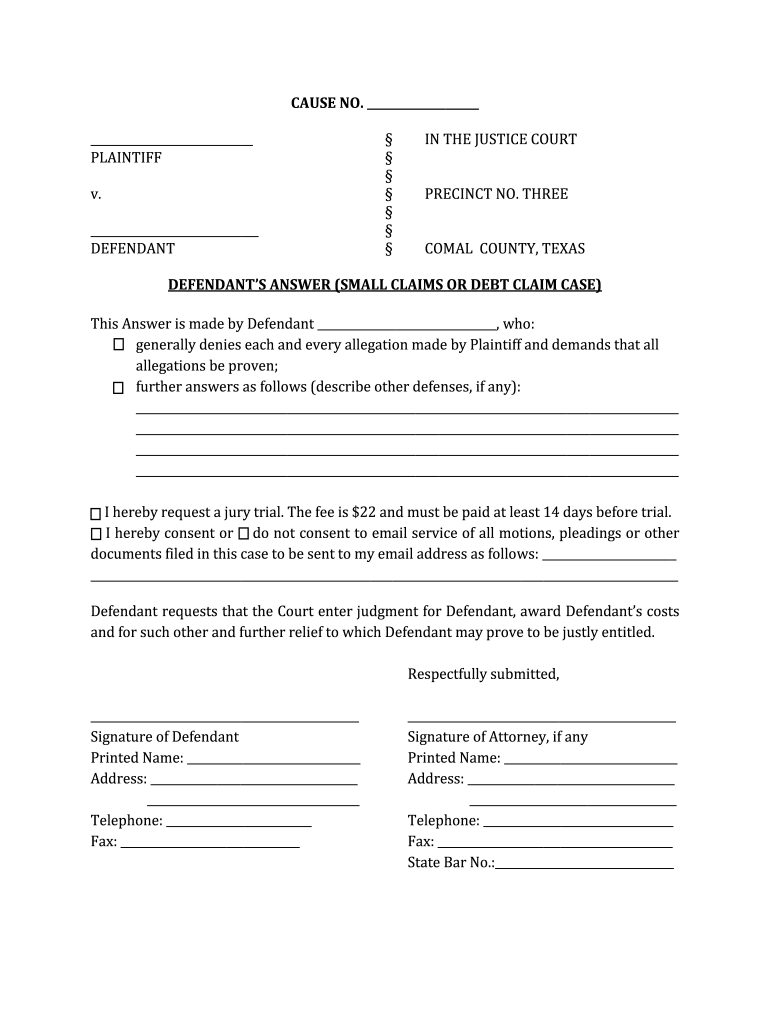
A standard Answer in Texas civil procedure does not require an exhaustive explanation of your personal financial history. Instead, it serves as a formal entry of appearance and legal notice to the court and plaintiff that you contest the claims. A properly drafted Answer contains five main sections:
1. The Caption (Header)
The top of your Answer document must match the heading of the lawsuit papers served upon you. This ensures the court clerk routes the document to the correct case file. The caption includes:
- The Court Number and County (e.g., In the Justice Court, Precinct 1, Place 2, Harris County, Texas).
- The Cause Number (Case Number).
- The full names of the Plaintiff (the creditor or debt buyer suing you) and the Defendant (you).
2. General Denial (TRCP Rule 92)
Under Texas Rules of Civil Procedure Rule 92, a General Denial is a broad defense that puts the plaintiff to its proof. By pleading a general denial, you inform the court that you deny all allegations in the plaintiff's petition and demand that the plaintiff prove every element of its claim by a preponderance of the evidence.
In Texas, a simple sentence stating, * "Defendant enters a general denial of each and every allegation contained in Plaintiff's Original Petition"* is legally sufficient to prevent a default judgment.
3. Affirmative Defenses (TRCP Rule 94)
An Affirmative Defense is an assertion that, if proven true, defeats or mitigates the plaintiff's legal claim—even if the underlying facts of the original petition were true. Under Rule 94, affirmative defenses must be specifically set forth in your initial Answer or an amended response filed before trial. Common affirmative defenses include the statute of limitations, lack of standing, and payment.
4. Sworn / Verified Denials (TRCP Rule 93)
Certain defenses in Texas must be verified under oath (signed before a notary public) to be valid at trial. Under Rule 93 and Rule 185 (which governs suits on sworn accounts), if a debt buyer sues based on an "Account Stated" or "Sworn Account," you must include a verified denial stating that the account or claim is not just or true, in whole or in part. Failing to file a verified denial when required may prevent you from challenging the accuracy or ownership of the account during trial.
5. Certificate of Service and Signature
Under Texas Rule of Civil Procedure 21a, every pleading filed with the court must be served on all other parties to the lawsuit. You must include a signed Certificate of Service at the bottom of your Answer stating when and how you provided a copy of the document to the plaintiff’s legal counsel.
Example Format of an Answer in Texas (Justice Court Template)
Below is an example template illustrating how an Answer is typically formatted for a Texas Justice Court debt collection lawsuit. This example demonstrates the essential structure required by Texas court rules.
CAUSE NO. DC-2026-12345
CREDIT ACCEPTANCE CORP., § IN THE JUSTICE COURT Plaintiff, § § v. § PRECINCT 1, PLACE 1 § JANE DOE, § Defendant. § TRAVIS COUNTY, TEXAS
DEFENDANT'S ORIGINAL ANSWER
TO THE HONORABLE JUDGE OF SAID COURT:
COMES NOW Defendant, Jane Doe, appearing pro se in the above-styled and numbered cause, and files this Original Answer to Plaintiff's Original Petition, respectfully showing the Court as follows:
I. GENERAL DENIAL
Defendant denies each and every, all and singular, the material allegations contained in Plaintiff's Original Petition and demands strict proof thereof by a preponderance of the evidence as required by the Texas Rules of Civil Procedure.
II. AFFIRMATIVE DEFENSES
By way of further answer, if such be necessary, Defendant asserts the following affirmative defenses:
Statute of Limitations: Plaintiff's claims are barred, in whole or in part, by the applicable four-year statute of limitations set forth in Texas Civil Practice and Remedies Code § 16.004.
Lack of Standing: Plaintiff is an alleged third-party debt buyer and has failed to demonstrate a complete, un-broken chain of assignment establishing ownership of the specific account at issue.
III. PRAYER
WHEREFORE, PREMISES CONSIDERED, Defendant requests that Plaintiff take nothing by this suit, that Plaintiff's claims be dismissed with prejudice, and that Defendant be granted all such other and further relief, at law or in equity, to which Defendant may be justly entitled.
Respectfully submitted, /s/ Jane Doe Jane Doe 123 Main Street Austin, TX 78701 Phone: (512) 555-0199 Email: janedoe@example.com Defendant Pro Se CERTIFICATE OF SERVICE
I hereby certify that a true and correct copy of the foregoing Defendant's Original Answer was served on Plaintiff's attorney of record in accordance with Rule 21a of the Texas Rules of Civil Procedure via certified mail, return receipt requested, on this 15th day of February, 2026:
Attorney Name Collection Law Firm LLP 456 Legal Way, Suite 100 Dallas, TX 75201 Counsel for Plaintiff
/s/ Jane Doe Jane Doe
Common Affirmative Defenses in Texas Debt Collection Cases
When preparing your Answer, asserting applicable defenses early is critical. If an affirmative defense is not raised in your written pleadings, the judge may refuse to allow evidence supporting that defense at trial.
| Affirmative Defense | Statutory / Legal Basis | Overview & Required Evidence |
|---|---|---|
| Statute of Limitations | Tex. Civ. Prac. & Rem. Code § 16.004 | Texas has a strict four-year statute of limitations for breach of contract and debt collection. The four-year clock generally starts on the date of default (usually 30 days after the last missed payment). |
| Lack of Standing / Assignment | Texas Common Law / Contract Law | Common when third-party debt buyers (e.g., Portfolio Recovery Associates, Midland Credit Management) purchase defaulted debt. The debt buyer must produce evidence of the bill of sale showing your specific account was transferred. |
| Payment / Accord & Satisfaction | Tex. R. Civ. P. 94 / Tex. Bus. & Com. Code § 3.311 | Applies if you paid the debt in full, or if the original creditor accepted a settled amount as payment in full. Requires proof such as canceled checks or written settlement agreements. |
| Failure of Consideration | Tex. R. Civ. P. 93 & 94 | Applies if the original lender failed to perform their contractual obligation (e.g., never disbursed funds or provided broken goods/services). Requires a verified plea under Rule 93. |
| Identity Theft / Fraud | Tex. Bus. & Com. Code § 521.051 | Applies if the account was opened fraudulently by a third party. Supported by police reports, identity theft affidavits, and FTC fraud reports. |
Deep-Dive: The Texas 4-Year Statute of Limitations
Under Texas law, the statute of limitations for debt collection actions based on debt or breach of contract is four years. If a collection firm files a lawsuit after four years from the date of cause of action accrual (the default date), the debt is legally uncollectible through judicial proceedings.
Be cautious regarding actions that can restart the limitations period. Under Texas Civil Practice and Remedies Code § 16.065, an acknowledgment of the debt can reset the four-year clock, but only if the acknowledgment is in writing and signed by the party to be charged. Making a partial payment or signing a debt acknowledgment after the four years has elapsed can unintentionally revive an unenforceable debt under certain circumstances.
Deep-Dive: Lack of Standing and Chain of Custody
Debt buyers purchase portfolios of charged-off debt for pennies on the dollar. However, to maintain a lawsuit against you in a Texas court, the debt buyer must establish that it legally owns your specific account.
A generalized bill of sale stating that the original bank sold "a portfolio of accounts" to an intermediary is legally insufficient unless accompanied by a specific schedule or appendix linking your account number, social security number, and balance to that assignment. Pleading Lack of Standing forces the plaintiff to produce verified business records proving every transfer in the chain of ownership.
Step-by-Step Instructions to File and Serve Your Answer
Filing your response properly requires adhering strictly to procedural rules. Follow these steps to complete the process:
- Step 1: Draft Answer & Verification
- Include Caption, General Denial, & Affirmative Defenses
- Sign before Notary (if Sworn Denial is required under Rule 93/185)
- Step 2: File with the Court Clerk
- Option A: In-person filing at courthouse clerk's office
- Option B: E-filing via eFileTexas.gov
- Option C: Certified mail (where permitted by court rules)
- Step 3: Serve the Plaintiff's Counsel (TRCP Rule 21a)
- Send via eFileTexas, Certified Mail (RRR), or Hand Delivery
- Fill out & attach Certificate of Service to Court Copy
- Step 4: Confirm Entry & Maintain Records
- Obtain file-stamped copy from Clerk
- Retain Certified Mail green card / eFile confirmation receipt
Step 1: Complete and Verify Your Answer Document
Fill in your caption, general denial, and affirmative defenses using the template format. If the plaintiff sued under a "sworn account" claim or if you are asserting defenses under Rule 93, execute a verification clause before a licensed notary public before filing.
Step 2: File the Answer with the Court Clerk
You must submit your completed Answer to the court clerk listed on your original citation:
- In Person: Take your original Answer plus two extra copies to the court clerk's office. The clerk will stamp all copies with the official date and time, retain the original for the case file, and hand back stamped copies for your records.
- Online via eFileTexas: Texas mandated electronic filing for attorneys, and self-represented litigants can also use the state's official electronic filing portal at eFileTexas.gov. Electronic filing automatically records the submission timestamp.
- By Mail: If filing by mail, send the original via USPS Certified Mail with Return Receipt Requested. Ensure the document is mailed far enough in advance to arrive at the court before the deadline hour.
Step 3: Serve a Copy on the Plaintiff’s Attorney
Under Rule 21a of the Texas Rules of Civil Procedure, you must send a copy of your filed Answer to the plaintiff’s lawyer (or directly to the plaintiff if they do not have legal representation). Acceptable service methods include:
- Electronic service through eFileTexas.gov (most reliable).
- USPS Certified Mail, Return Receipt Requested.
- Commercial delivery services (e.g., FedEx, UPS) with tracking capabilities.
- Hand delivery to the attorney's physical office address.
Step 4: Secure Proof of Filing and Service
Keep a filed-stamped copy of your Answer alongside your postal receipt or electronic confirmation notification. If a dispute arises regarding whether you filed on time, your file-stamped copy and proof of service serve as definitive evidence in court.
What Happens After Filing Your Answer in Texas?
Filing an Answer halts the immediate threat of a default judgment, but it is not the final step in the lawsuit. Once your Answer is entered into the court docket, the case moves into the pre-trial phase.
- Answer Filed
- Required Disclosures / Discovery
- Pre-Trial Motions / Settlement
- Trial
1. Required Initial Disclosures (TRCP Rule 194 & Rule 504)
In County and District Courts, Texas Rule of Civil Procedure 194 requires parties to exchange Initial Disclosures within 30 days after the filing of the Answer without waiting for a formal request. These disclosures require both sides to identify potential witnesses, legal theories, damages calculations, and relevant documents.
In Justice Courts, Rule 504 governs discovery. Full formal discovery is restricted in Justice Court unless approved by the judge, keeping procedures simplified for pro se litigants.
2. Pre-Trial Motions and Summary Judgment
Debt collection law firms frequently file a Motion for Summary Judgment (MSJ) after an Answer is filed. An MSJ argues that there are no genuine issues of material fact and that the judge should rule in favor of the creditor without proceeding to a full trial.
If the plaintiff files a Motion for Summary Judgment, you cannot simply rely on your initial Answer. You must file a written Response to Motion for Summary Judgment, supported by affidavits or documentary evidence, contesting the facts presented by the creditor before the scheduled hearing date.
3. Settlement Negotiations
After an Answer is filed, debt collection attorneys often realize that the defendant intends to contest the case rather than suffer a default. This shift frequently creates leverage for settlement negotiations. You may be able to negotiate a structured lump-sum settlement or payment plan for a fraction of the alleged balance, accompanied by a formal dismissal of the lawsuit with prejudice.
Common Mistakes to Avoid When Responding
- Admitting the Debt in Writing Prior to Verification: Avoid sending letters or emails to the court or plaintiff’s counsel stating, * "I know I owe this money, but I am currently unemployed."* Admissions of liability can be used as evidence against you to secure a quick summary judgment.
- Missing the Deadline Hour: Texas courts enforce filing cutoffs strictly. In Justice Court, failing to file by 5:00 p.m. on the 14th day allows the plaintiff to request a default judgment early the following morning.
- Failing to Serve the Opposing Attorney: Simply filing your Answer with the court clerk is insufficient. If you fail to serve a copy to the plaintiff's attorney under Rule 21a, the court can strike your Answer or sanction you.
- Neglecting Wage and Property Protection Rules: Many defendants panic thinking a debt collector can take their home or garnish their paycheck upon winning a lawsuit. Under Article XVI, Section 28 of the Texas Constitution, current wages for personal service cannot be garnished for consumer debt judgments in Texas. Furthermore, homestead properties and designated personal property up to $100,000 for families ($50,000 for single adults) are largely exempt from judgment seizure under Texas Property Code Chapter 41 and 42.
Frequently Asked Questions
How much does it cost to file an Answer in Texas?
In Texas, there is generally no filing fee for a defendant to file an Answer in consumer debt lawsuits in Justice Court or County/District Courts. Filing fees are assessed against the plaintiff who initiates the lawsuit. However, verify with your local county clerk if any nominal technology or e-filing fees apply if using electronic portals.
What is the statute of limitations on debt in Texas?
The statute of limitations for debt collection in Texas is 4 years under Texas Civil Practice and Remedies Code § 16.004. The clock typically begins running on the date the account went into default (usually 30 days after the last full payment was due and missed).
Can a debt collector garnish my paycheck in Texas if I lose?
No. The Texas Constitution explicitly prohibits wage garnishment for ordinary consumer debts, credit cards, medical bills, and personal loans. Wage garnishment in Texas is restricted to specific debts such as court-ordered child support, spousal maintenance, unpaid taxes, and federal student loans. However, once funds are deposited into a bank account, creditors may seek a post-judgment Writ of Garnishment against your bank account.
What is the difference between a General Denial and an Affirmative Defense?
A General Denial is a broad statement denying all allegations in the plaintiff’s petition, forcing the plaintiff to prove their case. An Affirmative Defense introduces new facts or legal grounds (such as the statute of limitations expired or lack of standing) that defeat the plaintiff's claim even if their factual assertions were true.
What happens if I miss my 14-day or 20-day Answer deadline?
If you miss the filing deadline, the court may enter a Default Judgment against you without holding a trial. If a default judgment is granted, you must act quickly to file a Motion to Set Aside Default Judgment and a Motion for New Trial (typically within 14 days in Justice Court or 30 days in District/County Court) establishing good cause for missing the deadline.
Next Actions and Guidance
If you have been served with a debt collection lawsuit in Texas:
- Locate your citation date: Note the exact date and time you received the citation to calculate your filing deadline immediately.
- Identify the court: Check whether your case is in Justice Court (14 days) or County/District Court (Monday after 20 days).
- Draft your Answer: Use the standard General Denial structure, add any valid Affirmative Defenses (such as the 4-year statute of limitations), and sign a Certificate of Service.
- File and serve: Submit your response to the court clerk via eFileTexas.gov or in person, and send a copy to the plaintiff's attorney via Certified Mail or e-service.
- Seek legal aid if needed: If the claim exceeds your ability to represent yourself pro se, contact legal aid organizations such as Texas Law Help, Lone Star Legal Aid, or the State Bar of Texas Lawyer Referral Service.