AARP Life Insurance is entirely legitimate and is one of the most recognized senior-focused insurance programs in the United States. While AARP itself is a non-profit advocacy group and not an insurance company, its life insurance products are exclusively underwritten and administered by the New York Life Insurance Company, a firm with over 180 years of history and top-tier financial strength ratings.
For many seniors, the flood of direct mail and television advertisements from AARP can raise questions about the program's authenticity. In 2026, with the insurance market more crowded than ever, it is vital to distinguish between a marketing brand and the actual financial institution holding the risk. AARP Life Insurance operates as a "branded" program where New York Life (NYL) provides the policies, manages the claims, and holds the capital to pay out death benefits.
The Relationship Between AARP and New York Life
Understanding the legitimacy of AARP life insurance requires looking at the partnership between the American Association of Retired Persons (AARP) and New York Life. AARP acts as the marketing arm and the "group" for which the insurance is designed. To participate in these insurance plans, you must be a dues-paying member of AARP.
New York Life is one of the oldest and largest mutual life insurance companies in the country. Their involvement is the primary evidence of the program's legitimacy. As of 2026, New York Life continues to hold some of the highest financial strength ratings from independent agencies:
- A.M. Best: A++ (Superior)
- Fitch: AAA (Exceptionally Strong)
- Moody’s: Aaa (Exceptional)
- Standard & Poor’s: AA+ (Very Strong)
These ratings indicate that the company has a "superior" or "exceptional" ability to meet its ongoing insurance obligations, meaning they are highly likely to pay out claims decades into the future. When you buy an AARP policy, you are entering into a legal contract with New York Life, not the AARP organization itself.
Types of AARP Life Insurance Programs
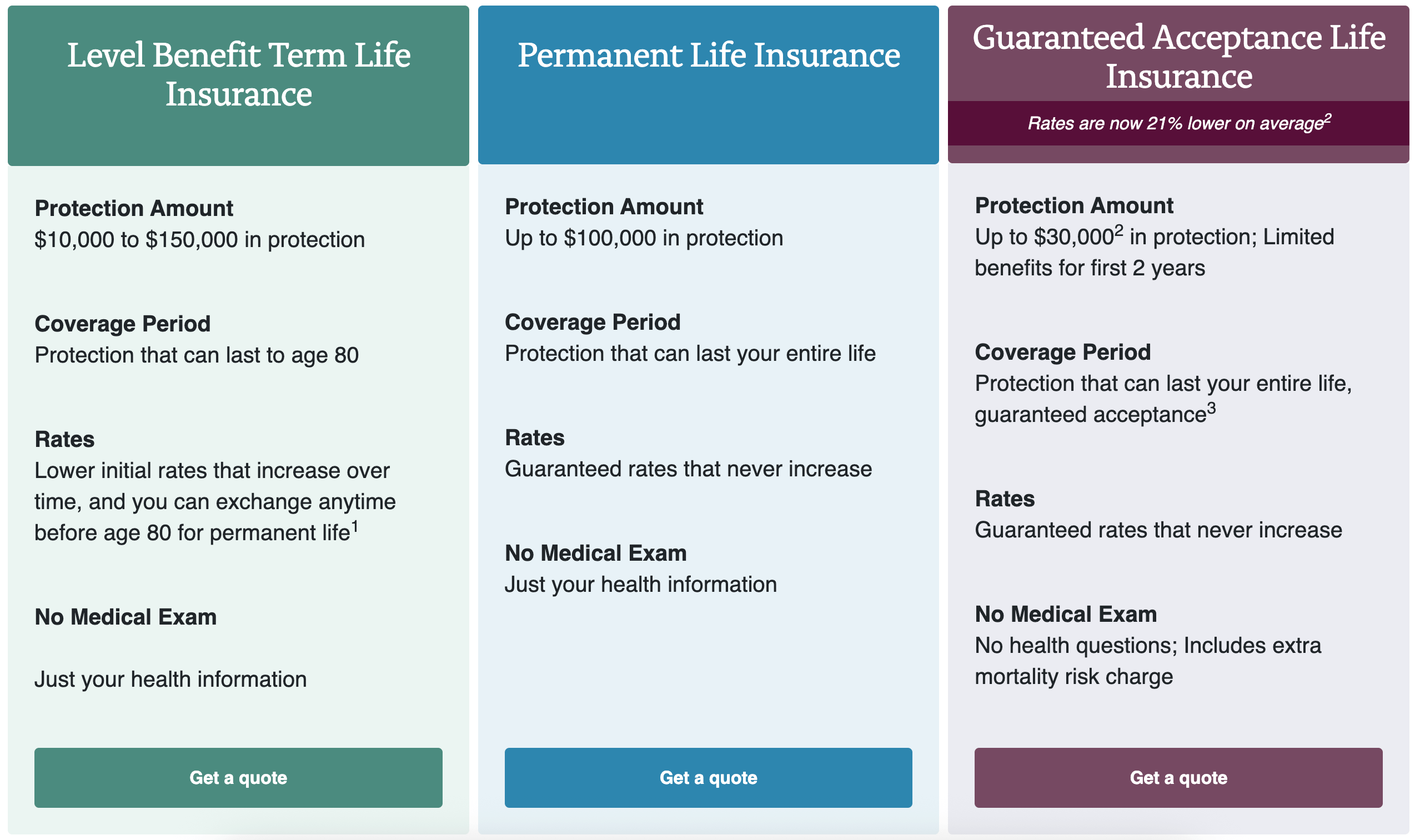
To determine if a policy is right for you, it is necessary to understand the three primary tiers of coverage offered through the AARP Life Insurance Program. Each has different eligibility requirements and underwriting standards.
1. AARP Term Life Insurance
The term life product is designed for members who need coverage for a specific period, such as until a mortgage is paid off or until children reach financial independence.
- Eligibility: Typically available to AARP members aged 50 to 74 (spouses 45–74).
- Coverage Limits: Often available up to $150,000, though higher amounts may be available based on underwriting.
- Underwriting: This is "simplified issue" insurance. You do not need a medical exam, but you must answer several health questions. If you have significant health issues, you may be denied.
- Structure: Premiums increase every five years as you enter a new age bracket. The coverage typically ends when the insured reaches age 80.
2. AARP Permanent (Whole) Life Insurance
Unlike term insurance, permanent life insurance is intended to last your entire life, provided premiums are paid. It also builds a small amount of cash value over time.
- Eligibility: Available to members aged 50 to 80 (spouses 45–80).
- Coverage Limits: Usually capped at $50,000.
- Underwriting: Like the term product, this uses simplified underwriting (health questions, no physical exam).
- Structure: Premiums are fixed. Once the policy is issued, your monthly cost will never increase, and the death benefit will not decrease.
3. AARP Guaranteed Acceptance Life Insurance
This is the product most frequently seen in television commercials. It is a form of whole life insurance designed specifically for those who may have health problems that would disqualify them from other policies.
- Eligibility: Available to members aged 50 to 80 (spouses 45–80).
- Coverage Limits: Usually capped at $25,000.
- Underwriting: No health questions and no medical exam. Acceptance is guaranteed as long as you meet the age and membership requirements.
- The Waiting Period: To maintain financial viability, these policies have a "graded death benefit." If the insured dies from natural causes within the first two years of the policy, the beneficiaries receive only the premiums paid plus a small amount of interest (usually 10%). After two years, the full death benefit is payable.
Comparing AARP Life Insurance Options
| Feature | Term Life | Permanent (Whole) Life | Guaranteed Acceptance |
|---|---|---|---|
| Best For | Temporary needs/Debt | Final expenses/Estate | Those with poor health |
| Medical Questions | Yes (Simplified) | Yes (Simplified) | No |
| Medical Exam | No | No | No |
| Max Coverage | Up to $150,000+ | Up to $50,000 | Up to $25,000 |
| Premium Status | Increases every 5 years | Fixed for life | Fixed for life |
| Cash Value | No | Yes | Yes |
| Waiting Period | Immediate full cover | Immediate full cover | 2-Year Graded Benefit |
The Costs: Is it a Good Value?
Legitimacy is one thing; value is another. While AARP life insurance is a "real" product, it is not always the cheapest option on the market. Because the program uses "simplified issue" underwriting (meaning they don't do blood tests or physical exams), they are taking on more risk. To compensate for that risk, the premiums are often higher than what a healthy person might find through a "fully underwritten" policy from another carrier.
The "AARP Membership" Requirement
You cannot buy these policies without being an AARP member. In 2026, membership costs approximately $16 per year (though multi-year discounts exist). While this is a small fee, it is an additional cost that should be factored into the overall "price" of the insurance.
Age-Banded Increases in Term Insurance
A common complaint regarding the legitimacy of AARP's term product is the way premiums increase. Many seniors are surprised when their bill jumps every five years. It is important to read the fine print: the "Term" product is not a level-premium policy. If you are on a fixed income, a Whole Life policy—though initially more expensive—might be a more "legitimate" long-term fit because the cost is predictable.
The Underwriting Process and Verification
When you apply for an AARP policy (other than the Guaranteed Acceptance version), New York Life will verify your health information using several third-party databases. This is standard practice for legitimate insurers. They typically check:
- The Medical Information Bureau (MIB): A database of previous insurance applications and medical conditions.
- Prescription Drug Databases: To see what medications you have been prescribed in the last 5–10 years.
- Motor Vehicle Records: To check for major infractions like DUIs.
If you are denied coverage for the Term or Whole life plans, New York Life is legally required under the Fair Credit Reporting Act to tell you why and what sources they used to make that determination. This transparency is a hallmark of a legitimate financial institution.
Pros and Cons of AARP Life Insurance
To provide a balanced view, it is helpful to look at why someone would—or would not—choose this program.
Advantages
- Ease of Application: Most people can complete the application in minutes online or by mail without a doctor's visit.
- Brand Stability: You are dealing with New York Life, which has a massive capital reserve. You don't have to worry about the company going bankrupt and failing to pay your claim.
- No Waiting Period for Healthy Seniors: If you can answer the health questions successfully, your coverage is active immediately.
- Spousal Coverage: The program makes it very easy to add a spouse to the coverage.
Disadvantages
- Higher Premiums for the Healthy: If you are in excellent health and don't mind a blood test, you can likely find more coverage for less money elsewhere.
- Coverage Caps: $50,000 for whole life or $150,000 for term may not be enough for those with significant debts or younger dependents.
- The Two-Year Rule: The graded benefit on Guaranteed Acceptance policies catches many families off guard if they don't read the contract carefully.
- Membership Friction: You must maintain your AARP membership to keep the policy in some instances, or at least to initiate it.
How to Verify Your Policy or File a Claim
If you already have a policy and are questioning its legitimacy, or if you are a beneficiary trying to file a claim in 2026, you should contact the AARP Life Insurance Program from New York Life directly.
Claims are typically processed within 7 to 14 business days once all documentation (like a certified death certificate) is received. This efficiency is consistent with New York Life’s standing as a premier insurer. You can verify the status of a policy through the New York Life AARP dedicated portal or by calling their customer service line.
For residents of specific states, you can also verify the licensing of New York Life through your state’s Department of Insurance. Every state has a regulator that ensures insurance companies are following the law and maintaining sufficient reserves. For example, the California Department of Insurance or the New York Department of Financial Services provide public tools to look up company licenses and complaint ratios.
Common Misconceptions
"AARP Insurance is a Scam Because I Was Denied"
Legitimate insurance companies deny applicants frequently based on risk. Being denied coverage for a simplified-issue term policy because of a history of heart disease or diabetes does not make the program a scam; it means you didn't meet the underwriting criteria for that specific product. In such cases, the Guaranteed Acceptance plan is the intended alternative.
"They Won't Pay if I Die in the First Two Years"
This is only true for the Guaranteed Acceptance plan and only for natural deaths. If you have this plan and die in an accident (like a car crash) during the first two years, the full benefit is usually paid. If the death is natural, they refund premiums plus interest. This is a standard industry practice for "no-questions-asked" policies to prevent people from buying insurance on their deathbeds.
Frequently Asked Questions
Is AARP life insurance better than Globe Life?
Both are legitimate, but they serve different needs. AARP is backed by New York Life, while Globe Life is its own entity. AARP’s term insurance has 5-year age bands (prices jump every 5 years), whereas some Globe Life products have different pricing structures. It is essential to compare the specific "Summary of Benefits" for both to see which matches your health profile better.
Can I keep my AARP life insurance after age 80?
If you have the Permanent Life or Guaranteed Acceptance plan, yes. These are designed to last until you die, as long as premiums are paid. However, the Term Life product typically expires or becomes prohibitively expensive once the insured reaches age 80.
Does AARP life insurance require a medical exam?
No. One of the main selling points of the AARP program is that none of the three main products require a physical exam or blood work. This is why it is popular for those who dislike needles or haven't been to a doctor in several years.
What happens if I stop paying my AARP membership?
Generally, you must be an AARP member to apply for the insurance. In most states, once the policy is in force, New York Life cannot cancel your life insurance just because you let your AARP membership lapse, but you should verify the specific "Terms and Conditions" in your policy document as state laws vary.
Is the cash value in AARP Whole Life significant?
No. These policies are primarily designed for the death benefit (final expenses). While they do build a small amount of cash value over decades, they are not effective investment vehicles. If you are looking for "cash value" as an investment, you would need a different type of policy, such as Universal Life, which AARP generally does not focus on in this program.
How do I know if my AARP mailer is real?
Legitimate AARP life insurance mailers will always mention New York Life Insurance Company. They will also include a specific address in Tampa, Florida (the processing center) or New York. If a mailer asks you to send money via wire transfer or cryptocurrency, it is a scam. Legitimate premiums are paid via check, automatic bank draft, or credit card through official channels.
Final Recommendation
AARP Life Insurance is a legitimate, safe, and financially stable option for seniors. Its association with New York Life provides the highest level of financial security available in the insurance industry.
However, "legitimate" does not always mean "best value." If you are in good health, you should take 15 minutes to get a quote for a fully underwritten policy from an independent broker before committing to AARP. You might find that a little bit of extra paperwork or a quick medical exam could save you 20% to 30% on your monthly premiums.
If you have moderate health issues or simply want the convenience of a brand you trust, the AARP Permanent Life or Guaranteed Acceptance plans are excellent tools for covering funeral costs and small debts. Always ensure you read the specific "Graded Death Benefit" clause if you choose the Guaranteed Acceptance route to ensure your family knows what to expect during the first 24 months of coverage.