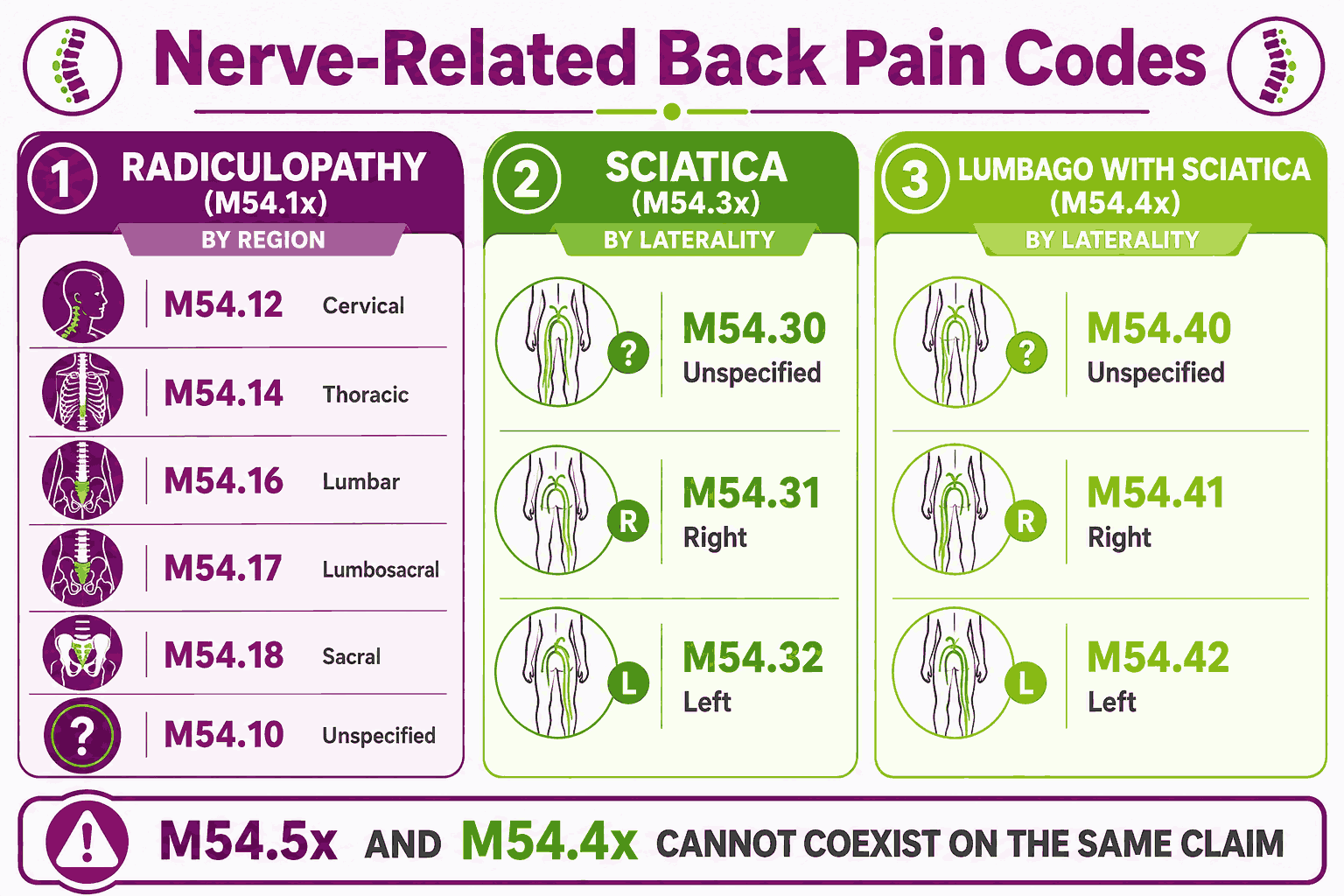
Accurate clinical documentation and precise ICD-10-CM coding for acute low back pain revolve around a single, non-negotiable requirement: identifying the specific etiology or underlying condition rather than relying on generic symptom codes. By prioritizing the documentation of underlying pathology—such as disc displacement, spinal stenosis, or muscle strain—medical coders and clinicians ensure regulatory compliance, support medical necessity, and facilitate accurate reimbursement.
The Foundation of ICD-10-CM Coding
The transition to the International Classification of Diseases, 10th Revision, Clinical Modification (ICD-10-CM) represented a seismic shift in the precision required for medical billing and data reporting. Unlike the predecessor ICD-9 system, which often allowed for catch-all "not otherwise specified" (NOS) coding, ICD-10-CM emphasizes clinical specificity.
For providers addressing low back pain, the system provides a robust framework that demands the identification of the patient’s clinical reality. When a patient presents with acute pain, the goal is not merely to record that the patient hurts, but to pinpoint why that pain exists. This requirement is driven by the need for population health management, accurate insurance verification, and the foundational principle that a code must represent a verified medical diagnosis rather than a subjective sensation.
Why "Low Back Pain" Is Not a Final Diagnosis
In the hierarchy of coding, "low back pain" (often mapped to M54.5) is essentially a symptom. While it may serve as a placeholder in the initial stages of an encounter, the standard of care in 2026 demands that providers seek a definitive diagnosis. Using generic codes frequently triggers medical necessity denials because payers often view symptom-based codes as insufficient justification for advanced imaging (such as MRIs), physical therapy, or surgical interventions.
When documentation lists only "low back pain," it creates an administrative bottleneck. A coder who reports M54.5 without further clinical context is providing incomplete information to the payer. To move beyond this, clinicians must document the structural or systemic source of the pain. Is the pain radicular? Is it caused by degenerative disc disease? Is there a component of muscle spasm or skeletal misalignment? These questions define the difference between a clean claim and a rejected one.
The Role of Clinical Documentation Improvement (CDI)
Clinical Documentation Improvement programs are the bridge between the exam room and the billing department. In 2026, healthcare facilities rely on CDI specialists to ensure that the physician’s notes align with the specificity required by the ICD-10-CM manual.
Effective CDI for back pain involves encouraging practitioners to be explicit in their notes. Instead of writing "patient complains of back pain," a high-quality note would state "acute lumbar strain with muscle spasm" or "lumbar disc displacement without myelopathy." This shift in language provides the coder with the necessary vocabulary to assign a code that is both medically sound and audit-proof.
Identifying the Key Etiologies
To master coding for this condition, one must understand the common categories of low back pain recognized within the ICD-10 system. Each of these carries its own specific coding requirements:
- Mechanical Low Back Pain: This usually involves the musculoskeletal structures. If the pain is related to an injury, an external cause code (V-Y codes) should accompany the diagnosis to explain how the injury occurred.
- Discogenic Pain: Documentation must specify whether there is "displacement" or "degeneration" and whether there is radiculopathy (nerve involvement).
- Spondylosis/Stenosis: These conditions often require specifying the level of the spine (e.g., L4-L5) and the presence or absence of neurological symptoms like weakness or numbness.
Comparison of Coding Approaches
| Feature | Generic Coding (M54.5) | Specific Etiology Coding |
|---|---|---|
| Payer Perception | Often viewed as "rule out" or "symptom" | Accepted as established medical necessity |
| Imaging Approval | High denial rate for MRI/CT | High likelihood of authorization |
| Audits | Frequent target for medical review | Generally robust under audit |
| Data Integrity | Low (lacks clinical depth) | High (supports clinical outcomes data) |
Navigating Medical Necessity and Justification
A significant hurdle in the coding process is proving the "medical necessity" of a treatment plan. Insurance carriers in 2026 utilize sophisticated automated review systems. If a provider orders a physical therapy regimen for a patient coded only with a generic back pain code, the system may flag the treatment as elective or experimental.
Conversely, by coding for the specific condition—such as "lumbago with sciatica" (M54.4)—the coder provides a logical link between the diagnosis and the treatment plan. This creates a narrative that the payer’s computer systems can understand and approve. When the documentation explains the cause of the pain, the treatment becomes a logical, defensible response to that pathology.
The Impact of External Cause Codes
A often-overlooked aspect of coding for acute back pain is the use of external cause codes. If a patient’s acute pain is the result of a slip, a fall, or a heavy lifting incident at work, the medical record must reflect this.
Under ICD-10-CM guidelines, these codes provide essential context. They distinguish between chronic, systemic conditions and acute injuries. While they do not provide a "diagnosis" in the medical sense, they satisfy the requirement for full disclosure of the circumstances surrounding the injury, which is critical for workers' compensation claims and liability assessments.
Common Pitfalls and Troubleshooting
Even with clear guidelines, providers and coders frequently encounter common mistakes that jeopardize reimbursement:
- Code Mismatching: Applying a chronic code to an acute condition. The distinction between "acute" (new, sudden) and "chronic" (long-standing) is critical for medical necessity.
- Neglecting "With/Without": Many ICD-10 codes require specifying the presence of neurological symptoms. For instance, coding for radiculopathy when the provider has not explicitly documented neurological deficit is a compliance error.
- Ignoring Laterality: While many back pain codes do not require laterality (unlike extremity codes), some related conditions—such as certain unilateral nerve root compressions—do. Always verify if the specific code in the "M" section requires a fifth or sixth character.
If a claim is rejected due to lack of specificity, the first step in troubleshooting is to review the original progress note. If the documentation is indeed vague, the provider must issue an addendum or a late entry that specifies the clinical findings. Never "upcode" or guess a diagnosis based on expected insurance coverage.
Ensuring Compliance and Avoiding Fraud
Compliance is the bedrock of medical coding. "Upcoding"—selecting a more specific or severe code than is supported by the medical record to maximize reimbursement—is a serious violation. The goal of using specific ICD-10 codes is always to reflect the documented reality of the patient's condition, not to achieve a higher financial payout.
Health systems in 2026 are subject to rigorous audits. These audits often focus on the nexus between the physician's exam findings and the final submitted claim. If a coder submits a code for "disc herniation" but the physician's note only mentions "muscle soreness," the organization is at risk for penalties. Therefore, the coder and the physician must act as a team, ensuring that every word on the bill is backed by a corresponding observation in the patient chart.
The Role of Technology in Coding Accuracy
Modern Electronic Health Record (EHR) systems have integrated "coding assistants" that suggest codes based on clinical documentation. While these tools are invaluable, they are not infallible. They often present a list of codes that may be technically valid but clinically inappropriate for the specific encounter.
A human coder, or a highly trained billing specialist, must always verify these suggestions. Relying solely on an EHR’s automated suggestions is a frequent source of error. Always prioritize the clinical notes over the machine-generated prompts. In 2026, the human element—the ability to interpret the nuances of a provider's narrative—remains the ultimate safeguard against errors.
Addressing Frequently Asked Questions
Is it ever acceptable to use the generic back pain code (M54.5)? The generic code should generally be reserved for instances where a provider has conducted a thorough investigation, and no other specific pathology (such as disc, skeletal, or neurological issue) has been identified. It should be the diagnosis of exclusion, not the default entry.
Does acute back pain require special documentation if it is work-related? Yes. When an injury occurs at work, you must include the appropriate Z-codes to indicate the place of occurrence and the external cause (e.g., heavy lifting, fall). This allows for accurate tracking and proper handling by workers' compensation adjusters.
What should I do if the provider’s note is too vague to code specifically? The coder should query the provider. A professional, respectful query asking for clarification regarding the specific diagnosis—rather than the symptom—is a standard and necessary component of the revenue cycle. Never make assumptions to fill in the blanks.
How does radiculopathy change the coding for back pain? Radiculopathy signifies that the pain is radiating, usually due to nerve root compression. This increases the severity of the diagnosis and often justifies more aggressive diagnostic procedures. It must be supported by physical exam findings, such as positive straight-leg raises or specific dermatomal deficits.
Is there a difference in coding for a first-time episode versus a recurring episode of acute pain? Yes, the distinction is significant. Recurrent pain might be classified differently or might suggest a chronic underlying condition. Documentation should clearly state if this is an "initial encounter" for a new acute episode or a follow-up for a recurring condition.
Final Recommendation
To achieve consistent success in coding for acute low back pain, facilities must move away from "symptom-first" documentation. The most effective strategy is to implement mandatory fields in the EHR that prompt the physician to document not just the presence of pain, but the suspected anatomical origin and the presence of neurological indicators. By ensuring that the clinical record is as specific as the patient’s condition, you optimize both the quality of patient care and the integrity of the billing process.