In chemical thermodynamics, a negative enthalpy change (ΔH < 0) indicates that a reaction is exothermic. This mathematical sign signifies that the chemical system has released heat into its surroundings. Because the products possess lower total enthalpy than the reactants, the "lost" energy is emitted as thermal energy, typically causing the temperature of the immediate environment to rise.
The Fundamental Concept of Enthalpy in Chemistry
To understand why a negative ΔH signals an exothermic reaction, we must first define enthalpy ($H$). Enthalpy is a thermodynamic property that represents the total heat content of a system. It is defined as the sum of the system's internal energy ($U$) and the product of its pressure ($P$) and volume ($V$). In most laboratory and industrial settings, chemical reactions occur at a constant atmospheric pressure. Under these conditions, the change in enthalpy ($\Delta H$) is equivalent to the heat added to or lost by the system.
The "delta" symbol ($\Delta$) signifies change, calculated as the final state minus the initial state. Therefore, $\Delta H = H_{products} - H_{reactants}$. When we say $\Delta H$ is negative, we are stating mathematically that the enthalpy of the products is less than the enthalpy of the reactants. This discrepancy in energy does not simply vanish; according to the Law of Conservation of Energy, it must be transferred out of the chemical bonds and into the surrounding environment, usually as heat.
The System vs. The Surroundings
In thermodynamics, the distinction between the "system" and the "surroundings" is critical for interpreting signs. The system consists of the specific molecules and atoms undergoing the chemical change. The surroundings include everything else—the beaker, the water in which the chemicals are dissolved, the air in the room, and the thermometer.
When a reaction is exothermic, the system "gives away" energy. From the perspective of the system, this is a loss, which is why the sign is negative. Conversely, the surroundings "gain" this energy. This is why a thermometer (part of the surroundings) shows a temperature increase during an exothermic reaction, even though the $\Delta H$ value of the chemical system is negative.
The Molecular Mechanism: Bond Breaking and Bond Forming
Every chemical reaction involves a two-stage process regarding energy: the breaking of existing chemical bonds and the formation of new ones. Understanding the balance between these two stages explains the origin of a negative $\Delta H$.
1. Breaking Bonds: The Energy Investment
Breaking chemical bonds is always an endothermic process. It requires an input of energy to overcome the electrostatic attractions between atoms or ions. Whether you are splitting a hydrogen molecule ($H_2$) or breaking apart a complex hydrocarbon, you must "pay" energy into the system.
2. Forming Bonds: The Energy Payoff
The formation of new chemical bonds is always an exothermic process. When atoms come together to form a stable bond, they move to a lower potential energy state, releasing the excess energy into the environment.
The Net Result
A reaction results in a negative $\Delta H$ (exothermic) when the energy released during the formation of new bonds in the products is greater than the energy required to break the bonds in the reactants. In simpler terms, the "payoff" is larger than the "investment." This net surplus of energy is what we measure as the negative enthalpy of the reaction.
Calculating Enthalpy Change: Standard Enthalpy of Formation
In 2026, chemical engineers and students continue to rely on standardized tables to predict whether a reaction will be exothermic. The most common method involves using the Standard Enthalpy of Formation ($\Delta H^\circ_f$), which is the change in enthalpy when one mole of a substance is formed from its pure elements in their standard states.
The formula used is: $$\Delta H^\circ_{rxn} = \sum [n \times \Delta H^\circ_f(\text{products})] - \sum [m \times \Delta H^\circ_f(\text{reactants})]$$
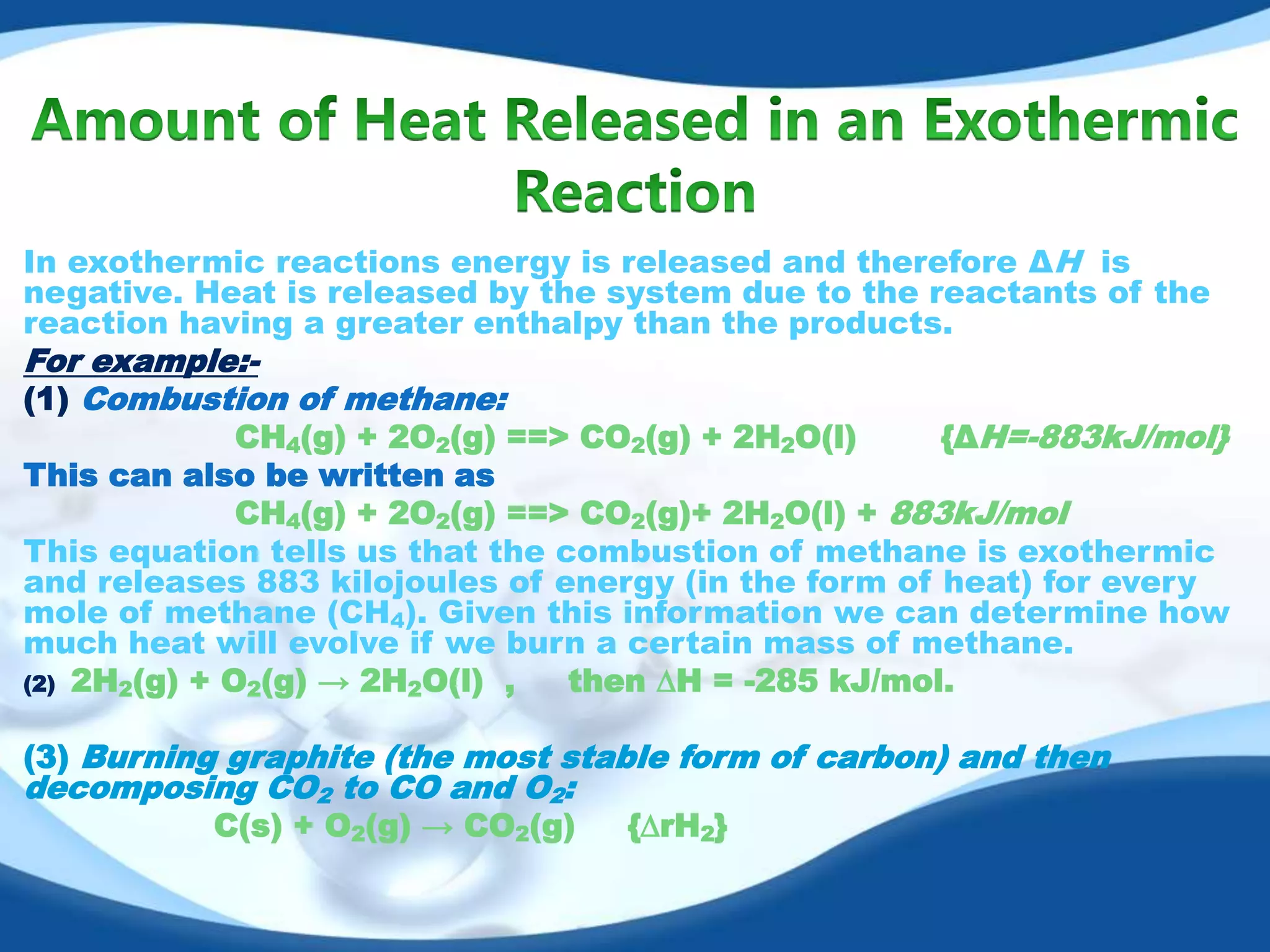
If the sum of the enthalpies of the products is smaller than that of the reactants, the result is a negative value. For example, in the combustion of methane ($CH_4 + 2O_2 \rightarrow CO_2 + 2H_2O$), the products ($CO_2$ and $H_2O$) sit at a much lower energy level than the methane and oxygen. This results in a $\Delta H$ of approximately -890 kJ/mol, making it a powerfully exothermic reaction used globally for heating and energy production.
Comparing Exothermic and Endothermic Reactions
To solidify the understanding of a negative $\Delta H$, it is helpful to compare it directly with its opposite: the endothermic reaction.
| Feature | Exothermic Reaction | Endothermic Reaction |
|---|---|---|
| Sign of $\Delta H$ | Negative ($\Delta H < 0$) | Positive ($\Delta H > 0$) |
| Energy Transfer | System $\rightarrow$ Surroundings | Surroundings $\rightarrow$ System |
| Temperature Change | Surroundings get warmer | Surroundings get colder |
| Enthalpy Level | $H_{products} < H_{reactants}$ | $H_{products} > H_{reactants}$ |
| Bond Energy | Forming bonds > Breaking bonds | Breaking bonds > Forming bonds |
| Common Examples | Combustion, Neutralization | Photosynthesis, Ice melting |
Thermodynamic Stability and Spontaneity
It is a common misconception that a negative $\Delta H$ automatically means a reaction will occur spontaneously (on its own). While a negative enthalpy change favors spontaneity because systems generally evolve toward lower energy states, it is not the only factor.
The Role of Entropy ($\Delta S$)
Entropy represents the degree of disorder or randomness in a system. To determine if a reaction is truly spontaneous, scientists use the Gibbs Free Energy equation: $$\Delta G = \Delta H - T\Delta S$$ Where:
- $\Delta G$ is the change in Gibbs Free Energy.
- $T$ is the absolute temperature (in Kelvin).
- $\Delta S$ is the change in entropy.
For a reaction to be spontaneous at constant pressure and temperature, $\Delta G$ must be negative. A negative $\Delta H$ (exothermic) contributes significantly to making $\Delta G$ negative. However, if a reaction results in a massive decrease in entropy (making $\Delta S$ very negative), an exothermic reaction might still be non-spontaneous at high temperatures.
Activation Energy ($E_a$)
Even a highly exothermic reaction with a large negative $\Delta H$ might not start immediately. For instance, a piece of paper does not spontaneously burst into flames at room temperature despite the combustion of cellulose being highly exothermic. This is due to the Activation Energy—the initial energy barrier that must be overcome to break the first set of bonds and kickstart the reaction. Once the reaction begins, the heat released by the exothermic process provides the activation energy for neighboring molecules, creating a self-sustaining chain reaction.
Real-World Applications of Exothermic Reactions
The fact that a negative $\Delta H$ signals heat release is utilized across various industries and biological processes.
Industrial Synthesis and Safety
In industrial chemistry, managing negative $\Delta H$ is a matter of safety. In the Haber Process (the synthesis of ammonia), the reaction is exothermic. If the heat is not efficiently removed from the reactor, the temperature can rise uncontrollably, potentially leading to equipment failure or "thermal runaway." Engineers must calculate the $\Delta H$ to design cooling systems that maintain a stable operating environment.
Domestic and Commercial Heating
Every time you use a gas stove or a furnace, you are witnessing a reaction with a negative $\Delta H$. The combustion of hydrocarbons is specifically chosen for energy production because their enthalpy of reaction is strongly negative, providing the maximum amount of thermal energy per mole of fuel.
Biological Metabolism
Cellular respiration is a series of metabolic pathways that break down glucose. The overall process is exothermic ($\Delta H$ is negative). This released energy is not all lost as heat; much of it is captured in the form of ATP (adenosine triphosphate), which the body uses to fuel muscular contraction and cellular transport. However, the heat generated as a "byproduct" of these negative $\Delta H$ reactions is what maintains the body temperature of warm-blooded organisms.
Common Mistakes in Interpreting $\Delta H$
- Confusing $\Delta H$ with Temperature: A negative $\Delta H$ refers to the internal energy change of the chemicals. The increase in temperature is what happens to the surroundings. Do not mistake the "negative" sign for a "decrease" in temperature.
- Assuming Speed: A negative $\Delta H$ tells you about the energetic "downhill" nature of the reaction, but it tells you nothing about the speed (kinetics). Some exothermic reactions are incredibly slow (like the rusting of iron), while others are instantaneous (like an explosion).
- Ignoring the State of Matter: Enthalpy values change based on whether a substance is a gas, liquid, or solid. When calculating or looking up $\Delta H$, it is vital to ensure the states of matter ($s, l, g, aq$) match the reaction conditions.
Frequently Asked Questions
Does a negative $\Delta H$ mean the reaction is hot?
A negative $\Delta H$ means the reaction releases heat. If the reaction happens quickly in a confined space, the mixture will feel hot to the touch or show a temperature increase on a thermometer. However, if the reaction is very slow, the heat might dissipate into the environment as quickly as it is produced, meaning the temperature might not noticeably rise.
Can a reaction be exothermic but have a positive $\Delta H$?
No. By definition and IUPAC convention, an exothermic reaction must have a negative $\Delta H$. If the $\Delta H$ is positive, the reaction is endothermic, meaning it absorbs heat from the surroundings.
How do I identify an exothermic reaction on a graph?
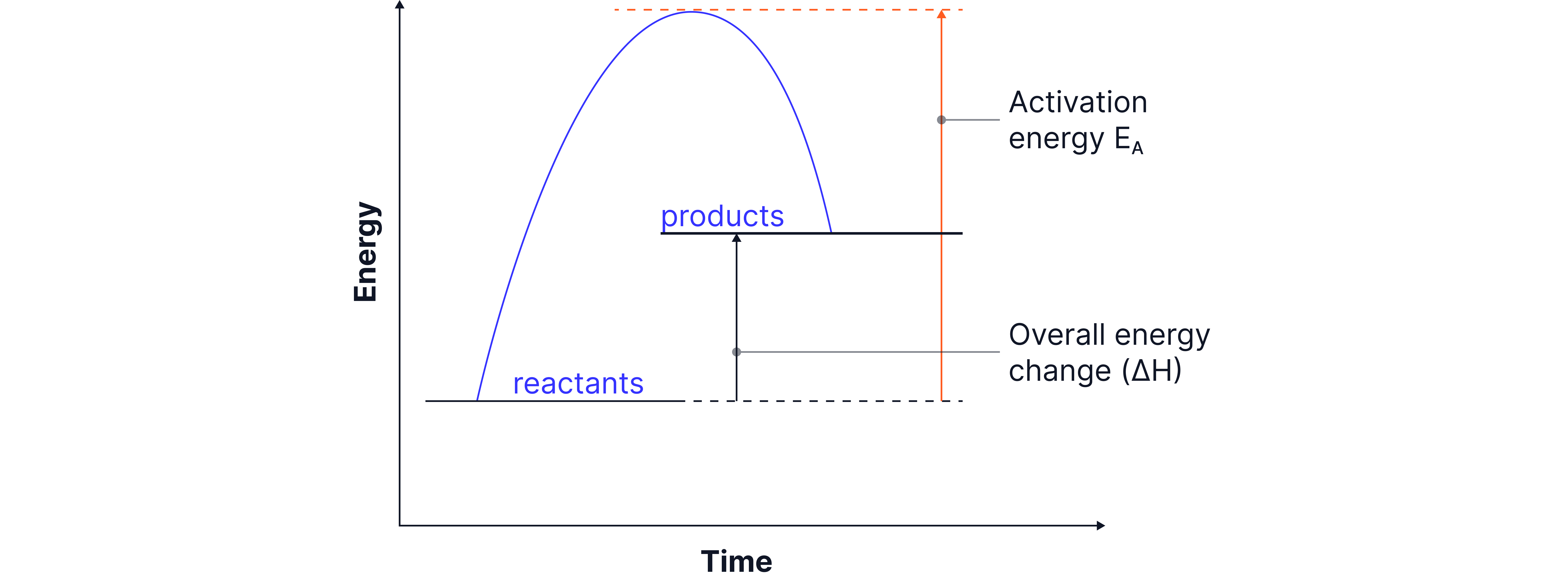
On a potential energy diagram (reaction coordinate diagram), look at the energy levels of the reactants and products. If the product line is lower than the reactant line, the reaction is exothermic. The vertical distance between these two lines represents the negative $\Delta H$.
Why is the enthalpy of elements in their standard state zero?
By convention, the standard enthalpy of formation ($\Delta H^\circ_f$) for a pure element in its most stable form (like $O_2$ gas or $C$ graphite) is defined as zero. This provides a baseline or "sea level" from which the enthalpy changes of all other compounds are measured.
Is freezing an exothermic process?
Yes. Although it is a physical change rather than a chemical reaction, freezing (liquid to solid) has a negative enthalpy change ($\Delta H_{fusion}$ is negative when reversed). As molecules slow down and form a structured lattice, they release kinetic energy into the surroundings.
Final Recommendations for Practical Application
When working with chemical equations or laboratory data, always look for the $\Delta H$ value to understand the thermal behavior of the system. If you see a negative sign, prepare for heat release. In a lab setting, this means you may need an ice bath to control a fast reaction or specialized containers that can withstand temperature changes.
In academic contexts, always verify your signs by calculating the sum of the products minus the sum of the reactants. A negative result is your confirmation that the system is losing enthalpy and the reaction is exothermic. For those designing industrial processes, accurate determination of $\Delta H$ is the first step in ensuring thermal safety and energy efficiency.