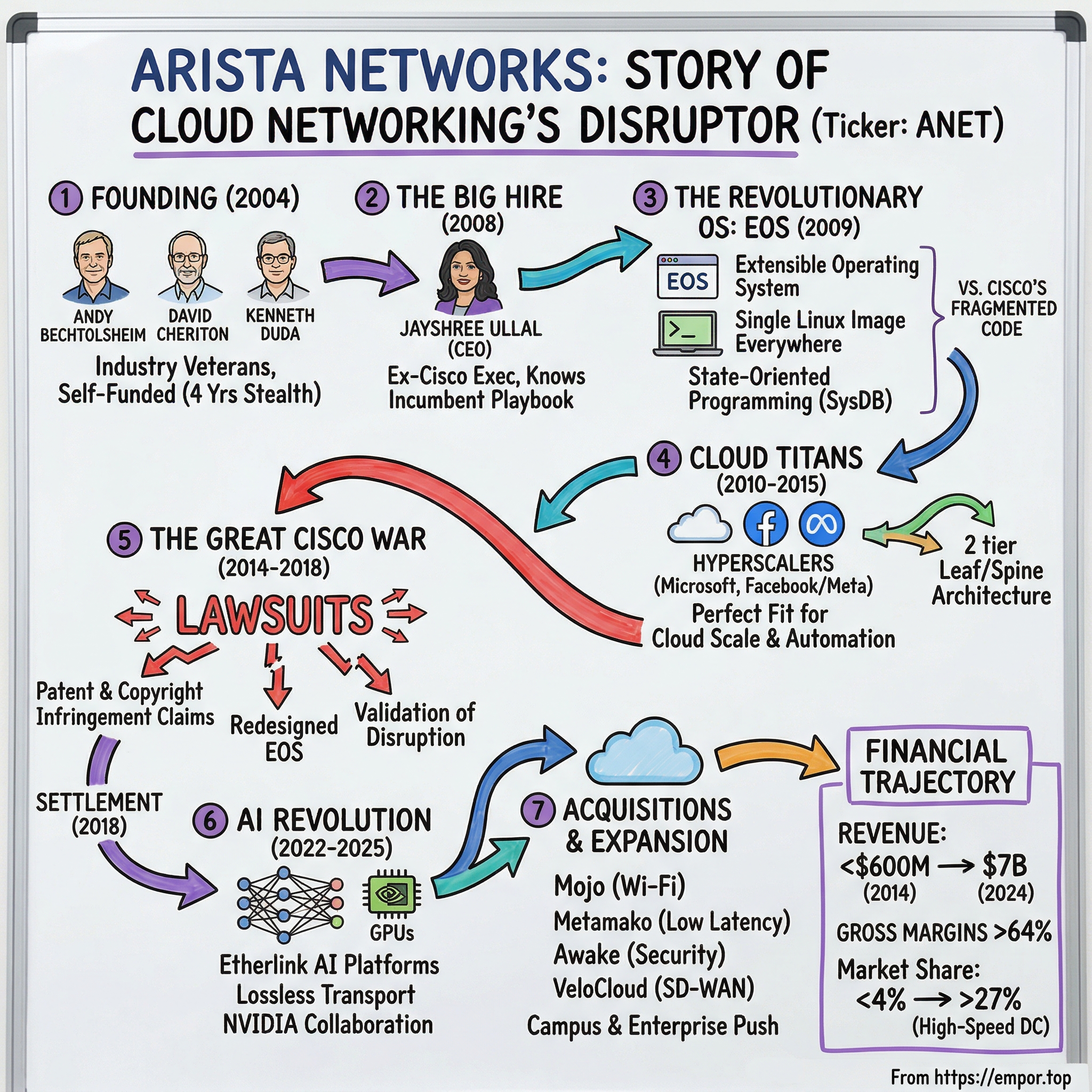
Arista Networks was founded in 2004 by Andy Bechtolsheim, David Cheriton, and Kenneth Duda. This trio of industry veterans established the company to modernize data center networking through a combination of merchant silicon and a programmable, Linux-based operating system known as EOS (Extensible Operating System), fundamentally disrupting the proprietary hardware dominance of legacy providers.
The story of Arista Networks is not merely a tale of corporate formation but a pivotal chapter in the history of the internet's infrastructure. By the early 2000s, the networking industry was stagnant, dominated by "black box" hardware solutions that were difficult to scale and even harder to program. The founders of Arista—then operating under the name Arastra—sought to apply the principles of high-performance computing and open-source software to the world of switching and routing. As we look at the landscape in 2026, the foundational decisions made by these three individuals continue to dictate how hyper-scale cloud providers and high-frequency trading firms manage their traffic.
Andy Bechtolsheim: The Architect of Infrastructure
Andreas "Andy" von Bechtolsheim is widely regarded as one of the most successful hardware designers and investors in Silicon Valley history. Long before Arista, Bechtolsheim rose to prominence as a co-founder of Sun Microsystems in 1982. His design of the Sun workstation revolutionized the technical computing market. However, his influence extends far beyond workstations; he has a unique pedigree for identifying tectonic shifts in technology before they become mainstream.
At Arista, Bechtolsheim’s primary contribution was the hardware philosophy. He championed the use of merchant silicon—standardized chips produced by companies like Broadcom—rather than the expensive, slow-to-develop custom ASICs (Application-Specific Integrated Circuits) favored by incumbents like Cisco. This approach allowed Arista to ride the performance curve of the semiconductor industry, delivering higher speeds (from 10GbE to 800GbE and beyond) faster and at a lower cost than competitors.
Bechtolsheim’s career is marked by a series of high-impact ventures. After Sun Microsystems, he founded Granite Systems, a gigabit Ethernet switching company that was acquired by Cisco in 1996 for $220 million. He later founded Kealia, which was acquired by Sun. His track record of building and selling successful networking companies gave Arista immediate credibility in the eyes of venture capitalists and early enterprise adopters. In 2026, Bechtolsheim remains a central figure at Arista as Chairman and Chief Strategy Officer, ensuring the company stays ahead of the next wave of AI-driven networking requirements.
David Cheriton: The Academic and Strategic Investor
If Bechtolsheim is the hardware architect, David Cheriton is the mathematical and strategic backbone of the founding team. A Professor Emeritus of Computer Science at Stanford University, Cheriton is famous not only for his academic research in distributed systems but also for being one of the world's most successful "angel" investors. Most notably, he and Bechtolsheim provided the initial $100,000 checks to Larry Page and Sergey Brin to start Google.
Cheriton’s involvement in Arista was born out of a desire to fix the fundamental flaws in network software. At Stanford, he led the Distributed Systems Group, where he explored how systems could be made more resilient and scalable. His "no-nonsense" approach to engineering influenced Arista’s early culture, prioritizing lean, efficient code and rigorous testing.
In the early days of Arista, Cheriton served as a mentor and chief scientist. His wealth and reputation provided the financial runway the company needed to develop its complex operating system without the immediate pressure of predatory venture capital terms. While Cheriton eventually stepped back from day-to-day operations to focus on other ventures and philanthropy, his architectural influence—specifically the idea of a "state-sharing" database for network operating systems—remains the core differentiator of Arista’s software stack.
Kenneth Duda: The Software Visionary and Creator of EOS
While Bechtolsheim and Cheriton provided the vision and the capital, Kenneth Duda was the primary engineer who translated those high-level concepts into code. Duda, who earned his PhD from Stanford under Cheriton’s supervision, is the architect of Arista EOS (Extensible Operating System).
Before Arista, Duda worked at Granite Systems and Cisco, where he grew frustrated with the fragile, monolithic architectures of traditional network operating systems. When he co-founded Arista, his goal was to build a networking OS that looked and felt like a modern server OS.
The breakthrough Duda achieved was the creation of Sysdb, a centralized state-sharing database. In traditional switches, different software processes (like BGP, OSPF, or interface management) talk to each other through direct messaging. If one process crashes, it can take down the whole switch. In Duda’s EOS, every process is isolated; they all communicate only with Sysdb. This modularity allows for:
- In-service software upgrades (ISSU): Updating parts of the switch software without dropping traffic.
- Self-healing: If a protocol agent fails, it can restart and pull its last known state from Sysdb.
- Programmability: Because EOS is built on a standard Linux kernel, users can run their own Python scripts or third-party applications directly on the switch.
In 2026, Ken Duda continues to serve as Arista’s Chief Technology Officer and Senior Vice President of Software Engineering, maintaining a hands-on role in the development of the company’s evolving AI-networking fabrics.
Comparison of Founding Contributions
The synergy between the three founders was essential for Arista’s survival in a market that had high barriers to entry. The following table outlines their distinct roles and the value they brought to the enterprise.
| Founder | Primary Role | Core Contribution | Industry Background |
|---|---|---|---|
| Andy Bechtolsheim | Hardware Strategy | Merchant Silicon selection & Hardware Design | Co-founder Sun Microsystems, Granite Systems |
| David Cheriton | Strategic Vision | Distributed Systems Theory & Initial Funding | Stanford Professor, Google Angel Investor |
| Kenneth Duda | Software Engineering | Creation of EOS and Sysdb Architecture | Granite Systems, Cisco Engineering |
The Birth of Arastra and the Rebrand to Arista
The company was originally incorporated as Arastra in 2004. The name was later changed to Arista Networks in 2008, shortly before the company began its aggressive push into the high-frequency trading and large-scale cloud markets. This period was critical because it coincided with the rise of "The Cloud." Companies like Amazon, Google, and Microsoft were building massive data centers that required thousands of switches to work in unison.
The founders recognized that these cloud titans didn't want proprietary features; they wanted reliability, speed, and the ability to automate their networks using software. Arista's decision to embrace the Leaf-Spine architecture—a two-tier network design that provides predictable latency—was a direct result of the founders' understanding of distributed computing. By 2010, Arista had established itself as the "gold standard" for low-latency networking, a reputation that allowed it to challenge Cisco’s decades-long dominance.
Technical Innovation: How the Founders Redefined Switching
To understand the impact of the Arista founders, one must look at the specific technical shifts they forced upon the industry. Before Arista, the networking world was largely a "hardware-first" environment. The founders flipped this script.
The Shift to Merchant Silicon
By using off-the-shelf silicon from vendors like Broadcom (the Trident and Tomahawk chipsets), Arista was able to release new products on a 12-to-18-month cycle. Legacy competitors using custom ASICs often had 3-to-5-year development cycles. This "speed to market" was crucial as data center speeds jumped from 10G to 40G, 100G, and eventually 400G and 800G. Bechtolsheim’s deep relationships with chip manufacturers ensured that Arista was always the first to market with the latest high-bandwidth silicon.
The Programmable Network
Ken Duda’s insistence on a "clean" Linux base meant that network engineers could use familiar tools like Bash, Python, and Ansible to manage their switches. This aligned perfectly with the DevOps movement. For the first time, a network switch was treated as just another "server with a lot of ports," rather than a mysterious piece of hardware that required a specialized certification (like CCNA) to manage.
Resilience Through Modularity
In a massive data center, a single switch failure can be a minor inconvenience, but a software bug that propagates through the network can be a catastrophe. The state-sharing architecture designed by Duda and influenced by Cheriton’s research ensured that Arista switches were significantly more stable than their counterparts. This reliability is what eventually won over the "Super-majors"—the top five cloud providers globally.
The Leadership Transition: Jayshree Ullal’s Arrival
While Bechtolsheim, Cheriton, and Duda were the technical and financial founders, no history of Arista is complete without mentioning Jayshree Ullal. She joined Arista as President and CEO in 2008, leaving a high-ranking position at Cisco.
Ullal was the missing piece of the puzzle. While the founders built the engine, Ullal built the vehicle. She turned the technical innovations of the founders into a formidable business machine, leading the company through its IPO in 2014 and navigating the complex legal battles with Cisco that followed. Her leadership ensured that the founders' vision reached a global scale, making Arista a multi-billion dollar entity that, by 2026, is a cornerstone of the world’s digital infrastructure.
Arista’s Position in 2026: The Founders' Legacy
In the current landscape of 2026, Arista Networks is no longer an underdog. It is a dominant force in AI Networking. The rise of Large Language Models (LLMs) and generative AI has created a demand for "AI Back-end Fabrics"—networks that connect thousands of GPUs with near-zero packet loss and extreme bandwidth.
The founders' original bet on Ethernet over proprietary technologies (like InfiniBand) has largely paid off. As AI clusters scale, the "open" nature of Arista’s EOS and the scalability of their merchant silicon designs have made them the preferred choice for training the next generation of artificial intelligence. Andy Bechtolsheim’s recent focuses have included the development of optical interconnects and co-packaged optics, technologies that are essential for the 1.6 Terabit speeds that 2026-era data centers are now implementing.
FAQ
Who are the original founders of Arista Networks?
Arista Networks was founded by Andy Bechtolsheim, David Cheriton, and Kenneth Duda. While Jayshree Ullal is the long-time CEO and played a massive role in its growth, she joined the company in 2008, four years after its inception.
Why did the founders choose the name Arastra initially?
The original name, Arastra, was a play on "ASIC-free" or related technical puns, but it was largely a placeholder during the stealth phase of the company. They rebranded to Arista (which means "the best" or "excellence" in various linguistic roots) to project a more professional and market-ready image.
What is the relationship between Arista and Cisco?
Two of the founders (Bechtolsheim and Duda) and the CEO (Ullal) were former Cisco employees or had sold companies to Cisco. This created a fierce rivalry, leading to high-profile patent and copyright litigation in the mid-2010s. Arista ultimately prevailed in most of these disputes, solidifying its right to use a Linux-based architecture and a Command Line Interface (CLI) similar to industry standards.
Is David Cheriton still involved with Arista Networks?
As of 2026, David Cheriton has largely retired from active corporate duties at Arista, though he remains one of the largest individual shareholders. He continues to influence the tech world through the Cheriton Family Trust and his support for computer science education.
What was the "secret sauce" the founders created?
The primary innovation was EOS (Extensible Operating System). By decoupling the network software from the hardware and using a state-sharing database (Sysdb), they created a switch that was as stable and programmable as a high-end Linux server.
Next Steps for Researchers and Investors
For those looking to understand the technical depth of the founders' work, reviewing Arista’s white papers on Cloud Networking Design and EOS Architecture is recommended. Understanding the transition from custom ASICs to merchant silicon is also vital for anyone analyzing the networking hardware market.
If you are interested in the broader impact of these founders, studying the history of Sun Microsystems and the Stanford Distributed Systems Group provides essential context for why Arista was able to succeed where many other startups failed. In 2026, the company continues to release detailed technical documentation via its official website, which remains the primary source for understanding their latest advancements in AI-driven Ethernet fabrics.