Aristotle defines government as the supreme authority within a city-state (polis), asserting that its primary purpose is to enable "the good life" for its citizens. He classifies constitutions based on two criteria: the number of people who hold power and whether they rule for the common interest or their own selfish benefit.
Aristotle’s political philosophy, primarily detailed in his seminal work Politics, remains a cornerstone of Western political thought in 2026. Unlike his teacher Plato, who sought an idealized "Republic" led by philosopher-kings, Aristotle took an empirical approach. He collected and analyzed 158 Greek constitutions to understand how governments actually functioned, why they failed, and what made them stable. For Aristotle, the "state" is not an artificial construct but a natural development arising from the human necessity to live in a community. Because humans possess the power of speech and moral reasoning, they are naturally "political animals" (zoon politikon) who can only achieve their full potential within a structured society.
The Teleological Foundation: Why Government Exists
To understand Aristotle’s view of government, one must first grasp his concept of teleology—the idea that everything in nature has a "telos" or an ultimate purpose. For a seed, the telos is to become a tree; for a human, the telos is Eudaimonia, often translated as happiness, flourishing, or living well according to virtue.
Aristotle argues that the state is the highest form of human association. It begins with the household (to meet daily needs), evolves into the village (to meet non-daily needs), and culminates in the polis (the city-state). The city-state is "self-sufficient," meaning it provides everything necessary not just for survival, but for the moral and intellectual development of its people. Therefore, a government is not merely a legal framework for trade or protection; it is a partnership in virtue. If a government fails to promote the moral improvement of its citizens, it is, in Aristotle's view, a failure.
The Six-Fold Classification of Constitutions
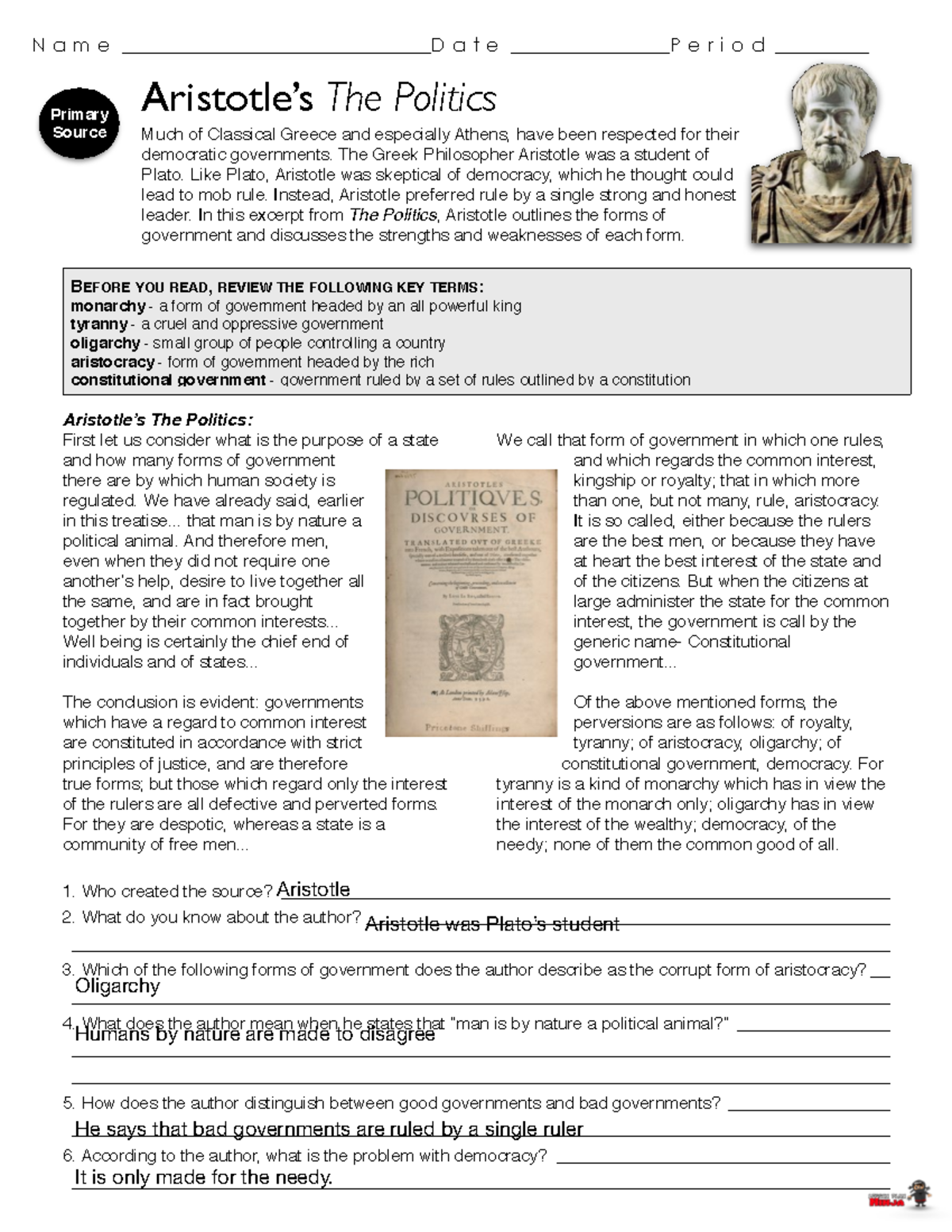
Aristotle’s most famous contribution to political science is his systematic classification of governments. He used a two-dimensional matrix to categorize states. The first dimension is quantitative: How many people rule? (One, few, or many). The second dimension is qualitative: In whose interest do they rule? (The common good or their own interest).
This results in three "correct" or "true" forms of government and three "deviant" or "perverted" forms.
| Number of Rulers | Rule for the Common Interest (True Form) | Rule for Private Interest (Deviant Form) |
|---|---|---|
| One | Kingship (Monarchy): A single ruler of exceptional virtue. | Tyranny: Rule by one for the benefit of the ruler. |
| Few | Aristocracy: Rule by the "best" (the virtuous few). | Oligarchy: Rule by the wealthy for the benefit of the rich. |
| Many | Polity (Politeia): Constitutional rule by the middle class. | Democracy: Rule by the needy for the benefit of the poor. |
The Correct Forms: Virtue in Action
- Kingship (Monarchy): Aristotle considers this the ideal form in theory, but nearly impossible in practice. It requires a single individual of such transcendent virtue that it would be unjust to subject them to the law. In reality, finding such a person is rare, and the risk of the position descending into tyranny is high.
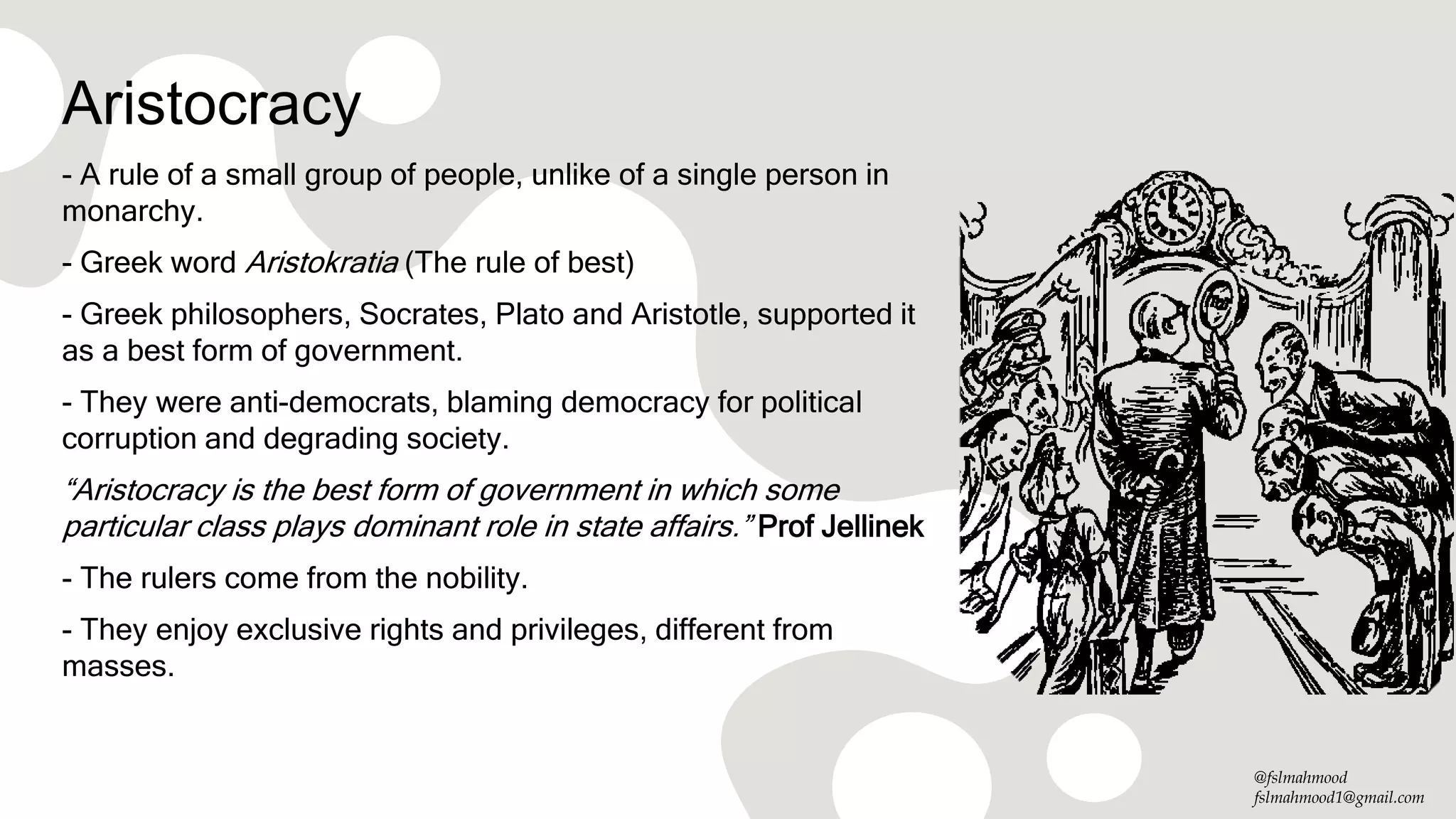
- Aristocracy: This is the rule of the "best" (aristoi). Unlike modern uses of the word, Aristotle’s aristocracy is based on moral excellence and merit, not birthright or wealth. The rulers are those who have the leisure to study philosophy and the virtue to put the community’s needs above their own.
- Polity (Politeia): This is the most practical of the correct forms. It is a "mixed" constitution that combines elements of oligarchy and democracy. It is characterized by the rule of the middle class—those who are neither excessively wealthy nor desperately poor.
The Deviant Forms: The Corruption of Power
- Tyranny: This is the perversion of kingship. The tyrant rules by force and for his own pleasure or security. Aristotle views this as the worst form of government because it is the most contrary to the nature of a free person.
- Oligarchy: This is the perversion of aristocracy. In an oligarchy, power is held by those with property and wealth. The rulers use the state to protect their riches and exploit the poor, ignoring the requirements of virtue or the common good.
- Democracy: Modern readers are often surprised that Aristotle labeled democracy a "deviant" form. In his era, democracy meant "rule by the many" (the demos), which specifically referred to the poor and uneducated. He feared that in a pure democracy, the majority would use their power to seize the property of the rich, leading to "mob rule" and instability.
The Doctrine of the "Golden Mean" and the Polity
Aristotle’s ethical "Doctrine of the Mean"—the idea that virtue lies in the middle between two extremes—applies directly to his politics. Just as courage is the mean between cowardice and recklessness, the best practicable government is a mean between the extremes of the rich and the poor.
The Polity is Aristotle's preferred practical solution. He argues that a state is most stable when the middle class is the dominant political force. His reasoning is psychological and sociological:
- The Very Wealthy: Often become arrogant, unwilling to obey, and prone to "great crimes." They seek to rule as masters, not as citizens.
- The Very Poor: Often suffer from malice, are too degraded to rule, and are prone to "petty crimes." They tend to be too subservient or too revolutionary.
- The Middle Class: Members of this class are most likely to follow the dictates of reason. They are not envious of the rich, nor are the rich envious of them. Because they have a "stake in the system" but are not consumed by the desire for extreme power, they act as a stabilizing buffer.
A Polity succeeds by balancing the interests of the wealthy (who want to protect property) and the poor (who want equality). By mixing democratic elements (like choosing officials by lot) with oligarchic elements (like requiring certain qualifications for higher office), the state achieves an equilibrium that prevents any one faction from becoming too powerful.
Citizenship and the Rule of Law
A central question in Aristotle’s Politics is: "Who is a citizen?" Aristotle’s definition is functional: A citizen is someone who has the right to participate in the deliberative or judicial administration of the state.
However, Aristotle’s view of citizenship was restrictive by 2026 standards. He believed that to be a good citizen, one required leisure (schole). If a person has to spend all their time performing manual labor just to survive, they cannot develop the intellectual virtues necessary for governance. Consequently, he excluded laborers, slaves, and women from his definition of active citizenship. While these exclusions are rightly rejected in modern discourse, his underlying point remains relevant: a functioning state requires a citizenry that is educated, engaged, and capable of looking beyond immediate survival.
Furthermore, Aristotle was a staunch advocate for the Rule of Law. He argued that "the law should be supreme over all," because law is "reason unaffected by desire." Even the best ruler is subject to passion and bias, whereas a well-crafted set of laws provides a stable, objective framework for justice.
The Causes of Political Instability and Revolution
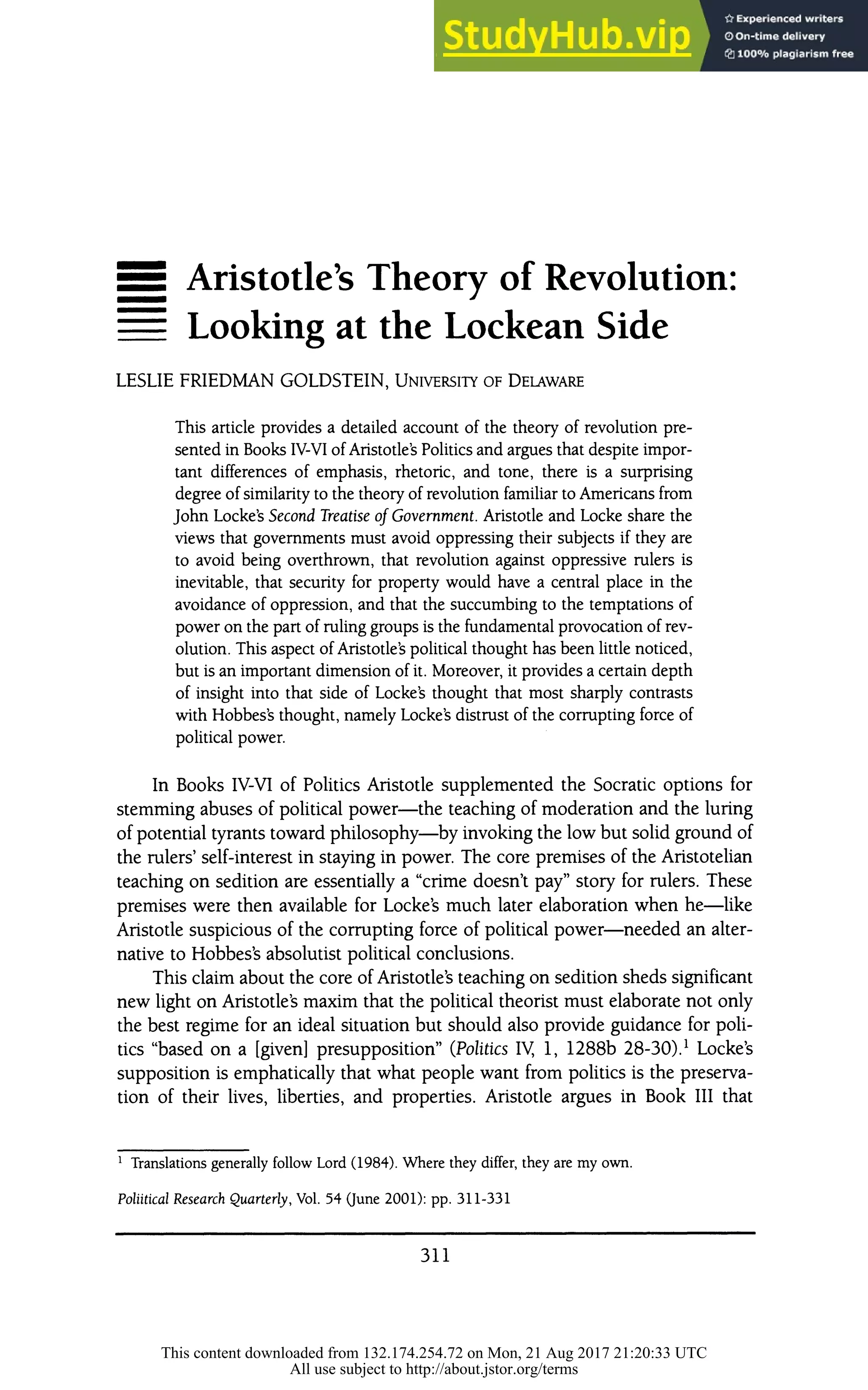
In Book V of Politics, Aristotle provides a masterclass in political sociology, examining why governments fail. He identifies the primary cause of revolution as inequality. When people feel they are being treated unfairly—whether the poor feel they lack the "equality" they deserve or the rich feel they lack the "superiority" their wealth should afford—friction arises.
Common causes of revolution include:
- Arrogance and Avarice: Rulers who treat the public with contempt or use their office for personal gain.
- Fear: Those who have committed a crime fear punishment, or those who fear they will be treated unjustly preemptively revolt.
- Disproportionate Increase: When one part of the state (e.g., the military or the wealthy) grows too powerful relative to the others.
- Ethnic Diversity: Aristotle noted that states with lack of "common feeling" or those that fail to integrate different groups often face internal strife.
To preserve a constitution, Aristotle recommends that the government must educate its citizens in the spirit of the constitution. It must also ensure that "no one person or class becomes too powerful" and that the law is strictly enforced, even in small matters, to prevent a general culture of lawlessness from taking root.
Aristotle’s Relevance in 2026
As we navigate the complexities of the mid-2020s, Aristotle’s insights remain strikingly applicable. His warning about the disappearance of the middle class resonates in an era of increasing economic polarization. Modern political scientists often use his "mixed constitution" framework to analyze the checks and balances of representative democracies, which attempt to balance the "will of the people" (democracy) with "expert administration" (aristocracy) and "protection of rights" (constitutionalism).
His insistence that the state exists for the "good life" serves as a critique of modern governments that focus solely on GDP or economic metrics. From an Aristotelian perspective, a nation is successful not just when it is wealthy, but when its citizens are capable of exercising virtue and achieving human flourishing.
For more on the historical context of Greek political thought, the Stanford Encyclopedia of Philosophy offers an exhaustive breakdown of his texts. Additionally, the Perseus Digital Library provides access to the original Greek and English translations of Politics for those wishing to examine his specific terminology.
Frequently Asked Questions
Why did Aristotle think democracy was a bad form of government?
Aristotle viewed democracy as "rule by the many" specifically in the interest of the poor, rather than the common good. He believed that without the constraints of law and the presence of a strong middle class, a democracy would devolve into "mob rule," where the majority would ignore the rights of the minority (the wealthy) and follow demagogues who promised to redistribute wealth, eventually leading to chaos or tyranny.
What is the difference between Aristotle’s "Aristocracy" and "Oligarchy"?
The difference lies in the character of the rulers and their objective. In an Aristocracy, the "best" people rule based on virtue and merit for the benefit of the whole city. In an Oligarchy, the "wealthy" rule based on their property status for the purpose of increasing or protecting their own riches. For Aristotle, Aristocracy is a "true" form, while Oligarchy is its "deviant" counterpart.
What is "The Good Life" according to Aristotle?
"The Good Life" (Eudaimonia) is not about material pleasure or wealth. It is a state of being where a person lives in accordance with virtue and reason. In a political context, it means the state provides the education, security, and social structure necessary for citizens to engage in intellectual pursuits, civic participation, and moral excellence.
What is a "Mixed Constitution"?
A mixed constitution is a form of government that blends elements of different systems—usually Democracy and Oligarchy—to create a "Polity." For example, it might use elections (an oligarchic/aristocratic element) alongside a system of lots (a democratic element), or it might have a property qualification for some offices while allowing all citizens to vote on others. The goal is to ensure that no single class has absolute power.
How does Aristotle’s view of government differ from Plato’s?
Plato was more idealistic and sought a "perfect" state governed by a philosopher-king, as described in The Republic. Aristotle was more pragmatic and empirical. He believed that instead of looking for an unattainable ideal, we should look for the "best practicable" state. While Plato focused on unity and a rigid social hierarchy, Aristotle focused on the importance of a diverse citizenry and the rule of law.
Final Recommendation for Students and Researchers
When studying Aristotle’s government, it is essential to move beyond the simple definitions of his six forms. To truly master the subject, one should focus on the relationship between his Ethics and his Politics. Aristotle believed that politics is effectively "applied ethics" on a grand scale. To understand how a government should function, one must first understand what a virtuous human life looks like.
For those looking to apply these concepts today, the next logical step is to examine the "Mixed Constitution" in the context of modern separation of powers. Comparing Aristotle’s Politeia with the writings of Polybius or Montesquieu can provide a profound understanding of how these ancient Greek ideas formed the bedrock of modern constitutional republics.