Aristotle views government not merely as a legal structure, but as a natural evolution of human association intended to facilitate the "good life." He classified regimes based on who rules and whose interest they serve, ultimately advocating for a "Polity"—a constitutional government led by the middle class—as the most stable and practicable form of state.
Aristotle’s political thought is primarily encapsulated in his seminal work, Politics. Writing in the 4th century BCE, his observations were grounded in the empirical study of over 150 Greek city-state (polis) constitutions. For Aristotle, politics was the "master science" because it determined how all other sciences and human activities should be organized to achieve the highest human good: eudaemonia, or flourishing. As we examine these views from the perspective of 2026, his theories remain the foundational bedrock for modern constitutionalism, the rule of law, and distributive justice.
The Natural Origin and Purpose of the State
To understand Aristotle’s views on government, one must first understand his teleological view of nature. He believed that everything has a telos (an end or purpose). For humans, that purpose is to live a life of virtue and reason. Aristotle famously asserted that "man is by nature a political animal." This does not mean humans are simply social; it means they are designed to live in a polis.
He traced the development of the state through three stages:
- The Family: Created to satisfy daily biological needs (reproduction and survival).
- The Village: A collection of families that meets non-daily needs through cooperation.
- The State (Polis): A collection of villages that reaches a level of self-sufficiency (autarkeia).
While the state comes into existence for the sake of life, Aristotle argued it continues to exist for the sake of the good life. A government that only provides security or facilitates trade is not a true state; it is merely an alliance. A true government must actively concern itself with the moral excellence and virtue of its citizens.
The Six-Fold Classification of Governments
Aristotle’s most famous contribution to political science is his systematic classification of government types. He used two criteria for this taxonomy: the number of people involved in the governing body and whether the rulers govern for the common interest or their own selfish interest.
Governments that serve the common good are "true" or "correct" forms, while those serving the private interests of the rulers are "perverted" or "deviant" forms.
Table: Aristotle’s Classification of Regimes
| Number of Rulers | Correct Form (Common Interest) | Perverted Form (Self-Interest) |
|---|---|---|
| One | Monarchy (Kingship): Rule by a single person of transcendent virtue. | Tyranny: Rule by one for the benefit of the despot alone. |
| Few | Aristocracy: Rule by the "best" men based on merit and virtue. | Oligarchy: Rule by the wealthy for the benefit of the rich. |
| Many | Polity (Constitutional Gov): Rule by the masses under law; a "mixed" regime. | Democracy: Rule by the needy/poor for their own class interest. |
The Distinction Between Polity and Democracy
It is vital to note that Aristotle’s definition of "Democracy" differs significantly from modern usage. In his view, democracy was a perversion because it represented the rule of the many (specifically the poor) who would use their numerical superiority to seize the property of the rich, leading to instability. His preferred "many-ruled" system was the Polity (politeia), which combined elements of democracy and oligarchy to create a balanced, law-abiding middle ground.
The Concept of Citizenship and Participation
In Aristotle’s view, a citizen is not merely someone who lives in a territory or has legal rights. Instead, he defined a citizen as someone who "shares in the administration of justice and in the holding of office." Citizenship is an active, demanding role that requires leisure time to deliberate on public affairs and serve in the courts.
Because of this high bar, Aristotle excluded several groups from citizenship:
- Mechanics and Laborers: He believed that manual labor "deforms" the mind and deprives a person of the leisure necessary for virtuous political activity.
- Women: Following the cultural prejudices of his time, he argued that while women have a deliberative faculty, it "lacks authority," placing them in a subordinate role within the household rather than the political sphere.
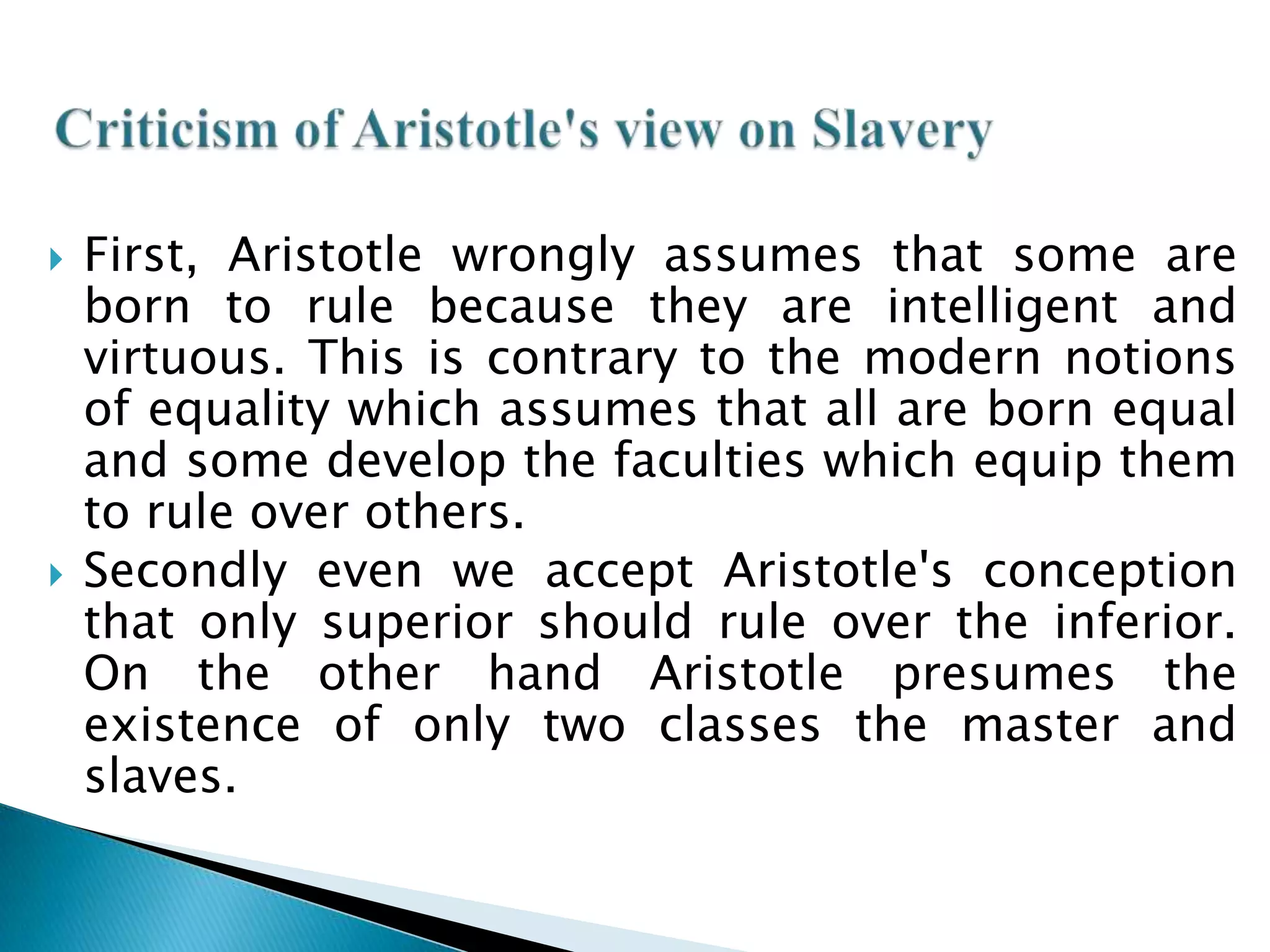
- Slaves: Aristotle’s theory of "natural slavery" suggested that some individuals lack the rational capacity to govern themselves and are better off being governed by a master.
While these exclusions are rightfully rejected in 2026, his underlying principle—that citizenship requires active engagement and a certain level of education—continues to inform debates about civic duty and democratic participation.
The "Middle Way": The Virtue of the Middle Class
Aristotle applied his philosophical "Doctrine of the Mean" to politics. Just as courage is the mean between cowardice and rashness, the best practicable government is a mean between the extremes of wealth and poverty.
He argued that a state dominated by the very wealthy tends toward arrogance and a refusal to be ruled, leading to oppression. Conversely, a state dominated by the very poor tends toward malice and a desire for revolution, leading to "mob rule." The middle class is the most stable element in society because:
- They are more likely to follow the "rational principle" of the mean.
- They do not covet the goods of others (like the poor) and others do not covet theirs (like the rich).
- They act as a buffer between the two warring factions of the rich and the poor.
The "Best Practicable State" for Aristotle is therefore a Polity where the middle class holds the balance of power. This ensures that the government is not captured by any single faction, promoting long-term stability and justice.
The Rule of Law and Constitutionalism
One of Aristotle's most enduring views is his preference for the rule of law over the rule of any individual. Even the best ruler is subject to passion and desire, whereas law is "reason unaffected by desire."
He acknowledged that laws are general and cannot cover every specific case (requiring epieikeia or equity), but he maintained that a government is only legitimate if it operates according to established constitutional principles. This view directly influenced the Enlightenment thinkers who shaped modern democratic constitutions, emphasizing that no one—not even a king or a president—is above the law.
Causes of Revolution and Stability
In the latter parts of Politics, Aristotle analyzed why governments fail. He identified the primary cause of revolution as a sense of inequality or injustice.
- Inferiors revolt to be equal: When the poor feel they are treated as lesser than they deserve.
- Equals revolt to be superior: When the wealthy or ambitious feel they deserve more power than the average citizen.
To preserve a government, Aristotle recommended that rulers:
- Prevent small illegalities from accumulating.
- Maintain a spirit of obedience to the law.
- Avoid deceiving the masses.
- Ensure that no single person or class becomes too powerful.
- Foster a robust system of education that aligns the character of the citizens with the spirit of the constitution.
Practical Implementation: How to Evaluate a Government
Aristotle did not just offer abstract theories; he provided a framework for evaluating existing governments. When analyzing a political system in 2026, his methodology suggests asking four key questions:
- What is the "ideal" government (the best in the abstract)?
- What is the "best possible" government for a specific population?
- What is the "average" government that is most likely to suit most states?
- How can we preserve the current government, even if it is flawed?
This pragmatic approach reflects his belief that politics is a "practical science" concerned with what is achievable, not just what is imaginable.
Frequently Asked Questions
What did Aristotle mean by "man is a political animal"?
This phrase means that humans can only reach their full potential and achieve happiness (eudaemonia) within a structured society (polis). Unlike animals that live in herds or solitary predators, humans possess the gift of speech (logos), which allows them to deliberate on what is just and unjust, a process that can only occur in a political community.
Why did Aristotle consider Democracy a "perverted" form of government?
In the 4th century BCE, "democracy" referred to the direct rule of the "demos" (the uneducated, propertyless masses). Aristotle feared that this would lead to a "tyranny of the majority," where the poor would vote to confiscate the wealth of the rich, leading to civil war and the eventual rise of a single tyrant who promises to protect the masses.
What is the difference between an Aristocracy and an Oligarchy?
For Aristotle, an Aristocracy is rule by the "best" (aristos) in terms of virtue and merit, governing for the benefit of everyone. An Oligarchy is rule by the "few" based specifically on wealth, governing only to increase or protect their own riches.
How does Aristotle’s "Polity" relate to modern Republics?
Aristotle’s "Polity" is the ancestor of the modern Republic. It is a mixed government that attempts to balance the interests of the wealthy few and the many poor through a constitution. Modern representative democracies often function like Aristotelian Polities by using checks and balances to prevent any one group from exercising absolute power.
What was the role of education in Aristotle's government?
Aristotle believed that "the citizen should be molded to the suit the form of government under which he lives." Education is not just about technical skills; it is about moral training to ensure that citizens value the same things the constitution protects. Without a common educational foundation, even the best laws will fail to hold a state together.
Recommended Action for Further Study
To gain a deeper understanding of these concepts, readers should focus on Book III and Book IV of Aristotle’s Politics. These sections contain the core of his classification system and his discussion on the middle class. For those interested in how these theories apply to modern governance, comparing Aristotle's Politics with the Federalist Papers (specifically No. 10) provides an excellent case study on how Aristotelian balance influenced the founding of the United States.
By recognizing the dangers of extreme inequality and the importance of the rule of law, modern citizens can use Aristotle’s 2,300-year-old insights to better navigate the political challenges of 2026.