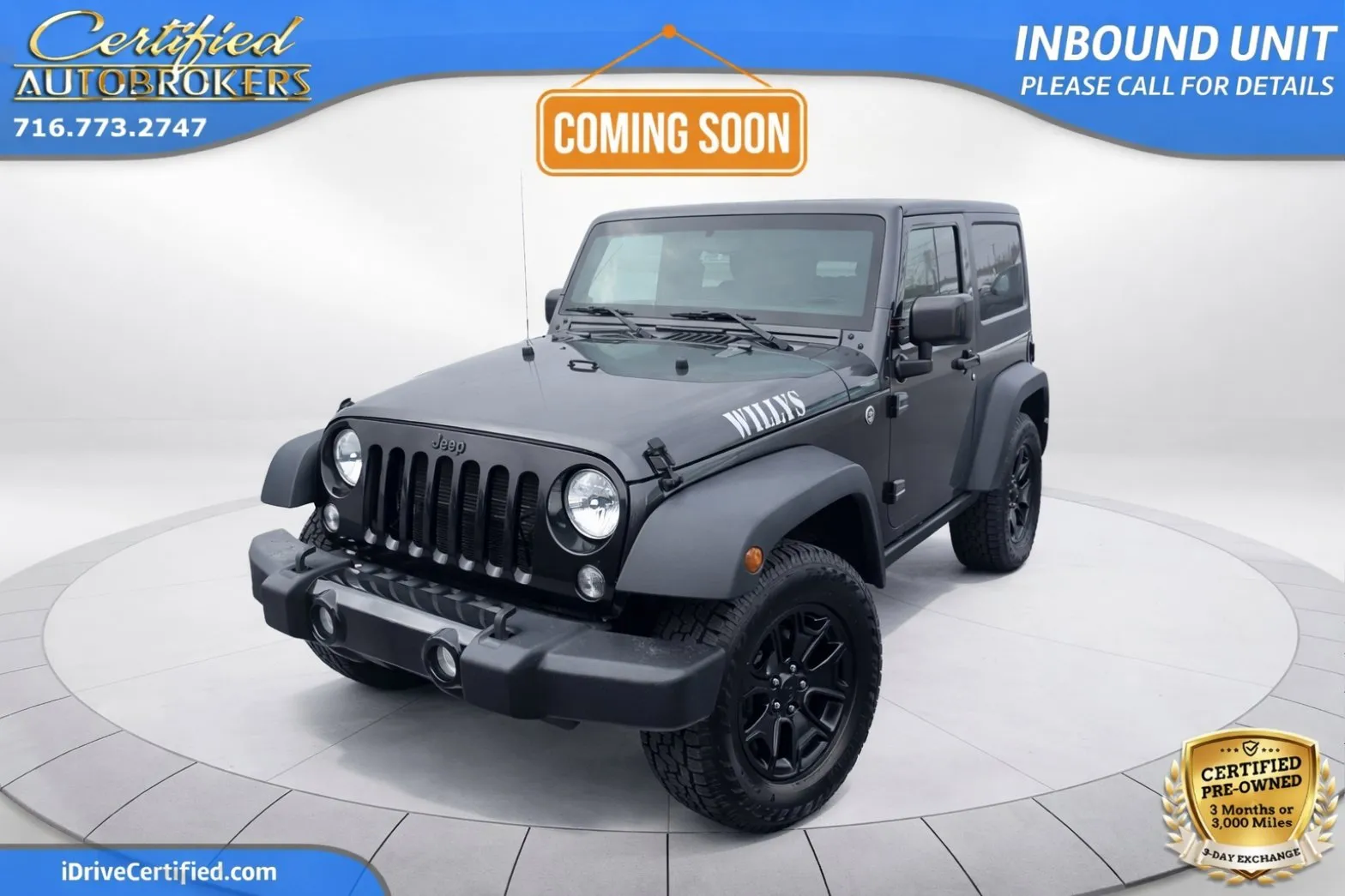
The 2017 Jeep Wrangler Willys Wheeler combines vintage military-inspired aesthetics with factory off-road hardware, bridging the gap between the entry-level Sport trim and the extreme-terrain Rubicon. Built on the final production run of the JK platform, it features a 285-horsepower 3.6-liter Pentastar V6, a Trac-Lok limited-slip rear differential, 3.73 axle gearing, and Rubicon-spec rock rails.
Heritage and History of the Willys Wheeler Edition
The Willys Wheeler edition serves as a direct homage to the original civilian Jeep—the 1945 Willys-Overland CJ-2A—which adapted wartime military utility for post-war agricultural and commercial use. Jeep first introduced the modern Willys Wheeler package during the 2014 model year to capture the nostalgic spirit of early 4x4 vehicles while providing functional, factory-installed trail equipment at an accessible price point.
By the 2017 model year, the Willys Wheeler edition occupied a critical position in the Jeep Wrangler line. The 2017 model year marked the culmination of the JK generation (2007–2018). Unlike early JK iterations produced from 2007 through 2011—which featured the lower-output 3.8-liter V6 and interior materials oriented primarily toward basic utility—the 2017 model benefited from a decade of platform refinement.
- 1945 Willys CJ-2A (Design Heritage)
- 2014-2018 JK Willys Wheeler Trim (2017 Final Refinement)
- 2-Door (JK) Architecture
- 4-Door (JKU) Unlimited
- 2014-2018 JK Willys Wheeler Trim (2017 Final Refinement)
Offered in both the standard 2-door Wrangler (JK) and the 4-door Wrangler Unlimited (JKU) configurations, the 2017 Willys Wheeler allowed buyers to select a trail-ready trim without paying the price premium associated with the front-and-rear electronic locking differentials and sway-bar disconnect system of the Rubicon. It represented a factory-engineered compromise designed for green-lane trail riding, muddy access roads, and everyday commuting.
Engine, Transmission, and Mechanical Specifications
At the heart of every 2017 Jeep Wrangler Willys Wheeler is the naturally aspirated 3.6-liter Pentastar V6 engine (engine code ERB). Constructed with a high-pressure die-cast aluminum cylinder block and dual overhead camshafts (DOHC) with variable valve timing (VVT), this engine was engineered to deliver broader torque curves required for low-speed off-road crawling while maintaining highway efficiency.
- 2017 Pentastar 3.6L V6 Powertrain
- Horsepower: 285 hp @ 6,400 RPM
- Torque: 260 lb-ft @ 4,800 RPM
- Bore x Stroke: 96.0 mm x 83.0 mm
- Compression Ratio: 10.2:1
- NSG370 6-Speed Manual
- Triple-cone synchronizers
- 4.46:1 First gear ratio
- Integrated Hill Start Assist
- W5A580 5-Speed Automatic
- Adaptive electronic control
- 3.59:1 First gear ratio
- Electronically modulated clutch
Transmission Options
Buyers in 2017 could choose between two distinct transmissions:
- 6-Speed Manual Transmission (NSG370): The standard manual gearbox features a 4.46:1 first-gear ratio, delivering an aggressive crawl ratio when combined with the 3.73 axle gearing and low-range transfer case. It includes triple-cone synchronizer technology on 1st and 2nd gears for smoother gear engagement, alongside standard Hill Start Assist to prevent roll-back on steep inclines.
- 5-Speed Automatic Transmission (W5A580 / NAG1): Derived from Mercedes-Benz architecture, this torque-converter automatic transmission features adaptive electronic control and driver-interactive Electronic Range Select (ERS). With a 3.59:1 first-gear ratio, it offers controlled low-speed torque application on technical trails and reliable durability under load.
Drivetrain, Axles, and Transfer Case Architecture
The 2017 Willys Wheeler uses Jeep's standard Command-Trac NV241 part-time four-wheel-drive system. This shift-on-the-fly transfer case features a 2.72:1 low-range gear ratio, which multiplies engine torque for low-speed maneuvering over rock, sand, and steep inclines.
The front axle assembly is a Next Generation Dana 30 solid front axle featuring a 181 mm ring gear diameter. At the rear, the Willys Wheeler upgrades from the standard base axle to a heavy-duty Next Generation Dana 44 solid rear axle with a 226 mm ring gear diameter.
Unlike the open differentials found on the base Sport model, the Willys Wheeler comes equipped with a Trac-Lok mechanical limited-slip rear differential. Trac-Lok uses internal clutch packs to automatically transfer torque to the rear wheel with the most traction whenever wheel slip occurs, providing seamless, passive traction aid on slick surfaces without requiring driver engagement.
Factory Equipment, Off-Road Hardware, and Aesthetics
The Willys Wheeler package is identified by package codes 23K / 24K (standard Willys Wheeler) and 23W / 24W (Willys Wheeler W). It combines mechanical trail upgrades with a distinct visual package inspired by classic military utility.
Standard Mechanical and Exterior Features
- 3.73 Axle Ratio: Replaces the fuel-economy-focused 3.21 rear axle ratio of the base Sport, improving off-the-line throttle response and wheel torque.
- 17-Inch High-Gloss Black Aluminum Wheels: Styled to complement dark trim accents and designed to accept wider all-terrain or mud-terrain tire choices.
- LT255/75R17 BFGoodrich Mud-Terrain T/A KM Tires: C-load rated 32-inch off-road tires featuring aggressive tread blocks and shoulder lugs for mud clearance and side-wall bite on trails.
- Rubicon Rock Rails: Heavy-duty, chassis-mounted tubular steel rock sliders designed to protect the lower body sills from rock impacts and trail debris.
- High-Gloss Black Trim Accents: Gloss black front grille, gloss black front and rear bumper appliqués, and retro-style "Willys" hood decals with a matching "4 Wheel Drive" tailgate stencil.
- Trail Rated Kit: Shipped in a canvas Jeep-branded bag, this kit includes a heavy-duty tow strap, two D-ring shackles, and protective work gloves.
Model Variants: Willys Wheeler vs. Willys Wheeler W
The standard Willys Wheeler (K package) prioritized utility, often equipped with manual windows, manual door locks, and standard air conditioning optional.
The upgraded Willys Wheeler W (W package) added daily convenience items as standard or optional equipment:
- Power Convenience Group: Standard on Willys Wheeler W 4-door models (optional on 2-door), adding power windows, power door locks, remote keyless entry, auto-dimming rearview mirror, and power heated side mirrors.
- Air Conditioning: Standard equipment on the W package.
- Connectivity Group: Includes Tire Pressure Monitoring Display, Electronic Vehicle Information Center (EVIC), and Bluetooth hands-free voice command functionality.
- Factory LED Headlight Option: For 2017, Jeep introduced optional factory LED headlights and fog lights, which provided significantly improved beam pattern width and color temperature compared to halogen units.
2017 Jeep Wrangler Willys Wheeler Technical Specifications
The table below outlines key dimensions, capacities, and mechanical parameters for the 2017 2-door JK and 4-door JKU Willys Wheeler models.
| Specification | 2-Door Willys Wheeler (JK) | 4-Door Willys Wheeler Unlimited (JKU) |
|---|---|---|
| Engine Type | 3.6L Pentastar V6 (24V DOHC) | 3.6L Pentastar V6 (24V DOHC) |
| Horsepower | 285 hp @ 6,400 RPM | 285 hp @ 6,400 RPM |
| Torque | 260 lb-ft @ 4,800 RPM | 260 lb-ft @ 4,800 RPM |
| Standard Transmission | 6-speed Manual (NSG370) | 6-speed Manual (NSG370) |
| Optional Transmission | 5-speed Automatic (W5A580) | 5-speed Automatic (W5A580) |
| Transfer Case | Command-Trac NV241 (2.72:1 Low) | Command-Trac NV241 (2.72:1 Low) |
| Front Axle / Rear Axle | Dana 30 / Dana 44 (Trac-Lok LSD) | Dana 30 / Dana 44 (Trac-Lok LSD) |
| Axle Gear Ratio | 3.73:1 | 3.73:1 |
| Wheelbase | 95.4 inches (2,423 mm) | 116.0 inches (2,946 mm) |
| Overall Length (with spare) | 163.8 inches (4,161 mm) | 184.4 inches (4,684 mm) |
| Ground Clearance | 10.0 inches | 10.0 inches |
| Approach / Departure Angle | 42.2° / 32.3° | 42.0° / 32.5° |
| Breakover Angle | 25.8° | 21.2° |
| Curb Weight (Manual) | Approx. 3,886 lbs | Approx. 4,294 lbs |
| Max Towing Capacity | 2,000 lbs (with Tow Package) | 3,500 lbs (with Max Tow Package) |
| Standard Tires | LT255/75R17 BFGoodrich Mud-Terrain KM | LT255/75R17 BFGoodrich Mud-Terrain KM |
On-Road Performance and Off-Road Driving Dynamics
The 2017 Willys Wheeler delivers a driving experience defined by its live solid axle front and rear suspension geometry. Understanding how this configuration behaves across different environments helps set realistic expectations for ownership.
| On-Road Dynamics | Off-Road Trail Capability |
|---|---|
| Solid Axles: Truck-like ride | 3.73 Gearing: Fast torque build |
| BFG Mud Tires: Highway tread hum | Trac-Lok LSD: Auto rear traction |
| High Center of Gravity: Moderate body roll | 10-inch Clearance: Good obstacle clearance |
| Recirculating Ball Steering: Firm center feel | Rock Rails: Sill protection on rocks |
Off-Road Capability
Off the pavement, the Willys Wheeler outperforms standard Wrangler Sport configurations due to its factory upgrades:
- Traction Management: The Trac-Lok rear limited-slip differential automatically redistributes power across the rear axle when one wheel loses contact or slip occurs in mud, loose shale, or snow. Unlike electronic brake lock differentials (BLD) that apply friction via the service brakes, Trac-Lok operates mechanically within the differential housing to maintain forward momentum.
- Gearing Efficiency: The 3.73:1 final drive ratio, paired with the 2.72:1 low-range transfer case, allows the Pentastar V6 to keep engine speeds within its optimal torque band during low-speed ascents without requiring excessive slip from the clutch or torque converter.
- Undercarriage Protection: Factory Rubicon rock rails allow the vehicle to slide over obstacles without crushing the sheet metal pinch welds under the door sills.
Daily Driving Dynamics
On paved highways, the Willys Wheeler retains the character of a traditional utility vehicle. The rigid live axles transmit road imperfections into the cabin more direct than modern independent front suspension setups.
Additionally, the aggressive tread pattern of the standard BFGoodrich Mud-Terrain KM tires generates audible tire whine at speeds above 45 MPH. Steering response is governed by a recirculating-ball setup, which requires small, continuous steering inputs on rutted highways. However, the 2017 model year benefits from sound insulation improvements made during the late-stage JK production run, reducing overall cabin noise compared to earlier model years.
Known Issues, Maintenance Considerations, and Inspection Areas
The 2017 model year is considered one of the most mechanically refined years of the JK generation. However, long-term ownership requires attention to several known mechanical and structural areas:
1. Engine Oil Filter Adapter Housing Leaks
The 3.6L Pentastar V6 uses a synthetic oil filter adapter housing located beneath the intake manifold in the valley of the engine. Over multiple heating and cooling cycles—or due to over-tightening the oil filter cap during oil changes—the plastic housing can warp or crack, causing engine oil or coolant to pool on top of the engine block.
- Inspection Tip: Check the underside of the engine bellhousing for dripping oil or pink/purple OAT coolant. Aluminum aftermarket replacement units (such as those manufactured by Dorman) provide a permanent resolution.
2. Front Suspension and Steering Wear ("Death Wobble")
Solid front axle vehicles equipped with track bars can develop severe front-end oscillation—commonly referred to as "Death Wobble"—if steering joints or suspension bushings become worn.
- Inspection Tip: Inspect the front track bar mounting bolt holes for ovalization, check the drag link and tie rod ball joints for movement, and ensure steering damper health. Proper torque on track bar bolts (125 ft-lbs) is essential for steering stability.
3. Radiator Core Seam Seepage
Factory JK aluminum radiators use plastic end tanks crimped onto the core. Thermal expansion can cause microscopic weeping at the upper left or lower right seams after 60,000 to 90,000 miles.
- Inspection Tip: Look for dried residue along the outer side tanks of the radiator and monitor engine temperature readings via the EVIC display.
4. Freedom Top Roof Panel Water Ingress
Models equipped with the modular 3-piece Freedom Top hardtop can develop water leaks near the top of the windshield A-pillars if the foam rubber weatherstripping becomes compressed, dirty, or misaligned during panel re-installation.
Market Value, Collectibility, and Future Outlook
The 2017 Jeep Wrangler Willys Wheeler occupies a unique position in the pre-owned 4x4 market. Positioned between standard base models and high-end Rubicons, it continues to attract buyer interest for several key reasons.
- Market Positioning
- High Value Retention
- Refined Late-JK Architecture
- Pure Mechanical Simplicity
Market Resale Performance
Wranglers are recognized for strong resale value retention across all light truck classes. The 2017 Willys Wheeler benefits from being a late-model JK production vehicle:
- Desirable Factory Spec: Pre-owned buyers actively seek out Willys Wheeler models because they come factory-equipped with 3.73 gears, Dana 44 rear axle, limited-slip differential, and upgraded wheels, saving buyers thousands in aftermarket upgrades.
- Pre-JL Analog Appeal: While the successor JL generation (2018–present) introduced an 8-speed automatic transmission, aluminum doors, and interior touchscreen displays, some off-road purists prefer the mechanical simplicity, steel body components, and traditional lever-operated transfer case of the late JK platform.
Long-Term Collectibility Assessment
While mass-produced vehicles rarely function as high-yield financial investments, the 2017 Willys Wheeler (specifically low-mileage, 2-door manual transmission examples) is well-positioned for long-term desirability:
- Final Year Significance: 2017 was the last full model year of the pure JK line before the transition phase.
- Factory Special Edition Identity: Heritage graphics, factory black accents, and distinct wheel packages maintain higher buyer demand compared to non-edition Sport models.
- Modding Baseline: Undamaged, un-modified examples command premium prices on used vehicle marketplaces because many original Wranglers were modified heavily with aftermarket parts of varying quality.
Frequently Asked Questions
What is the main mechanical difference between a 2017 Willys Wheeler and a Rubicon?
The 2017 Willys Wheeler utilizes a Command-Trac NV241 transfer case (2.72:1 low range), a Dana 30 front axle, and a rear Trac-Lok limited-slip differential with 3.73 gears. The Rubicon features a Rock-Trac transfer case (4.0:1 low range), heavy-duty Dana 44 front and rear axles, Tru-Lok front and rear electronic locking differentials, and an electronic front sway-bar disconnect system.
Did the 2017 Jeep Wrangler Willys Wheeler come in both 2-door and 4-door versions?
Yes. The 2017 Willys Wheeler was produced in both the standard 2-door Wrangler short-wheelbase configuration (JK) and the 4-door Wrangler Unlimited long-wheelbase configuration (JKU).
Can the 2017 Jeep Wrangler Willys Wheeler tow a travel trailer?
Yes, within manufacturer limits. 2-door Willys Wheeler models are rated to tow up to 2,000 lbs when equipped with the factory tow package. 4-door Willys Wheeler Unlimited models are rated to tow up to 3,500 lbs when equipped with the 3.73 axle ratio and trailer tow receiver package.
What tire size came stock on the 2017 Willys Wheeler, and will 35-inch tires fit without a lift?
The factory tire size is LT255/75R17 (approximately 32 inches in diameter). Fitting 35-inch tires requires a minimum 2.5-inch aftermarket suspension lift kit, along with adjusted wheel backspacing or wheel spacers to prevent the tires from rubbing against the sway bar links and inner fender liners during suspension articulation.
Does the 2017 Willys Wheeler have mechanical rear lockers?
No. The Willys Wheeler features a mechanical Trac-Lok limited-slip differential (LSD) in the rear axle, which uses internal clutch packs to transfer torque to the wheel with traction during wheel slip. It does not feature driver-selectable, 100% mechanical or electronic locking differentials like the Rubicon.
Practical Recommendations for Prospective Buyers
If you are shopping for a pre-owned 2017 Jeep Wrangler Willys Wheeler, follow this evaluation protocol to ensure you select a solid vehicle:
- Verify Package Authenticity: Ensure the vehicle is a genuine Willys Wheeler by checking for the 23K/24K or 23W/24W option package on the original window sticker or VIN build sheet. Confirm the presence of the 3.73 rear axle tag and Trac-Lok rear differential.
- Inspect the Frame and Undercarriage: Check the tubular frame rails, skid plates, and axle housing welds for severe rust or deep gouges that indicate heavy rock crawling abuse.
- Check Engine Valley for Leaks: Inspect the engine valley under the intake manifold for signs of engine oil or coolant accumulation around the plastic oil filter housing.
- Evaluate Suspension Components: Check for original suspension arm bushings, steering linkage play, and tire wear patterns on the front BFGoodrich Mud-Terrain tires. Uneven tread cupping indicates worn shocks or misaligned toe settings.
- Test 4WD Range Engagement: Shift the Command-Trac transfer case into 4H (4-High) and 4L (4-Low) on a loose surface (gravel, dirt, or grass) to confirm smooth shift lever operation and proper front axle engagement.